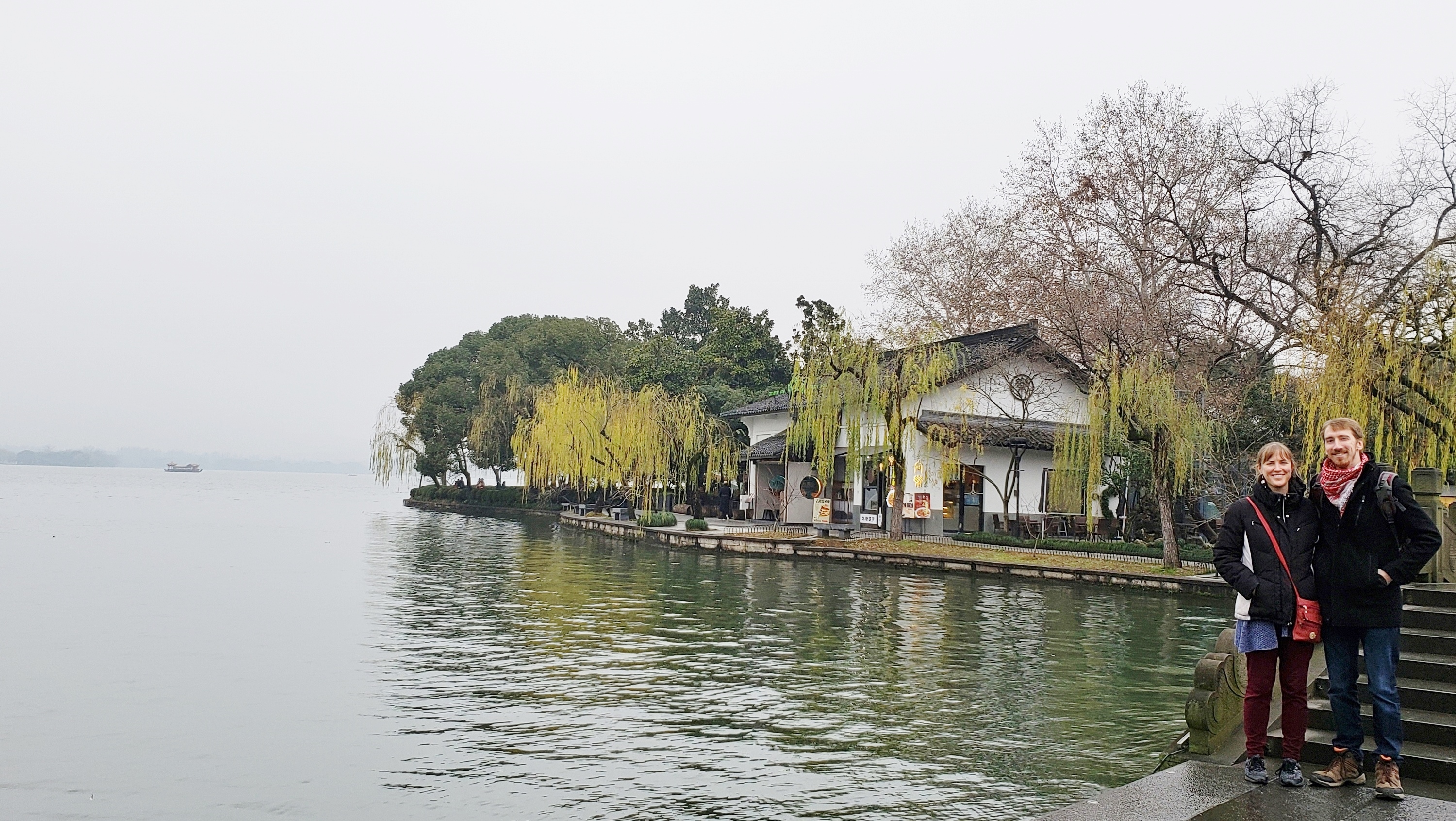
In my previous entry, I touched a bit on the ability of QR codes on shared bikes, as a convenient and very cheap way to get around major cities. Shanghai has 24 million people in it, but we also visited the nearby Hangzhou, which “only” has 7 million people in its urban core. We saw bike share prices ranging from 10 yuen cents per hours, to one yuen per hour. As of this writing, a yuen is worth about 15 cents… so yeah, pretty cheap.
The bullet train to Hangzhou was cheap too, 88 yuen one-way. Clean and spacious, with somber-faced apron-wearing attendants quietly mopping the floor of footprints after each stop. On initial startup, the train would glide forward slowly, with none of the creaking and clanking noise of wheels grinding against tracks that we associate with trains. It took quite awhile to get from Shanghai Central Station to the Western station, at a pretty low speed for safety. But once out of the city, we got our first and only chance to glimpse at how rural Chinese people live. Bearing in mind too, that these folks were still only a 20-30 minute drive outside the city so we can’t truly classify them as rural as I know still so many Chinese villages exist hours away from major cities! The houses I saw though, were palatial mansions in comparison to the small apartments that the average Shanghai citizen would be able to afford. Daniel told us that Shanghai is one of the most expensive cities in China, and that housing costs are outpacing food and transportation. I told him it was similar in the USA: more than those two things, space to live in is something you can’t just import or create, so prices are skyrocketing. But these outside-Shanghai houses seem to rejoice in their expansive land options, and building 3 story homes, even though plain and unadorned on the outside (most were of the simple vertical rectangle style) they had plenty of space! Farms and rice paddies seemed to be the norm.
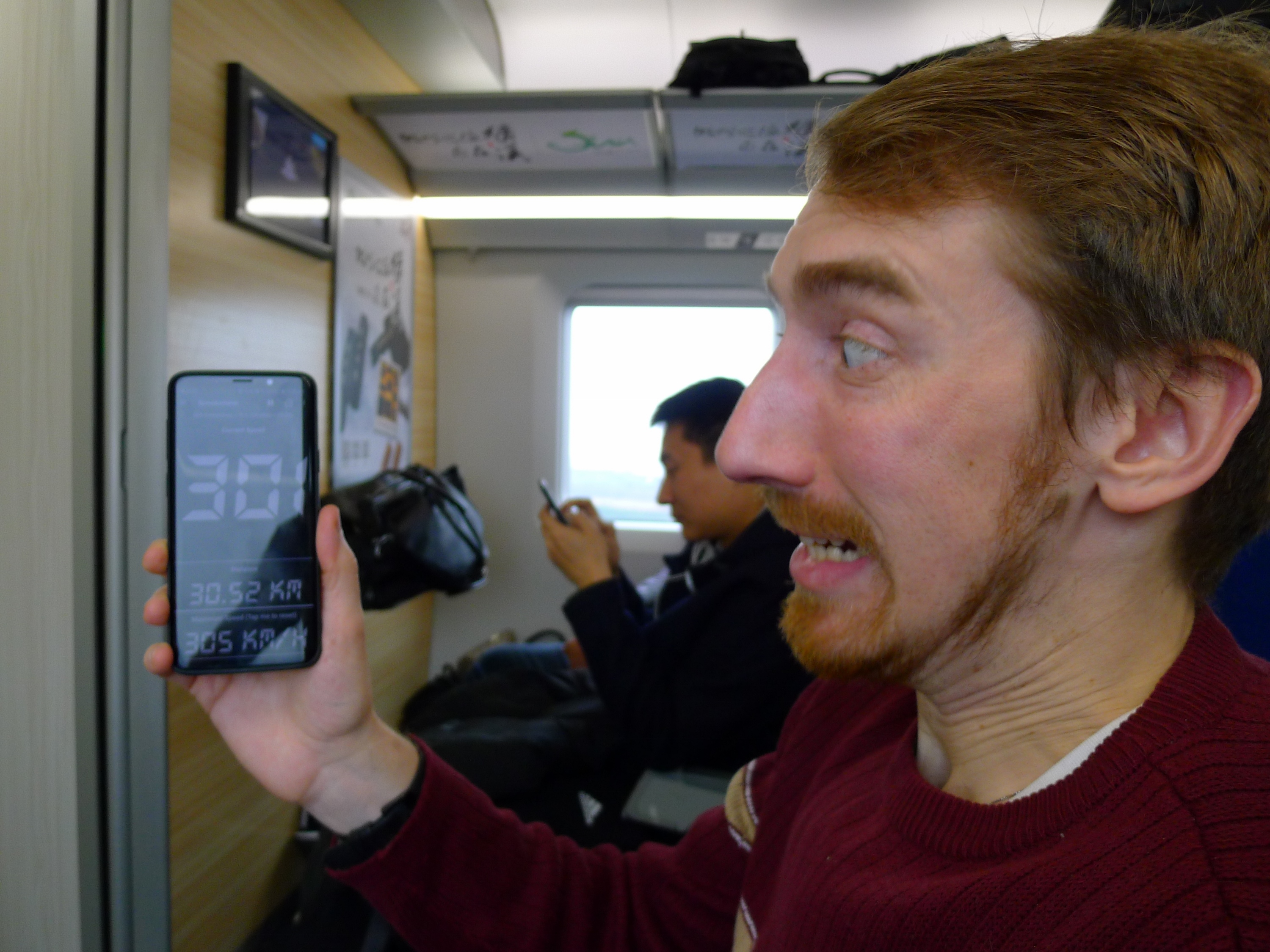
Okay, I got my money’s worth
Within 10 minutes outside the city, the train had increased its speed up to the rated 300 kilometers per hour and the vibrations and noises had increased to what Amtrack customers would probably classify as “normal” – I’ll admit it wasn’t the face-melting experience I might have been hoping for, but it says a lot for the quality of engineering that 300kph felt slow and comfortable, and I wanted to say “what, this is it? This baby feels like it could go so much faster!” However, Hangzhou is only an hour away at 300kph so really, by the time we got up to speed, we only got to keep at that pace for a few minutes before we were already gracefully slowing back down again to reach the first stop on the outskirts of the “small” city.
Looking at China’s technological expertise firsthand during our week in Shanghai is simultaneously awe-inspiring and unnerving. We know that we’re in China’s most expensive city, which arguably pushes tech even further than it might be in other parts of the country, but even with that in mind, I sometimes felt like it will take the USA ages to catch up with things that the Chinese take for granted – or possibly, we’ll never catch up at all. More on that below.
Let’s get the obvious out of the way first – yes, the Great Firewall is large and imposing. An obvious show of strength and control by a totalitarian one-party government. The list of websites they’ve blocked, both western and of course, many more local Chinese ones, is large and growing all the time. Websites rarely, if ever, get taken off the block list once they’re put on it, either. Piss off “the party” once, and you’re blocked for all time. There’s no recourse to turn to and say, “look, I took down the post where I pointed out the failings or vast corporate wealth of party leader such-and-such, can I be allowed back again?”
Google search is gone. Gmail seems, weirdly, to allow mail to be sent (sometimes) but not to be received. Facebook and its sub-companies (instagram and whatsapp) are all wiped out. But hey, you’ve got Skype and the Chinese-hosted version of Bing Search! Christine, who didn’t have a VPN on her phone, has gotten very used to searching with Bing now. It’s just as terrible of a search engine in Chinese as it is in English.
I came equipped with two VPNs on my phone – my work one, and a personal one running off my home router. The former is IPSec Xauth, and the latter is PPTP (yes I know it’s old and insecure! I just needed it to see if it could circumvent the Great Firewall!) – the IPSec one worked almost always and could connect very quickly, the PPTP one worked most of the time (some wifi routers seemed to block it without exception) and could connect a bit slower. So my analysis is that as of January 2019, the GF is not completely blocking all PPTP connections, as some websites have posited. The blocks are, as I expected, for commercial VPN companies that are publishing their VPN addresses online for the Chinese government to scoop up and block, not for the entire PPTP protocol. While it would be trivial for the GF to block all PPTP traffic (it uses well known and easily blockable protocols) the Chinese government is now very pro-capitalist and very pro-money. Corporations might not be using PPTP very much anymore (and they sure the heck shouldn’t be, as it can be decrypted within a day) but the Chinese government doesn’t want to run the risk of scaring away companies and their valuable tax revenue by blocking corporate VPN traffic – they seem to only want to block commercial ones.
Okay, enough arcane tech jargon.
What isn’t blocked by the GF? Wechat. 100% Wechat. I remember 5-10 years ago China also used a chat client called QQ (and my AFS brother Daniel still uses an email address with the wonderfully short qq.com domain name (I love me a short email domain!)) but now in 2019, any other GF-approved companies have been washed away by the dominating flood of Wechat. Every person uses it, and every company uses it.
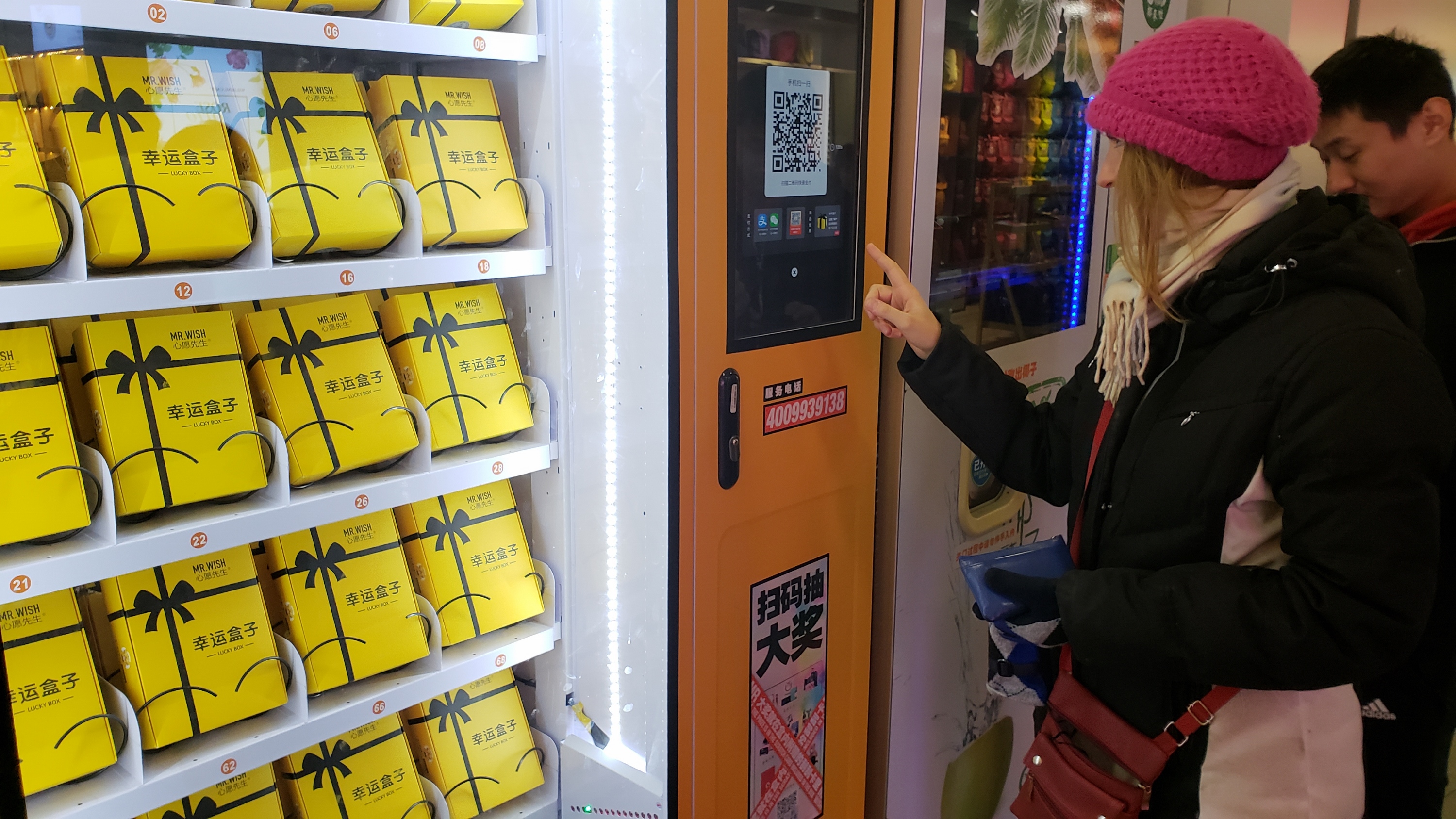
Christine prepares to have Daniel pay 30 yuen for a “Mr Wish” mystery box (she got a big bottle of shampoo)
QR codes. Relegated to an amusing nerd “wouldn’t it be cool if we used these?” oddity in the USA, China has grabbed the ball and run with them so far that there’s essential no way we could ever catch up. Beyond the usual “chat client” functionality of Wechat that we Americans can understand and use ourselves, the other 75% of wechat is how it uses QR codes. If you give Wechat the ability to access your smartphone camera (and let’s face it, most do) then you can enter its “scanner” mode, and aim it at a QR code. Every billboard for every company, large or small, will stick at least 1-2 QR codes on it that you can scan to “follow” that company’s news postings. This is how Wechat is not only a chat system, but also a twitter-esque social media system with a “newsfeed” of public postings by your friends, official company handles, and internal groups – just like how we use them.
But let’s take restaurants. Sure, they have a wechat handle you can follow. Sure, even a noodle cart will let you pay for your meal by displaying your personal wechat QR code, which is linked to your bank account or credit card, and payment takes less than 5 seconds, your phone vibrates and a notification pops up that “15 yuen has been deducted”. But in four different larger restaurants we went to, even each individual table had its own, personal QR code that you could scan with your phone, immediately be linked to not just a menu, but a full ordering system where you could have any item on the menu, sent directly to your table. Interaction with waiters is essentially null at places like these.
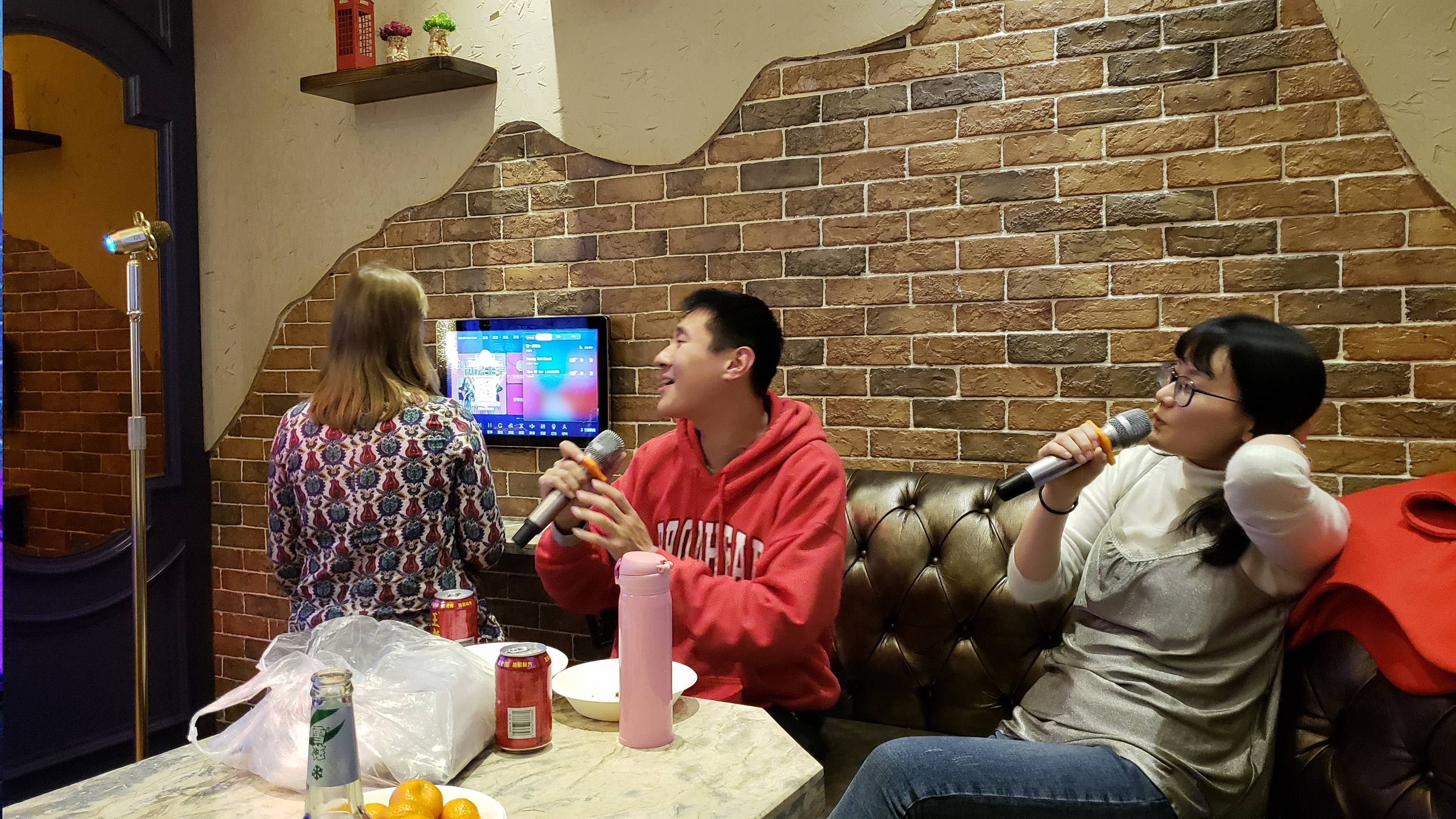
We went to a karaoke house with Daniel, his wife Valerie, and his dad Steven. When most Americans think Karaoke, we think of a Bar format, where there’s usually a DJ, a book of songs he has, and you come up with pieces of paper and give them to him, and he keeps track of what order people give them to him. Then you have to wait your turn, put up with people who aren’t your friends singing terribly, and all that jazz. The Chinese would laugh at us if they saw this. Their karaoke setup is worlds ahead of ours – for $20, our party of 5 got a private room with three microphones, a TV on each wall showing music videos with lyrics overlaid, and a control screen where you can modify the volume of the backing audio, the main vocals track (if you need help singing, for example), and choose the next song out of an internet-connected list of thousands. But of course, you can also aim your phone at a QR code and be automatically connected to the control system for your specific room and do everything from there. Amazing.
Christine works with the control screen instead of using her phone – foreigner problems!