Will he survive the flight or will his lung explode? Find out… in tonight’s episode.
Please note I’m not a doctor, nor do I play one on television. I’m just related to several of them, even though they’d rather be neutering cats than dealing with fickle, litigation-prone humans. That being said, this post is solely my personal experience and probably wasn’t a good idea in the first place.
At long last, it seems that the sun of post-pandemic life has broken through the hazy greenish clouds of COVID-19. Christine, laid up now for almost a year with chronic back and neck pain with a side of tinnitus since our wedding party and Türkiye trip last June, was feeling cautiously optimistic about being on airplane seats again, and our good friends Branden and Caitlin were also looking to travel. The two of them had never been to Mexico before, so with the additional of our friend Dan, we made a five-some plan to travel to Tulum, just a few hours south of Cancun where Christine and I had last been in December 2021, right after our wedding.
Everything seemed like it would be in good order until, a mere week before we were supposed to fly out of Chicago on March 20th – my left lung collapsed. Again. For the third time in four months. Christine and I had both (finally) had our first and hopefully only coronavirus cases in November 2022 and I was suspicious that lingering viral whatsits in my body were causing this new and frequent resurgent of collapses. Over the past decade of living with chronic pneumothorax, I’ve become accustomed to about one collapse a year. This was an irritating new pattern starting to emerge.
Not that my collapses are what I (at this point in my life) would call “a big deal.” A dull, mild ache in my back when I lie in certain positions, slightly shortness of breath. I’ve never been diagnosed with a total collapse, either, they’ve always just be in the 15-20% range. And ol’ righty has always been fine, carrying the load for his weaker partner. But all pneumothorax sufferers know that you’re not supposed to fly with a collapsed lung. It’s basically the first thing they tell you (that, and no SCUBA diving) when you join this happy, breathless club. (It’s brought up quite a bit on our subreddit.) How was I going to go to Mexico with my four fellows next week?
Well, I’ve got my trump card, I thought (triumphantly) to myself. I’ll just check myself into the hospital, get put on a pure oxygen nasal cannula overnight, the osmotic pressure of the heavier atmospheric air (nitrogen, carbon dioxide, and oxygen) vs the lighter oxygen in my lungs will cause the air outside my lungs, to get pulled back in, and I’ll be totally cured in a matter of days, and certainly by the 20th. Off to the doctor I go to get a referral!
….Except, the last time I had done this little fast-heal trick had been pre-pandemic. You might have heard there’s a slight oxygen shortage going on worldwide. My doctors apologetically reminded me of this and said that basically you needed to be having serious medical complications in order to be granted oxygen in this day and age. Well, nuts. Even three days after the collapse, I could tell I was on the mend – it was getting less awkward to sleep on my back each night.
At this point, my insurance and I (mostly I) were paying for new x-rays of my chest every couple of days. Finally, on the 20th itself, I had a meeting with a thoracic surgeon to discuss possibly redoing the pleurodesis surgery procedure I had gone through a decade earlier. The surgeon was sympathetic, and we had a good hour long discussion about why he didn’t have high-hopes for a second, similar surgery. It turns out that when your lung tissue is more-or-less glued onto the inside of your chest wall, which is how further pneumothoraxes are prevented, it’s kind of the surgical equivalent of collapsing the entrywide behind you. All of the post-pleurodesis collapses had all been, after all, near the top part of my lung, not my side – which is where the typical entry points for the procedure are (entering from the shoulder is far more complicated because of the greater number of nerves, tendons, and other stuff up there). For all we knew, the “glue” of the previous surgery was still holding strong in my side. If he were to go in again, the process of entering my chest cavity might badly damage my lungs. Not guaranteed, but it would certainly be more risky than the first time.
“So, doc, about flying – of course everyone knows we collapsey types aren’t supposed to fly when we’re having an episode – what’s the worst case scenario?”
He said that the worst case that could happen is that since airplanes are pressurized, and the atmospheric air “bubble” that is trapped in the pleural space between your lungs, and your chest wall, is not able to equalize with the lowered air pressure of the cabin that’s inside your lungs, it could start to swell in your chest, press against your heart, and cause a cardiac arrest situation while you’re on the airplane. That’s about the worst direct occurrence for flying in this condition.
“What if,” I said carefully, “I were to go on an airplane now, with my lung collapse percentage down to just 3-5% and I’m almost healed?”
Ah yes, he said, glancing at his notes. Your primary care provider did mention you had a vacation in Mexico coming up. Well… I won’t speak against official medical guidelines. You’re not supposed to travel with a pneumothorax, of any size, for at least a few days after an x-ray shows it has closed. However, that being said, based on your history of having these collapses, the small percentage it has left to close, and your general overall good health besides this condition, I do think that the likelihood of anything happening like I described… is very low.
“Good enough for me!” I thought.
By the time I was actually in the car with Christine, ten minutes away from the parking lot where we’d be catching the Chicago metro to the airport, though, I wasn’t feeling so confident. I popped a half xanax (and had Christine drive) and drifted peacefully through security. On the plane itself, I put on an inexpensive pulse oximeter I’d purchased a few days ago for the trip, and put it on my index finger briefly to get a baseline reading. 97%, not bad at all.
The plane took off. I squeezed Christine’s hand tightly, and she squeezed back.
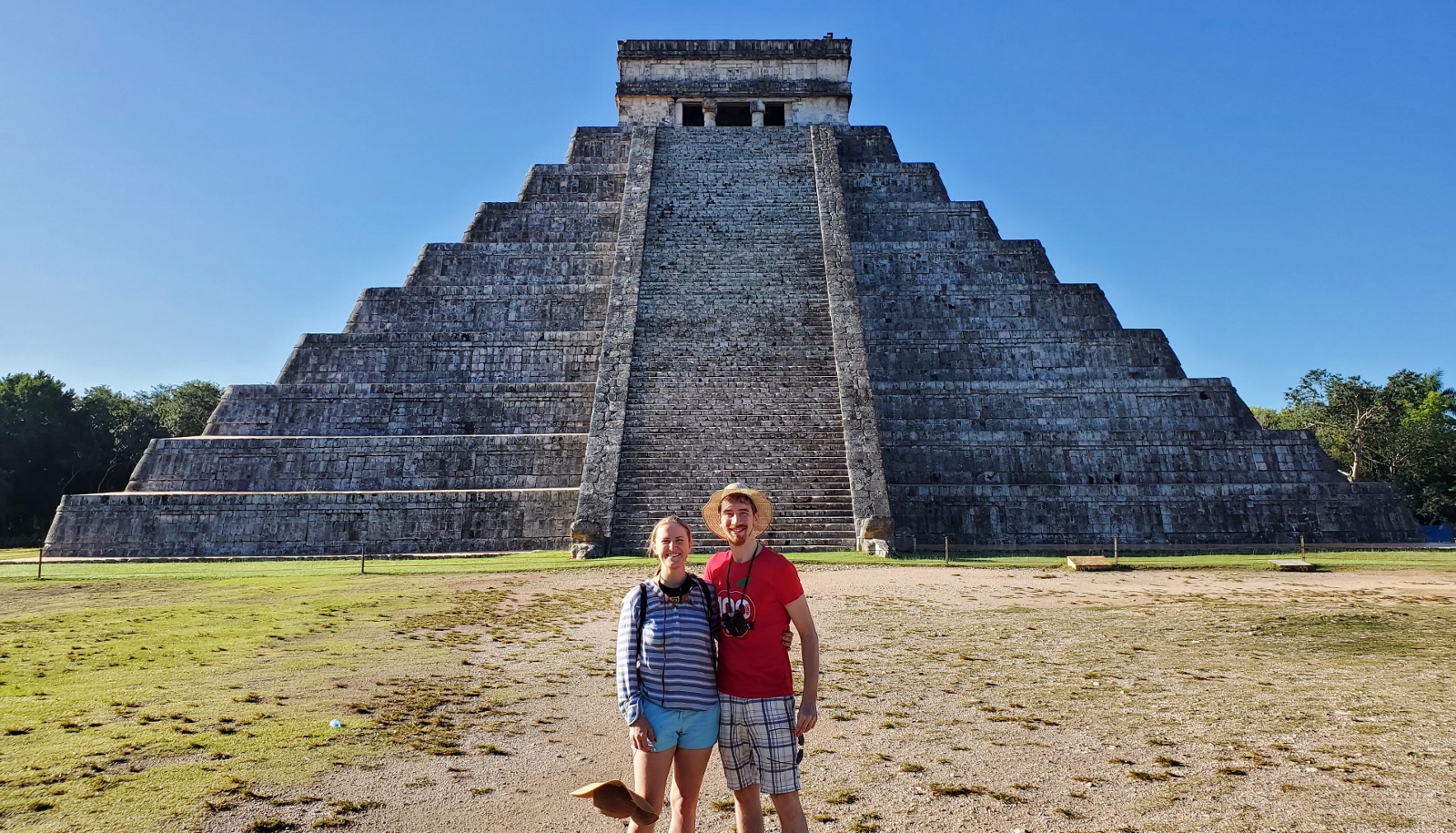
Chichen Itza with no other tourists in it (yet)? Just get up at 5 in the morning!
Another excuse to go to Mexico! Christine and I have been several times before, but this is the first time we’ve had a honeymoon. Over the past several months we’d been looking around for places to travel to while she had her Christmas break, but thanks to COVID, Mexico was an easy thing to settle on – namely due to the low prices (we got tickets for $187 apiece round trip) and the lack of a mandatory 14-day quarantine. We want to go visit my foreign exchange sister Farah in South Korea, but the quarantine they require pretty much kills any chance of a trip for pleasure. Which to be honest, is probably as it should be during a global pandemic.
While Christine had been to the Yucatan peninsula twice before, this was my first visit. While the temperature hasn’t been too bad in Wisconsin thus far, it was still nice to get to tropical climates. After arriving at the Cancun airport, we had initially planned to take the 5 dollar (approximately) “ADO” branded bus from the airport past the “Zona Hotelera,” the huge North-South running strip of gorgeous beach running along the eastern coast of the Mexican state of Quintana Roo, to get to Central Cancun, where we had our first night’s hotel before heading on to the Yucatan State Capitol of Merida. However, despite the bus company’s website stating that buses would run until 11:45 at night and us stepping out into the humid air at 11pm, the taxi drivers were more than happy to inform us that the buses had stopped for the evening, and “you are at our mercy” was not stated, but subtly implied.
At 1AM in Cancun, you can still find a good Mexican party with an idol to Mary
We knew the Mexican cartels control the transport system around Cancun (Uber and other ride-share systems simply do not exist in Cancun, like they do in other parts of Mexico, due to High Chances of Messy Decapitation) so we didn’t bother arguing too much. We took our “private” taxi for $15 per person up to Central, although the hustlers at the taxi center suddenly crammed another 3 backpacking young people into our cab (all English speakers from Europe, who told us they were also told they were getting a “private” taxi for $15 each) and necessitated several long waits in heavy traffic along the Hotel Zone.
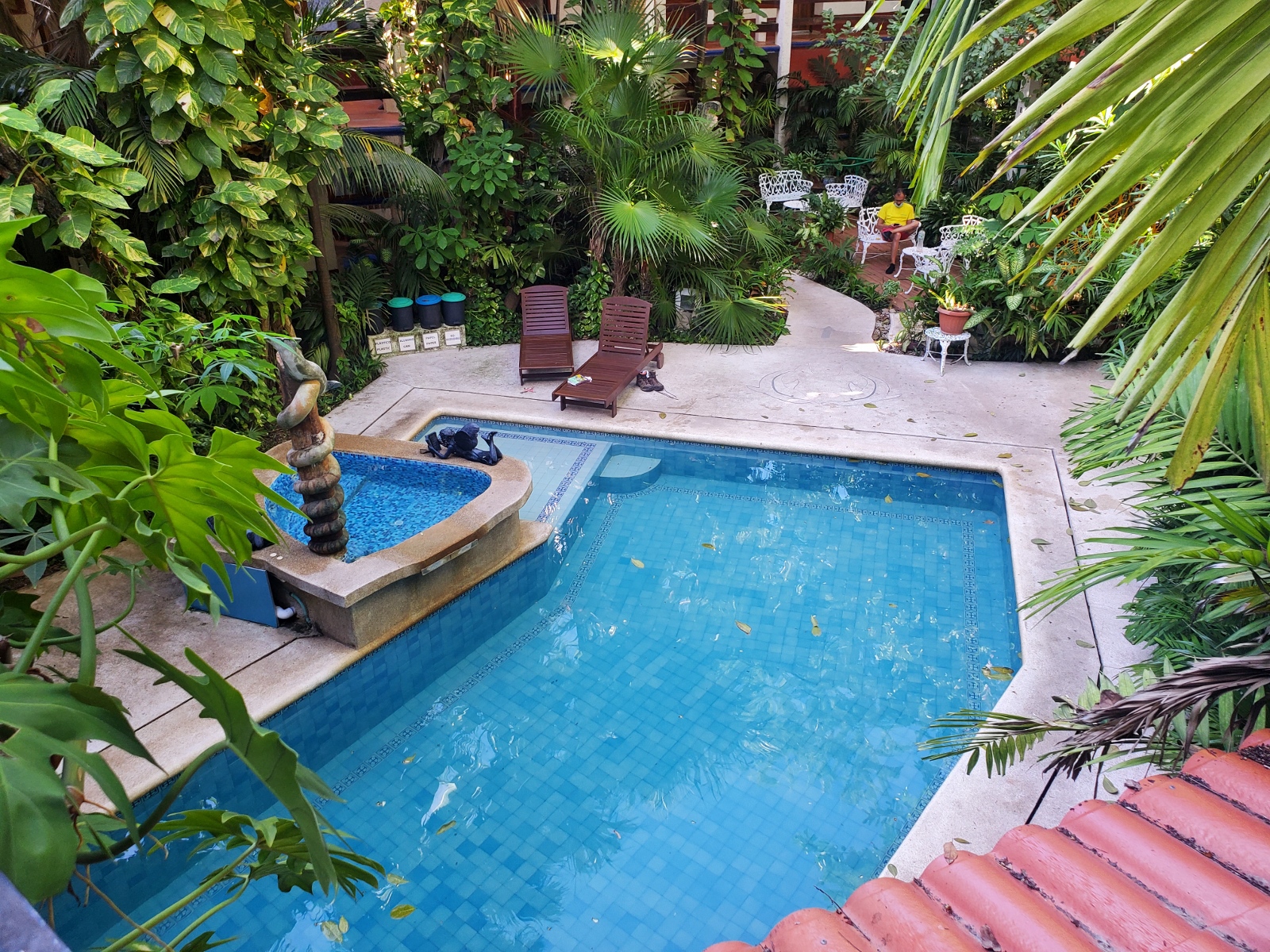
I love a good courtyard
Our first night’s stay was quiet and relaxing in an “eco-hotel” – a refreshing return to one of my favorite aspects of Mexican and Spanish (and Arabic, let’s be honest – thanks Moors!) architecture, the unassuming front of the building hiding a gorgeously appointed interior courtyard with fountains and gardens everywhere. A quick foot-dip in the pool and breakfast, and we were on to the central bus station of Cancun (we had chosen the hotel because it was a 5 minute walk to the bus station) and a 3 hour ride to Merida.
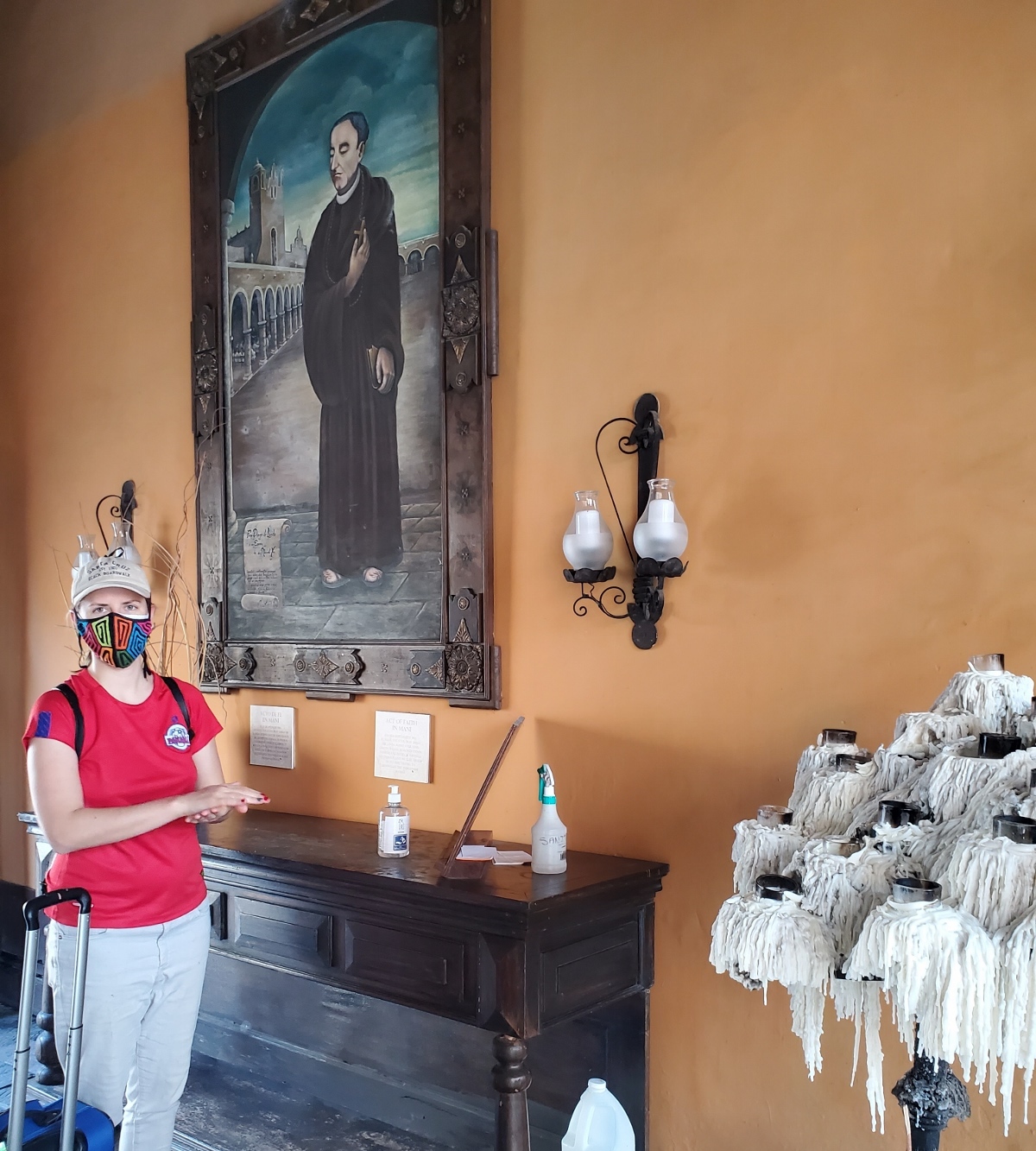
Our hotel in Merida was called the Mission of Friar Diego. I had never heard of this Spanish fellow, but the stately convent-converted-to-hotel had lots of helpful plaques, artwork, statues, and signs to give some history. Apparently several hundred years ago he performed an “act of faith” for the Mayan people, by helpfully burning thousands of religious books and objects to better focus their attention on his god. He was later granted the Bishopric of the region by the Spanish crown for this action. Fast forward to now, and I’m not entirely sure how the hotel’s owners were presenting this guy; as neutrally as possible, it seemed. The room was nice though; having 2 foot thick stone walls really kept the place comfortably cool and quiet.
Some say they’re still on the original candles.
For our first day in Merida, a young Mestizo (Mayan/Spanish descended) man named Gus gave us a cooking class. We were joined a quartet of 20-something Germans, two brothers and their girlfriends on vacation. Gus freely admitted to us that this was his first time leading his class again in a year and a half since the pandemic began. He and his elderly aunt had run it out of her home for several years, but due to her advanced age he didn’t want to risk her health with guests, so we’d instead be using his friend Joachim’s kitchen.
Our previous Mexican cooking class experience in Oaxaca several years ago had begun in the local market, and Gus’s class was the same: the bustling central market does indeed seem to be a hallmark of Mexican culture. Throughout our time in Mexico, people did a great job of keeping their masks on, even outside in public – from what we could tell it was until recently mandated to wear masks even while outside, but that had been relaxed somewhat. 18 month habits die hard though, and it seemed 60-80% of people kept up the practice. Inside in the market, it was closer to 95-99% – which was good, because the aisles were tightly packed.
I’ve seen places like this in dozens of countries over the years but never in the USA. Perhaps an FDA/USDA safety issue?
We saw lots of fresh hot sauce for sale, and surprising numbers of radishes. Proprietary and exotic blends of red, black, green, and brown spices, mixed with oil and water to make it a sticky and grainy paste, were sold in plastic bags. Most interesting to me was a rickety, almost steam-punk looking corn tortilla making machine in one stall – its owners would feed in the stone-ground cornmeal dough into a chute on the top, where it’d be flattened and exuded into a thin sheet on a drum underneath, where two disc blades sliced the sheet every 6 inches into two neat circles and recycled the excess back into the drum. The twin baby tortillas would drop onto a semi-circular grated conveyor belt which was precisely long enough to run the sets of twins under a long upper and lower burner, perfectly toasting them by the time they reached the end where the staff would scoop them up by the handful and place them directly into consumers’ waiting hands. The price was 20 pesos per kilo, which equals a little less than a dollar. And a kilo of small corn tortillas looked like about 60-80 – so yeah, people here eat a lot of tortillas!
Thanks to the pandemic, the government has set laws on the number of people that can be in taxis and rideshares – and no one can ride in the front seat next to the driver. So our group of 7 had to be split into three Ubers (no cartels here to stop the rideshare industry; Merida is known for being a relatively safe community in the peninsula) which Gus paid for in cash. The 20 minute ride across town cost the equivalent of about 2 USD.
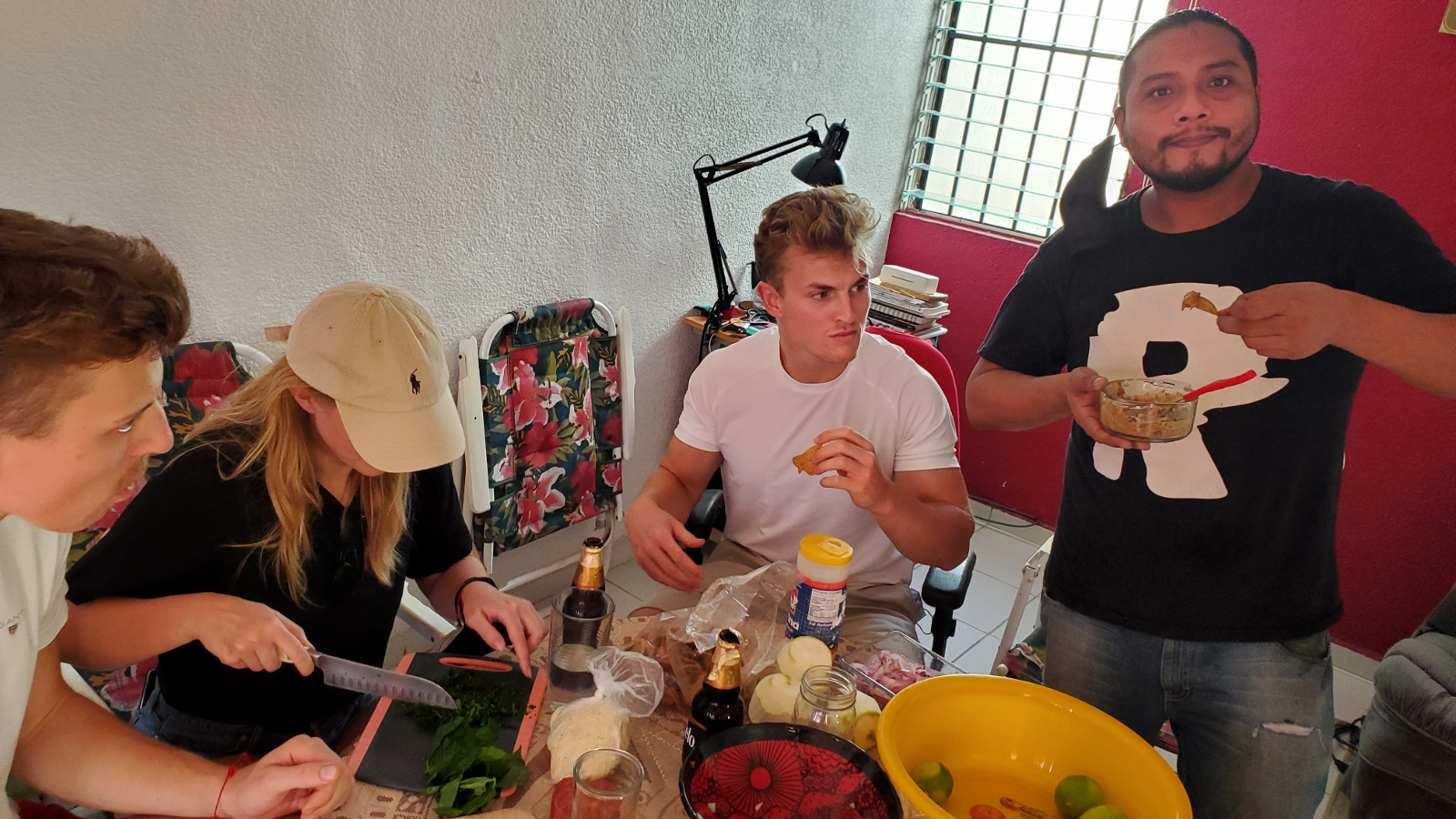
We met Joachim at his home and beers were cracked open all around as we began to cook. One of the young German couples worked in the kitchen of a boutique hotel near the Baltic sea and industriously began perfectly dicing the tomatoes and onions exactly to Gus’s specifications. We made our own tortillas from masa corn flour Gus had on hand (we didn’t grind the kernels ourselves though!) in an aluminum die-cast mold. For some of the tortillas, we mixed in the finely diced leaves of a local Mayan herb, Chaya, into the dough before molding.
Gus samples some of the salsa we made as a starter(more…)
Standing on the steps of the Moon Pyramid with a view over the main plaza, with the Sun Pyramid behind us
Surprisingly, there’s only about three months left of our time abroad, living in Panama. With Christine on a teacher’s schedule, we don’t have much time to get away from the city and travel internationally – but in devoutly Catholic, Latin American countries, Easter can provide that opportunity for a vacation!
Our original plan was to put a new country under our collective belt – Nicaragua. Christine had a fellow Language Fellow friend living in the capitol city of Managua, so we quickly arranged a 4 day trip that covered Managua and the nearby tourist central of Granada. We were quite excited to see the nearby Masaya semi-active volcano, which Christine’s friend pointed out was only 15km from his home. Oh good! Everyone is okay with this, right? Nicaraguans don’t mind having bubbling lava cauldrons within murder-range of their homes? No? Okay then.
But obviously, the title says Mexico City and pyramids, not Nicaragua and volcanoes. So what happened? We were all set the morning of March 28th; we got to PTY airport with plenty of time, relaxed in our Priority Pass lounge with some complimentary drinks, and ambled casually to the gate when we figured it was about time to do so. The attendants at the gate scanned our tickets and then asked us to show our Yellow Fever certifications.
Wait, what? What certification?
Our hearts started to thump a bit as we stepped out of line and waited for a specialist to come over from her office to speak with us. A couple minutes later, we were told that Nicaragua requires a certification of health, stamped by the World Health Organization at least 10 days prior or more, verifying that you’ve received the Yellow Fever vaccination…if you’re coming from Panama or 11 other countries. We had thought that we had done our due diligence by looking up the CDC advisory page for Nicaragua. As you can see, it doesn’t even mention Yellow Fever, much less that its vaccination is mandated. But of course, that page doesn’t say anything about the requirement, because it’s written for Americans arriving from the USA. If we had searched for Panamanians traveling to Nicaragua, we would have found this page and things would have gone much differently. But we had failed to do our proper research, and now, there would be no trip to Nicaragua, no volcanoes, and no vacation. A lump rose in my throat as I stared down at my now-worthless boarding pass. We left the airport, found a Diablo Rojo bus and sat in thoughtful, frustrated silence for the two hour ride back to the apartment.
Christine, to her immense credit, didn’t give up. After three hours on a shaky VoIP phone call to Chase’s support line (she had purchased both our tickets via Chase’s travel portal) we discovered that we’d be able to get a complete refund in Copa Airline credits, valid for one year…complete, minus a $100 per ticket penalty. It was far better than we’d expected, though, and we quickly cast about online, searching for plane tickets for Friday, the 29th, that wouldn’t break our limited budget.
There was basically nothing, though. Panama might be a central travel hub for Latin America, but it’s a business hub… there’s no “last minute” cheap seats available anywhere. The only affordable option that kept coming up was Mexico City, where we’d be able to only spend an extra $220 for each ticket, on top of our credit, for a weekend getaway. We reasoned with ourselves though, that at least housing and food would be cheap – it’s Mexico City, after all!
So, the wheels of vacation turned in our favor thanks to Christine’s patience on the phone, and we were on a 9am flight to Mexico the next day. It would be her sixth time visiting the country, and my second… I loved the food and friendliness of the Mexicans on our visit to Oaxaca in 2015, so why not turn our disappointment from losing out on Nicaragua to excitement for the opportunity to visit one of the largest, most ancient cities in the world?
What kind of meat goes into tacos that you’re paying 17 cents apiece for? ….chicken and sausage, of course. Geez, they’re running a legitimate business here.
Mere minutes after leaving the MEX airport, we found a covered market next to the metro and the chance to eat 5 tacos for 15 pesos… about 90 cents or so. Although we’d be later teased that there was no way the chorizo and chicken in those tacos was safe to consume at those prices, they were slathered in onions, cilantro, and tomatillo sauce, so we were in heaven. Tacos in Panama City, for comparison, are usually one taco for $2.50, and that’s if you’re lucky. Have I mentioned before that Panama City is an insanely expensive place to get food? It is.
After checking in at the AirBnb of the wonderful Fabrizio and Mariana (we definitely recommend these two as friendly, hip young people with a cute little apartment) we immediately set off again to see if there was any sort of Easter-related activities we could partake in. Fabrizio told us that down in Itzatapalapa (I love the names of barrios and regions around the Central Mexico area) there might be a Passion reenactment going on, if we hurried. Well, we were too late for that (missed it by 15 minutes) but it turned out the main street of the barrio was athrong with people for a street carnival and fair. We found out that in Mexico City, Easter is such a huge holiday that kids are given two entire weeks off from school – the weeks before and after the holiday itself. We wandered the packed streets, eating cheap tacos all the way and examining the cheap (safe? maybe) rides and cheap trinkets that you could win with familiar shooting and ring toss style games. We rode an extremely fast Ferris wheel and while it was great at first, I found myself wondering if perhaps I had eaten too much cheap Mexican street food beforehand…
All officially licensed from the appropriate authorities, of course
There were so many things for sale next to the carnival – besides food of course, there was thousands of pieces of reddish pottery (which we saw in restaurants everywhere), wooden ladles at least a meter long (for stirring what, we wondered), all kinds of little plastic knickknacks from China, but more heartwarmingly, dozens of types of different little wooden children’s toys that looked hand made… perhaps cheaply made, and quickly, but wooden handmade toys for just a few dollars. Also, fried and spiced locusts! I remembered seeing those both in Jordan and Oaxaca the last time we visited.
At first I thought this might have been a temporary, paper maché addition for Easter… But nope, it’s steel and welded right onto the pedestrian walkway!
After a breakfast of fresh baked bread from Fabrizio the next morning, Christine and I took a bus from Estación Autobuses del Norte to one of México City’s most famous tourist sites – the ancient city of Teotiuacan. The line to purchase bus tickets stretched back for 20 meters and the buses themselves seemed to be arriving, filling in 15 minutes, and then speeding off with a cough of that famous Mexico City pollution. The ride itself was short, only 45 minutes, but we were all deposited a good half mile away from the entrance to the site at the side of the road and told to just walk a bit further up the path. Seeing the slow moving line of cars trying to get into the actual parking lot ahead of us, it seemed like this was probably a better option for both tourists and driver.
Another half an hour waiting in the entrance line (this would become a recurring theme on this, a holiday weekend in one of the world’s most packed cities) and having paid our 70 peso entrance fee, and we were free to wander the dusty paths of the archeological site. Hundreds of vendors had set up bags by the paths, or were even wearing their entire commercial ventures on their backs. Most of the items for sale were common trinkets like bracelets, shawls, and little statues, but I had been hearing an eerie sound for the past hour and was curious to figure out what was making it.
Mateo the jaguar seller
It turned out that the craftsmen had developed what I will call, in absence the knowledge of its proper name, the Jaguar Whistle. About the size of a fist (the medium sized one; they also came maybe 2 centimeters larger and smaller for plus or minus thirty pesos each way), it was brightly painted and sculpted as the snarling head of a jaguar, sometimes as a jaguar headdress with the scowling face of a warrior peering through the teeth. My chosen vendor, Mateo, was a good salesman and quickly taught me how to blow through one not with a straight breath, but with a buzzing “frtrtrtrtrt” roll through your teeth. The shape of the whistle shapes and deepens your breath and makes it sound just like a big cat’s raspy snarl. I’d never seen one before, and promptly paid my 100 pesos to receive a freshly painted (and smelly) new whistle. Mateo pointed out that all the vendors worked overtime to shape and paint thousands of new items right before major holidays, knowing that the tourist sites would see easily 10 times the usual amount of foot traffic, hence the sharp smell of the paint; the item I was holding had been made just yesterday. Well, no better way to help that paint dry faster then to blow on it constantly, much to Christine’s delight!
Praise the Sun!
Christine and I are more thrifty than educationally enlightened when it comes to most archeological ruin sites: we don’t pay for a guide or usually even a pamphlet (although we will take a free map if offered), we just make a beeline for the biggest, coolest looking thing we can see from the front gate. And in this case, it’s the Pyramid of the Sun. Wikipedia calls it the third largest known pyramid in the world (by volume, not height) with the largest being a massive step pyramid, also in Mexico, and the second being the Great Pyramid in Egypt. Oh well, at least I’ve seen two out of three now. The line was gigantic, and took about 1.5 hours to wait through (surrounded by Mexican children attempting to use their own jaguar whistles but only getting sad wisps of air through it; they hadn’t had the benefit of Mateo’s teachings so I showed a couple of them the proper blowing method. Their parents looked as thrilled as Christine!), carefully parsing our shared bottle of water and trying to keep our skin either covered by jackets or slathered in sunblock. Mexico City is at one of the highest altitudes I’ve ever been at, and the combination of thinner atmosphere and dry air was already wrecking havoc on us.
The moon pyramid, as seen from the steps of the Sun
By the time we got down the steep flanks of the Pyramid (so steep they had police officers helping people climb down the steps, and the “exit” steps were almost as slow-going as the “entry” steps due to cautious climbers) it was almost 2, so we mosied over to the Moon Pyramid at the end of the “Avenue of the Dead.” No one knows who the original builders and inhabitants of this religious complex were; even the name Teotiuacan was given by awestruck later cultures when the site was found again and is not the original name; it means something along the lines of The Place Where Men Become Gods, with the idea that any humans who could have built such impressive edifices must have been deified and raised into the heavens as a reward for their prowess. The names Sun and Moon Pyramid, likewise, are not original. Avenue of the Dead, though, seems a little silly and “edgy” for it to sound original; at least the Sun and Moon Pyramids are believable names!
We weren’t allowed to climb to the top of the smaller Moon Pyramid, only to a platform about halfway up it, but its position at the far end of the site allowed for some good pictures looking down the Avenue with all the little temples and the Sun Pyramid proudly overseeing.
That night, back at our Airbnb, the four of us were chatting together when the electricity suddenly went out on the entire block. It seemed like as good an excuse as any for us all to go and find a pub, so we took a half hour walk along the Paseo Reforma main Street to Regina Street, a pedestrian walkway with a lot of trendy little bars and nightclubs. I had the opportunity to try a locally made Imperial Porter which was expensive by Mexican standards (120 pesos or $6.66 at the moment) but was delicious. Christine tried a “Curada” which is pulque, a common Mexican fermented cactus water, mixed with a flavor of your choosing. After we tried Fabrizio and Marianas pitcher of Curada Zapote (mixed with the jet black and sweet zapote fruit) Christine thought that the Avena (oatmeal) one sounded good. Well, one thing was for sure, we definitely got more of the pulque flavor coming through on that one – but not to poor Christine’s benefit. Soon afterward Fab and Mariana caught us all a taxi home so she could lie down and rest her churning stomach.
Sympathizing with Christine’s upset stomach, Fabrizio cooked us an authentic Italian dinner at 1am!
The next morning was Easter Sunday and also April Fool’s day, so we began the day by heading to the Historic District of the city and seeing the almost completely destroyed ruins of the great temple of Tenochtilan, the Aztec/Mexica city that the Spanish “Nuevo España” had been founded on top of. Of course, Catholic Europeans would not have missed a chance to humiliate their captive locals, so after razing the great temple down to its foundations, they built an ostentatiously massive cathedral right next to it to send all their new converted-by-the-sword Mexica subjects to. My own obvious feelings on colonialism aside, the cathedral was quite beautiful on the inside and we listened to a sermon in progress for a few minutes from the rear galleries. There were police officers standing beyond the gallery making sure that tourists didn’t try to get unholy on the place and proceed any further to take more pictures and be inadvertently disruptive.
Outside the cathedral, however, some native people were holding a worship service of their own to Queztalacotl. Sans sacrifices, thankfully.
We caught the excellent Mexican metro from the Historic district down to the main central park of the city, where we had a relaxing 20 minute walk with several thousand of our new close friends, enjoying their holiday. Street clowns were out in force, drawing large crowds and bringing up children from them to pantomime with. Vendors of course were everywhere (sunglasses for 10 cents, anyone?) and people were walking more dogs than I think I’ve seen in half a year in Panama city.
nom nom nom statuary
Our destination was INAH, the national anthropology museum that we’d heard good things about. Admission was 70 pesos yet again (seems to be a common foreigner price in the city) and free for the locals on Sundays, so once again, the place was packed. The museum is laid out into 3 two story buildings, facing toward a sunny inner courtyard with a pool, with each of the three buildings covering a different period – the ancient pre-historical, the pre-Mexica cultures like the Toltec and Mayan, and then the last building being reserved for the most recent and final native culture, the Mexica (which most people know as the Aztec). Of course there are a lot more relics from that latter culture since it only ended 400 years ago vs thousands.
While perusing a time line of the Mexica’s wanderings, I noticed a Matt Groening cartoon on it! What are the chances…
While the majority of the relics and items being presented didn’t have English translations of their signs, Christine knows me well enough after a decade that she knew what I’d find interesting and translated for me if she thought I’d like something. Also, the larger signs introducing groups of exhibits together were usually written in both Spanish and English so every time we entered a new area, I’d immediately scout out its English signs so I’d have at least a basic idea of what was going on, and whether or not I should stay and turn my puppy dog “please translate” eyes on Christine. Overall, I’d say that for $3.86 the museum is definitely worth seeing for any English-only gringo that might find themselves in the city, and if you’re fluent in Spanish, it’s a must-see. We didn’t even have time to check out the second floors in each building or walk around much in the outdoor exhibits!
Oh don’t you worry, Teotiuacan, I hadn’t forgotten about YOU since yesterday…
There was enough time left in the evening to grab some delicious plates of mole-drenched tacos and some savory Micheladas (ingredients: 20 oz of dark beer, a half ounce of worcestershire sauce, and a salted rim – oddly addictive!) at the nearby Los Panchos restaurant and catch a bus back home. Tomorrow afternoon we’d be catching our flight back to Panama – and hoping that the country hadn’t initiated a yellow fever certification requirement while we were gone!
Well, at least we got to see Nicaragua from a distance (that’s the main lake in the country, with its two main volcanic islands in the middle)
Monte Alban, North main platform: Here’s squinting at you, kid
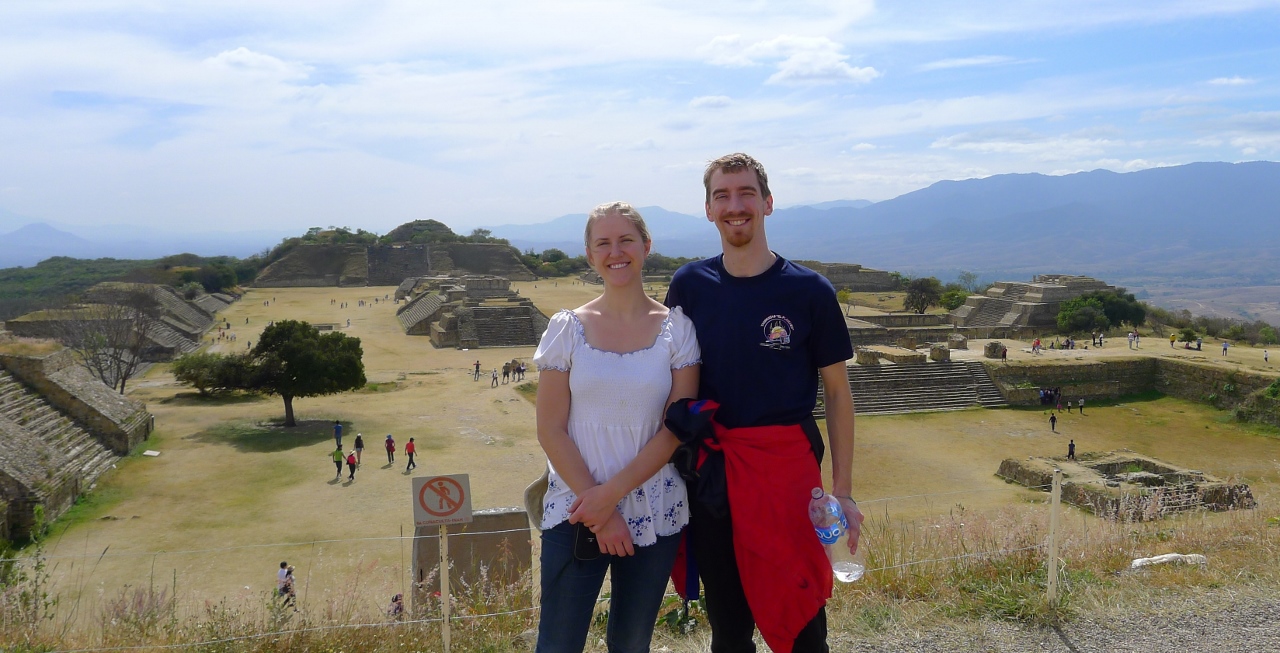
Like most ancient ruins of ancient civilizations, the Zapotec/Mixtec ruins of Monte Alban are filled with big rocks. Built on a large mountain overlooking the modern city of Oaxaca (the priestly/ruling caste of the Zapotec had a thing for being able to overlook their subjects), Alban has a serene, tranquil feel to it even during the post-Christmas high season. Christine and I took a 60 peso shuttle with a bunch of American-Mexicans on vacation to their homeland to the site and were dropped off in a parking lot filled with vendors hawking cowboy hats, combs, and masks. Admission was a mere 59 pesos each, or about 4 dollars – a far cry from the 70 dinar – or was it dollars? – that one had to pay to see Petra back in 2010.
Visually, Alban isn’t as impressive. Exposed to the constant sun and summer rainy season, and to the fact that a modern city is only 15 minutes away by car, a lot of the big rocks are missing, leaving only the foundations of the most important buildings, jagged rocks that if you were to lay on them, would either be great massage therapy or painful torture. The homes of the common people would have been built into the hillside below us in terraces (ancient Mesoamericans love them some terraces) and out of mud or daub, and have long since been eaten up by time and the brambles of cacti and scrubby trees.
To me, Monte Alban could be summed up into three main parts – the central ‘field’, and the north and south raised platforms. We didn’t hire a guide and the English/Mixtec/Spanish informational signs were few and far between, but the empty field seemed to me like it would have been where simple markets and vendors would have set up little tiendas and stands to buy and sell things, with the priestly temples and important political houses surrounding them on the sides. In the middle of the field were a large rectangular raised area which again, was probably for announcements and rituals, but more interesting to me was the angular, offset base off something which the signs thought might have been an observatory. A common theme of every part of the ruins was that it was straight lines, perfectly arranged in north-south alignment. Everything was either squares or rectangles. But if you look here, you can see that the only thing that didn’t fit with this is this ruin, which would make sense if the scientist/priest caste was using it to track particular stars or constellations that didn’t fit with north-south alignment.
We toured the north platform first, climbing up the steps to high points (which originally had shrines and temples on them) and getting some good pictures and wondering to the farthest north points to see some houses. The guide signs referred to almost everything in the far north by “Tomb Number XX” -> after the Zapotec civilization fell apart around 600-800 AD, the Mixtec people slowly moved into the newish ruins and made the stone buildings into tombs for their important dead. The signs used the words “residencies” and “tombs” interchangeably – it didn’t seem like the Mixtec were much into building their own stuff, preferring to use the probably-still-impressive buildings left behind by the politicians and priests. And of course, they seemed to be happy to cart off some rocks from other buildings down the mountain to begin to create what would eventually be the modern Oaxaca, where plenty of Mixtec-speaking people still live today.
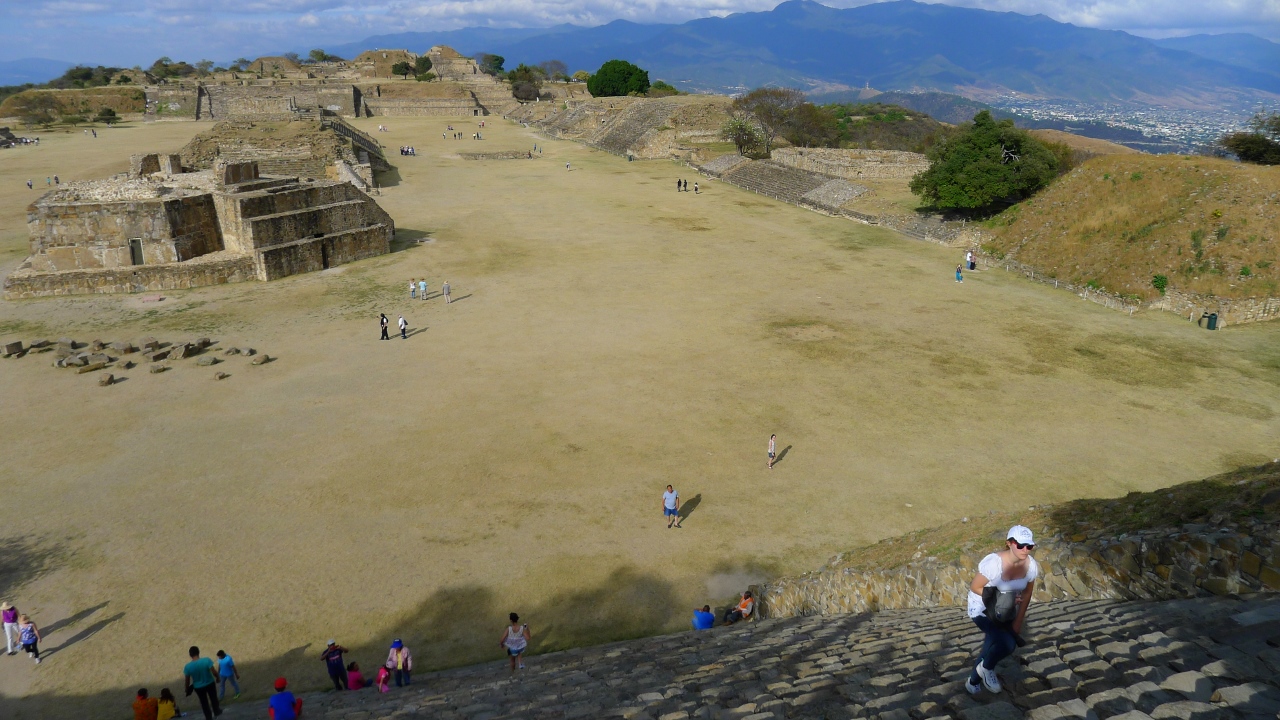
After lunch at the gift shop’s tasty outdoor restaurant (Christine eating a tamale and me with Oaxacan quesadillas) we briefly stopped by the south platform, which was more of the same but notable mostly for the massive set of steps that were necessary to climb. It seems common in most religions that steps to climb upwards are needed; in order to keep from breaking your neck, your head must be bowed, looking down at your feet, and not looking up and perhaps disrespectfully making eye contact with the religious icons at the top of the steps.
Christine Carefully Climbs
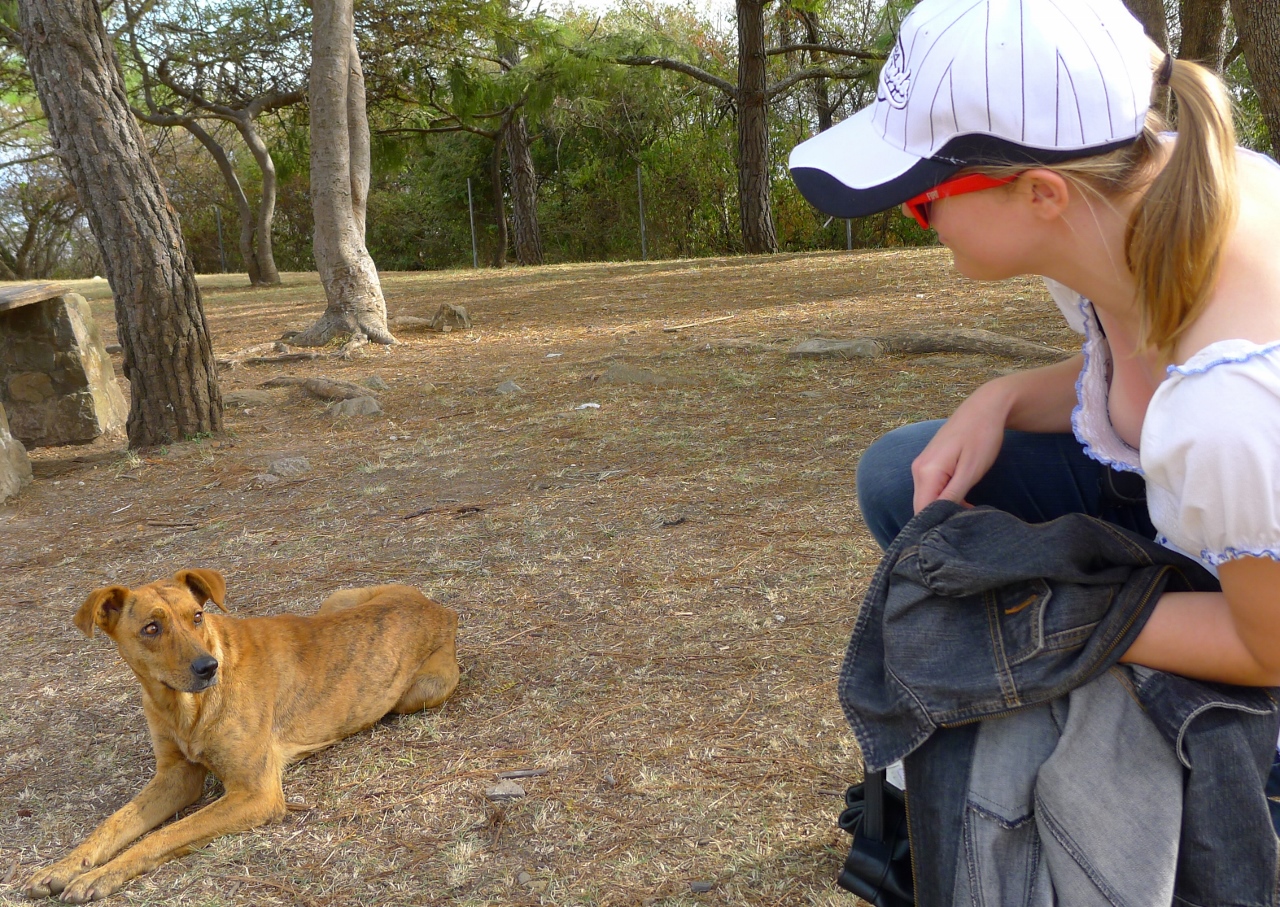
A common theme with Christine and food here in Mexico has been that she will save a few tortillas or, if I let her, a bit of my meat. She’ll wait until no one seems to be watching her, then quickly stuff everything into a napkin or two and into her purse. We haven’t seen a single cat in Oaxaca. Not even one; street cat or otherwise. But there are plenty of hungry street dogs who are almost always frightened of humans and slink away as Christine inevitably crouches and calls pleasantly to them to be petted. Monte Alban was no exception; down near the parking lot where we were to meet our shuttle bus again 3-5 skinny dogs lounged in the shade. I don’t speak much Spanish, but I can hear people talking about time in Spanish and I’m pretty punctual. Our return shuttle was for 4pm, and Christine let a bunch of other people with stubs for 4:30 or 5 take our spots on the bus – I teased her that it was for the express purpose of having more time to feed the dogs the tortillas and meat she had in her backpack! The dogs were, of course, extremely grateful and one of them even consented to be petted. The others guilty grabbed the food and hurriedly retreated away to glonk it down their throats (glonk is the verb I have created to describe how a dog attempts to eat, snake-like, a big piece of food by just swallowing it whole when they’re in a hurry).
Yeah, both me and the dog are onto you, Christine!
The slightly deranged look in Christine’s eyes is most likely the fear that a firecracker would explode on our heads
It’s not proper IPA spelling, but hopefully Christine the linguistics Masters degree holder will forgive me. It’s been quite awhile since the last post, and instead of addressing things consecutively as I usually do, I’ll handle the food of the Oaxacan region first.
On New Year’s Eve, Christine and I went out from Casa Giron to see the festivities on the Zocalo, the main square in the city. We stopped to watch a fast speaking clown called “el Tonto” (the Fool) who had drawn a crowd at its edge, but of course as soon as he spotted two foreigners in the crowd, he just had to pull us into his act, and literally into the center of his act to speak in rapid fire Spanish while blowing up balloon animals for us. Christine told me later that it was mostly dick jokes regarding Mexicans and Americans, so I guess I didn’t miss out on too much. We were stuck with the balloon animals for the rest of the long night; we ended up giving them away to some begging children on the edge of the square (along with a peso or two as well). The rest of Tonto’s act was something that drew some wry amusement from the Americans in the audience – Tonto pulled two little boys and a girl out of the crowd and (apparently, according to Christine) was going to have them reenact “the classic love tragedy.” One of the boys was given a poncho, the other a sombrero, and the girl a dainty red lace umbrella. And then both of the boys were given cap guns and Christine said, “oh geez, this would never fly in the USA.” Tonto told the children exactly what to do – the girl was to deliver a passionate speech regarding “I love both of you, how could I ever choose!” and then the two boys were to circle each other menacingly, threatening each other with child-level threats (“your hat is dumb!” “you look stupid!”) and then open fire on each other with the cap guns. One boy was “killed” immediately (although he had difficulty remembering to stay dead, much to Tonto’s derision) and then the girl threw herself down at his side, shouting that it was actually he that she had loved the most. Then she grabbed the gun, shot the other boy, and then shot herself, and all three lay on the ground twitching theatrically.
“Kids, resolve your problems by shooting each other the way you see them do it in old movies!”
The crowd of children, parents, and young people in our age group just ate it up. Tonto’s off-color jokes probably helped too. Christine and I enjoyed it as much as two non-native speakers could, but of course our perspectives were colored by the fact that if any children’s clown tried this in the USA, screaming parents would be hurling themselves at him, shielding their own children’s eyes, and he’d probably be imprisoned for willful endangerment of children’s minds or some other similar charge. (more…)
We ate our way around some of Oaxaca’s plentiful taquerias and food stands. Second breakfast (after the omlettes served by Concepcion) was at Oaxaca’s number one rated restaurant, a bakery conveniently located only a couple blocks from Casa Giron. The owners were both there, two young Mexican men who spoke perfect English and made us some great sandwiches on ciabatta and focattia and served them with a mug of homemade kombucha.
Coin Candles just don’t have the same effect for me.
The large and impressive Temple of Santo Domingo was nearby, so we stopped there. In my opinion, the edifice and its insides were much more impressive than the Cathedral we had seen the day before, and it appeared to be a hangout spot for both vendors hawking goods and university students who were handing out free maps of Oaxaca to anyone who looked slightly foreign. As it was a Catholic church (and really, they all probably are in Mexico) there were several of those “pay a bit, light a candle” stations, except with a modern twist – you could drop in either 2, 5, or 10 pesos into a slot on the front of a box, and then one of about 40 electric candles on the top would light up and flicker dimly. Christine and I agreed it was a rather tacky replacement.
We were walking back down one of the main streets when I saw a sign that called out to me – tacos for 5 pesos each, or about 33 USA cents. Both of us were a bit taken aback by the thumping club music emanating from the establishment, and the emptiness of the place, but it seemed to be a dance hall that didn’t really do much business until the late hours, so we tried the cheapest tacos we’d ever seen….they were about as spicy as the “Porky” tacos in the airport, which I’m starting to realize now is probably a bad thing, but the taste was also BBQ chicken, so it was at least recognizable. At some point I tried to ask in Spanish “what bird meat is this” but Christine told me I said instead, “which airplane meat this?”
At that point, I started wondering what the taco quality gamut might run. If five pesos was the lowest, then what about ten pesos? fifteen? We were doing so much walking around the city (about seven miles by the end of the day, I estimated later on) that I was bound to be constantly hungry. After reserving our spots for a two-day overnight bike ‘n hike, we came across a little taco cart called El Flamazo which had amazing smells coming off from it. I couldn’t resist taking a seat at the cart and ordering a “plata” of five tacos for 38 pesos. What meats do you have, I asked, and the three young men running the cart told me that my choices were tasejo, tripe, and cabeza; head meat. Christine was looking at me nervously, and I knew why; it was a street cart in Mexico, which meant that the water quality was going to be suspect. Everything was cooked but the cilantro, but the smells were so wonderful I threw caution to the wind and ordered two tasejo (which is just ‘regular’ muscle meat,) two tripe (stomach/intestines) and a single head meat taco…which I guess I’m assuming is cheek meat? I suppose it could come from any part of a cow’s head that has meat on it. They came to me smothered in fried onions and cilantro, with (of course) two lime slices on the side. They were absolutely amazing and I made numerous attempts to tell the high-school age workers that in my broken, mangled Spanish.
One of Christine’s photos where I’m wildly and exuberantly gesticulating about the food
Next to us, a somewhat-off looking guy was arguing with one of the employees about how much money he should pay. It seemed that he was short 10 pesos, or about 60 cents. My meal was going to be 38, so I paid with a 50 peso bill and told the employees I would pay for the guy’s last ten, too. They refused and made the guy pay anyway, so I tossed them the 10 as a tip (the man begged the remaining two pesos off me, which I gave him, to the eye rolls of everyone else at the cart. What can I say? I was filled with delicious taco and probably would have kept giving small change to people all night if pressed). The young man reached under his cart and pulled out a t-shirt bearing the logo for El Flamazo and gave it to me, saying “for you.” I told him I would wear it proudly, and asked if they had other carts around the city, or if this one moved. I was told that there were 3 other carts, run by other brothers in the family. Now, my Spanish isn’t so good, and they might have been kidding us, but when I asked how many other brothers they had, they said “there are twelve of us, three each with a cart.” Maybe they meant “hermanos” in the metaphorical sense – aren’t we all brothers on this taco-cart of a planet? – but maybe they actually meant 12 biological brothers running delicious taco carts in Oaxaca.
Cheers to El Flamazo!
I don’t know, but I got a sweet shirt out of it, which I’ll be wearing today when we go to Monte Alban, the archeological site a few kilometers to the southwest of the city.