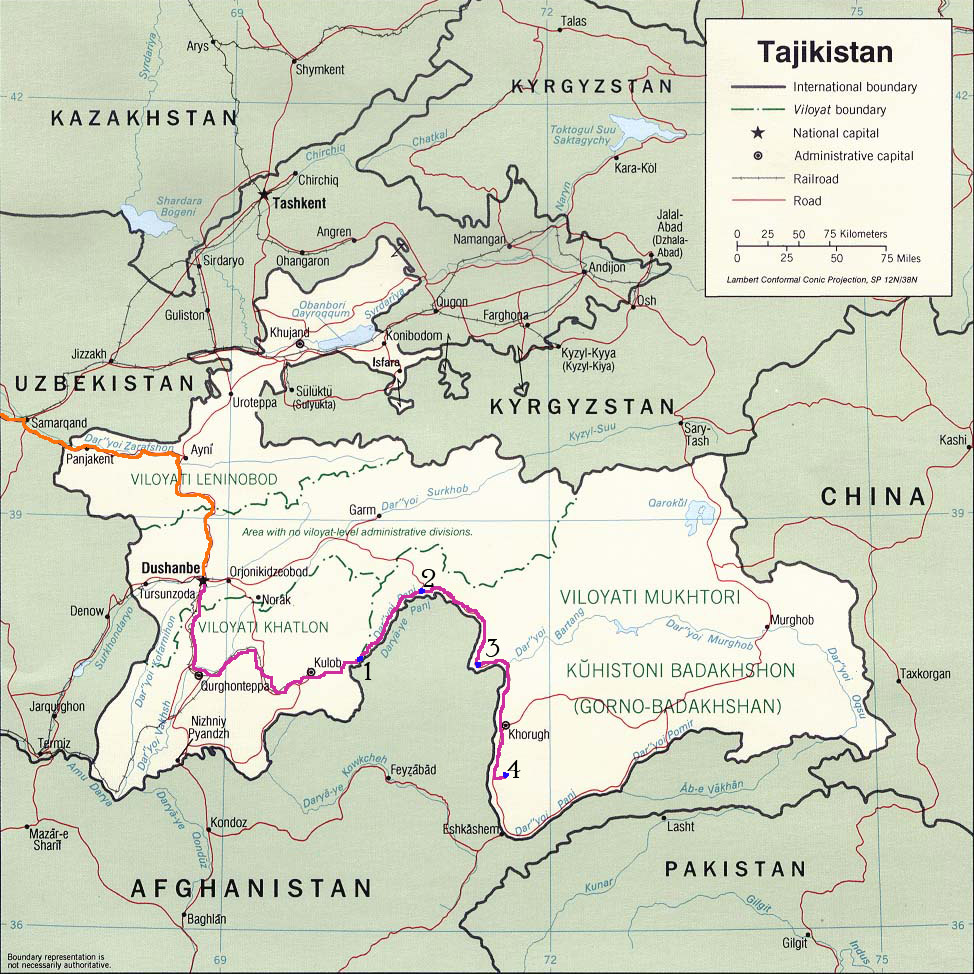
On the map above: the purple line represents the actual route we took to get to Khorog. “1” represents the approximate location of the There Will Be Mud article, “2” is the location of Qala-i-Khumb, “3” is the approximate location of the “Forty Bodies Teahouse,” and “4” is the approximate location of the Hot Springs (Garm ChashMA!). The orange line is the approximate route that we used to get into Uzbekistan.
It’s a been a week now since I returned from my Central Asian vacation, and it’s time for me to stop backdating my entries and set the clock on the blog properly. I’ve been doing some rereading and poring over my old travel entries from my time in Britain in summer 2007, and noticed that they were all much shorter, and without pictures. That probably explains why I was able to easily keep up with day-to-day activity then – in the time since then, my blog has just had its second birthday, and my family and friends’ expectations for my blog has increased. It’s a photography-based internet out there, and 500-600 words of text just won’t cut it anymore.
Besides that, I felt like I had an honor and a duty to uphold to Tajikistan. As the previous blog entry mentions, I’m now an unofficial “Son of Tajikistan” and I want to make sure that this small, proud, and beautiful country gets the recognition that it deserves on the national scope. There are so many opportunities for business and tourism waiting in those mountains and forests; all it needs is a financially-responsible guiding hand a government that embodies the wishes of the people – progress, health, education, and technology. It’s my pleasure to write these copious blog entries in the hopes that readers searching for more information on Tajikistan in particular, or Central Asia in general, can receive an in-depth picture of the area. This means I tried to make my writing honest to my opinions on the country: strong, beautiful people with a fervent wish for progress in their new country, but a corrupt and ineffective executive government that takes the worst aspects of Communism and Capitalism and twists them into a beast in which change and hope die in their infancy.
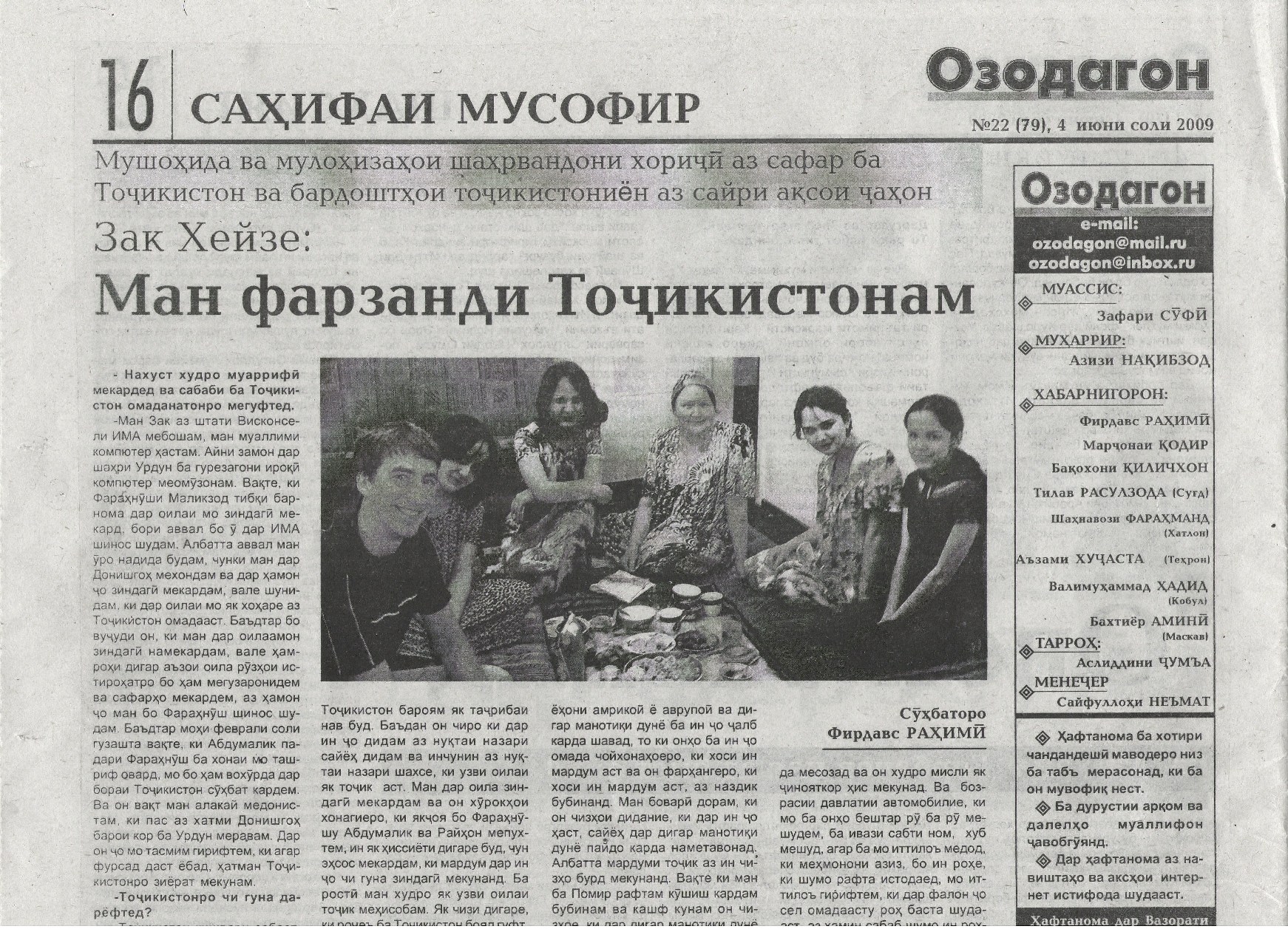
Speaking of me being a “Son of Tajikistan” – below is a scan from Farahnush of the newspaper article they wrote about me. Of course I’m unable to read it but apparently it was entirely unchanged from what I said – the good and the bad alike. I can’t believe they wrote so much about me, and at the bottom of the second page (which is located here) I’m told it says “to be continued,” I guess they really liked what I had to say.
Ман фарзанди ТоҶикистонам: I am a Son of Tajikistan
And, you know, this is happening all over the world. Dozens of countries around the globe suffer daily with outrages and injustice, media suppression, taxation, and emigration snafu. Certainly, Tajikistan isn’t in the same league of difficulties as Palestine, Iraq, the Congo, Darfur, or North Korea, to name a few. But therein lies the problem. A good dictator like President Emomalii Rahmon knows that the key to a successful power consolidation is to be low-key and non-expansive. As long as he doesn’t try to overstep his boundaries of the little country, he can get away with essentially anything he likes and the International Community will overlook it, remaining more concerned with other things. I didn’t speak with a single citizen of Tajikistan who felt that their president had their best interests in mind, or that Tajikistan was seeing the post-Communism changes that it deserves. But most remain hopeful that their future could get brighter if governmental changes were made – not just in Tajikistan, but in many of the former-Soviet countries. For example, President Rahmon has been able to remain in power indefinitely so far thanks to his modification of the constitution that allows him to run, and rerun. He imprisons or exiles political competition when it appears. Such things are apparently so common to the jaded eyes of the United Nations that this isn’t even worth investigating. Yet here the United States is, continuously pouring money into a war into a war in Iraq that Obama cannot control (his military staff says one thing to him, then under their breath says another) and working as Israel’s lapdog to fund a slow but steady genocide against the people of Palestine. Your tax dollars at work. If a large percentage of that was put not into war, occupation, and weaponry but instead research, unbiased news, foreign aid, and diplomats to help Tajikistan and all the others like it, I think a lot more people could sleep more soundly at night. Okay, I’ll get off my soapbox – for now.
So what are some of the differences, similarities, and things that surprised me in Tajikistan?
After my experience two weeks earlier in the shining-yet-expensive-transportation city of Istanbul, Turkey, I made the solemn vow on the flight from Dushanbe to Istanbul that I would simply not go over twenty dollars, or about thirty Turkish lira, for my day in Turkey. To put it more simply, I couldn’t – I was down to my last $20 and I really didn’t have any idea how much I had withdrawn from my bank account while in Tajikistan. I was kind of a little worried to look, in fact. But I still had a fresh, crisp Jackson in my pocket and 10 hours to kill. I slapped my banknote down on the exchange counter and proudly received two notes in return, a twenty lira and a tenner.
So what to do? Thanks to my mother’s advice while I had been in Tajikistan and the remarkable online guide to everything in Turkey, I knew that there was a subway/metro transport system, somewhere in the bowels of the airport, that for about 2.8 lira could get me all the way to the Sultanahmet’s vicinity, and the same fare would take me back to the airport as well. A slightly better deal than the 90 lira “deal” that shifty Murod and Co. had whipped up for me two weeks previously. If I had seen any of that group on my way to the lower levels of the airport, I would have gladly taught them a few choice Arabic phrases.
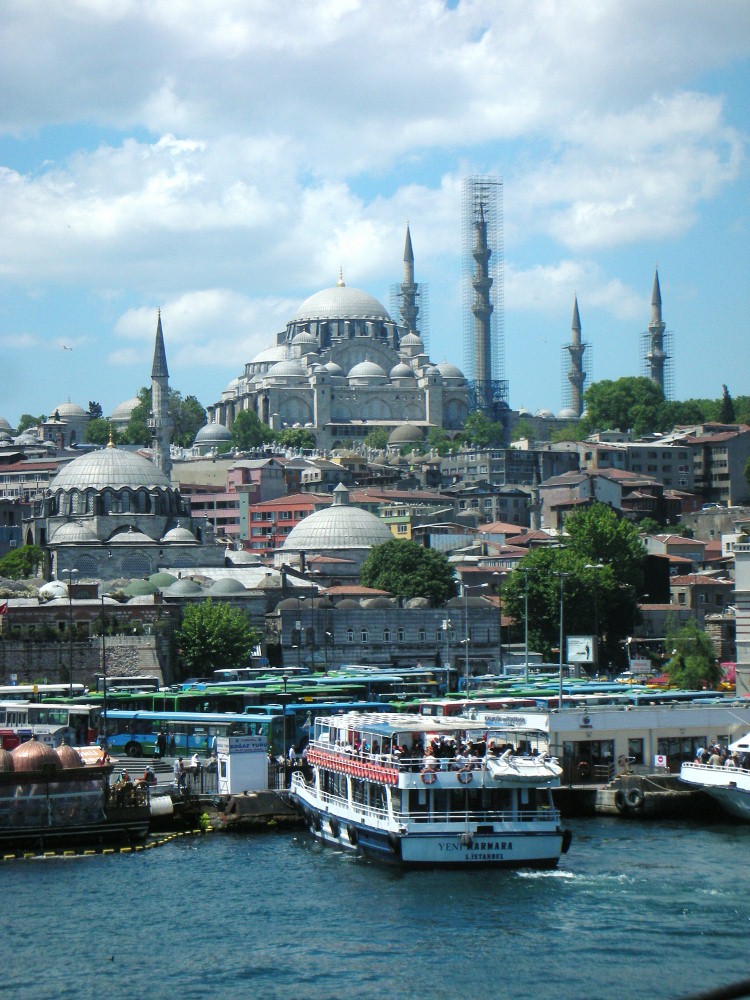
In Istanbul, they know how to make their mosques: icicle minarets, domes galore, stack 'em high
The clearly-marked, clean metro rail smoothly carried me exactly where I expected to go – the Eminonu bridge just beyond the Sultanahmet Mosque and the Hagia Sofia. I wandered across the wide bridge, cars and metros buzzing past next to me. Just like the previous time, I was in awe of the towering, majestic mosques with their flying, no, soaring buttresses and domes that are built so close together that it’s almost like they’re on top of each other. I stared into Bosphorus Strait at the specks of buildings in the distance and pondered the best way to find a boat across that wouldn’t cause me to go over my self-imposed budget. As I looked around for inspiration, I caught a glimpse of a tall, interesting-looking tower in the distance on my side of the strait. Shouldering my pack, I started up the hill for it.
What could it be?
It turned out to be an ancient watchtower, the Galata Kulesi, billed as the “oldest tourable tower in the entire world.” Whether you’re counting the original wooden structure built in 528 AD as a lighthouse or the stone tower built in the same place in 1348 makes a big difference though, I suspect. I paid my 10 lira entry fee, noting with wry amusement the now-familiar ploy of non-English-speaking tourist locations to write out the price numerically in English (“This is 10 lira entry”) but above it literally spell out the price, in Turkish – in this case, beş, or “besh” as we’d say it, which means “five lira.” I got used to this technique in Petra, where the price for people who read English is 22 dinars, but for Arab-reading nationals of Jordan, 1/22 of that price. As far as I know, America has never charged different prices for different nationals for tourist locations…has it?
The view from the top was great, although a little cramped. The little walkway around the top had been almost entirely removed during renovations, which I cynically believe was to make room for the bar and nightclub that now occupy the top floor. Something tells me the Turks can make a lot more money from selling 8 lira glasses of beer and 20 lira glasses of wine in an evening than selling their tickets. But no matter – I was happy to be able to walk in a full 360 degree loop to see the cityscape laid out for me. One moment, I was looking into Asia, the next moment, back into Europe where I was currently standing. The experience was slightly marred by some American tourists, a group of maybe a half-dozen college-aged women who continuously complained to their guide that their feet hurt, that the air smelled funny, and that they wanted to go back to the hotel and watch TV. What a long way down to fall off the side of this tower, I mused thoughtfully.
I left the tower and its expensive refrigerator magnet souvenirs behind, and meandered back towards the Golden Horn Strait (the Bosphorus’s little brother that I had just walked over). A street vendor offered me a gyros/schwarma-like sandwich stuffed with lamb meat, which I thought I was accepting for three lira but found that the price written on the wall behind him had magically become 4 lira in the 15 minutes while I sat and ate. Rolling my eyes, I paid the man – I figured I had walked into that one and I should have expected that to happen to me here in Istanbul.
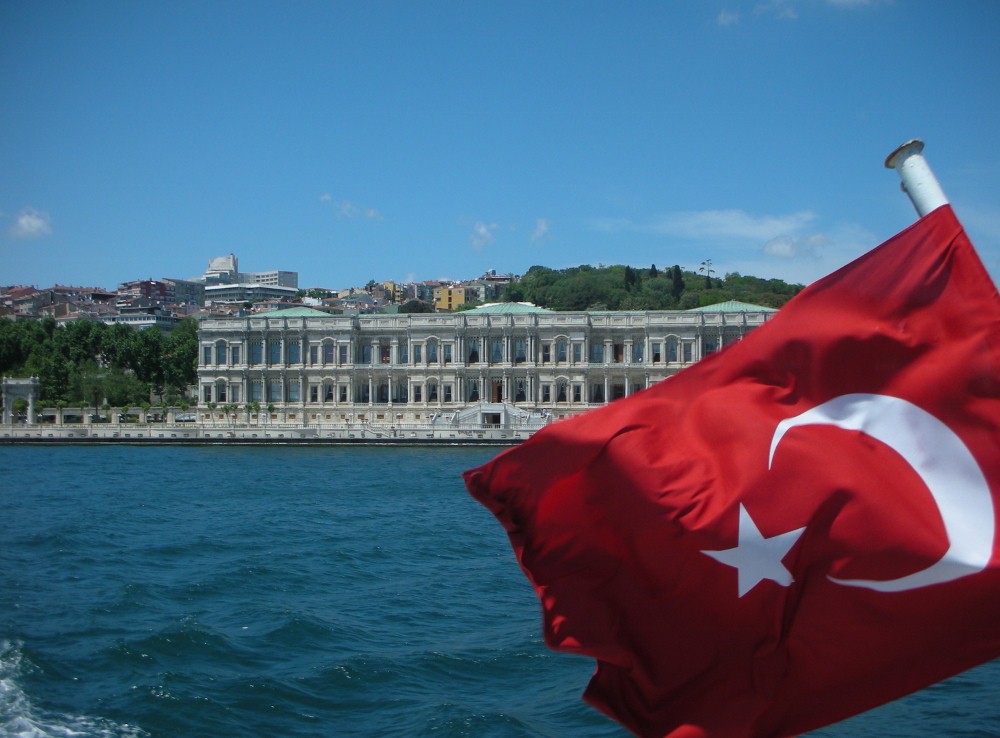
Checking my watch after lunch, I saw that I still had a good 3 hours left before I should try to return to the airport. I paid another 2.8 lira for two ferry tokens, the basic transport ferry which left every half hour. Frankly, that was the best part of the day right there – I rode up the Bosphorus for 45 minutes, snapping pictures of the luxurious houses and villas along the coastline on both sides, and under the huge steel suspension bridge with tiny beetle-like cars flitting over it high over our heads. If only I had brought my sweater with me, it would have been perfect; the air got quite chilly for me in my t-shirt.
Yes, those are some fine villas on the strait's coast.
When we arrived with a bump at the Çengelköy port on the Asian side of the strait, I stretched happily and offhandedly mentioned to a woman nearby me that it was the best lira and a half that I had spent. She snorted and said, “Not such a good deal if you paid 60 lira.” I gaped at her while she explained that she and her husband and daughter had each paid 20 lira to take the scenic guided tour along the coast, but at the dock the handlers had (apparently) directed them onto the wrong ferry and now their dated tickets had expired. They were understandably displeased, and as I chatted with the three of them, we realized that we had all detected a palatable level of distaste for Americans here in Istanbul. I was surprised, almost dumbfounded – in all my months in the Middle East, I had never felt like I was disliked just because of where I came from, but here in the European cultural center of Turkey, I realized that these three tourists were right – there was a careless, generalized dislike of Americans that I could see in everyone’s eyes. Sure they liked our money, but it was a case where few would help you or give you advice if you were about to, say, waste 56 lira by climbing onto the wrong ferry. I sadly sipped at a 2 lira can of Coca-Cola and stared out across the strait back at Europe. I missed Jordan, Tajikistan, and America all at the same time, and felt very alone.
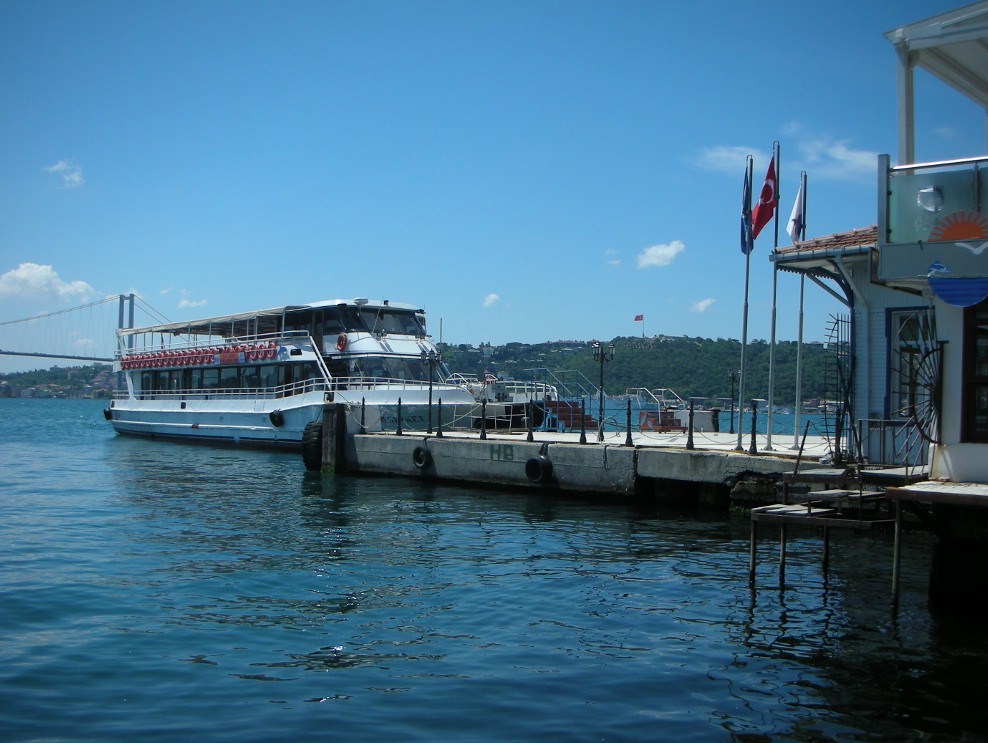
Waiting for the ferryboat to be ready, with the suspension bridge in the background
After half an hour of watching the boats glide across the water, the same ferry that had carried us few passengers across in the first place was ready to head back. I used my second ferry token and joined the three Americans for the return trip, where they sat somewhat morosely and sipped at tea served by a jovial attendant. I bought a 5 lira can of beer from him, and drank it slowly while I read my Dune book, the chilly wind playing with its pages. The boat was almost empty: like the vendor in the Kaplicharshi had told me two weeks earlier, this was the dry season for tourism and there were few tourists or natives willing to bother with the scenic ride when there was a bridge right over our heads.
Same as it had that morning, the ride back to the airport in the metro was smooth and uneventful: a good end to an action-packed two week trip through three different countries, and along the river bordering a fourth. Checking through my wallet and funds, I was pleased to see that I had succeeded in my financial goal: I had spent 29.60 lira for the day’s activities, staying under my goal by 40 kuruş (cents).
I was tired enough that I requested coffee several times on my last flight back home back to Amman, but I made good on my (other) promise to myself to finish the last book in the Dune trilogy somewhere over the Mediterranean Sea. I was entertained by my seatmate, a buoyant young Danish archeology grad student who was on his way to Jordan with his classmates to study the ruins of Jerash, who was overjoyed when I shared my photos from my previous trip with him and was practically dancing in his seat, exclaiming in his accented drawl that he couldn’t wait to land and get started. Suddenly, he got a worried look in his eyes, and he leaned conspiratorially towards me over the armrest and whispered, “What do you think the gay scene is like in Jordan? Am I going to be okay, or are people going to try to beat me up?” I assured him of his safety and helpfully tried to give him the names of a few gay bars in Amman, trying to remember them as the ones that Haitham had once told me “NEVER GO IN THESE PLACES.” Just like the fact that there’s no drinking age in Jordan because the government refuses to acknowledge that anyone drinks alcohol in Jordan, there is no official policy on gay bars either because people prefer to put their fingers in their ears and sing loudly when the topic comes up.
At around half past ten, the plane touched down in Jordan and I was home, back in my familiar desert with my familiar procrastinating bus system that took another two hours to send a bus to the airport to pick up the assembled crowd: me and one other person. The owner of the company had even driven to the airport, apologized to me personally for the wait, and proceeded to yell obscenities at his drivers through his mobile while shaking my hand repeatedly and thanking me for coming to Jordan. Ahhh, Jordan. Lord knows you drive me bonkers sometimes but I love you anyway. It’s good to be home.
So will read the headline of an upcoming article in one of Dushanbe’s major newspapers, after Malik requested a meeting between me and some local reporters to ask me about what I thought of Tajikistan “from a tourist perspective.” They got more than they asked for, though – after I described my close, familial connection with the Malikzod family, they told Malik that they had already come up with the aforementioned headline for the article. The interview took about an hour, and took place in an old, foreboding, dimly-lit building with creaking doors and elevators that in America I would have described as “Soviet-esque,” but here in Central Asia, it would be because it was built by the Soviets for news and radio purposes decades ago. Malik handled all the translations of the reporters’ questions and my responses, which were recorded. They asked me questions pertaining to what I liked and didn’t like in the country, causing me to wax eloquently on the beauty of the mountains, rivers and people, but against the corrupt and stubborn police system. I half-wondered if my comments would be edited by the “establishment,” namely, the unpopular President Rahmon and his goons. I guess I’ll find out in a week, when and if it is published.
The last couple days of my stay in Tajikistan were bittersweet. The previous day, after my return to Panjakent to the joyfully exuberant Raouf and his company of friendly archeology employees, Malik and I went hunting for pheasants and drank even more vodka with Russian businessmen who were visiting Raouf. We got a tour of the archeological sites themselves, 4 small squares of uncovered earth protected by huge metal shields erected over them. The shields guard ancient buildings made of mud and early brick, estimated to be between 6000 and 5000 years old. Raouf, as the curator and chief archeologist, showed us the pots and weapons over the dinner of cooked pheasant with osh, and laughed uproariously when I wore a 4000 year old cracked piece of jar on my head. Perhaps we had had one too many toasts of vodka, but the brotherly fellowship of drinking in this part of the world is just too welcoming to turn down. I drank what was offered to me, mindful of the fact that in just a few days I’ll be back in Jordan where the strongest drink easily at hand is in a teacup with an extra Lipton bag in it!
It's hard to be taken seriously sometimes.
When we returned from Panjakent late that night with Shirehlee, I knew that this would be my last day in the country and I wanted to spend it with my little sister. Without her, I’d never have had the slightest of chances to spend this much time here in Tajikistan, and with so much care and kindness. At my suggestion, Farahnush took me to her university a few blocks from home so that I could meet her friends and see what things were like. She was initially shy about about it, but I pointed out that I completely understand that this is a country that was only recently released from the grip of civil war and Soviet rule, only about 15 years ago – I wasn’t expecting to see Yale! Interestingly enough, I was given permission to attend her class on International Business, where I watched one of her classmates give a presentation, in English, about creating a motivational class for underclassmen. He introduced the lecture with, “Thank you for attending, to my teachers, my fellow students, and our guest from America.” I tried to imagine myself giving a speech in Arabic or Tajik, much less in front of people, and found my mind boggling at that sort of guts. I’m just too lazily comfortable with speaking in English, and having Wamidh as my translator, I guess.
Farahnush shows off the main courtyard for her school, the Technological University of Tajikistan (TUT)
Farahnush’s classmates were very friendly and polite to me, although some did give me some curious stares, and the administration obviously thought that she was trying to sneak her boyfriend into the school and shot disapproving looks at us as we walked about the campus. I mean, I clearly wasn’t biologically related to Central Asia, although I mused about how I’d fit in if I just tanned a little bit more and dyed my hair black. But there were no problems getting into any of the classes that Farahnush took me to, and indeed several of the students thanked me for coming. Of course, it was my pleasure – I only wished that the school’s administration gave these young adults more credit for their intellectual ability. Several times, it seemed to me like the students were more likely to show up and do their job than the teachers were, which is a disservice to the hard work that the students are trying to put in.
Before venturing back in the direction Akbar and I had come the previous day from the Tajikistan border with Uzbekistan, I awoke early in the Komil hotel to have some breakfast in their 19th-century dining hall, a stone-walled museum piece of a room with high windows, a tall arched ceiling, and deeply-carved etched stonework along the other wall. I ate with 4 other tourists from America, a middle-aged oil worker named Ray who was on vacation from his contract in Kazakhstan, and his three sons: Zach, Josh, and Jonathan. And no, I’m not kidding about those names, although I didn’t tell him about the wild coincidence that all four of them had the same names as my nuclear family members. I had to eat quickly so I could check out from my beautiful hotel room and meet Akbar at the gate at about 8.
On our way out of town, I asked Akbar to take me to Emir’s summer retreat, the simply-named “Summer Palace” that he used to escape from the invading Russians when they stormed Bukhara, by using an underground passageway from the Arq, his main palace. Although I didn’t see or find this passageway (as most of the place was unfortunately closed to tourists) I did see a dozen beautiful peafowl, completely accustomed to human presence that allowed me to get within a meter or two of them before haughtily stalking off. I had first heard their loud, haunting calls while walking through the main hallway of the palace, which reminded me strikingly of my trip to Versailles over six years ago when I was in high school. A guard followed me about closely; it was early enough in the morning that I was actually the first tourist to arrive and he was curious about me. He was doubly surprised and curious when I spoke to him in my bad, heavily accented Tajik. I think the Bukharans and Samarqandis figure that most tourists would try to speak to them in Uzbek instead of their colloquial language of their ancestral homeland, but I had the advantage of my native family back in Dushanbe.
This fellow couldn’t have cared less that I was standing in front of him; how very regal.
It wasn’t until we drove through the main street of Samarqand two hours later that I realized that I had been here the previous day. I stuck my head out the window into the warm morning sunlight (those precious few hours before it starts baking like apparently everywhere else in Central Asia) and stared at the round, lumpy mass of the Guir-Rukhabad, or “Grave of the Little Soul,” a brown ziggurat that held the remains of a famous Islamic scholar from the region, and supposedly a single hair from the head of the Prophet Mohammad himself. We didn’t stop here; not yet at least. Akbar wanted to get me to my hotel, another boutique which although as not as old nor fancy as the Komil was larger and even had air conditioning. Air conditioning! This is not a commonly used thing either in Jordan or Central Asia, and I spent five minutes just standing in front of it as I dropped my bag off in the room.
I went back to the lobby to meet my new guide for the city, a bespectacled, respectable, white-haired gentleman who coincidentally was also named Akbar like my driver. “Greater and greater!” I said, in reference to the Arabic translations of their name: Akbar means the biggest or the greatest. Akbar had been a tour guide for about 30 years, and before that a reporter, so he knew his way around Uzbekistan like it was written on his eyelids. The two Akbars drove me to the center of town to the most famous and picturesque location in Central Asia: the famous Registan Square which holds three famous 700-year-old madrasahi. After we left the young Akbar behind with the car and a soft drink, the elder Akbar and I toured each one of them in turn, taking pictures everywhere as always. Akbar was delighted to hear that I was from Jordan and that I could speak a little Arabic, but seemed even more excited to think that I would have friends who could read the hundreds of intricately written words set in tile on the walls of each building, and urged me to take as many pictures of them as I could for later translation.
Madrasahi from left to right: the Ulegh Bec, the Tillya-Kori, and the Sher-Dor
I noticed right away that these three madrasahi had very small entryways everywhere, not just because people were shorter 700 years ago but also because the architect preferred that people would have to bow their heads in order to enter a room, a sign of respect to those already present. Inside, the recently-restored rooms were neatly whitewashed like they would have been then – any sort of decoration would have been distracting to their meditation and contemplation of the Holy Qur’an. Inside one of the buildings, I was allowed to climb one of the minarets (for a small fee of course) and poke my head and upper body out through a hole in the roof, 40 meters above the ground, to give me a bird’s eye vantage point on the other two madrasahi. I sat up their for a while, photographing the panoramic spread before me and the silver lids of the city’s houses in all directions, but the burning sun had turned the silver lid I was sitting on into a hotplate and I couldn’t sit up there too long before I had to retreat back into the cool darkness of the minaret’s rough stone walls. My best shots were of the ridged domes of the Sher-Dor (Having-Tigers) Madrasah to the right, which were so vibrantly colored and shiny that they looked like electric blue popsicle, glistening in the sunlight. Not the most respectful description, but on a day that hot I definitely meant it reverently.
I can’t help that it looked like a popsicle, or ice cream. It was really hot out!
All three of the buildings were laid out the same way, and had been built within 100 years of each other. The insides were not nearly as interesting as the outsides – the same pretty internal courtyard with large mulberry trees and vendors setting up shop inside the rooms that had once been the student dormitories. Where were the classrooms, though, I asked. Akbar gestured around the inner courtyard and said, “this is it!” It made sense – because of the high heat, it wouldn’t have been practical to be in a roasting classroom all day when they could just teach outside and students could just sit around their scholarly masters. Each madrasah of course had its own mosque at the back of the building, in various levels of restoration completeness. By far the most beautiful one, however, was in the central madrasah, Tillya-Kori which conveniently had been more of a mosque than a school. They had used 5 kilos of gold to restore the gilding inside the dome’s roof, and it had taken them several years just to complete the relatively small 20-meter high space because it was so complex. A Russian women in the Tillya-Kori sold me some Uzbeki silks, which made sense to me since were on the Silk Road, after all.
I asked Akbar if they were worried about the gold being stolen, but he told me it was all at the top of the dome and would take quite the ladder to reach it
After the 8 hours spent along the banks of the Panj River waiting for a mudslide to be cleared, I should have expected that there would be a good chance I’d see more of the same, and I was right. Malik and I were on our way towards the Tajiki city of Panjakent with our hired driver Shirehlee (yes, it is very close to how we’d say “Shirley”) through the snow-covered northern mountains when we were waylaid by a Chinese road construction team for four hours, joining yet another convoy. I thought I would be done with convoys! But such is life – the problem is that the Chinese building group had no idea when they’d be done, or when they started, or when they might stop, and even worse is that this isn’t communicated through any centralized radio network that a driver can tune into. As it was just the two of us and Shirehlee, Malik stretched out in the backseat and napped and I read the final chapters of the last book in the Dune Trilogy that I had gotten for Christmas, six months earlier.
The light and shadows through the rebar tunnel construction made for some interesting mountain scenery
When we at last rumbled into Panjakent at close to midnight, we were enthusiastically greeted by Rauof, the director of the Panjakent archeology facility and a very close friend of Malik’s. He entertained us late into the night with stories about his years working in Paris with such joviality and camaraderie that I thought for the first hour that he must have been Malik’s old university roommate or something. He poured us shot after shot of vodka, downing them all joyfully and with exquisite toasts to our health and families, his fluffy mop of salt and pepper colored hair bobbing erratically, giving him the look of a Central-Asian Andrew Jackson. His driver sat near by, a quiet young man who worked at the archeology excavation site just a few kilometers outside the city limits of Panjakent. Rauof and Malik offered him drinks, which he quietly declined – probably best for his employer’s safety on the ride home!
Our intention was to enter Uzbekistan by 9 in the morning, meet our tour guide at the border, and be in Bukhara just after lunch. However, disaster struck us at the border: the Uzbek guards refused to let Malik enter the country, saying that his official visa pass was not enough and in order for him to use this particular border entrance, he needed to have special faxed documentation for a travel necessity – random tourism of Bukhara was apparently not enough of a necessity. The problem is that the Uzbeks and the Tajiks dislike each other on principle, and the governments of each country even more so. The two border facilities on each side of the no man’s land, for example, weren’t even on speaking terms with each other. To make matters worse, the southeastern corner of Uzbekistan that contains the most famous cities and landmarks is essentially a part of Tajikistan because the majority of the people there identify as Tajik, including speaking Tajik instead of Uzbek languages! This is a sore idea for the Uzbek government which enjoys receiving loads of tourist money from these cities and certainly has no intention of returning the region to Tajikistan just because the inhabitants are Tajiki. It passed laws on those borders saying that neither Uzbeks nor Tajiks can cross that particular border there. Malik didn’t know for sure, but he speculated that it was because the Uzbek government is trying to prevent nationalist feelings of uprising or secession in their Tajiki holdings by limiting their access to Tajikistan, and vice versa. Whatever the case, I knew that I couldn’t just throw my $200 visa away – we still had our tour guide waiting for us, after all. I bid Malik a sad, worried farewell and took my first unguided, untranslated steps into Uzbekistan alone.
I was met by a thin, dour-faced young man named Akbar, a Samarqand native who would be my driver for the next four days. He spoke only a little English, and was a little put-off by the fact that I arrived alone, fact he communicated to me with his questioning sign printed with Malik’s name. Although Malik had written a note for me in Tajiki (which all Samarqand natives speak) for him, he still needed verification of this from the tour guide office before we could begin our four-hour drive to Bukhara.
Here so close to the border with Tajikistan, the villages and towns our white Chevy sedan passed through were quite similar to those that I’d seen for the past week, but the obvious differences were in the language – the official language of Uzbekistan uses the Roman alphabet instead of Cyrillic, and in fact looks and sounds a lot like Turkish. Good thing I’m now an expert on Turkish after my one day in Istanbul. The other very noticeable difference was in the mountains or lack thereof: after moving away from the border, the land quickly flattened out until everything looked like Wisconsin farmland as far as the eye could see, the mountains merely vague shadowy pillars on the horizon behind us.
By far the most surprising stop we made was in the middle of Samarqand, where Akbar got out, instructed me to wait a moment, and returned with a stack of money so large that I assumed he had robbed a bank and I was now an internationally-wanted criminal. It wasn’t until later that I learned that the Uzbek form of currency, the СУМ (or as we’d pronounce it, the saum), is extremely unwieldly, and goes by a base of 100 saum, with their largest note being only 1000 saum. This means, of course, that a lunch might be 7,000 saum, and a hotel room might be 30,000 saum – which would mean 7 or 30 notes. That 15 centimeter stack of notes that Akbar stuffed into the glove compartment next to me would only last a few days.
Before reaching the city, we stopped briefly at the workshop of the famous ceramic, pottery, and linencraft artisan, Abdullah Narzullav, who solemnly led me around his workshop, firing kiln room, and of course provided Akbar and I with fresh tea, berries, and nuts in some of his handmade ceramicwork. I learned that his family had been working in pottery for 6 generations, and when I looked over at his wall of photographs, I saw pictures of him presenting Queen Elizabeth and First Lady Hillary Clinton with half-meter wide plates, as well as a signed letter of thanks from Ms. Clinton. There were many other royalties there, like a prince of Saudi, but no one else I could name off the top of my head. I looked at the quiet, sedately-smiling Abdullah with new respect, and bought a few small items that I could fit into my luggage.
Abdullah with two of his beautiful potteryworks. It's like meeting a Ceramics Celebrity!
In only a half hour more, Akbar had deposited me at the front door of the Komil Boutique Hotel with a promise that he would pick me up the next morning at 8. The owner of the hotel was aptly named Komil, a young man only a little older than myself. Apparently, this hotel had been his family’s house for generations, and after he became the man of the house, he decided that the home’s beautiful carvings, both in stone and wood, were too beautiful to be kept to himself. Check out some of the pictures from his website, and definitely keep them in mind if you’re ever in the area. Komil told me he had called my guide and she was on her way here, giving me a half hour to shower and change after my long car ride.
After arriving back in Dushanbe in the early afternoon and being fussed happily over by Reyhon who was happy to see us safely arrived home, Malik and I went to the Uzbekistan embassy in Dushanbe to pick up our visas for entry to Tajikistan’s neighboring country. Because of some changes in my travel dates, I needed to request “rush” processing (which means they stamped it right away instead of waiting for a day and then stamping it) which at an extra ~$40 brought the total cost to exactly $199. Ouch – Uzbekistan is not a cheap place for an American to visit! Malik and his Tajiki passport, however, only had to pay the extremely reasonable $8. One thing’s for sure, I’ll never complain about Jordan’s 10JD (about $15) ever again!
Before Malik and I left for Uzbekistan the next day, I wanted to go and see Dushanbe’s technological pride and joy – an internet cafe that was gifted to the city from their sister city in America, Boulder Colorado. I saw the 20-year-old gift from Dushanbe last summer while Farahnush was living with my family, which is an ornately carved and beautiful teahouse built by master Tajiki craftsmen. The new internet cafe was scheduled to be opened in late 2008, and was indeed the subject of a grand opening party in September, but it continues to sit empty of computers and customers. Farahnush confided in me that as usual, lack of communication between the government and other parties involved (or the necessity for bribes) had stalled the project.
The cybercafe was tidy and brightly lit by massive window panels along all the walls. As we entered, a single man, surrounded by empty bottles of vodka and a hunting knife, rose from one of the two tables in the main room and greeted us. As Farahnush translated for me, we learned that he was a Russian building guard who had been watching the place for months. Upon learning that I was an American, he plaintively asked me whether I knew how to connect solar panels, or whether anyone could find out for him if he was going to get paid again. Apparently, he hadn’t received a paycheck in months and was going through a couple bottles of vodka a day (as we could tell; he was having difficulty standing and it was only 9 in the morning). However, he was happy to have someone to talk to, and explained how the building would be functioning, if it had electricity. Apparently that was the main problem: no one knew how to connect the large solar array outside the building, to the panel down in the basement that was supposed to feed the plugs for the computers. The state-of-the-art computers themselves were nowhere to be seen, but the Russian assured us that they were “in a safe place,” which we can only assume meant in the basement and behind his large, extremely effective-looking knife.
Within the cafe, a guard awaits any intruder with a vodka-powered hunting knife
Not only is there the internet and cafe sections of the building, but behind the central island pictured above, there’s also space for a small library, complete with comfy-looking black overstuffed chairs and cozy little nooks under low-hanging ceilings. There’s also a meeting room beyond that (close to the small window pictured to the right) that perhaps could be rented out to organizations looking for a good place to discuss things that need a handsome, brightly-lit environment.
The guard told us that some members of the Tajiki government and business had offered to buy the beautifully modern-looking building and turn it into a bar. However, the Americans in charge of the project had of course, refused, at which point Farahnush interrupted her translation with a “thank God.” I definitely agreed – a building like this would be excellent for Tajikistan’s burgeoning young population as a friendly hangout and place for them to have a high-speed connection with the rest of the world. However, it was sadly obvious that no one besides the guard and the occasional tourist had paid much attention to the place in the intervening months since September 2008; weeds and grass grew wildly through the cracks between slabs of new concrete outside, and the infinity-shaped pool in the back sat dry and dusty. Hopefully the Tajiki government finds a skilled electrical contractor and gets those power panels hooked up soon.
Come on, Tajikistan! This beautiful place needs power and some customers!
UPDATE: Breaking news from the Boulder-Dushanbe sister cities program! Apparently they just found an operator for the internet cafe and it will be opening up in only a few weeks! Details here from a local Boulder newspaper.