HeiseHeise.com

The Personal Blog of Zach Heise

Campus Antiwar Network Summer 2007

A random image. Reload page for more. Want more info?

Category: Morocco

  • Blue down the west coast

    The final phase of our vacation in Morocco had begun. With Nicole and Connie safely on their way back to the USA, our travel group was back down to the family group, same as it had begun a week and a half ago. Our next destination was the incredibly famous, highly photographed “blue city” of Chefchaouen. Mom mentioned that she was pretty sure it was on the cover of all of the ‘visit Morocco’ guidebooks she owned, and pictures of the city may have even played a part in creating her initial wish to visit the country over a decade ago. So, good work Chefchaouen; you’re a beacon to tourism for the nation.

    On the drive north, we stopped at a roadside stall to buy some (blue) trivets made from repurposed, spun plastic bags. Both Betsy and mom were wearing blue too! With a blue lake behind us! We’re blue!!!

    Part of the journey involved stopping by the ancient Roman city of Volubilis for a couple hours, one of the best-preserved examples of Roman influence on the south side of the Mediterranean. Omar said that Odynovo Tours had subcontracted this part of the trip to a local guide, Amarad, who lived in the nearby village of Fertassa. Amarad’s command of English wasn’t great, but he was enthusiastic in his descriptions of the various surviving Mosaics that had been unearthed over the past couple centuries before the site reached UNESCO status. Almost no trees were allowed to sprout up in the extremely low ruins so the November sun beat heavily upon us. Apparently a lot of the Roman stones had been repurposed by various rulers over the centuries to build the city of Meknes a couple dozen kilometers to the south, explaining why the surviving city ruins were “knee high.”

    Amarad overlooks the city’s low-slung ruins
    The tallest, overall largest surviving structure on the site is the Basilica

    We reached Chefchaouen in the early evening as the sun was starting to set. Nestled into the hills between two mountain slopes, we examined it from one of said slopes alongside a small tour bus of about 20 Asian tourists. From up here, it didn’t actually look that blue and I wondered where the heck the pictures came from; I was expecting to crest the hillside and look down onto a town that might as well be as blue as the sea. Omar explained that it was further in (here he gestured to a section of town in the northeast corner of the city) that they painted everything blue, and it was difficult to see from here.

    Without planning it at all (I actually forgot we were going to a blue city when I got dressed this morning) we all were wearing somewhat blue clothing!

    It turned out that our big Mercedes touring minibus (large van?) was not allowed to go into the old city where our hotel was, so Omar flagged down a couple of taxis to take us and our luggage up the narrow streets to “Vanci Hotel” where we’d be spending our single night in the city. In comparison to the Palais Faraj or Ksar Ighnda, it was a bit of a step down, but Odynovo had warned us that here in the high-tourism season of November, hotels in Chefchaouen booked up incredibly fast and this rather middling hotel was really the only place left that could accommodate the four of us in 3 separate rooms. As we were checking in, a group of 30 Asian tourists flooded into the lobby, led by a Moroccan guide. I can’t find any news articles about this but it was quite interesting actually; of course we had seen other tour groups on our trip so far, but here in Chefchaouen the vast majority of large groups were Asian. I mentioned this to Omar, and he said that he thought it was because traveling outside China had been somewhat difficult before 1978, ever since that point, Chinese tourism had been constantly rising, filled with tourists that were obsessed with taking as many pictures and seeing as much as they possibly could. When put in that perspective, I can completely sympathize that they finally were free to travel and therefore, wanted to make the most of it. Maybe there was also a worry that perhaps the Chinese Communist Party will take their freedom away again at their whim someday too?

    Omar met us the next morning at the hotel at 8am to begin our walking tour. Several friendly local dogs who found us in the first 10 minutes of the walk seemed to enjoy our companionship, playing with a discarded shoe they had found (way to be stereotypes, dogs!) and romping within 20 feet of us for the first half an hour. It was still quiet at this time of morning except for gradually increasing sound of water. We came to the source eventually – a fast moving narrow channel of water that seemed to be used for washing by numerous stern looking elderly ladies. Omar cautioned us not to photograph them (I hope the Asian tourists got a similar memo), and we crossed a bridge over the stream and into the picturesque part of town. Here’s where the souvenir stands began and all* the walls were painted blue.

    Why the asterisk you ask? Well, it seemed like in most cases, despite most of the buildings being 2, 3 or even 4 stories tall, in these narrow car-less alleys we were walking through, the blue color only extended up to the top of the ground floor – the upper areas were left the drab color of unpainted concrete. It definitely helped to explain why the previous day, when viewed from a distance, the city didn’t actually look that blue.

    It was pretty, of course, but felt extremely touristy. In one town square, we came across a group of tourist women in lawn chairs who were simply painting a blue wall and alley. I was getting a rather bizarre vibe from the city by this point – what am I missing??? It’s a city with a lot of blue paint! Is this the best idea to make into tourism or what? I mean, I get that it has a historical background, having been inhabited by a lot of Jewish folks who were forced to flee Europe during the Re-conquest and the expulsion of all non-Christians from Andalusia.

    (more…)
  • Time to Fes up

    The mosaic-coated pillars of our hotel stretched away into the darkness of the night sky as Yaseen unloaded our bags. A trio of brown-suited bellhops, and a duo of black-suited concierges, greeted us at the 10 foot tall gate to usher us into the reception area. Credit cards were solemnly run for ‘incidentals’ and presented back to us with bowed heads and a clearly trained 2-handed, thumb and forefinger grip. This was the Palais Faraj, built in 1911 by a local judge favored by the Sultan as a home for his immediate and extended family – one year before the curtain came down on the Sultanate and the French forced the nation into a Protectorate status. So while it was only a century old, only after I later chatted with the concierge did I learn this, because the judge had a decidedly 1600’s taste in decor, following the yellow/blue/black/green mosaic style we’d seen in many of the madrasas of that time period.

    We were led through numerous sitting rooms, libraries, stepping up and down cautiously in the dim light to avoid tripping over the many small changes in floor height in our path. Some areas had once been courtyards, but all these courtyards had since been covered in glass caps; Fes after all does get plenty of rain, and tourism at a hotel like this demands that guests never sully their dainty heads with wet.

    Since our drive the previous day had been so long, Omar let us sleep in a bit, picking us up after our continental breakfast on the top of the building. Our view looked out over the edge of the Old City, across the Ouislane Valley, and upon the other side framed in the morning mists was a blocky, imposing beige structure called the South Tower. We’d be seeing that later.

    A tight squeeze in Fes’s old city alleys

    For now, though, we’d be starting in the Old City. Omar would be our guide, and he led us down the narrowest alleys and corridors we’d seen yet, sometimes no more than half a meter wide. In some places the 400 year old buildings were practically leaning into each other over the alleys, and needed to be braced with new-looking wooden supports. Omar explained that alleys this small would never have been okay with the municipality of the time, but instead were once a single large house, but then the owner had sold it, and it had been divided into smaller and smaller parcels until only these little practical crawlspaces remained.

    We saw a museum called Nejjarine, a beautiful former inn that now housed three stories worth of “stuff Moroccans have made that is made of wood.” If you can make it out of wood, there was probably some creation of that family in that museum. Musical instruments! Doors! Bridal palanquins! Mosque screens! Weapons! Islamic legal decisions! Toys! Intricately cut and painted shelves! It was quite fancy and all the signs were written in Arabic, English, and French so dad and I could browse inscriptions to our hearts’ content.

    Next was another madrasa, similar to Ben Yousef that we had seen back in Marrakech. This was al-Attarine, and it was similarly beautiful with its mosaics, fresco inscriptions, and carved wood upper areas. One immediate difference I noticed between Ben Yousef and Attarine was in the student dormitory area – while the former’s rooms were darken, with windows only looking back into the hallways, these ones were well lit, with openings in the ceilings to let sunlight pour in (like the Palais Faraj, they had been capped with glass for tourism purposes), and almost, if not all, student rooms had an outside facing window. Omar said that unlike Ben Yousef, which was more of a ‘graduate school’ for students practiced enough to have already memorized the Qur’an, Attarine was made for younger children who could graduate through ‘levels’ of memorizing parts of the Qur’an before the whole thing, and also that there was more competition from other possible madrasas that wanted students, so they wanted to make the student lodgings more attractive.

    We made a couple of stops in handicraft areas; the famous tanneries which are hundreds of years old and a well-known tourist stop. Dozens of pits in a 2000 square meter courtyard emitting a smell that could be described as ‘interesting’ in the politest sense. The entrance was nondescript, a staircase through a tiny door with merely a sign that said “tanneries; looking is free!” A fellow sat on the first landing with a sack of fresh mint leaves next to him, and he smiled as he handed a sprig to each tourist, and gestured to hold them under our noses. Every wall and every passage was covered in leather goods of all types and colors; jackets, belts, and thousands of handbags. Effective insulators, we could barely hear the murmur of the hundred other tourists ahead of us as we climbed and walked through the tangled hallways to find the ‘overlook’ of the tannery pits. The men below had their trousers hitched up to their thighs and were working the leather with their feet. The employee describing the hectic work below mentioned that pigeon dung was used as part of the process too, but the smell at this point was harsh, thick, acrid, and not really describable beyond ‘it smelled like a tannery.’

    Oh honey, do you really need to be posing right over tannery pits in your bright white palazzo pants for your “insta” followers?
    (more…)
  • Morocco’s desert southeast

    I am become… camelman

    Our traveling home away-from-home/hotel for the next 10 days is a black, 12 seat Mercedes van. It rumbled contentedly up the High Atlas mountains, heading east, always east (and usually south) from Marrakech. We had been met at our hotel by Omar, with a close-trimmed black beard and mustache, baseball cap, and well-lined smiling face. A 48 year old freelancer hired by Odynovo, he was partnered with Yaseen the driver, a few years younger than me and also wearing braces, same as I’ve had for the past six months. Yaseen came with the van from a separate company too, but Omar told me that the two of them had worked together dozens of times over the past few years with small private tours. As his regular tour size was 45 people in a full-sized bus, hopefully we represent a less stressful and more relaxing tour for him, too.

    The road we were on heading into the mountain switchbacks were well-maintained and recently paved, and as we paused to take pictures on a mountain vista overlooking the kilometers we had just traveled, I commented to Omar about the strange way the trees seemed to grow extensively on one part of a mountainside to our west, but then stop abruptly in almost a straight line. Omar, like our previous two guides before us, was quick to extol the wisdom of both the current king and the past one – a tree-planting initiative had been created by the monarchy and government in the past several decades almost exclusively using a special type of oak native to the Mediterranean region (I’d never heard of it; the waxy, water-retaining leaves look almost like holly, don’t they?) that would, in time, develop a deep root system, preventing erosion and rock-slides as well as improving the soil quality itself. While not yet everywhere, Omar thought large stands of these trees would eventually cover every public mountainside in the country.

    We had a brief stop at a rug shop, a multi-village cooperative, on the other side of the mountain range. The small, salt-and-pepper bearded Berber sheikh introduced himself to our group as “Ali Baba” and like most of the others we’d met so far, launched into his explanation nee sales spiel with the practiced ease of a longtime businessman. At my request, he pointed to his wall-hung Certificate of Official Cooperative-ness from the government, and said that this shop he ran was owned by a dozen people together, and coordinated the distribution of wool from the widespread (about 50km worth of villages/families) shepherds to the weavers themselves, who mostly work at home, determined what patterns and designs to make this month, etc. There were 2 women working in Ali Baba’s shop while we visited, and he explained that the women would take turns coming in to demonstrate the process to tourists for a few weeks at a time. They smiled shyly at us as they rested from clacking at their vertical hand-looms, and one got up to serve us the ever-present mint tea. I asked them if working for a cooperative was a good job and they glanced at each other, nodded, and giggled. Their Arabic was limited, as they primarily spoke Berber, but Ali Baba helped translate from my English/bad Arabic to them.

    The sizes of the carpets ranged from about a half meter square (“if you are looking for a post card?” Ali Baba laughed as he pointed them out) to the largest he and another male assistant spread before us, about 4×6 meters and intricately designed with lots of tight, close stitches and many colors. Ali Baba said that of course, the carpets made by less-experienced workers would have less-tight/close together threads and one could see more of the plain white “loom lines” (I’m sure there’s a proper word for it but I’m not a weaver) if you nudged the cloth hard with your finger, instead of the colored thread. He pointed to the huge carpet commanding the attention of the room. “This… golden fingered women!” he laughed, and gestured to a smaller piece that was off to the side, pulling at the threads. “This is copper fingers! Just starting out, but if she has patience and practice, she will get there.” Apparently all the weaving itself is done by women (“you know, ladies – men have no patience, right?”) but the shepherding and related farm work is done by the men. Unlike the women’s pharmacy cooperative in Marrakech, this was a holistic cooperative with work distributed between the two sexes.

    Ali Baba displays the rug he just sold this smiling tourist

    Lunch was at a heavily trafficked tourist restaurant in the village Ait Ben Haddou. Ait is a Berber word for tribe, so the full name is “The tribe of the sons of Haddou.” There were at least 3 busloads of people swarming about the numerous tables, and equally numerous, harried looking staff – lunch options were a prix fixe sets of soup/salad + pizza/tagine/couscous + fruit for dessert. Omar and Yaseen (we would learn now, and continue to see over the next few days) would generally not eat with us, disappearing elsewhere during meals and Omar would reappear magically just as we were ready to stand up. Therefore although we could see a tall hill to the northeast with a small structure atop it, and people walking all over said hill, we had no idea what it was. We knew there was supposed to be a centuries-old village, created from carefully daubed and packed mud and cane that was what we were visiting, but it wasn’t visible from this side.

    After lunch, our three companions decided to head straight to the hotel, so my parents and I had a nice hour-long walk with Omar as he went into Tour Guide mode for us. We walked along meandering gravel paths from the restaurant toward the aforementioned hill, circling round it and there, Ait Ben Haddou came into view. It was indeed a unique sight. While we had been seeing milk-chocolate brown thick-walled buildings for several hours in this region, this was the largest collection of them yet, looking like they were built on top of each other with the optical illusion of the steep hill behind them. Many of the largest buildings also had simple but elegant pressed Berber symbols and motifs in repeating shapes around their crenelated tops. Omar told us that about a thousand people still lived in this ancient village, and another several hundred lived in the “new city” across the road from it. Unsurprisingly, luxury hotels for tourists were springing up all over this area and jobs were being created for the local Berber villagers (mostly) in them.

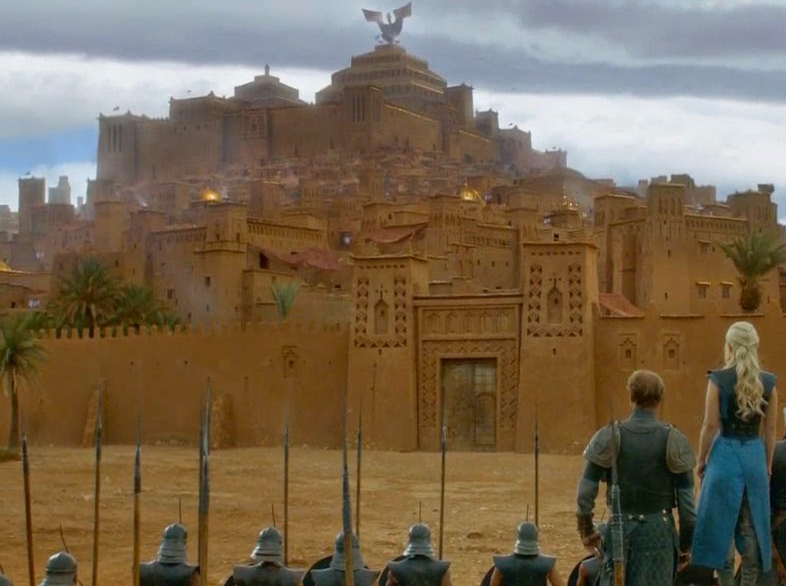
    We learned that Ait ben Haddou and the nearest large city to it, Ouarzazate, were also internationally known due to their connection to the film industry, both of the USA’s but also France and others. From a cynical perspective, the local Berbers were inexpensive extras for multibillion dollar movie machines, yes. But on the positive side, they and their parents and even grandparents had been doing it for so long, they were also now in high demand for other reasons. Intelligent, patient, and extremely practiced, the Berber would also offer up their livestock and other animals to be extras as well, continuing to lend authenticity to background shots. The appearance of this region is similar to many areas of the American southwest, and to the average moviegoer, also any other part of the Arab world – or fantasy worlds. Some famous examples that had at least one scene here were Gladiator, Lawrence of Arabia, and the more recent Game of Thrones scenes that involved the city of Yunkai, one of the cities in Essos (not the main region Westeros) that is filled with enslaved people. Many of these enslaved characters were of course, played by the local folks of Ait ben Haddou. In Ourazazate there are sound stages and lots for recording that doesn’t need to be onsite, too.

    (more…)
  • I Dream of Tagine-y

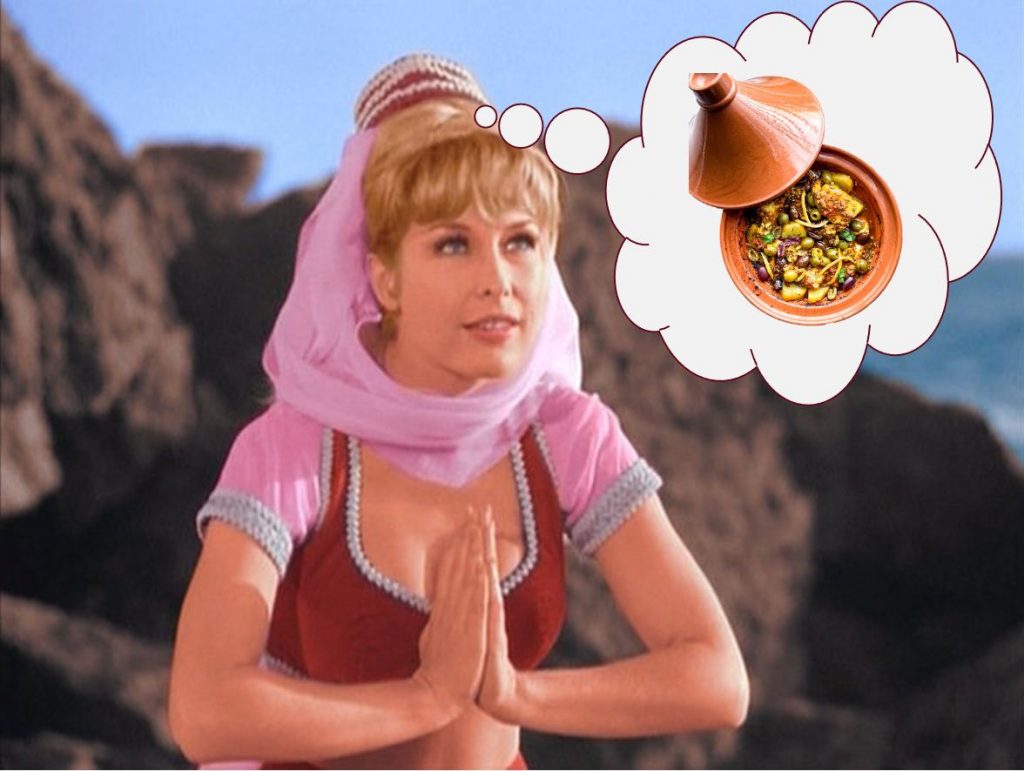
    Photo credit of Jeanie to NBC, and to my lovely remote photo-editing wife for adding the Tagine/Thought Bubble

    We managed to fit quite a bit of sight-seeing of Marrakech’s old city in just two days. We’ve just started our actual ‘guided tour’ on a big bus, left Kech an hour ago, and are starting to wind our way into the Atlas mountains. They are lovely, reddish, and covered in small shrubbery, but of course, also somewhat repetitive, so perhaps I’ll be able to get some writing done now.

    Our hotel of the past 3 days, Maison Arabe, was – like many traditional muslim riads – unimpressive from the outside (with the exception of one Arabesque street-facing wall that contained the door to – of course – the hotel gift shop) but luxurious on the inside. In order to enter the hotel itself you have to walk up a small alley, where we met our first examples of, I think, what we all agreed was the number one annoyance of Marrakesh – the mopeds. We’re in an alley probably 7 feet wide and riders will tear up and down the streets at 20 miles an hour, which seems slow when you’re driving on an actual road, but sure doesn’t when you’re leaping out of the way of an angry buzzing vehicle. This blog post could also be titled “I nightmare of approaching 2-stroke engine sound”

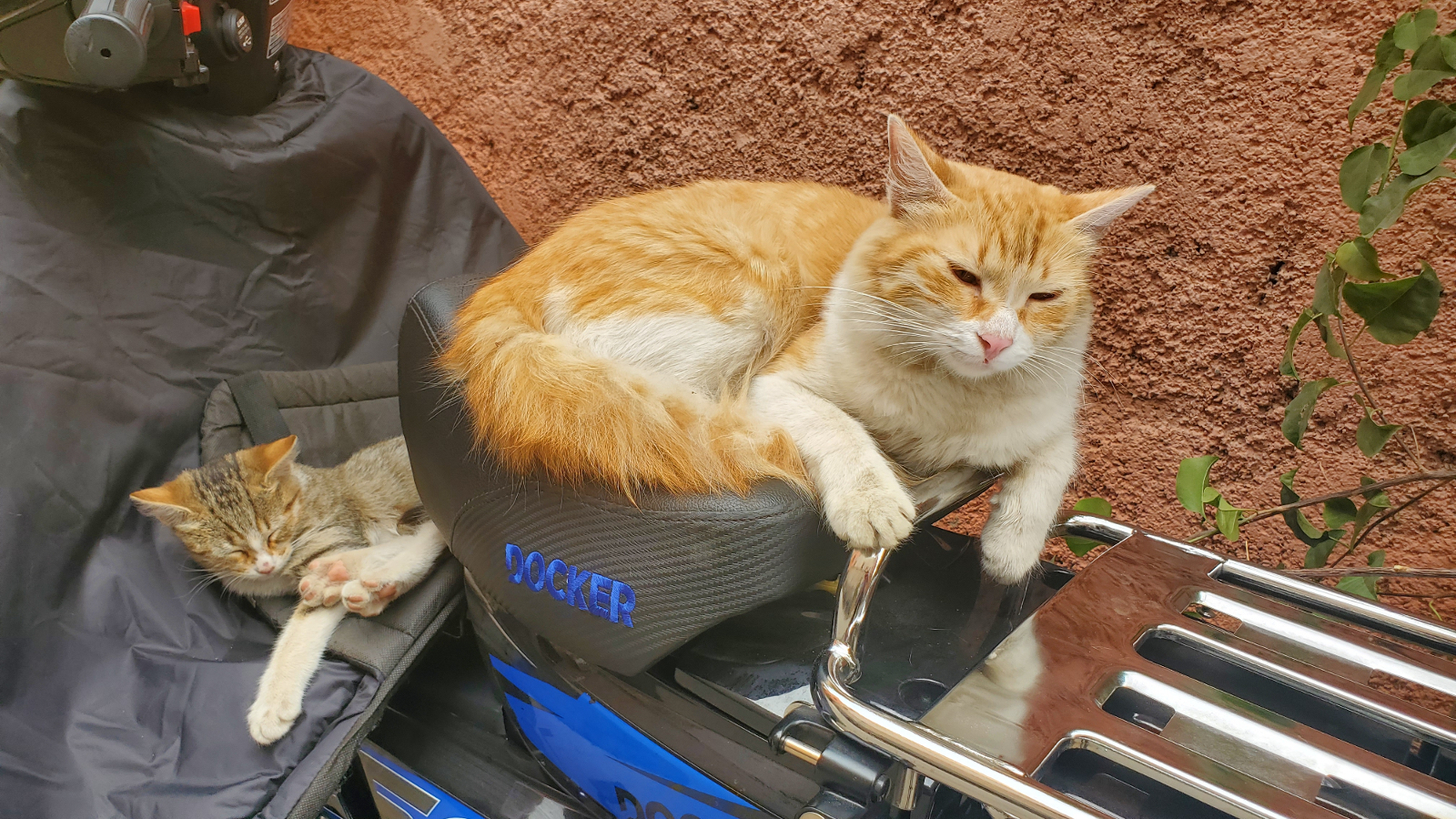
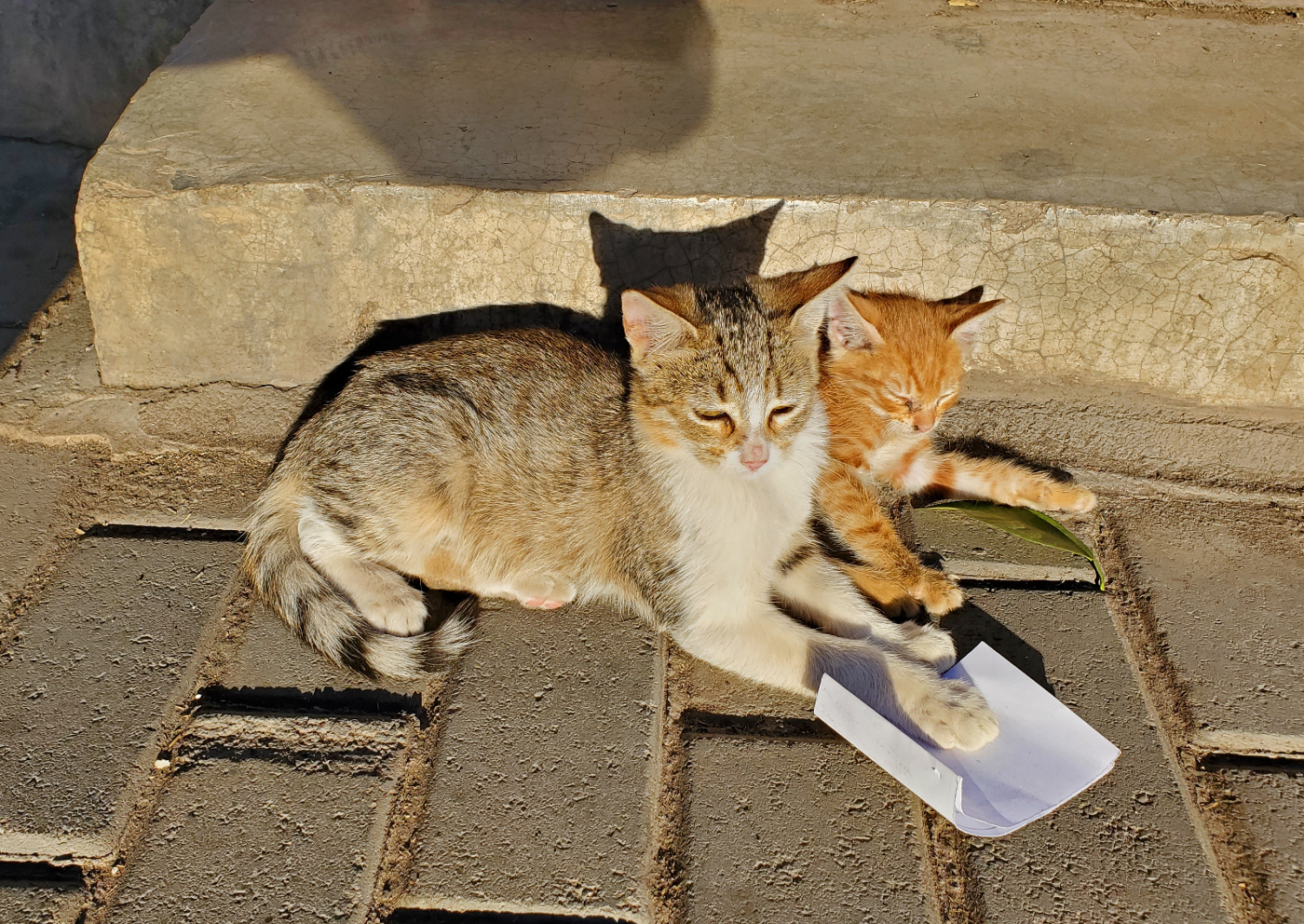
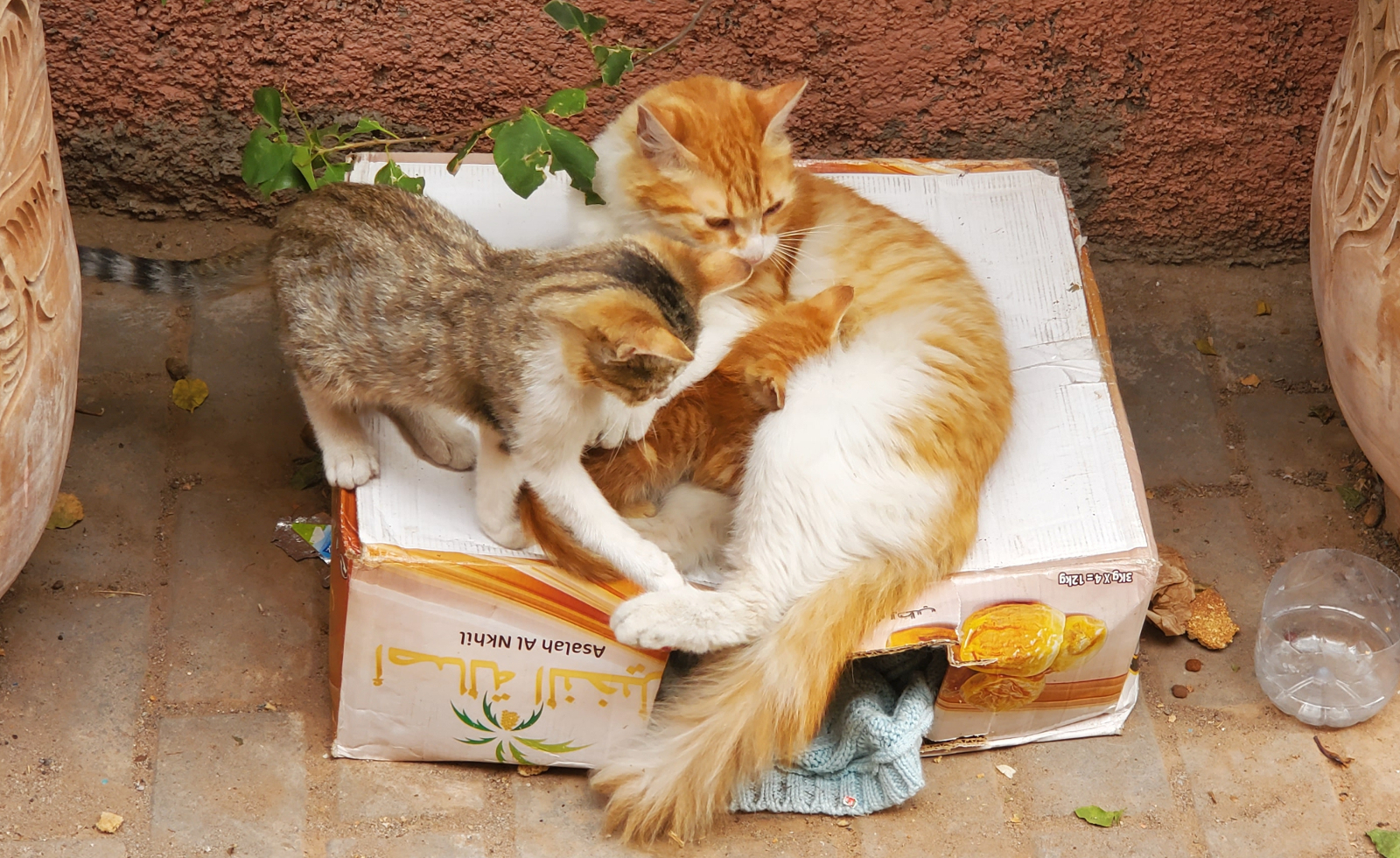
    The street cat situation we saw in Essaouira was, of course, also present here. In that same small moped-filled alley an orange and white long-haired mama cat and her two kittens lived. Being exposed to luxury hotel tourists on a constant basis, Mamacat was extremely friendly, happy to come up to anyone, trilling sweetly, to rub up against legs in the hopes of snackums being provided. It seemed that the nearby residents were helping her out; an old man brought a dish to her filled with what looked like a puree of tuna or chicken, which she and her larger kitten happily gobbled down. A box with a hole cut into it, with a towel inside, was placed against the alley wall, safe from mopeds between two of the hotel’s large planter pots.

    We all thought – except my veterinarian mother – that the two kittens were from different litters. One was a white-and-tabby bicolor almost as large as Mamacat and seemed strong and outgoing. The other was a tiny orange kitten, even smaller than Riba when we got her in Panama, who seemed to perversely enjoy sitting in the middle of the alley, sunning himself. “I think they’re littermates, and that’s the runt, ” said mom, a bit sadly. The kitten responded sweetly to pets and gentle scritches, squeaking weakly and gazing blearily up at us. Mamacat seemed not entirely trained in Mamahood, nursing her orange kitten but then jumping up and running over to tourists for pettings and snacks at the slightest provocation. Even on the second day of our stay, my dad mused that the little orange baby might not make it, as he seemed weaker and less outgoing compared to the first day. However, I ordered the kitten not to die while we were staying at the hotel, as it would make us sad, and I’m happy to report that he obeyed my command, and this morning ate several cat treats out of the bag that I had purchased for Betsy (at her request) to carry around and give to every cat she saw. Let’s all wish him luck, shall we?

    The hotel itself was a tightly twisting maze of numerous individual properties and buildings that had been slowly purchased and built up over decades, walls knocked down and connected together. If you were to view it isometrically I’m sure it would be like an Escher, or Dr Seuss drawing. Jazz bar with a pianist every evening, two restaurants, free tea every afternoon, hammam/massage, that sort of thing. A team of smiling young staff nodding at your slightest request. Whatever the heck the purpose of a nightly “turn down service” is. You get the picture. I’m sure some people love that sort of thing, but I preferred the much more authentic feeling beauty and rustiscm of the previous Riad Chbanate where we were left alone a little more and had more space. Maison Arabe didn’t even have exterior-facing windows for my parents or my “standard” rooms, just windows that faced back into the ceilinged ‘courtyards’ of the hotel itself. Betsy in a ‘junior’ suite had two small exterior facing windows (each about 6×12 inches in size) and after Connie and Nicole checked in, a couple hours after us fresh from the airport, they had a ‘deluxe’ suite with a balcony overlooking a non-ceilinged courtyard that incoming guests were served their introductory tea in. A nice place to be sure, and very nice staff, just not really my thing.

    We had two days for sightseeing, so we scheduled the morning of the first day to see a couple nearby modern attractions, the afternoon for a guided tour, and the second day to explore entirely on our own. The hotel frequently employed the services of a small, easy-going Berber man also named Rachid as a driver for its guests, and we’d be seeing quite a lot of him over the next couple days. He told us that he and his family were also from the Atlas mountains just an hour from the city and their ancestral home had been destroyed by October’s earthquake – but thankfully, they all got out in time and no one was injured. Needless to say, he was tipped generously by our group.

    The first two stops were next to each other – Majorelle Gardens, and Yves Saint Laurent’s Museum. Apparently the latter had been a French clothes designer or some such, pretty popular, made women’s clothes from the 60’s to early 2000’s. His museum was small with just a couple of exhibits – Australian Aboriginal snake art in one as the traveling/rotating piece, and a permanent collection of hundreds of YSL’s sketches where his dresses, both somewhat normal looking and bizarrely weird, bubbled out of his mind. Some of the actual dresses were on display too. There are only two YSL museums, one in Paris and one here, but apparently he and his companion Pierre bought a maison in what became the Majorelle Gardens and over the second half of his life, he’d spend many months of the year in Marrakech, sketching his imagination. The gift shop was credit card only, even for my 10 dirham (about 90 US cent) postcard. I’m guessing that the Museum/shop was entirely an extension of the European versions of the same, and wanted as little hard currency to deal with as possible.

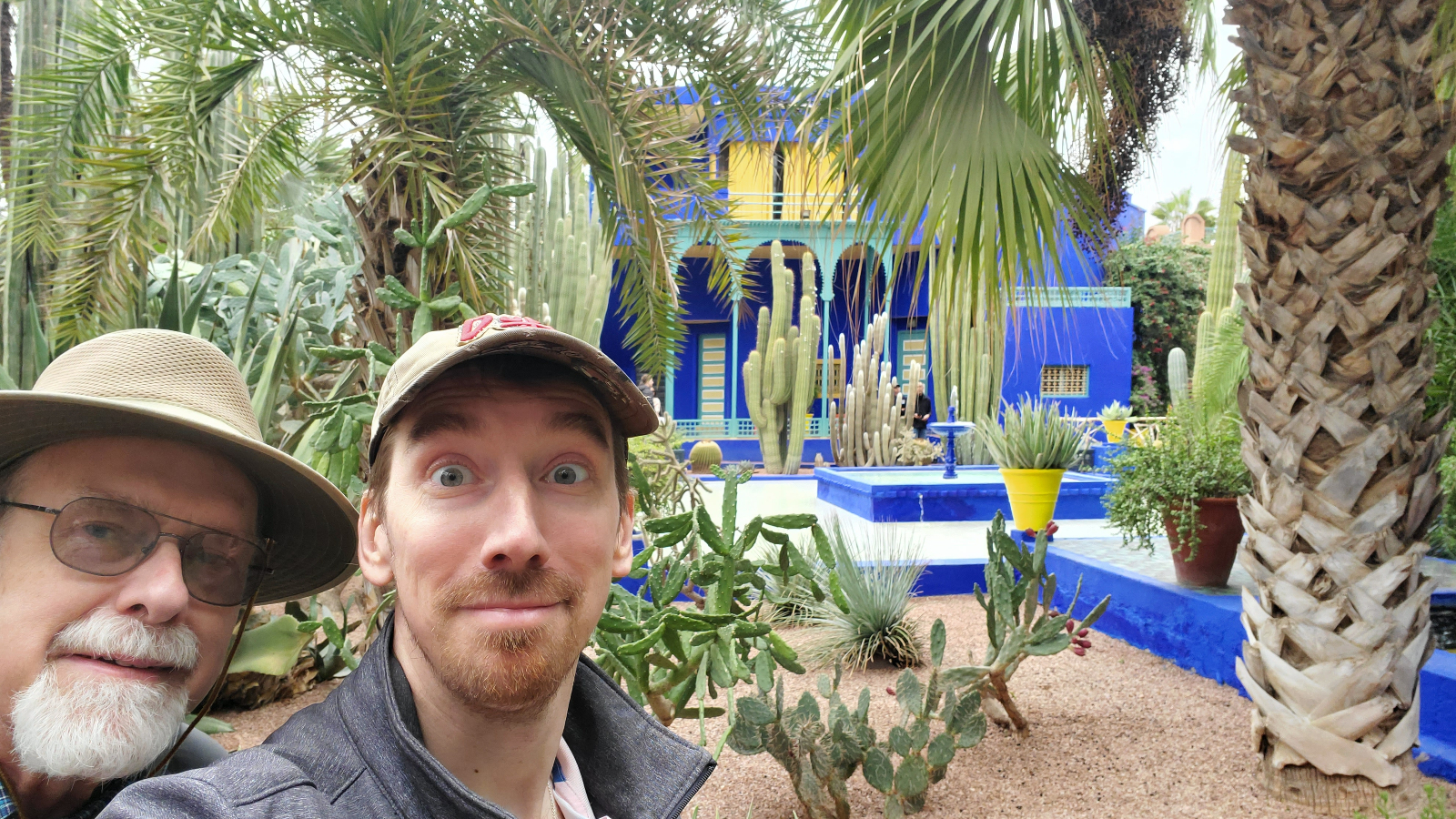
    The garden was pretty, lots of cacti and cacti-esque plants from all over the world it seemed, including the American southwest (saguaro and prickly pear, perhaps?) but do you hear the uncertainty in my typing? My dad and I, both lovers of plaques and information panels, were somewhat disappointed/annoyed to find that almost nothing at all was labeled, in any way. What kind of plant is this? Is that? What type of fish are in this lovely reflecting pool? If you’re going to charge 30 euro to get in, why not have an employee spend a day putting up little tags with QR codes on the trees? They did do exactly that for a set of potted plants on a small tea table outside the YSL maison, and dad and I spent a happy 10-15 minutes scanning the QR codes, which all led to the Wikipedia pages for each species of plant we were seeing. YSL and Pierre’s old house was painted a rich, deep blue (almost purple) on the grounds, and a separate ticket purchase got entrance to it, which had been entirely converted into a Berber museum showcasing their ancient tools/art/religious artifacts, the typical clothing of various tribes throughout the country, their jewelry (lots of lovely, finely worked silver with huge heavy “gems” of amber and coral), and even a few bric-a-brac like some ornately carved ancient doors, rugs, and musical instruments. Everything was wonderfully labeled and lovers of information will rejoice that despite all the on-premise tags being only in Arabic and French, there was a QR at the door which led to PDFs in several other languages (obviously including English) that had exact translations of every single notecard in the building. Very nice. No photos allowed though.

    Someone get these men something informational to read, pronto

    We had lunch at the Amal Women’s Training Center (Amal means hope in Arabic) – more details on them and their mission here. After the earthquake, my mom had heard that they were making food for the displaced families, rescue workers, etc – we were happy to support them. The food was great too.

    After a brief return to Maison Arabe, the second part of the day began when our effervescent guide, a woman about my age named Ouidad arrived to take us to part of the old city. Cracking jokes about her family, particularly mother and mother in law seemed second nature to her – a midwesterner might describe her as “a real hoot.” She gushed about King Mohammad the Sixth, in power since 1999, for his reformist attitude toward women and his subsidizing of and expanding the idea of cooperatives to better support local artisans and creators of Moroccan handicrafts. In particular, she mentioned that he legally codified the possibly less popular (with men at least) lines of the Qur’an that state that in order for a man to marry up to four wives, the preceding and incoming wives all have to be equally cared for. Men are not allowed (legally, at least – no idea about religiously) to marry another woman unless his preceding wives all officially sign off and agree to him adding more wives to his harem. Ouidad chuckled at this and said that her own husband was allowed to marry a beautiful, younger woman who would cook for him, bear him more children, and the like… but he’d better like being asleep for the rest of his life because it’d only be “in his dreams!” She was wearing a long, flowing black djellaba, with a black and white checked keffiyeh (i.e. traditionally Palestinian, vs the traditionally red Bedouin/Jordanian one I typically wear) pinned to her left shoulder. I also noticed her fingernails were painted with the Palestinian flag. We didn’t talk politics (although she, like Rachid before her) also mentioned with great pride the millennia-long history of cooperation and tolerance between Abrahamic religion in the kingom) but I had a pretty good guess of her feelings on the current goings-on in Gaza.

    (more…)
  • Essaouira – as pretty as a picture

    Morocco is a little over three times the size of Wisconsin, and if maps are to be trusted, mostly diagonal east to west. So when we touched down in the middle of Morocco after blissfully uneventful 8 hour, then 2 hour flights from Chicago, to Madrid, to Marrakesh, it was a relatively short drive westward to reach the lovely seaside town of Essaouira as our “intro” to the country.

    Many hotels are referred to as “riads” in Morocco, and our Riad Chbanate had sent a driver to collect us from the airport in an SUV. With my background of “fly thrifty” I’m not used to having a checked bag at all but my trio of traveling companions each had a couple of bags, and we were fairly jam packed into the vehicle. Our driver Hamoudeh spoke enough English to be jovial and convivial but due to jet lag, we were surprisingly quiet on most of the drive as we each passed in and out of drooping sleep in turn.

    We arrived outside the walled Old City of Essaouira by 5 or so, and a porter from the riad met us at the car to take our many bags. Cars are not allowed inside the city (although moped riders either are allowed, or no one cares enough to stop them). The old city is, surprisingly, not actually that old in the scheme of things, having only been built in the mid 1700’s. Still old enough though that the narrow, dim, winding streets would certainly not fit any modern 4-wheeled vehicles. Chbanate (the riad, and the street it’s named after that it’s situated on) is placed right along the easternmost wall of the old city, so it wasn’t a long walk.

    After an hour to very briefly nap, we set out for dinner. Although we were no more than a kilometer from the ocean breaking along the fortress walls, the tall thick stone buildings absorbed almost every sound. The eastern part of the city seemed to be mostly residential and not very touristy at all. Small restaurants, little more than stands, would have little groups of local families clustered around them chatting quietly. As we continued westward for another five minutes, European looking tourists increased until finally we burst onto a well lit main street covered with souvenir stands and cats, lounging everywhere.

    Speaking of cats, the culture – at least of Essaouira as I can’t yet speak for the rest of Morocco – seems to be similar to Istanbul, where cats are most beloved and found as endearing. A welcome change toward the relative antipathy the average Jordanian, at least in my neighborhood, had toward them. Over the past couple of days I’ve seen several men, managers of touristy trinket shops, dutifully shaking out plastic bags of kibble into beautifully painted bowls, surrounded by a dozen mewing kitties gently patting his leg and gazing soulfully up at him. The majority of the cats I attempted to interact with were curious and friendly, coming up to my outstretched hand and rubbing their faces up against it and trilling at me. My aunt in particular adores cats and is greatly enjoying this aspect of the trip.

    (more…)
  • Morocco – A long time coming

    Almost a decade ago, with memories of relatively recently departed Jordan fresh in my memory, my parents asked if I had any interest in going to Morocco. My old boss at Entity Green, Aaron, had done Peace Corps in Morocco before working with Philip and Wajih, and I’d heard many (mostly) pleasant stories about the country’s mix of Arab, Spanish, French, and Berber culture. There was a small Moroccan restaurant on the west side of Madison whose owner made annual trips to his home country to restock his spices and replace any ceramic dishware that had broken in the past year, and he often gave guided tours at the same time. We attended an informal ‘trip planning’ meeting with him to talk about potential itineraries, but a year later, I heard (via my parents) that the restaurant had closed, and no further progress was really made on any Morocco trip plans.

    Over the years that followed, my parents developed an annual, sometimes even biannual hobby of international travel with my mother’s sister in law, my Aunt Betsy. While all three of them had traveled quite a bit throughout Europe and the USA, my parents’ visit to Jordan to see me in 2009 had awakened a hunger to see less touristed parts of the world, and Betsy was eager to do the same with some travel companions.

    Every year since then, I’d hear about their trip to Tanzania, or Vietnam, or Cuba, or Croatia, or some other interesting area, and feel a little jealous that Christine and I couldn’t go with them. Unfortunately most of their travel would happen in the spring or the fall, exactly when Christine and her teaching schedule absolutely wouldn’t allow her to go anywhere.

    But Morocco was always brought up, and I’d always (semi-jokingly) remind them that I was supposed to go with them on that trip, and we’d laugh, and they’d jet off somewhere else. But finally, as the effects of the pandemic started to wind down (at least for our demographic), my parents started talking about taking a big international trip again. And at long last, talks of Morocco turned from joking, to serious. And I said well, even if Christine can’t join me, I’d like to come along.

    (more…)