HeiseHeise.com

The Personal Blog of Zach Heise

A random image

A random image. Reload page for more. Want more info?

Month: June 2009

  • Rum in the Sun

    If I had all the time in the world, I probably wouldn’t have chosen the end of June as the best time of the year to pack a bag and head out into the middle of the desert. However, I was happy to do it for my friends Khalil, Silas, and Silas’ housemate Moses. When Silas told me a few weeks ago that he had never been to Wadi Rum, the famous Jordanian camping retreat in the desert, I was very surprised. I had already seen it a couple times in the past year, first with Haitham, and then with my EGT coworkers. But to have not seen Rum after two years (Silas) 4 years (Moses) or 20 years (Khalil) seemed downright unfair to yourself. I vowed to do something about it and told Silas that I would find a way to get him and his housemate down there before they left the country in a few weeks.

    Khalil kindly offered his SUV as our transport vehicle, and after work on Thursday afternoon he and I left Ayn al Basha, picked up the others from Rabbia, and the four of us basked happily in the air conditioning of the large extended cab and watched “Wicker Man” on the DVD player built into the dashboard. We only stopped the car once on the 3 hour drive south, and when I climbed out to stretch my legs at the edge of the burning desert sands, the dry wind whipped my breath from my throat, leaving me gasping for breath and sweat pouring down my face. Nothing was visible around us at the point except for the glowing ball to our right and the occasional truck roaring past, windows tightly rolled up and sealed.

    However, when we arrived in the Wadi at half past 6 that evening, the sun had shrunk below the pitted mountains that now surrounded us and the weather was much more tolerable. We were a little late, but Suleiman jovially greeted us at the same parking lot where I had last said farewell to him seven months ago as my EGT colleagues and I had left from our Thanksgiving trip. I had called him up as soon as I learned that Silas had wanted to go to Rum, and he was happy to schedule our little group in for an overnight trip. Same as before, we loaded our bags and cooler into the back of the tall Bedouin’s familiar banged-up Jeep, and the engine banged us forward across the reddish sands drifting over the Bedouin village’s streets. Within a few minutes, the road vanished and the huts faded behind us into the mountains, and were swallowed by the deserts.
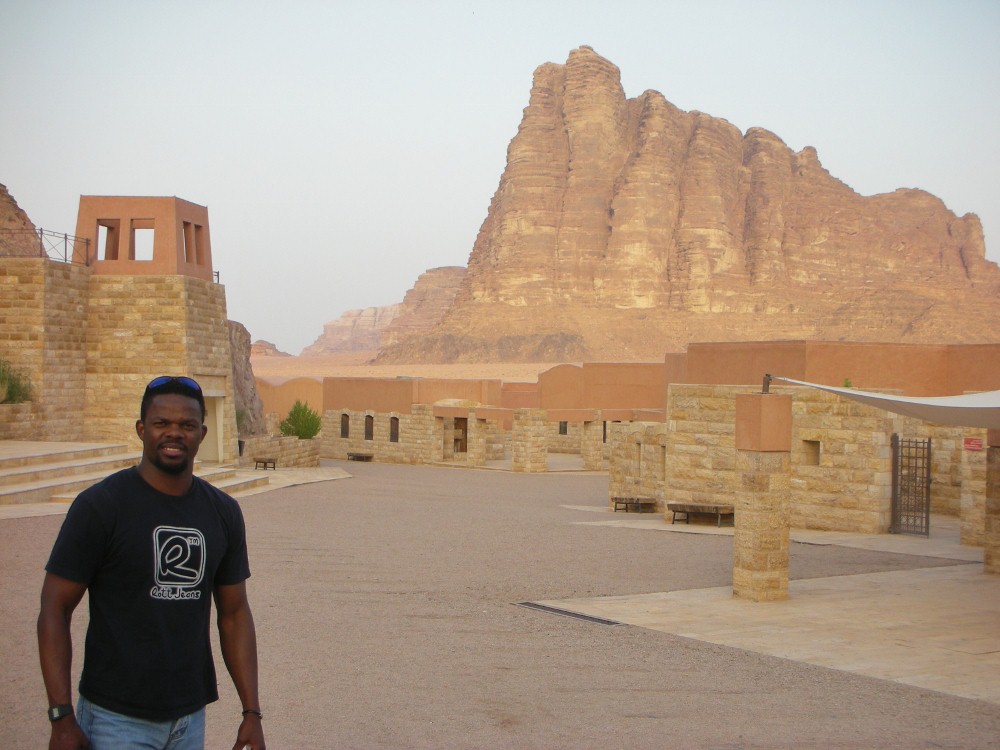
    Moses poses next to Rum's most famous mountain group, the Seven Pillars of Wisdom
    At the tourist center, Moses poses next to Rum's most famous mountain group, the Seven Pillars of Wisdom

    My three companions were enjoying themselves greatly, especially Khalil, who is probably one of the most cheerful men I’ve ever met. Although he’d certainly camped in the desert in Saudi before, mountains like these were entirely new to him and he snapped photographs constantly and called his wife enthusiastically to tell her what he was seeing. Although Khalil only speaks a few words in English, between Silas, Suleiman, and myself, we were able to keep him entertained, and he’s vowed to be “conversational” in English before I return to America in October. I don’t think he’ll have a problem – I tell all of my non-English speaking Arab friends that anyone that learned to speak Arabic can learn English without breaking a sweat.

    We bumped our way up to the campsite and with a final lurch, the Jeep ground to a halt, causing us all to fall on the floor and atop the cooler. The sun was just moving behind the lowest mountains in the distance, but the four of us climbed to the top of the low mountain behind the tents, gaining the high ground and the ability to watch the sunset a second time. Back on the ground, I met Suleiman’s two assistants at the site, Amar and Mahdi, both of whom where also wearing the long flowing thobe that is so common in these parts for relieving the heat. Suleiman joked with us, switching easily between English and Arabic in conversation although Silas and I tried to keep things in Arabic mode as much as possible to help Khalil out.
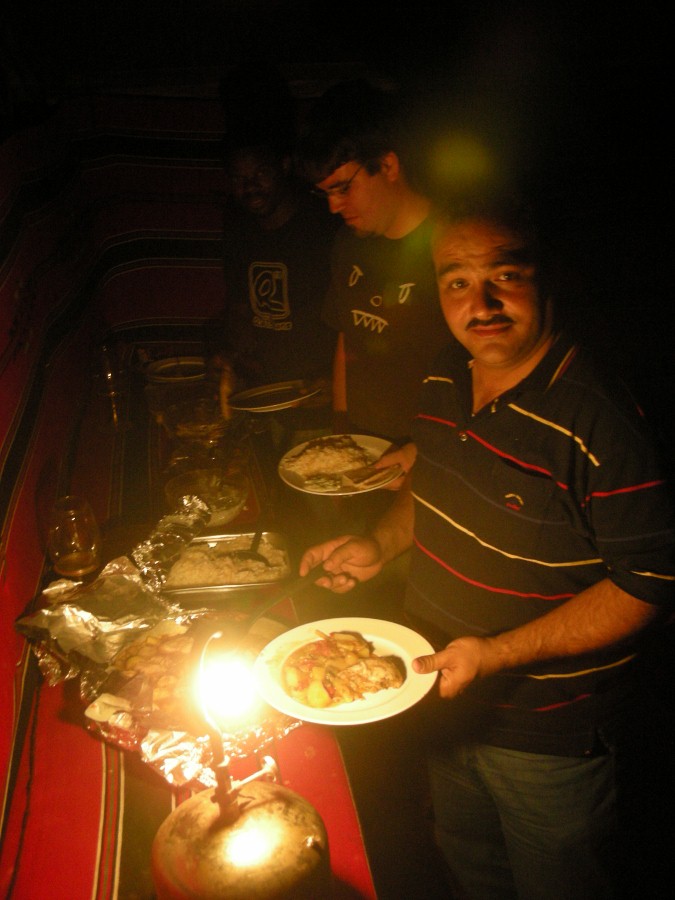
    The other three tourists load up their plates by the glow of gas camping lamps
    The other three tourists load up their plates by the glow of gas camping lamps

    Dinner was roasted chicken and vegetables with rice, illuminated dimly in the red-carpeted tent by two gas lanterns that once again brought sweat to our foreheads. No zarb this time, unfortunately – I guess you need to let them know a little more ahead of time in order to get some zarb-cooked food. Afterward, the seven of us stretched around the campfire on farshat-mattresses atop the soft sand. Khalil had brought his personal argeilleh along (he’s never without it for long) and lit up the classic tuufah (apple) flavored tobacco, puffing away as he and Suleiman chatted. Moses, Silas, and I watched the stars brighten into existence above, and as our eyes adjusted into the darkness we could even make out a couple satellites shooting past overhead, dim dots next to the stars but moving as fast as any airplanes. Because of the khamaseeneh dust weather which still has not entirely cleared up yet, the stars weren’t as bright as back in November, but it was still a gorgeous night and the temperature had rapidly descended to a warm breeze which blew around us and lit the coals in Khalil’s argeilleh. Like he had at Thanksgiving, Suleiman rose at about 10:30 and bid us farewell, vanishing into the sand silently, his sandals barely raising a whisper. The coals darkened around the blackened teapot sitting the circle of stones, and suddenly the night stars doubled again.

    Suddenly it was dawn, and I had a nasty discovery of what the cool daylight brought with it – biting black flies who had a penchant for flying into your ears like tiny bad-tempered jackhammers. Smacking my head a few times blearily, I pulled my small blanket over myself, tucking in my legs, and managed another hour of semi-sleep, vaguely attuned to the sound of dozens of tiny whirring flies bouncing off the blanket like BB-gun pellets. When I next pulled the blanket aside, I was the only one left by the ashes of the fire and everyone else was gone. As it turned out, Silas had abandoned the campfire in the middle of the night citing the cold breeze and was lying in a heap on the floor of the tent a few meters away.
    (more…)

  • iPhone 3.0 with Arabic: 2 years late better than never

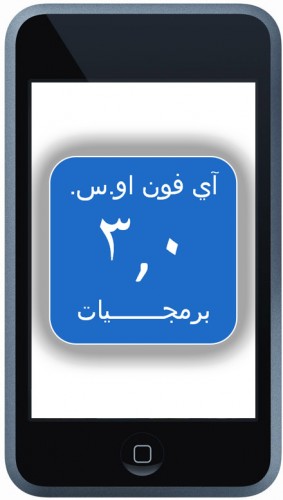
    Would you believe that Photoshop doesn't support right-to-left typing? I had to make this in Microsoft Word.
    Would you believe that Photoshop doesn't support right-to-left typing? I had to make this in Microsoft Word.

    For the past 10 months, I’ve used an iPod Touch to synchronize my mobile life with my computer here in Jordan. I picked it up a few days before leaving for Jordan because I didn’t want to pay AT&T the ludicrous sum of $80 a month for a phone that wouldn’t even work properly overseas without doing something called “unlocking” it. I may be a tech person but I tend to avoid phone tech like the plague so this was news to me. So I kept using my aging Motorola Razr V3, and still use here in Jordan now, but the iPod does everything else. Music, email, calendar, photos, and most importantly, a single file in the “Notes” section of the iPod that I’ve simply titled “Jorabic Words.”

    This file contains approximately 300-400 tiny lines of text that I’ve recorded throughout my time here, adding a new line whenever I hear an important word and happen to have an Arab nearby to tell me what it means and how important it is. If I scroll back down through it, the first word is…let’s see here…ah, here it is, at the bottom: “fathi” which means “empty.” But therein lies the problem – I wrote it just like that, without the actual Arabic accenting and pronunciation, because that was all I could do. Until 1.5 weeks ago, your iPhone or iPod could not handle any of the right-to-left Semitic languages, like Arabic or Hebrew.

    Now, for most people this is a non-issue, and I’ll admit that I’m one of those people. But it was the single largest annoyance ever that I had with my favorite electronic handheld device, even more than the glitch 5 months ago that made the date and time reset every time I plugged it into a computer so I lost all my appointments and alarm clocks, and I had a dim view of that one after missing my carpool to work a few times.

    What really burned me was that Apple had the nerve to market a device, in the Arab world, the Umma, without adding Arabic language support to it. It’s only either the 5th or 6th most widely spoken language in the world, guys.* How can you sell a phone to a region and it is literally impossible to input the native language on it, and when it comes to outputting it from a website or something, it’s completely broken up and segmented, which is actually harder to read for a poor guy like me who has enough trouble as it is putting the letters together into pronounceable words.

    What is this, Apple? You can handle Chinese, which is right-left AND up-down, but not Arabic?
    What is this, Apple? You can handle Chinese, which is right-left AND up-down, but not Arabic?

    Sure, Apple may argue (if they cared) that anyone who can afford an iPhone in the Arab world can probably speak English and they’d probably be right, too. But what about the people who just need it to communicate, or read articles or news that might only be available in a particular language? For example, I email Ahmad’s older brother, Majid, all the time with short messages in Arabic from my laptop, but I can’t do that from my iPod, I either have to drag out the ‘top or call him and attempt to use my mangled language skills to communicate with him. I’m sure there are hundreds of Arab businessmen and Expats all over the Arab world who need to do the same thing, daily, and Apple just smirks and then partners with Orange (worthless excuse for a Telecom provider that it is) to release a crippled smartphone.

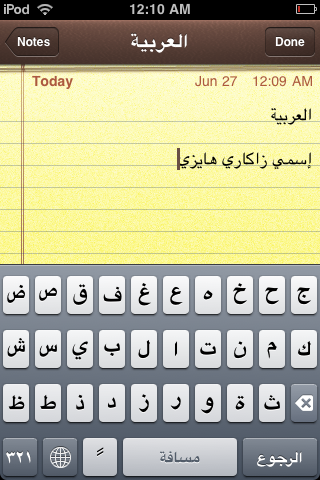
    But now the OS 3.0 software has been released, and after I coughed up my $9.95 for the software update, all has been forgiven on that front. The iPod now perfectly displays and connects Arabic text, and allows me to input not just the letters, but all of the various symbols (َ ِ ً ٍ ْ ُ  ٌ) for pronunciation above and below the letters. I have no idea how to use them, of course – I don’t speak or write the proper, “Qur’anic” or “Fuhsah” Arabic, but the stunted street Arabic that the average speaks and writes to get their point across without having to perfectly dot out hundreds of tiny little lines and squiggles next to the letters. That’s why I titled the file as “Jorabic” instead of Arabic – the regional differences mean that probably a good 20-30 percent of the words I’ve recorded there would be useless in Morocco. However, next time you’re a bookstore, pick up a copy of the Arabic Qur’an and look inside it. See all the tiny little doodads above and below the thicker squiggles? That’s “Fuhsah,” which might as well be a second language to me, and frankly, it is one.

    إسمي زاكاري هايزي - My Name is Zachary Heise. At last!
    إسمي زاكاري هايزي – My Name is Zachary Heise. At last!

    So that’s my main “Review” of the iPhone/iPod 3.0 software, because this firmware has already been beaten to death like a horse with reviews and the Internet is running out of room. However, one thing that people don’t talk about is the speed of the update when it’s put on different Apple devices, unfortunately. Most of the reviews you’re likely to come across are for the latest and greatest iPods and iPhones, but I’m running everything on a First Generation iPod Touch – the one without the speaker – and with the slowest processor of them all, running a 412 Megahertz compared with the later gen’s 533 MHz system. So for all you other old-school iPod users out there, be forewarned – some things are going to be a little slow on this new update. The new “Spotlight” search function, for example, has a definite lag when inputting text (in either language, I found, but more so for Arabic) and when performing the search. Also, the cute little “ripple” effect that Apple uses to close/minimize a running Application disappears about 70% of the time now when exiting an App, just causing the App to unceremoniously dump me back at the home screen – a sure sign of a crash-quit instead of a proper close. I wish I knew more about how Apple’s internal indexing program worked for “Spotlight” on the iPhone – is it like on OS X and Vista, which has a database, or does the iDevice actually rescan the whole little 8GB/16GB drive whenever it searches? I wish I had more information on this.

    (more…)

  • A different kind of church

    Summer has definitely hit Amman with a vengeance. When I arrived in late August, I was freshly hardened from our mind-meltingly hot and humid Wisconsin weather, and Jordan seemed like a dry, stiff vacation in comparison. It also helped that within a month and a half things had simmered down to a perfectly comfortable 19-21 degrees. But now – the dust is the killer. It just hangs in the dry air and seems to replace all the air in your lungs. It could be worse, though. Khalil and Wajih have told me stories about the Gulf area (Khalil lived in Saudi for 30 years before coming to Jordan) and how it easily gets into the 55-60 range. For your metric-challenged people (I’m sorry) that’s 140 degrees in Fahrenheit. The sun reflects brilliantly off the white sand and dust in Ayn al Basha, causing me to squint pathetically whenever I venture out of my classroom without shades, but strangely enough the Iraqis and Palestinians going to class almost never where sunglasses and seem unaffected. Wajih told me that the light usually just doesn’t bother them, but he admitted that once on a trip to Dubai in August, the sunlight was literally bright enough and hot enough that it almost burned his retinas just as he crossed the street from one of their sealed and air-conditioned buildings to another. Good to know.

    The city is continuously emptying of my friends, and now Silas is next on the list – he’ll be returning back to the states soon. It makes me sad because he was one of my first friends here; without him I never would have joined Dozan wa Awtar. With school being out, I don’t see him nearly as often as before, either – but I made up for it last weekend when I kind of invited myself along with him to a German-language church out on the west side of town. He speaks German fluently, and although my ancestry is definitely close to 50% Germanic, I haven’t kept up quite as well with the family history as he obviously as, or at all. However, I hadn’t been to a Lutheran service here in Jordan before and this seemed like a good chance to not only see how Lutheranism went in Jordan, but also to hear it in its original tongue.

    The liturgies and rhythm of the service was in fact quite identical, and although I had to amuse myself with reading the parables of Jesus from Silas’ Bible during the sermon, I definitely enjoyed myself. Of course, every one of the attendees spoke English with perfect fluency as well and we were all happy to talk about our respective work here, so far from our native homelands. The Germans were all visibly shocked when I informed them that Silas (who was happily chatting away in rapid, guttural Deutshsprachen in another part of the room) was not actually German, and told me that they would have been completely believed him if he had said he was from Berlin. I did learn a little German, too – but, for posterity I can add “ß” (which is actually an “S” sound) right next to Tajik and Russian in my list of “Languages that use letters that look like English but are actually completely different.”

    Speaking of church, I had a really great worship experience last night with Imad, the Egyptian janitor that works at the Christian Academy. The academy is doing some remodeling over the summer while the students and teachers are back in America – fairly major stuff in fact that involves ripping out and replacing all the walls on the 4th and 5th floor, and completely adding a brand new 6th floor on top of everything. He and the administration wanted me to stop by after work so I could dictate how I wanted the new ethernet cables placed in the walls, but I wasn’t able to get over there until almost 10 at night. Over the phone, I apologized to my friend and colleague for my lateness – I knew he had a young wife and new daughter to look after, but the darn thing with Arabs is that they’re so kind and friendly that you’d never know if you actually were disturbing them because they will insist that you will come over and have some food and drinks with them. 🙂 He and I chatted for awhile in his apartment, then headed next door to the school, where I quickly drew up a diagram for where I needed plugs and jacks to be to hook up the various wireless routers I’ll be installing in a few months.

    Back downstairs, Imad introduced me to two fellow Egyptians who were helping with watching the school over the summer. I stepped out to grab a drink of water, and upon my return found myself treated to a fervently spiritual Arabic prayer to Jesus. The three of them kneeled and prayed together for 20 minutes. I learned that Christian Arabic prayers are extremely similar in content and flow to English prayers, with phrases like “Bidoon anta, ma fi Ayesh!” – without you, there is no life, and “Na’iftah qoluubna alayk” – we open our hearts to you. Imad led the two younger men in song, “Tahahl alayna, Yazuah” – Come to Us Jesus. Their high-pitched voices floated effortlessly through the chords in the Arabic style that would have made Pavarotti proud. I was truly honored to be there with them to hear their joy and spiritual strength. I thanked Imad for allowing me to join them, and he chuckled and translated my gratitude to his beaming friends. “You might not be able to to sing with us now, but in Heaven we will all speak the same language together.”

  • Summer Concert from Dozan wa Awtar

    The Dozan wa Awtar choir works very quickly and efficiently to find, practice, and most importantly perform new music to Amman’s choir-loving community. There aren’t very many choirs in Jordan, and most of them are through schools and are gender-segregated. This leads to me jokingly describing Dozan wa Awtar as the “best” or “national” choir of Jordan, although unfortunately King Abdullah hasn’t yet had time to bestow that honor on us (I’ll be writing him weekly letters until he does, though!)

    We had the Christmas Concert in December, the Easter Concert in April, and now we’ve just finished off our third concert session for the summer months. As always, I think we all sounded great, but I’m embarrassed to say that I definitely don’t think I was completely up to snuff for my performance because of my two week absence last month. For the first couple practices after I returned, I just sat quietly in the corner and attempted to figure out what everyone was singing, especially in our French and Arabic pieces. The men’s Arabic solo piece for example, Ya Ghazyel, was so tough for me to decipher that I only finished learning the words and bouncy style of singing the day before the concerts started.

    Probably the most fun piece to sing was Ascot Gavotte, from the musical “My Fair Lady,” with Julie Andrews and Rex Harrison. For this piece, Shireen gave us free reign in props and stage acting. We have three English choir members as well, and they gave us tips on proper pronunciation and carriage for ladies and gentlemen attending the Ascot races in the early 20th century. One of the ladies in the choir provided a fine Panama hat for me to wear, and Yanal (always the smooth guy) had a full vest, derby hat, and cigar. We made him lose the cigar for the children’s concert on Friday, though.

    I think I’ve never had so much fun with the men’s solo pieces as I did with our trio this time around. Besides Ya Ghazyel, we also had What Shall We Do With a Drunken Sailor and Vive L’Amour. I was able to act out a lot more on stage with those last two than usual, especially because Shireen had given the women leeway to “be sassy” for their medley of solo songs, including “Wishin’ and Hopin’.” Both of our English-language pieces were drinking songs, and we mutually agreed that we should treat them as such, although Shireen gave us a head-shake at my suggestion that we should whip out flasks in the last bar of Drunken Sailor (although Yanal and Nedy provided perfectly-timed hiccups instead).

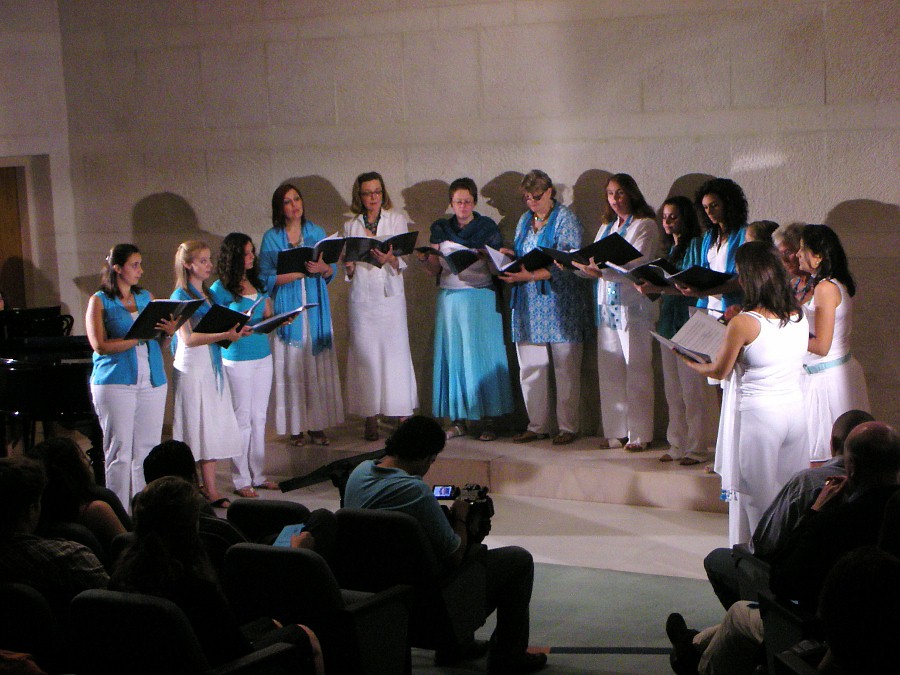
    The ladies sing "Annie Laurie" as the DVD company films them
    The ladies sing "Annie Laurie" as the DVD company films them

    We’re having the same DVD company make the videos as last time in the Easter Concert. For both that concert and this one, the second performance was professionally filmed, and a few weeks later Shireen distributed the completed DVDs to us, complete with menus and credits. Unfortunately, I don’t know if we’ll ever see a performance from the Christmas Concert, but I haven’t given up hope yet. When we get our DVDs from this concert, I’ll try to rip out a copy of the Ascot Gavotte performance and post it here.

    In other news, it’s hard for me to believe that summer is fully upon us now and I have less than a month and a half remaining as a teacher here in Jordan before my contract officially ends. My students in this session are even more question-filled than any previous group, to my delight, and I think I’ll be able to go farther with their education if their intensity continues at this pace. As always, I enjoy getting to know all of them and learning about their experiences in Iraq

    Good news from Qayssar, my former student and first translator – he emailed me last week with the happy news that he’d been successfully resettled in Pittsburgh, Pennsylvania. On that same subject of translators moving on with their lives, Wamidh is now in more and more monthly meetings with the refugee resettlement programs in Amman – it’s very possible that he may be heading for the States as well soon after our last session together ends. Although his meetings have required him to be absent from translating for me, but Mohammad J, the sheikh from the previous session, is usually available even on short notice by telephone for him to come in and save the day. I’ve put the graduation photos from the last two classes up on the wall next to the whiteboard, and Mohammad enjoys the questions that my current students ask him about how his class experience was, and if they’ll be put up on the wall too.

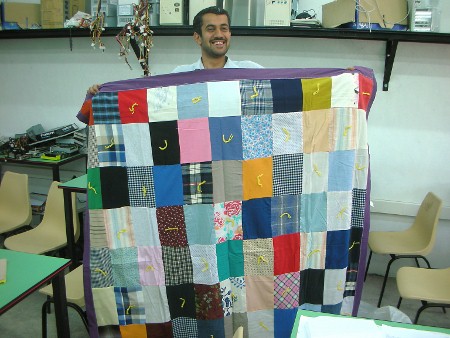
    Last week, all Iraqi students were provided with free handmade blankets and basic necessities from relief agencies
    Last week, all Iraqi students were provided with free handmade blankets and basic necessities from relief agencies

    Well, it’s a beautiful day outside, a downright balmy 29’C and I should clean out the house a little before heading over to church. Church is a lot more lonely with all my friends from the Academy gone back to America on vacation, but at least I can continue to make a joyful noise to the Lord!

  • Dodging the Jordan Rally

    I remember back when I first arrived in Jordan, many taxis and other cars had bumper stickers bearing the cryptic phrase “Jordan Rally 2008.” It wasn’t for a long time that I discovered that meant rally as in “race car” rally. The previous ruler before Abdullah II, the late King Hussein, really liked cars of all kinds, and race cars in particular – back in September of last year I went to the museum named in his honor with some friends to see his legacy collection. I’m not positive, but I think that the rally is held in his memory. However, until this last weekend, I didn’t realize it was an annual thing, although I probably should have deduced that from the year after the name.

    I had just rejoined with Cycling Jordan after almost a month of absence while in Central Asia, and Sa’ad was excited because he was taking a group up to North Jordan for the first time, a new place called Wasfi al-Tal Forest. This was especially intriguing to me; I had been to North Jordan (i.e., north of Amman) a few months ago with my friend Mika and some other friends and I thought it was an excellent place for outdoor activity. Speaking of Mika, she was about to head back to America and, because she’d been here for the same amount of time I have, I was feeling sad because her and so many of my other American/European colleagues and friends are leaving and returning to their homelands – often for good. However, she hadn’t left yet (she leaves today, in fact) and had even agreed to finally come out biking with us, something we had been trying to find time for for months!

    Sa’ad and I were relaxing in the front of the bus, talking about the route and watching our group chatting amicably. Suddenly, he glanced out the window towards the mountain we were heading toward and muttered, “uh oh.” Never liking it when someone looks at a mountain and says “uh oh” I followed his gaze, seeing a line of support vehicles and personnel, the logo “Jordan Rally 2009” emblazoned all over them. I recalled suddenly that I had seen posters all over the city since my return from vacation – the Jordan Rally would be on the 6th of June, all morning and afternoon. And here we were, heading right for them. I had a sudden memory of two years ago, when I arrived on the Isle of Man and suddenly discovered that there was something called the TT Motorbike Race going on, horribly timed to coincide with my vacation.

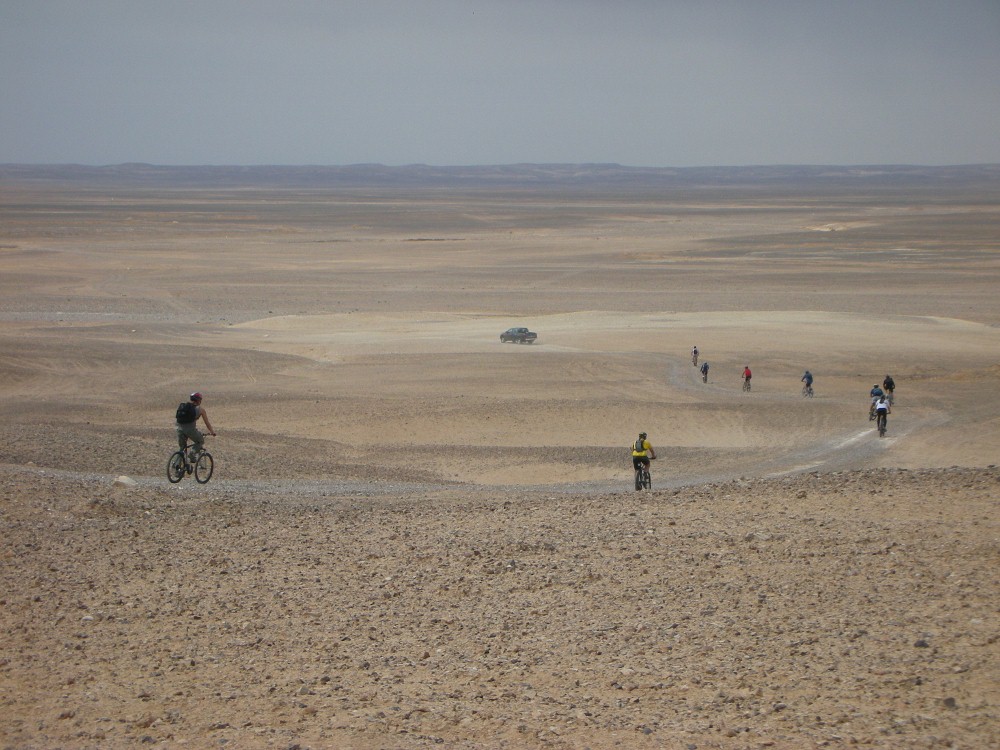
    Over the past couple months I’ve been on some interesting trips with Cycling Jordan. Sa’ad has been getting me acquainted with the areas of Jordan outside of the norm for foreigners, like the Eastern Desert around the Azraq nature reserve. We didn’t see the nature research or its lake (azraq is Arabic for the color blue), but we did bike through a long stretch of barren eastern desert that vibrated our bikes so hard I thought it would turn my forearms to pulp.

    Our group followed a desert guide in Sa'ad's pickup for most of the trip
    Our group followed a desert guide in Sa'ad's pickup for most of the trip
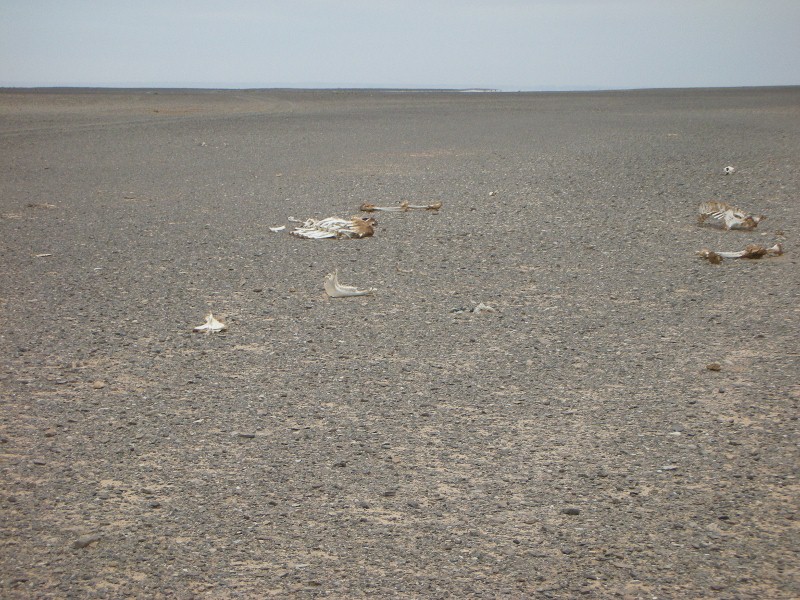
    Did I say the desert was barren? I meant except for camel skeletons.
    Did I say the desert was barren? I meant except for camel skeletons.

    As summer has come upon on us here in the Arab world with full force, Sa’ad has started taking us out into the cool shade of the country’s few large forests. The first one we went to, Shwaifat, is only a half an hour bike ride outside of Amman, but has some great deciduous forests plus old pine growths that makes you forget that you’re in the part of the world that everyone else considers a desert. And how many people (besides skiers “in the know”) have discovered that Lebanon has one of the world’s largest and most famous ski resorts in it? One thing’s for sure, we shouldn’t be caught in the trap of assuming that each region is uniformly stereotypical, like in Jordan and Lebanon. However, even without ever going there, I’m going to assume that Saudi is 100% desert sand. Just sayin’.

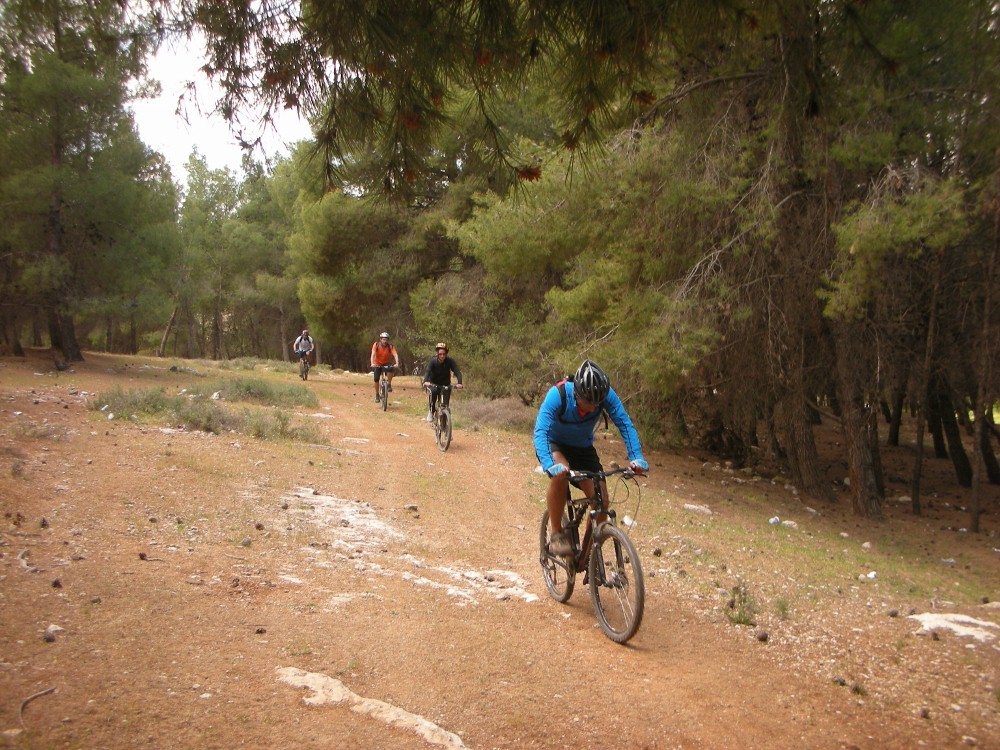
    Sa'ad leads our group through Shwaifat Forest
    Sa'ad leads our group through Shwaifat Forest

    Now here we were at the Wasfi al-Tal, and Sa’ad rapidly secured authorization for us to enter its roadways on our bikes. I skeptically questioned if this was a good idea; would it be better to postpone the trip if the dirt and gravel paths were filled with Nascar(ish) drivers traveling at 130KM/h? Sa’ad admitted that we’d have to have a shorter ride along a different route of paths than what we’d planned, but we’d make it up to anyone from this group who came next week with some incentives. I helped him and Uday unload the bikes from the roof, selected one with a 19″ frame for myself (the largest one available) and set off along the path, waving jauntily at Mika before slipping on a patch of sand, sending me sumersaulting over the frame into the rocks, slicing my knee open with a 6 centimeter cut. Stupid sand.

    Wincing and feeling blood trickling down my left leg, I took up my regular position as a Cycling Jordan “employee,” counting everyone off and riding in the rear of the group to make sure that no one was left behind. I had never guided here before, but Sa’ad and I always communicate by cell phone to make sure that even if we’re 15 or 20 minutes behind him and the group leaders, I can follow whatever trail he takes.

    As we wove through the trees, it didn’t take long before I heard the sound of angry buzzing coming from the valley far below us as if a thousand angry cell phones had suddenly entered tunnels (you thought I was going to use a “bee” analogy, didn’t you!) Emerging again into the sunlight, I almost ran everyone else over as they waited, assembled by the side of a brilliantly white gravel road, staring expectantly to the left as if waiting for someone. As the cell phones got louder in the distance, I joined them and squinted into the sunlight. Suddenly, before I could get my camera out, a shower of dust exploded around a corner and shot towards us like a whirlwind. Inside the cloud, I could just barely make out the flat black rectangle of a windshield, looking like it was floating and fired at us like cannonshot. Someone shouted to get back, farther from the road. We obeyed just in time as the white car squealed only a few meters from us, throwing a hot spray of jagged gravel into where we’d been standing a moment ago. In another second, the dust caught up with the vacuum caused by the car’s passage and we were all coated with a light dusting of white powder. “That’s the champion driver for the whole country,” Sa’ad told me. “But there’s still 10 other ones behind him – we could be waiting here for awhile.”

    (more…)

  • Back in Jordan: A Tajikistan Summary

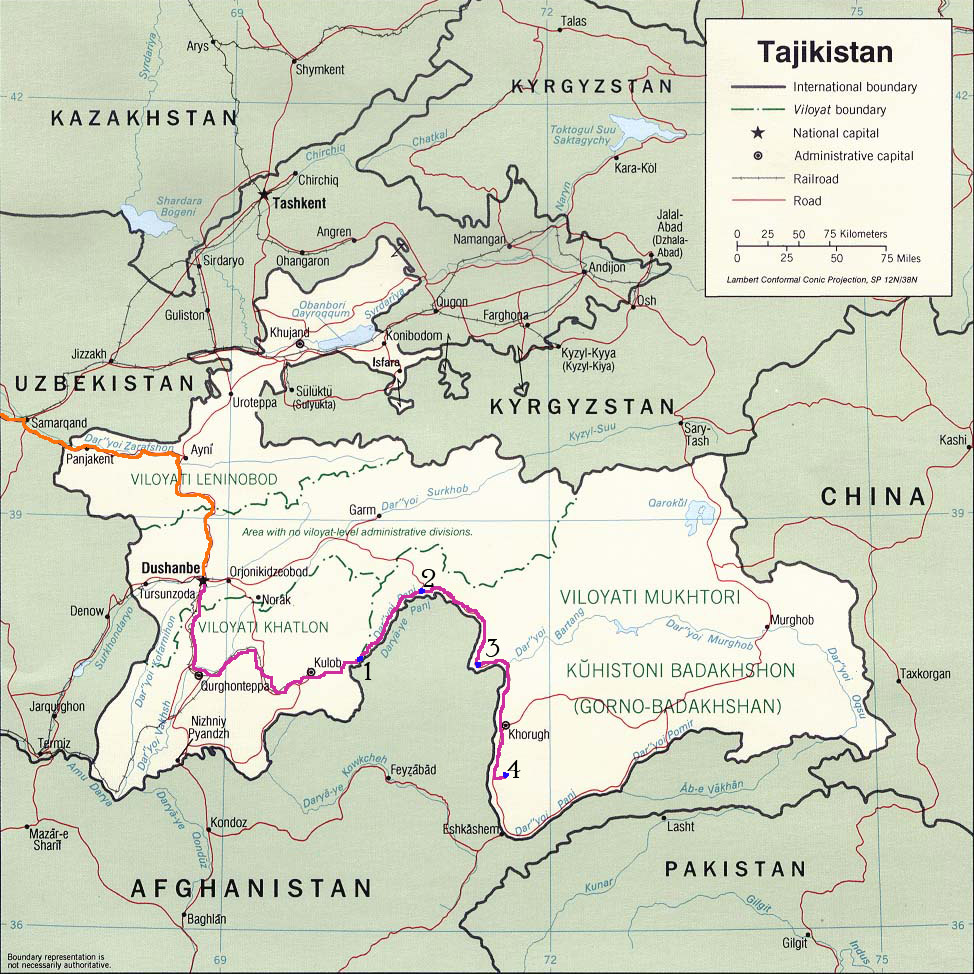
    Tajikistan Route Map

    On the map above: the purple line represents the actual route we took to get to Khorog. “1” represents the approximate location of the There Will Be Mud article, “2” is the location of Qala-i-Khumb, “3” is the approximate location of the “Forty Bodies Teahouse,” and “4” is the approximate location of the Hot Springs (Garm ChashMA!). The orange line is the approximate route that we used to get into Uzbekistan.

    It’s a been a week now since I returned from my Central Asian vacation, and it’s time for me to stop backdating my entries and set the clock on the blog properly. I’ve been doing some rereading and poring over my old travel entries from my time in Britain in summer 2007, and noticed that they were all much shorter, and without pictures. That probably explains why I was able to easily keep up with day-to-day activity then – in the time since then, my blog has just had its second birthday, and my family and friends’ expectations for my blog has increased. It’s a photography-based internet out there, and 500-600 words of text just won’t cut it anymore.

    Besides that, I felt like I had an honor and a duty to uphold to Tajikistan. As the previous blog entry mentions, I’m now an unofficial “Son of Tajikistan” and I want to make sure that this small, proud, and beautiful country gets the recognition that it deserves on the national scope. There are so many opportunities for business and tourism waiting in those mountains and forests; all it needs is a financially-responsible guiding hand a government that embodies the wishes of the people – progress, health, education, and technology. It’s my pleasure to write these copious blog entries in the hopes that readers searching for more information on Tajikistan in particular, or Central Asia in general, can receive an in-depth picture of the area. This means I tried to make my writing honest to my opinions on the country: strong, beautiful people with a fervent wish for progress in their new country, but a corrupt and ineffective executive government that takes the worst aspects of Communism and Capitalism and twists them into a beast in which change and hope die in their infancy.

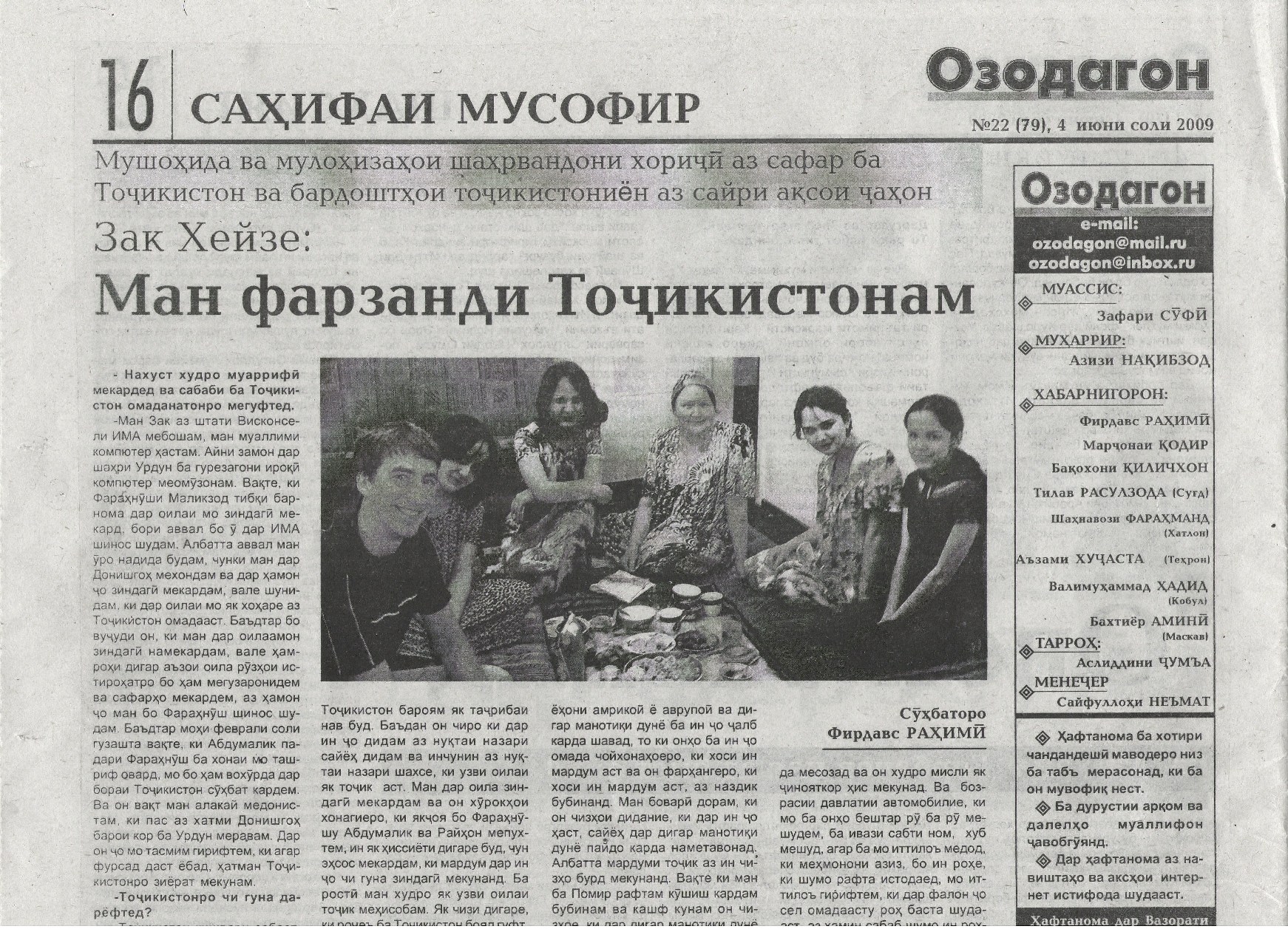
    Speaking of me being a “Son of Tajikistan” – below is a scan from Farahnush of the newspaper article they wrote about me. Of course I’m unable to read it but apparently it was entirely unchanged from what I said – the good and the bad alike. I can’t believe they wrote so much about me, and at the bottom of the second page (which is located here) I’m told it says “to be continued,” I guess they really liked what I had to say.

    Ман фарзанди ТоҶикистонам
    Ман фарзанди ТоҶикистонам: I am a Son of Tajikistan

    And, you know, this is happening all over the world. Dozens of countries around the globe suffer daily with outrages and injustice, media suppression, taxation, and emigration snafu. Certainly, Tajikistan isn’t in the same league of difficulties as Palestine, Iraq, the Congo, Darfur, or North Korea, to name a few. But therein lies the problem. A good dictator like President Emomalii Rahmon knows that the key to a successful power consolidation is to be low-key and non-expansive. As long as he doesn’t try to overstep his boundaries of the little country, he can get away with essentially anything he likes and the International Community will overlook it, remaining more concerned with other things. I didn’t speak with a single citizen of Tajikistan who felt that their president had their best interests in mind, or that Tajikistan was seeing the post-Communism changes that it deserves. But most remain hopeful that their future could get brighter if governmental changes were made – not just in Tajikistan, but in many of the former-Soviet countries. For example, President Rahmon has been able to remain in power indefinitely so far thanks to his modification of the constitution that allows him to run, and rerun. He imprisons or exiles political competition when it appears. Such things are apparently so common to the jaded eyes of the United Nations that this isn’t even worth investigating. Yet here the United States is, continuously pouring money into a war into a war in Iraq that Obama cannot control (his military staff says one thing to him, then under their breath says another) and working as Israel’s lapdog to fund a slow but steady genocide against the people of Palestine. Your tax dollars at work. If a large percentage  of that was put not into war, occupation, and weaponry but instead research, unbiased news, foreign aid, and diplomats to help Tajikistan and all the others like it, I think a lot more people could sleep more soundly at night. Okay, I’ll get off my soapbox – for now.

    So what are some of the differences, similarities, and things that surprised me in Tajikistan?

    (more…)