HeiseHeise.com

The Personal Blog of Zach Heise

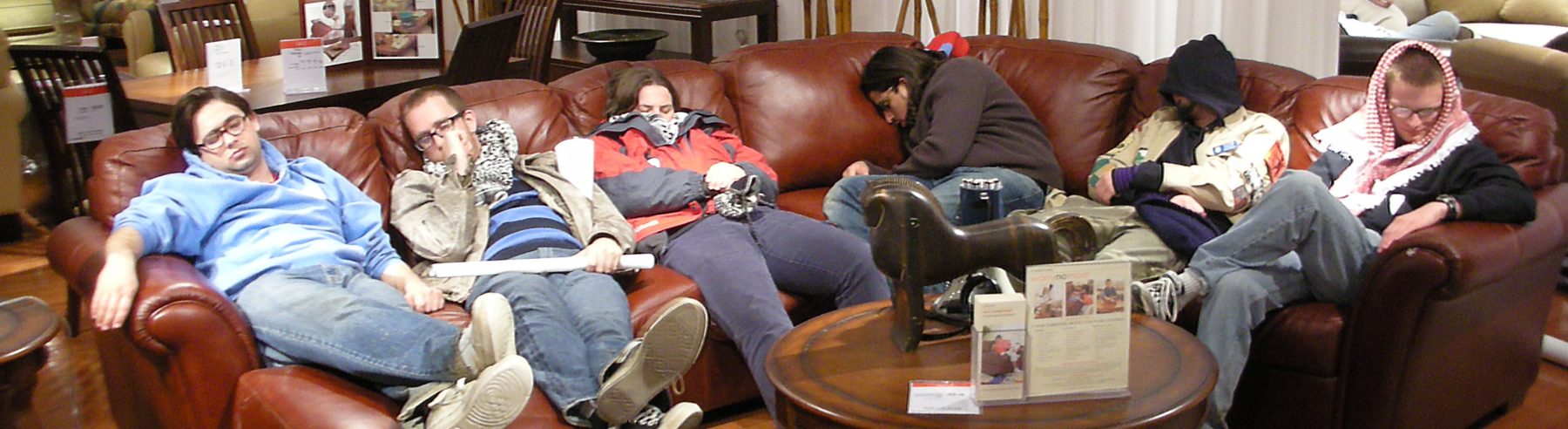
Sleepy aftermath of Stop the Surge 2007

A random image. Reload page for more. Want more info?

Month: July 2009

  • Graduation in a dishdasha

    (due to security reasons, I have to keep group pictures low-res)
    (due to security reasons, I have to keep group pictures low-res)

    It’s hard to believe that I’ve finished my nine-month stint with Entity Green Training and will be saying goodbye to Ayn al Basha as a part of my daily life. The morning car rides through the dusty desert on the edge of Amman, coffee, constant hand-shaking with a dozen hopefuls, all wanting to get into the next session, joking with them in Arabic as best as possible…it’s weird that it’s over almost as soon as it’s begun. The final session, my last group of 16 students, received their certifications in the Yohm al-Tukhreej, or Day of Graduation.

    I had been looking at photographs on the wall in my classroom last week, looking at the graduations for the previous students that had come and gone over the past year. With my first group I was wearing jeans and a plaid shirt, for the second I was wearing a tie and slacks. What to wear for the third and final one? I remembered Philip’s gift to me back in January after I had returned from Christmas vacation in America, a long, blue flowing robe, called a thobe in Saudi, or a dishdasha here in Jordan. Why not? When in Rome…

    The days leading up to the graduation were like the others; each time we do it a little better and a little more efficiently than the previous one. This time we had all of our certificates printed out, stamped, signed, and bagged early, and our office administrators seemed confident that things might go smoothly. We’ve added three new sessions since November ’08, for a total of about 8 graduating at one time, and we had to take into account that each class’ ceremony takes about 20 minutes to do. With everything prepared the afternoon before, all that was left for me to do was to bring the dishdasha from Jebel Amman over to Wajih’s house.

    To be honest, I was a little unsure of how to present myself. Several of my students over the year have been shiookh, (plural form of sheikh), which could be roughly translated as a scholar or devout Muslim. They grow their beards long, wear the traditional cap, and a long, flowing dishdasha – they’re never without these items, and they stand out on the campus since the majority of Iraqis would not be considered shiookh; that’s the Gulf countries you’re thinking about. So what would be their reaction to me, a tall, essentially-beardless white guy, dressed in the clothes that have traditionally belonged to the Followers of Mohammad? I didn’t want to offend anyone. But then there were the students who I saw wore the dishdasha for comfort in the hot summer weather. After all, no one knows how to live in the desert like Arabs do, and the dishdasha is designed for cooling purposes if worn properly.

    For that matter, I fretted, what is the normal way to wear it properly? Jeff had told me that down in the Ghor Safi region where I had met the Sheikh Suleiman last year, men tend to not wear too much underneath the robe, merely underwear – or less. However, some shiookh worn full undershirts and short trousers, too. I decided to split the difference and forgo a shirt, but wore regular khaki shorts below, as it seemed like the safest route. I realized I could have posed this question to my class, but Iraqis tend to get very excitable and love to debate, and even a debate on what to wear under a dishdasha might take 2 hours to bring to a conclusion. I can only imagine the look on Aaron’s face if he wandered by the classroom and heard people shouting about the benefits of nudity beneath a robe.

    When Aaron and Jeff arrived to pick me up from my usual spot near 6th circle that I’ve used since coming to stay at Wajih’s, they grinned, cracked the window, and asked me who I was and if I had seen Zach. They also asked me the “what’s under the dishdasha” question, which I truthfully answered for them: nothing for you to fire me over, gentlemen. My students, as they began arriving in their best suits and clothes an hour later in Ayn al Basha, roared with pleased laughter upon seeing me. “Why are you wearing that Mr. Zach?” a few of them asked me, and I explained the Western world’s tradition of wearing robes on graduation day – it was as good a reason as any! Mahmoud, the chief shiekh of my class, nodded solemnly his approval behind his thick black beard – we were lucky to have him with us briefly that day, as his wife was in the hospital that day having their first child.

    As you can probably imagine, it’s hard to walk in a dishdasha, no matter how easy the Arabs make it look with their years of practice. I found it much easier to sit outside in the warm breezes with my students after the ceremony than to try to fight gravity’s wish to trip my feet in the flowing blue robe. We sat outside, sipping Pepsi (or Beebsi, in Arabic’s “p”-less alphabet), and talked about Jordan, Iraq, and America, and finding work in all three of those places.
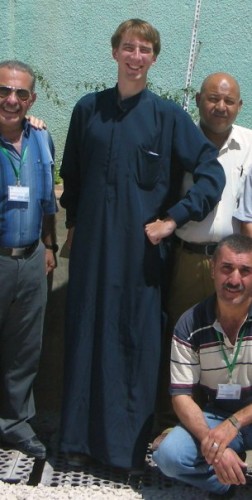
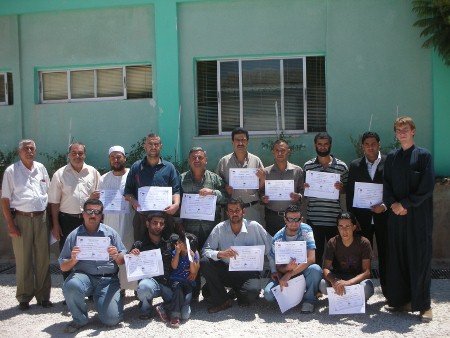
    Me with all of the other teachers after the graduation ceremony
    Me with all of the other teachers after the graduation ceremony

    I needed to return to Amman before 3, as the usual post-graduation party was settling down. Late last month I acquired a contract with an organization called PTEE near third circle to do tech support work with them, and I had a meeting to attend. Magid gave me a ride back to the city, but he needed to drop me off still several kilometers from home. I assured him that I could catch a taxi from there – or so I thought. I ended up walking the entire route from University Street to third. There was almost no empty taxis available for me, and strangely enough, the two that did stop for me took one look at the hooded, shade-wearing, backpack-carrying man in a blue dishdasha and then drove off again. I didn’t know what could possibly cause this reaction, until I arrived at PTEE and Dick, the organization’s founder and president, looked at my dusty and sweaty dishdasha and explained that the blue color of my clothing was common in Egypt than anywhere else.

    I hate to have to make the comparison, but unfortunately it will simplify things. It’s a sad but true fact that the stereotype of the “Mexican in America” brings to mind a certain level of education and skill set. Racism affects every country, and Jordan and the rest of the Arab world are no different with the Egyptians. Egyptians are expected to be building guards, drivers, and construction workers, and they’re certainly not assumed to be rich enough to afford a standard “yellow” taxi (as compared with the other common forms of transportation in Amman, the “white” taxis (neighborhood-specific local transport) and the bus system. With my hat and dark glasses on, I was given no more than a disinterested passing glance at the color of my clothing before being passed over. If they say that racism means being no more than skin-deep with your judgments of people, than what do you call racism merely based on the color of your robe? It was a disappointing thought for me – after all, Arab nations enjoy calling themselves al-Allum Arabeeyeh and al-Umma, literally “the Arab World” and “the Mother.” This sort of racism seemed a far cry from the kind of brotherhood and camaraderie that I think they would prefer to be known for.

    The fun with the dishdasha wasn’t finished yet. After work I briefly stopped by my usual residence at Philip’s. There I found a new tall, black gate with a shining gold lock on it that certainly hadn’t been there two weeks ago when I last stopped by. And here I was, without the key to my own home and wearing a garment that definitely wasn’t going to make my usual Mario-esque wall jumping any easier. I went next door long enough to greet Marwan at his grocery store (who greeted me with his usual “Mr Zach the teacher! Welcome Marwan’s Shop”) and let him know that if any of our other neighbors asked why a strange Egyptian was climbing over Mr Philip’s wall, he should reassure them on my behalf. Then I hitched up my dress around my hips, tossed my bag onto the top of the wall, and then scaled over the side into the welcome dust that eased my landing. I was very, very glad I had decided to wear something under the dishdasha.

    I dropped off some paperwork and put the dishdasha back on its hanger in the corner of my room. It was an strange experience to use it: both physically for the feel of its cold, smooth silk around my ankles but also the reactions that it brought me, both the good and the bad.

    I’ve started so many posts with “It’s hard to believe that…”. Ever since I first arrived in Amman almost a year ago, there’s at least a couple things every day that makes me think or say that phrase – some great, and some less wonderful. Although the main reason I came to Jordan was to help people that had lost everything in their flight from their terrorized country, it’s also just as true to say that I came to the other side of the world specifically to find things that I’d find hard to believe.

  • EU treats Microsoft like dirt; Microsoft lets them

    Wouldn’t it be ridiculous if the government ordered McDonald’s sell Burger King’s products at all of its restaurants, simply because Burger King did not have as many locations? Wouldn’t you roll your eyes at this example of the government sticking its nose where it doesn’t belong? Doesn’t that seem like it would be unfairly punishing McDonald’s for having more restaurants than Burger King, and then add insult to injury by forcing the company to sell their competition’s products?

    Welcome to the insane world of the European Union, which doesn’t seem to have anything better to do than make money by suing American corporations. Ever since Microsoft’s anti-trust suits in America, the EU has decided that instead of encouraging their own corporations to flourish and breed competition to the world’s most widely-used operating system, they will instead attempt to suck huge lawsuit-related profits out of Microsoft in order to allow the company to sell in Europe.

    In this case, the “hamburger” in question is Internet Explorer, every tech’s favorite punching bag. Now, I’m no real fan of Internet Explorer either; I think a company like Microsoft with all of its power and money should be able to make a browser that’s much more secure and functional, but that’s beside the point here. Microsoft made the operating system, which includes certain pre-built programs: it comes with a calculator, text editors, picture and video viewers, and of course an internet browser.

    The EU objects to the inclusion of this software. In previous years with Windows XP and Windows Vista, the software targeted was Windows Media Player. Even more ridiculous, the EU demanded that Microsoft release the source code for its server operating system so that competitors would be able to get full Windows Server functionality, without paying for Windows Server. As the linked article points out, these two stipulations also included a fine of 800 million USD, the largest the EU had ever leveraged. After the EU declared the Microsoft had not met their expectations, they started fining the corporation 1.5 million USD per day until they “complied.”

    It’s not over yet. The EU continuously rates Microsoft’s compliance as unacceptable, and last year handed out a ruling of almost 1.5 billion USD to the American company as punishment for “foot-dragging.”

    Microsoft has since released versions of XP and Vista in what they refer to as the “N” series, which removes Windows Media Player. However, the EU is not content with this, and in their search for new and more lucrative ways to loot American intellectual property, have their sights set on the upcoming Windows 7. Microsoft perhaps sensed this, and even as the EU hemmed and hawwed about telling Microsoft to take out their long-included Internet Explorer, Microsoft proudly whipped off the cover from their new baby (which has been extremely well-reviewed by dozens of sources) which pretty much allows for everything in the OS to be modular – install it when you want, uninstall it when you want, including of course Internet Explorer. They even offered to make a version for the EU that didn’t have the browser built into it. I’m sure they felt they had all their bases covered.

    The EU was disappointed, as this meant there would be no lawsuit for them to leech off of. So, they came up with a proposal that they felt sure Microsoft would never go along with (= another lawsuit), which is to force Microsoft to offer a “ballot box” option that would appear the first time a Windows 7 computer is turned on. This “ballot box” would ask customers what browser they want to use, and then upon the selection, that browser would be installed and made the default. Basically, they told Microsoft to sell their competitors’ software, for free.

    (more…)

  • Finishing things up at school

    It’s hard to believe I’ve almost finished my nine-month tenure as an instructor in Jordan and have been been overseas now for eleven months altogether. Everyone I know has been asking me what I’m going to do next, and to be honest, I still am not entirely sure. It’s ironic – at this time last year, many of my fellow just-graduated friends were worrying about what they were going to do next. I was a month away from leaving for Jordan and unworried about the future (except for that little thing about flying halfway around the world to work with people I’d never seen before and learn a language I’d never spoken before). Now it’s my turn to wonder: with all the opportunities I have in front of me, what should I do next?

    My contract with EGT will be expiring at the end of the month, and that will be the end of my contractual duties to them, although I know I’ll be doing odd jobs for them and server work for quite awhile. The other teachers all seem to be quite sad to see me go, and ask me what could convince me to stay. I heard about an email that was sent to one of the administrators from a teacher admonishing them to “pay Mr. Zach more money so he will stay with us.” I had to chuckle at that one, but anyone who knows me knows I’m not here for the money – only to help people and see the world.

    If I choose to go back to America for a little while before embarking on my next travels, one of my closest friends won’t be as far away as I thought. Wamidh got his official acceptance and approval for he and his wife to emigrate to America! He came to the office to greet Jeff and I early in the morning, a big smile on his face, and said simply, “They let me in.” All of the students were congratulating him, shaking his hand, and going over their favorite stories about America one more time. Normally I would try to keep the non-class related chatter to a minimum until I let them out on a break, but in this case I was willing to make an exception – and not only because with Wamidh answering questions from the students, I wouldn’t be able to get translated anyway! He won’t know where and when exactly he’s being moved for several weeks more, although he’s thinking possibly somewhere in Virginia first to be with his family. However, it would be wonderful if he had arrived before January 2010, as he’d then be able to visit Wisconsin and I could show him around the land I grew up in.

    Wamidh wears a blissful expression during his first visit to Fuddruckers; I got him the "Southwest" with all the "fixins'"
    Wamidh wears a blissful expression during his first visit to Fuddruckers; I got him the "Southwest" with all the "fixins'"

    It’s amazing how popular the Ayn al Basha site has become. We’ve gone from being newcomers and a faceless NGO in the village to being the center of attention. I take that back, it’s not that amazing – we work with more than Iraqis now, although they’re still our primary audience for our training with at least 80% of the classes being filled with Iraqis, with a few Jordanians and Palestinians from the nearby Baq’a refugee camp coming in. Lines of people wait outside the door every morning for Jeff, Aaron and I to arrive so that they can ask Jeff for application forms. It’s gotten so crowded in there that Jeff and Ahmad have had to start turning away everyone who isn’t an Iraqi until “the shaher tamanyah” – the “eighth month” as they say. Everyone wants to be in on it, though – how many training schools do you know that pay the attendees to take lessons? I guarantee that at the beginning of August, they are going to be swamped with everyone coming back at once.

    In other news, I’ve been living on the other side of town for the past several weeks now. Wajih is heading out on some business trips soon, and his family is on vacation in America, which means that they needed someone to take care of the house and their sweetheart of a dog, a big happy golden-colored fellow named Chance. I was happy to oblige the request; every one of my pets back in Brodhead has passed away since I left for Jordan, and the thought of taking care of a lovable dog for a month made me nostalgic to see my old boxer, Willie, and our golden retriever Bailey once more. Chance probably wouldn’t be a very good guard dog, but the large majority of Muslim Arabs have a distrust or even fear of any dogs which means that his very presence is an excellent deterrent for any unwanted guests. Also, he has this weird habit of smiling whenever he’s smiled at, something that Wajih swears they didn’t teach him but instead he just learned by mimicking his family. So whenever someone comes into the house, Chance will run towards them, wagging his tail and smiling at them while barking and snuffling. Of course, when a dog tries to smile like a human, his lips pull backwards and all his teeth are bared, which means that Chance’s smile means to most people that he’s going to eat them.

    Lastly, guarding Wajih’s house also means guarding his PS3 and 50″ flat screen LCD too. Like I said, I was happy to oblige the request.

    Man's best Friend(s)
    Man's best Friend(s)
  • Israeli “non-fatal” weaponry

    Ironically, I don’t think about the occupations of Iraq or Palestine as much as I used to back in America, even though I’m closer to it than ever before. Every day, my work influences the lives of dozens of different refugees from Palestine and Iraq. We do business, they learn from me and I from them, and sometimes I forget the impossibly difficult situations they or their families came from, somewhere between 61 years ago and last month. However, they are proud people, my friends and students, and they don’t like to talk about their plight, and if I ask them if there will ever be peace in their countries, I’m given a small smile, spread hands, eyes cast upward, and the ever-present Insha’allah – God willing.

    The Campus Antiwar Network, the student activism group that started me along this path over two and a half years ago is still going strong in the USA. I’m still on their email lists and I enjoy reading about their protests, planning, and conferences to rally student enthusiasm behind a full troop withdrawal and authentic democratic elections in Iraq, and a full Israeli withdrawal into the pre-1967 borders defined by the United Nations. I’m pretty sure if anyone actually paid attention to anything the United Nations commanded, at least half of their ambassadors would suffer heart attacks from shock.

    Some of my friends from CAN are over in Palestine right now, working in the West Bank with the ISM, International Solidarity Movement. Here’s their website, Feta Cheese and Falafel. There’s been some amazing videos and stories coming from the small group of dedicated international workers there, and I encourage you to check them out, and leave some words of encouragement on their blog.

    The utter depravity of Israeli soldiers who teargas peaceful protesters, throw percussion grenades at them, arrest them without warrant or reason, and drench them with some possibly nerve-damaging “non-fatal” weaponry called “Skunk” is being brought ever closer to home for me. This is happening less than 150 kilometers from my house now. What can I do when my colleagues are fighting for the rights of people like my students? I can’t just sit here any longer.

    In a couple more weeks, after I finish my final class teaching here in Ayn al Basha, I am planning on joining them over there for a couple weeks in early August, to document, to protest, and to cut down some barbed-wire fences. If all goes as planned, I should be able to join my friends for a week in early August.The more media we can push in the faces of the bored and apathetic American public, the better the chance that we will slowly but surely cut down the barbed fences of Israel’s terrorism against their Arab cohabitants.

    “Occupation is a Crime, from Iraq to Palestine!” Time to dust off my old chants and start practicing again. It’s been a year, but an activist only goes dormant for awhile; he never stops activizing.

    Update: Due to unforeseen travel related circumstances, I’m unable to join my comrades in Palestine. However, I’ll be praying for them and their safety, and I encourage you to check out their website and share with your friends. We need more people like them to spread the truth of Israel’s bloodthirsty depravity.

  • Dinner with Khalil’s family

    Sa’eed yohm al-Istiqlal! Or as we’d say it, Happy Independence Day! Jordan celebrated its own independence from Britain on May 25th while I was off in Tajikistan, but from what I’ve been told, they do much the same as America does, except with more cannons. I wish I’d seen that one – or heard it! To celebrate America’s 233rd birthday while thousands of kilometers from home, Aaron arranged a party at my house for all of our expatriate American (and other) friends and colleagues.

    It was a great success; beer, beef/chicken/pork available, and Aaron managed to avoid blowing off his head with fireworks, or setting my house on fire when he was shooting foot-long Roman Candles off of my roof. Although, of course, when everything is made out of cement and concrete like it is here, it’s probably somewhat difficult to actually start a dangerous fire. Something tells me that the Amman Fire Department probably doesn’t get many calls; if one even exists.

    As I’ve mentioned before, fireworks are a common sight here in the city – they’re always set off for weddings and now, in the summer, for graduation parties as well. Here on the top of Jebel Amman, I can always see at least 4-5 sets per night lit off somewhere in the city spread out to the south. However, that didn’t stop the neighbor children from lining up out on the sidewalk in front of the house to stare, mouths agape, at Aaron’s pyrotechnics, and shriek madly with every gunshot-like report. However, it’s just as likely that they were equally intrigued by the large number of foreign women present outside under the fig tree – possibly an unusual gathering here in central Amman.

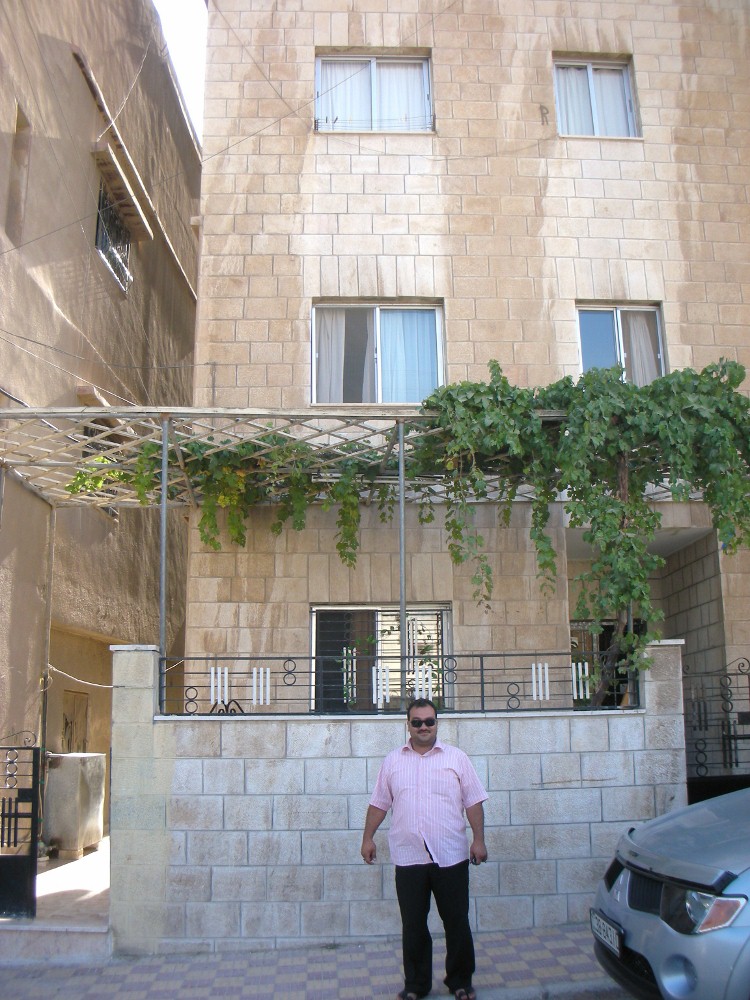
    A few weeks ago, Khalil had suddenly turned to me at work and asked me why, after all my months working with him in Jordan, I had never been to his house for dinner. I told him to name a date and I’d be there, so we decided on July 4th, the day after our Istiqlal-party. He picked me up and drove me across town to yet another one of the dozens of Jebels that the entire city is built across. As always, the weather was blindingly sunny and cloudless, and I could see for kilometers from the top of this mountain, all the way back to Jebel Amman and the Royale Hotel (momentarily visible there in the previous video) that is next to my house. Huge and cylindrical, the hotel makes a perfect landmark.

    Khalil proudly presents family's grape-adorned building to me
    Khalil proudly presents family’s grape-adorned building to me

    Khalil welcomed me to his apartment building, although a better name for it would be “domicile for the entire extended family.” From what I could decipher from Arabic into English, the house had started as one (or two) floors for his parents and his seven brothers, but in the decades since it has expanded into an entire apartment building for all 9 families. The idea of family in the Arab world is entirely more personal than it is in the West. In America, it’s considered a normal, if painful part of life for the family to disperse and the parents to eventually be put into a nursing home. Here, however, it would be a gross embarrassment for your parents to be put in a home, and socially it would be like wearing a sign that says “I am a disgraceful, incompetent son.” Likewise, few Arab young men have any interest in leaving home and striking out on their own – Haitham, for example, gave me a skeptical look when I asked him about this and said, “but who would take care of my parents if I left?” Khalil and his brothers, their wives, and the combined total of ~15 nieces and nephews make sure that their matriarch will never, ever have to worry about a single thing; they treat her like a queen.

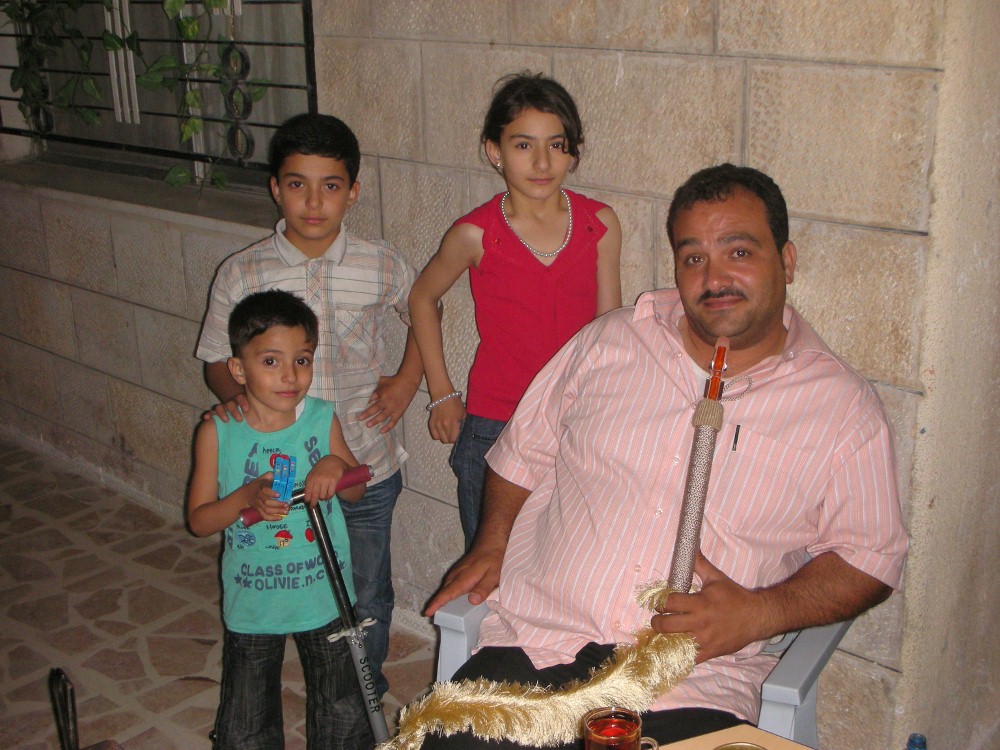
    I was introduced to Khalil’s three beautiful children, Mohammad, Marwan, and Rama, the eldest child and only daughter. Rama, like most Arab children and especially females, was extremely shy for the first half hour and barely peeked around the door of the sitting room where Khalil and I sat and talked. Her two younger brothers, the solemn-faced 8-year-old Marwan and the excitable 5-year old Mohammad. Marwan was extremely serious and laid back, sitting on the plush couch in the “visitor’s room” across from his father and listening carefully to everything that Khalil and I would say to each other. Meanwhile, little Mohammad climbed all over Khalil and his couch while bouncing up and down on his shoulders, openly peering at me with wide eyes.

    Khalil and his three children, enjoying the cool night air after dinner
    Khalil and his three children, enjoying the cool night air after dinner

    Like all Arab houses, the Khalil’s apartment has a large main room for dining and entertaining visitors, with the best of everything – lines from the Qur’an hung in pictures around the room, a picture of his late father, and plush curtains and hangings in every window. My eye spotted an odd thing in the otherwise richly-furnished room: a wall-mounted singing bass. You know, one of the ones that you walk in front of, and then its head and tail start to twist and gyrate and it painfully screeches out some folkish tune. Thankfully for all of us, the batteries in it had long since died, and judging from the level of corrosion on the contacts, it was debatable as to whether it would ever work again (the Arab world doesn’t deserve the Singing Big-Mouth Bass). I asked Khalil where he had found a gem like this, and he shrugged and told me it was from Saudi. Although he hasn’t worked there for several years, at least five or six of his brothers have jobs in the country in engineering and construction-related fields.

    The dinner, prepared by Khalil’s wife and brought to us by Rama, was a delicious spread of grilled Sultan fish and roasted chicken. As I’ve now come to expect with Muslim families, Rama and her mother ate elsewhere, while the four men ate in the visitor’s room. Khalil proudly proclaimed that all the food on the table was for me, and personally spent more time watching me and refilling my glass and plate than eating himself. Mohammad sat to my right and gazed at me raptly, barely chewing. Finally, he asked me in a hushed whisper if I loved Satan. Khalil dropped his fish and looked up at him sharply and Marwan gave his younger brother a scandalized look. Mohammad followed up by asking me if I was Satan’s friend and if I lived with him in hell, enjoying the reaction from his brother and father. I was amused and tried to explain to him in my broken Arabic the similarities between Christianity and Islam, which Marwan keenly noted and quizzed me on just how devout a Christian I was. Khalil firmly reprimanded the boy, telling him that he was embarrassing him and not to ask such silly questions. Finally, Mohammad asked the table at large if Satan loved God, and Khalil rolled his eyes skyward and plaintively asked Allah why his son persisted in asking such things to a guest. I repeatedly told my friend that I wasn’t bothered by the questions, but after that point Khalil was definitely asking Mohammad to get more things from the kitchen for the rest of the meal, as if to keep him from focusing on me too much.

    Afterward Khalil led me back downstairs to the veranda overlooking the main street outside his home, where several of his brothers were returning from their 10-month stint in Saudi to be with their children in the much-more-comfortable Jordan summer. I met all five of Khalil’s brothers who had come back to Jordan; the other two were still in Saudi for the time being. The evening was filled with the sounds of shrieks of laughter and games from cousins playing in the patio and in the street as their fathers and I watched contentedly from the shade created for us by dozens of overhanging grape vines. Each father in turn took great pride calling over his children from the group, presenting them to me and having them demonstrate the results of their English lessons for me to rate. Like Rama, the girls were highly embarrassed by this and most of them hid behind their fathers’ chairs, but all seemed to love the attention and were happy to answer the quizzes that Marwan I, Mohammad I, Ibrahim, Mahmoud, and Wahleed gave them. One of the girls was even able to sing most of “I’m a Little Teapot” to me, to which I applauded heartily. Rama, being one of the oldest and much braver now that she was surrounded by her younger cousins, boldly strode up to me and greeted me in whole sentences, welcoming me to the family home. I thanked her in return and told her that it was her responsibility to help her father learn as much as she was in school, causing her to blush furiously and her uncles to laugh uproariously at their elder brother. Khalil chuckled and nodded sagely; the patriarch of the family surrounded by his flock. One of Marwan’s daughters, goaded by whispered nudges from her playmates, came right up to me, shook my hand firmly while saying “Howareyou,” and then pulled me down to her diminutive height and kissed me on both cheeks like she’d seen Marwan do when he greeted me, causing everyone to once again break up with shouts of laughter and pat the little girl on the head as she beamed proudly and skipped back off to the others and Rama, who looked a little put out.

    The seven of us sat around the little table for several hours, smoking argeilleh/cigarettes, drinking juice and watching the children play – talking in mostly Arabic and only a little English. Although I was definitely able to hold my own in the language, it was good to have Ibrahim there to help, because as an architectural engineer he spoke English with semi-fluency. They all marveled at how quickly I’d learned Arabic and told Khalil that he should figure out the methods I was using and try them himself. Khalil pulled on his argeilleh thoughtfully and said that Jeff had been trying to teach him for years but nothing seemed to stick. I showed them my qomoos (dictionary) on my iPod and told Khalil that writing was the key, to which he vowed to be a little more proactive in his education then merely jotting a word or two on a whiteboard at Entity Green.

    Mohammad went back with us when I was dropped back off at home. He stood in the backseat between the two front seats and his little eyes struggled between falling asleep and staying open at the excitement of the city around him. I asked him if he minded that I was a Christian, and he ducked his head and bashfully murmured that I was a good guy. I told Khalil that he should bring his kids to Ayn al Basha more often so they have more experience with Western foreigners and Iraqis. I think that everyone would love to meet them – as long as they don’t mind a little interrogation from young Mohammad!