This weekend’s hiking trip to Petra really let me know that my body has missed out 4 months of bicycling. I won’t say that I was exhausted after the trip, but my thighs felt like rubber bands by the time we were finished. Located slightly southwest of the main body of Petra, Jebel Haroun (or, in English, Aaron’s Mountain, or Mount Hor) is not a cakewalk to climb to. If I hadn’t had Pat and his son Marshall to help me out in some places, I might never have made it out of there alive!
As I’m starting to learn is customary for trips to the south, we left at 5 in the morning when Pat’s friend and colleague, Andrew, drove down from Irbid to pick us up. The two of them are Boy Scouts scoutmasters, and besides it being a good trip for the four of us, they’re always looking for new parts of Jordan to take their scouts. I was shocked when Pat confessed to me that he and his family had never been to Petra before, even though they’ve lived in the country for 6 years. “We lived in Egypt for years beforehand” he scoffed jovially. “I mean, can Jordan’s piles of rocks really compete against the pyramids and the Valley of the Kings?” Although I should have known better, I still am in the “Wisconsin mindset” and it’s in December mode. I brought 3 layers of clothes and a light jacket as well. I should have paid more attention to Marshall, who was wearing shorts and polo.
The trip down flew by (obviously, I was asleep for almost all of it) and soon we were in Little Petra, the workers’ village that is near the main tourist village of Wadi Musa. Because we were really going into Petra itself, we skipped the main entrance and the walk down the Great Siq, and instead used the employee entrance, sliding and slipping down the slopes of the mountain to reach the little track that the trucks, camels, and donkeys of the Bedouin use every morning and evening. Even though by this point it was 9AM, I was surprised when we reached the intersection with the main path through Petra and saw that there were almost no tourists. At this same hour, same time last month, the place was already packed with shuffling people in khakis. This time though, the place was deserted, and the four us had to constantly fend off Bedouins, wheedling with us to rent donkeys from them to carry us to wherever we wanted. “But what if we want to walk?” I queried, summing up my general feelings towards transportation in Jordan. I mean, we were clearly wearing hiking boots, wearing backpacks weighed down with water bottles, and all of us had akamma, or residency papers, with us. My question was met with baffled stares and eye rolls, as well as some laments about the fact that we were sure to die of exhaustion.
After we crossed over the central path, the road quickly narrowed, then vanished, leaving us with only a compressed, sandy pair of tire skids to mark the trail. An ominous sign in remarkably well-written English loomed over us as we climbed the first hill, leaving Petra behind us: “Venturing from the regular route on your own is not advisable, it is highly recommended that should you wish to do so beyond this point we strongly advise either a local guide or at least one companion.” Great! We were four, so…onward!
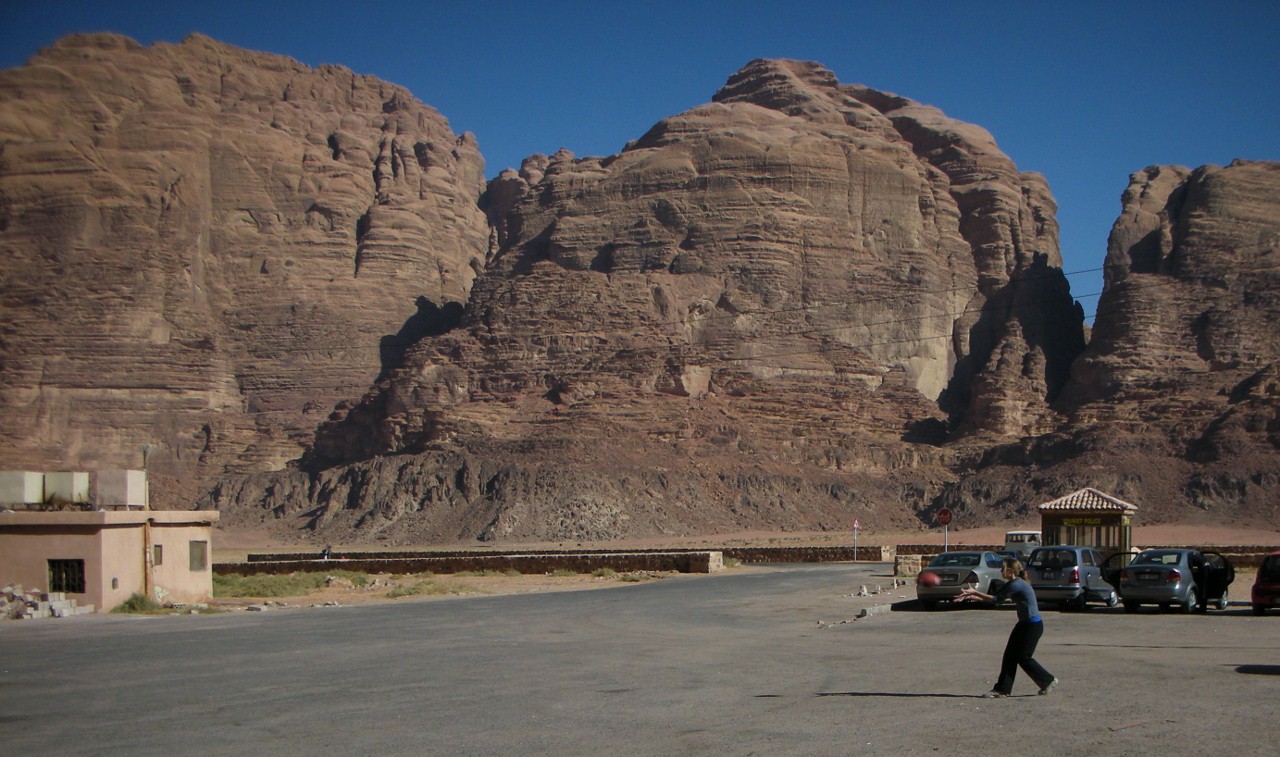
The trail, such as it was, wound around the dunes, climbing gradually in some places and sharply in others. We usually kept the Nabatean mountain range to our right, and it was still possible to see some misshapen and badly eroded Nabatean tombs lumped into the red stone, all with the same stair step-shaped crown over all of them that delineated it as a tomb. The sand under our feet was thankfully pressed down enough that it wasn’t too difficult to walk in most places, but it was only a matter of time before I found myself sweating and pulling off all of my exterior layers, leaving me in just my jeans, boots, and t-shirt. Sweating in mid December! Who would have imagined such a novel concept! Well, I’ve learned my lesson after that day.
We followed a worn steel pipe that was haphazardly draped over dunes and rocks. We saw little Bedouin camps, literally no more than holes in the rock walls, with shreds of fabric and and cooking fires in front of them. Herders watched us disinterestedly from the cliffs above us, and the air was silent except for the sound of our feet in the sand, or clicking over occasional gravel.
About thirty minutes into the walk, we were approached by a Bedouin woman who, to judge by Western appearances, looked positively ancient with a wrinkled, leathery face and hands, but the dark straw color of the hair under her hijab betrayed the fact that it was only the hard life of the Bedouin among the rocks that aged her appearance like this. She spoke a little English, and Pat and Andrew conversed with her and her little daughters that crowded around us. She invited us for tea (which we politely declined, gesturing to our full water bottles), and spread a little bag of worn bits of metal in front of us. Marshall and I inspected them closely at her encouragement, and saw that they were actually Roman and Arab coins, all centuries old – tiny monuments to the massive trade empire the Nabateans had established between the entire Arabic peninsula, and civilizations of the northern Mediterranean. The price was right, and both of us bought a few from her. Marshall knew a bit of Latin and was able to translate a bit of the script around some of the coins, but all they seemed to say was “Hail to the Emperor.”
After another hour on the trail, the tire marks vanished entirely and we found the mountain’s grade beginning to increase. Pat pointed ahead, and I saw a tiny, faraway white dot on one of the mountains in the distance, glittering and blinking like a mirage in the morning sun. “There’s the shrine to Aaron,” Pat informed me. “They say that he was buried up here.” Aaron/Haroun is the brother of Moses/Musa, and because he is mentioned in the Qur’an as a prophet, is very important to Islam. The tiny dot we were seeing was the glittering minaret of a mosque, built on the peak of the mountain almost a mile above sea level.
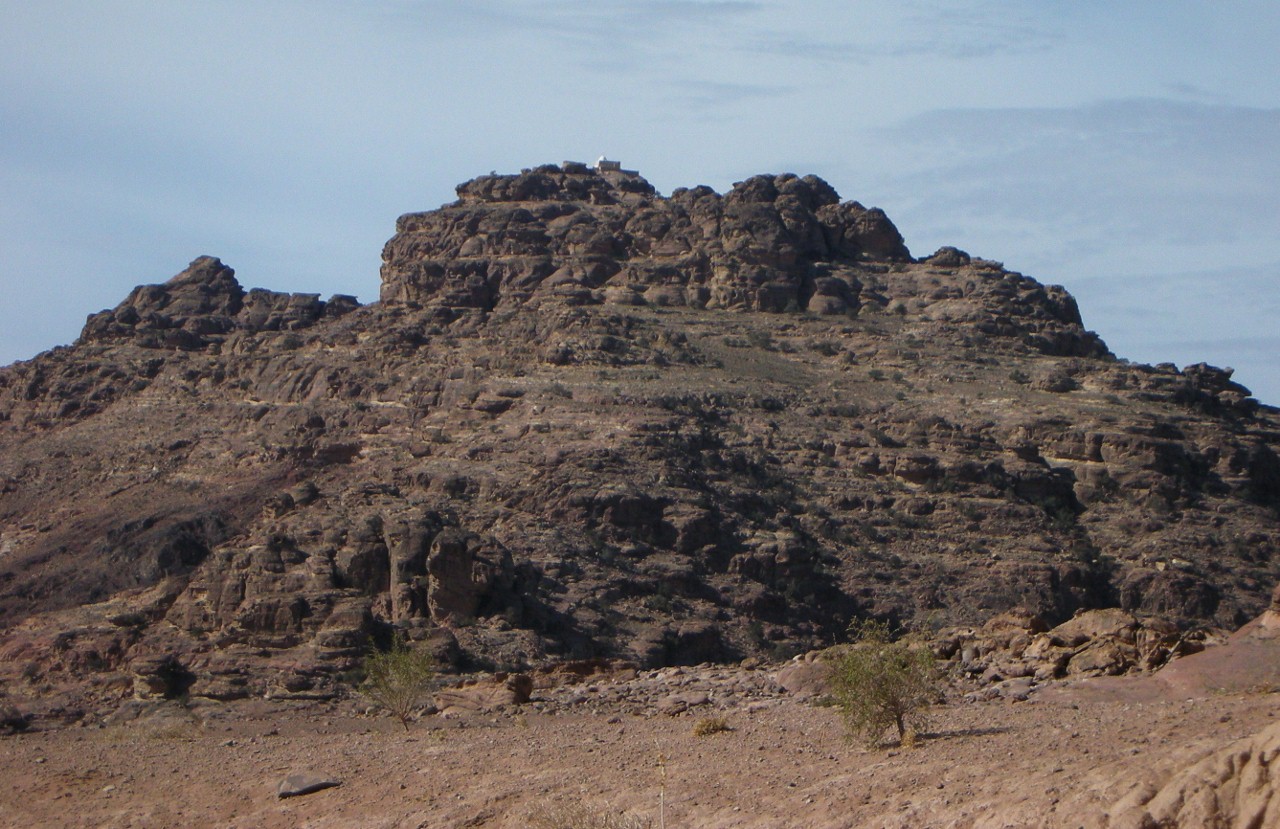
It may look close from here, but it's still 2 hours away. You can see click the picture and see the tiny white dot of the Mosque.
A Wadi (valley) split the stone in front of us, and we skirted its edge for another half hour before we could find a tiny path, no more than a slightly more cleared area of the fist-sized rocks that were now the footpath, and also with small stacks of flat stones set every 50 yards. Someone had put them there, strategically, so we figured that were in the right place and at least probably weren’t going to wander into the desert and die. The ground here seemed to be made to break ankles, so conversation was limited as we kept our eyes to the ground, picking our own paths in an unspoken competition to see which one of us could get to an unspoken point the fastest without looking like we were having a competition. The shimmering dot swam in and out of our vision, crossing behind the peaks of other mountains.