Looking at China’s technological expertise firsthand during our week in Shanghai is simultaneously awe-inspiring and unnerving. We know that we’re in China’s most expensive city, which arguably pushes tech even further than it might be in other parts of the country, but even with that in mind, I sometimes felt like it will take the USA ages to catch up with things that the Chinese take for granted – or possibly, we’ll never catch up at all. More on that below.
Let’s get the obvious out of the way first – yes, the Great Firewall is large and imposing. An obvious show of strength and control by a totalitarian one-party government. The list of websites they’ve blocked, both western and of course, many more local Chinese ones, is large and growing all the time. Websites rarely, if ever, get taken off the block list once they’re put on it, either. Piss off “the party” once, and you’re blocked for all time. There’s no recourse to turn to and say, “look, I took down the post where I pointed out the failings or vast corporate wealth of party leader such-and-such, can I be allowed back again?”
Google search is gone. Gmail seems, weirdly, to allow mail to be sent (sometimes) but not to be received. Facebook and its sub-companies (instagram and whatsapp) are all wiped out. But hey, you’ve got Skype and the Chinese-hosted version of Bing Search! Christine, who didn’t have a VPN on her phone, has gotten very used to searching with Bing now. It’s just as terrible of a search engine in Chinese as it is in English.
I came equipped with two VPNs on my phone – my work one, and a personal one running off my home router. The former is IPSec Xauth, and the latter is PPTP (yes I know it’s old and insecure! I just needed it to see if it could circumvent the Great Firewall!) – the IPSec one worked almost always and could connect very quickly, the PPTP one worked most of the time (some wifi routers seemed to block it without exception) and could connect a bit slower. So my analysis is that as of January 2019, the GF is not completely blocking all PPTP connections, as some websites have posited. The blocks are, as I expected, for commercial VPN companies that are publishing their VPN addresses online for the Chinese government to scoop up and block, not for the entire PPTP protocol. While it would be trivial for the GF to block all PPTP traffic (it uses well known and easily blockable protocols) the Chinese government is now very pro-capitalist and very pro-money. Corporations might not be using PPTP very much anymore (and they sure the heck shouldn’t be, as it can be decrypted within a day) but the Chinese government doesn’t want to run the risk of scaring away companies and their valuable tax revenue by blocking corporate VPN traffic – they seem to only want to block commercial ones.
Okay, enough arcane tech jargon.
What isn’t blocked by the GF? Wechat. 100% Wechat. I remember 5-10 years ago China also used a chat client called QQ (and my AFS brother Daniel still uses an email address with the wonderfully short qq.com domain name (I love me a short email domain!)) but now in 2019, any other GF-approved companies have been washed away by the dominating flood of Wechat. Every person uses it, and every company uses it.
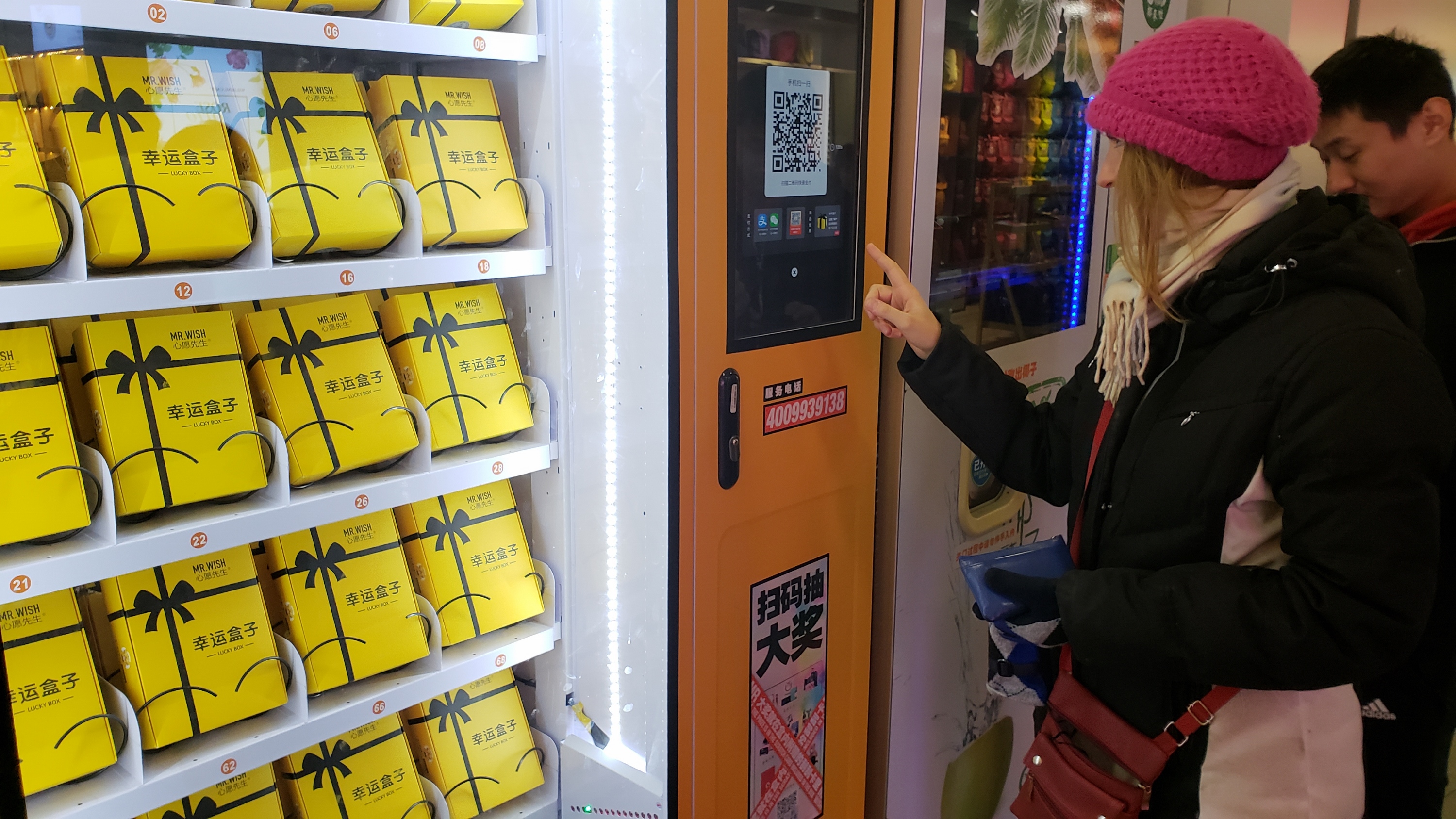
Christine prepares to have Daniel pay 30 yuen for a “Mr Wish” mystery box (she got a big bottle of shampoo)
QR codes. Relegated to an amusing nerd “wouldn’t it be cool if we used these?” oddity in the USA, China has grabbed the ball and run with them so far that there’s essential no way we could ever catch up. Beyond the usual “chat client” functionality of Wechat that we Americans can understand and use ourselves, the other 75% of wechat is how it uses QR codes. If you give Wechat the ability to access your smartphone camera (and let’s face it, most do) then you can enter its “scanner” mode, and aim it at a QR code. Every billboard for every company, large or small, will stick at least 1-2 QR codes on it that you can scan to “follow” that company’s news postings. This is how Wechat is not only a chat system, but also a twitter-esque social media system with a “newsfeed” of public postings by your friends, official company handles, and internal groups – just like how we use them.
But let’s take restaurants. Sure, they have a wechat handle you can follow. Sure, even a noodle cart will let you pay for your meal by displaying your personal wechat QR code, which is linked to your bank account or credit card, and payment takes less than 5 seconds, your phone vibrates and a notification pops up that “15 yuen has been deducted”. But in four different larger restaurants we went to, even each individual table had its own, personal QR code that you could scan with your phone, immediately be linked to not just a menu, but a full ordering system where you could have any item on the menu, sent directly to your table. Interaction with waiters is essentially null at places like these.
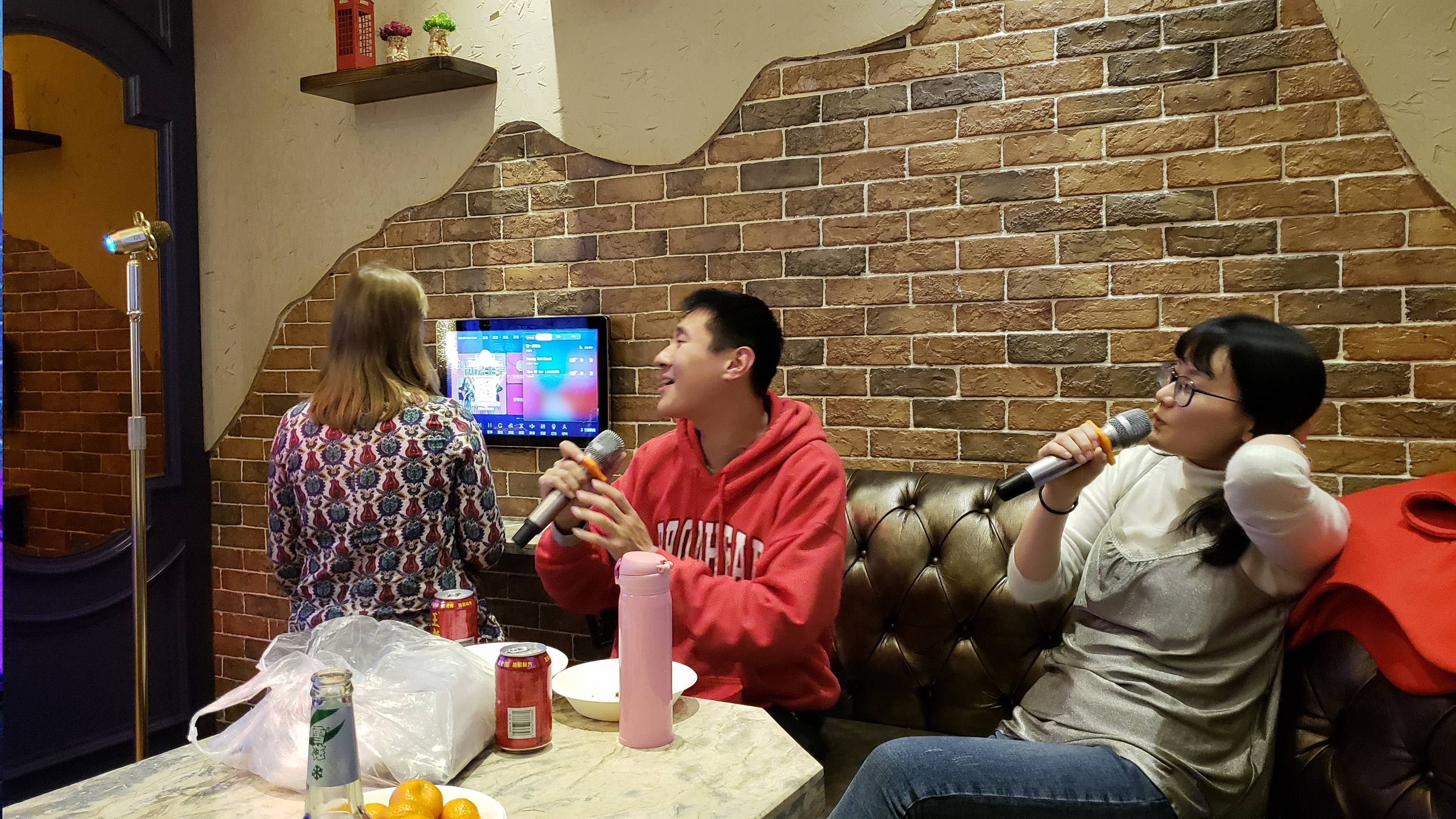
We went to a karaoke house with Daniel, his wife Valerie, and his dad Steven. When most Americans think Karaoke, we think of a Bar format, where there’s usually a DJ, a book of songs he has, and you come up with pieces of paper and give them to him, and he keeps track of what order people give them to him. Then you have to wait your turn, put up with people who aren’t your friends singing terribly, and all that jazz. The Chinese would laugh at us if they saw this. Their karaoke setup is worlds ahead of ours – for $20, our party of 5 got a private room with three microphones, a TV on each wall showing music videos with lyrics overlaid, and a control screen where you can modify the volume of the backing audio, the main vocals track (if you need help singing, for example), and choose the next song out of an internet-connected list of thousands. But of course, you can also aim your phone at a QR code and be automatically connected to the control system for your specific room and do everything from there. Amazing.
Christine works with the control screen instead of using her phone – foreigner problems!
I’ll make no secret of the fact that this blog is 10 years old; something I’m very proud of. However, I’m less proud of the fact that my theme, based on Talian 1.0, is also 10 years old. The maker of the the theme, Steve Arun, seems to have entirely pivoted away from themes to focus on his Virtual Assistant business, and there’s no visible mention of it on his site anymore, nor on the FB page he made for his theme(?!?)
My previous blog post was a test of whether or not I could make a post on mobile, while at a concert, and have it not look like complete crap. Well, H265 encoded videos having no video and only audio aside (hey, at least they work in Safari, Edge, and Internet Explorer!), the pictures were the main problem. A Galaxy S9 photo defaults to what, 4k by 2.2k resolution? When Talian 1.0 was built in 2006, no one was putting pictures that size on the internet. Who’d be able to download them without it taking 5 minutes per photo?
WordPress rolled out “responsive images” back in v4.4 and I was left in the dust. Whenever I uploaded an image onto the internet, be it on mobile or desktop, I’d have to carefully handcraft each entry, making sure horizontal width didn’t exceed the fixed-width “body” of 400px (heh, the old days when 1920×1200 was a big screen).
Today, I’ve discovered the CSS entry “max-entry: 100%” and that % sign is my new best friend. I’ve stuck that onto the img, video, and iframe elements (for Youtube embeds) of the venerable Talian’s stylesheet, and from now on, no more needing to monkey with images quite so much.
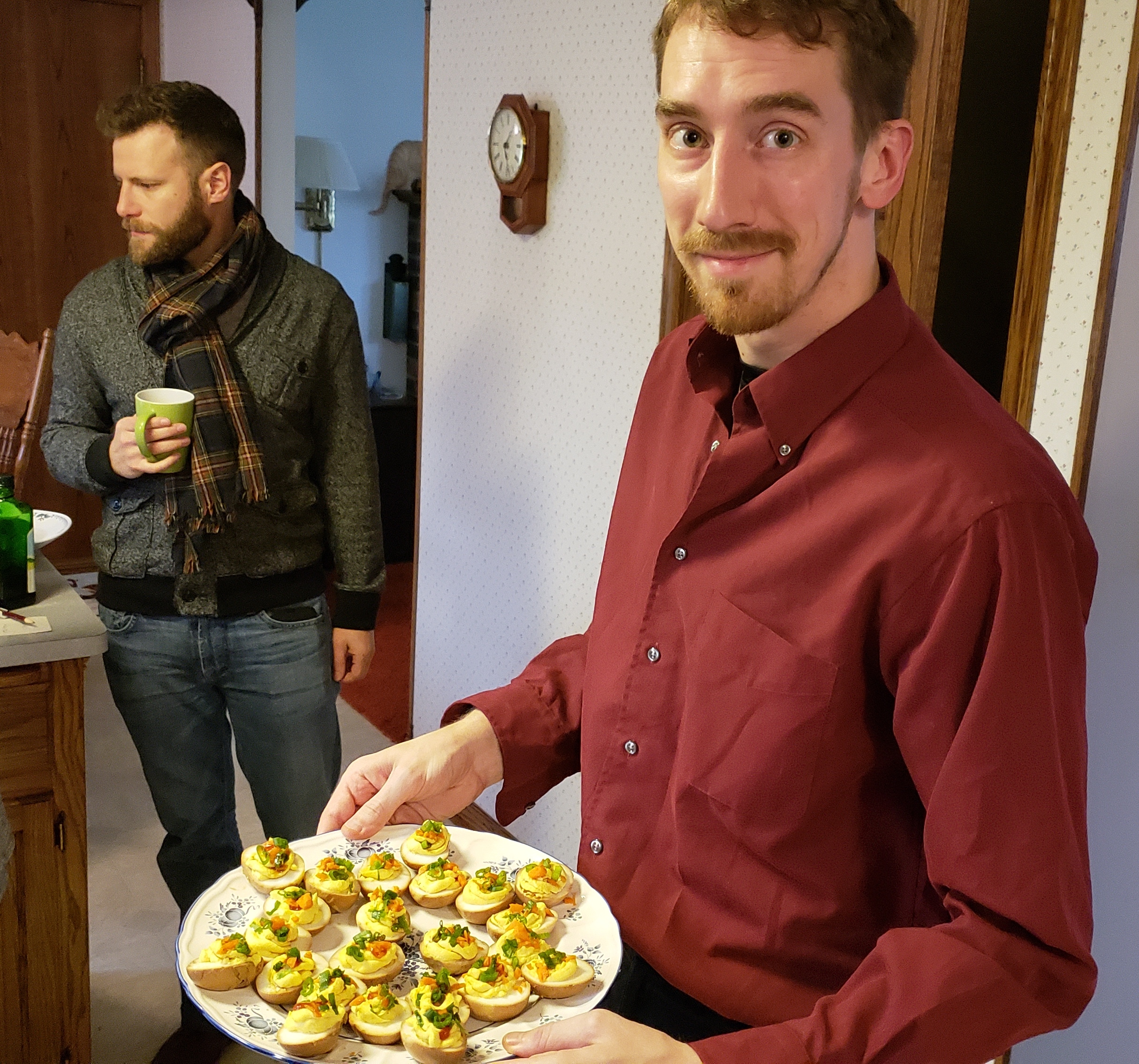
Also, Christine and I made Soy Deviled Eggs for Thanksgiving Yesterday. They were delicious.
No messing with this image! Well, except to set the open-in-new-tab function. Grr.
Note – videos work in Edge, Internet Explorer, and Safari. They’re encoded with H265 which doesn’t have support with Chrome and Firefox.
Note 2 – 8 years later, re-testing; these should now work in Firefox. I don’t use Chrome so I can’t attest to the former.
Since returning from Jordan back in 2010, my musical tastes have changed quite a bit. One of my go-to melodic electronic bands in the past decade has been El Ten Eleven. They were at the High Noon Saloon tonight with Thunder Dreamer opening for them. Bassist/guitarist Kristian Dunn was his usual theatrical self, self deprecatingly joking with the crowd when first his looping pedal and then actually his amp exhibited a few random electric problems. Dunn soon fixed them and was back to wowing the crowd with some super relaxing loops.
The band just came out with its sixth studio album since they first published in 2004, the new one being named “Bankers Hill” – their merch table had it of course, both in vinyl and also cassette tape. I couldn’t believe it! You’ve gotta be pretty dedicated to still be picking up cassettes in 2018.
They had a great light show going on, too. I had a chance to speak with their soundboard operator, who told me that he was from Denver, and joined them whenever they started a tour out from California. The band’s now 18 years old and have had plenty of opportunities to do so! It was his first time visiting us here in Madison at the High Noon Saloon, and he said he was really liking the acoustics.
Speaking of which, whoever that soundboard operator was, he did a great job of tuning his tones to the space. Everything was comfortable to list to without earplugs, and both Kristian on his guitar and loopers and Tim on his drums blended perfectly in the room. As well they should after so many years of playing together!
I haven’t spoken about young Miss Arriba Mordida Heise very much since Christine and I welcomed the tiny 2 pound, six inch long kitten into our condo back in mid September 2017. Cats weren’t allowed in our condo and as this is a publicly viewable blog that I put my real name on, you do the math. However, the end of our time in that condo – and in Panama itself – has arrived. Arriba and I flew back to the USA together on Monday afternoon, the 19th of June.
“Going somewhere, papa? Have fun; see you when you get back!”
I didn’t write about my parents’ visit to Panama in early May; I had just had my Galaxy S8 lost/left behind (and then immediately stolen) from a bus a few weeks after my last blog post regarding Mexico, and I was feeling pretty depressed. When you don’t have a job and you’d only owned your flagship smartphone for six months before losing it, some people might tend to mentally beat themselves up a lot. I wasn’t in the mood to write very much.
But my parents enjoyed meeting the feisty, spritely and energetic kitten that they’d come to know from Christine and I sending private messages and photos to our shared family Google Hangouts chat. They knew that we were having trouble finding a forever home for a spirited – and unfortunately a bit bitey, as you’d guess from the middle name I gave her – 10 month old kitten. My mother was a bit dubious – how would a single female kitten fit with their current cat, a large plump male orange tabby? My father, the softy that he is, seemed instantly smitten with her playful ways, and although she wasn’t on her best behavior for the two of them, her sheer playfulness and loads of personality seemed to be winning them over.
A few days after they flew back to the USA, they told me they’d acquire a second female cat of a similar age, whom they named Mariposa, the Spanish word for Butterfly (one of their favorite hotels in Panama was called the Casa Mariposa in Valle de Anton, the same place where Clayton and Aurelia stayed back in January). Mariposa and Riba could be buddies so old man Suleiman, the orange tabby, wouldn’t feel too stressed by lots of kitten attention directed solely at him.
Now Arriba would have a home. Christine and I were thrilled. She, however, is staying in Panama for a few more weeks before doing some more traveling (you may have heard of the 330 Rule if you’re an expat) so we both knew right away that the task of bringing Riba to live with her grandparents would fall entirely to me. I wasn’t looking forward to it, but for the opportunity to see Riba live out her life only an hour from me instead of thousands of miles away in Panama, I decided it would be worth it.
Now, what airline to choose? Kayak made it easy: the only options seemed to be the hated Spirit Airlines, bane of laid-over travelers, or the pricey United subsidiary, Copa Airlines, based out of Panama. Spirit didn’t accept pet travel internationally. That only left Copa. And they only allowed pet travel on weekdays, not weekends, so there you go, I already had narrowed down my possible flight days by a quarter.
We purchased some Feliway cat calming pheromone spray, and a new soft-sided cat carrying case – Copa’s website told us that our current hard-sided carrier would be too large to be used, but for whatever reason, the dimension limitations for soft sided cases was greater by an inch in all directions. I’ve been saying jokingly that Arriba is our little dandelion cat: acquired from the scrappy streets of Panama, her genetics are built to survive off of trash and whatever she could scrounge up. Imagine bringing a dandelion into your home and caring for it like a prized houseplant. Riba has grown quite large, long, and lanky over the past six months of what I know is her “adulthood” now, but in my mind she’ll always be the tiny month-old kitten, crawling onto my shoulder and falling asleep. My goodness, how she’s grown though. Still acts like a kitten though!
Anyway, what I’m getting at is that it was a tight fit for her in her new carrier. She’s not heavy; Copa restricts total weight of pet and carrier to 20lbs, and Riba by herself is a mere 10 pounds. But because of her long body, it meant that it would not be a comfortable five hour flight for her. And five hours? Add the time it takes to get from El Cangrejo, to Tocumen, to waiting in the airport, to the flight itself, to getting through USA customs, to driving back to Wisconsin (three hours) and you’re looking at twelve hours of your cat being in a cramped little carrier case.
The afternoon of the flight arrived, and at 3pm, Christine and I loaded Riba into her new carrier (she had already learned to dislike it after a twenty minute walk down the busy side streets of the city to get her export papers from a local veterinarian) along with my bags. As my hands were literally full enough already, Christine accompanied me to the airport to help sooth the frightened kitten in the car and carry her for the last time. (more…)
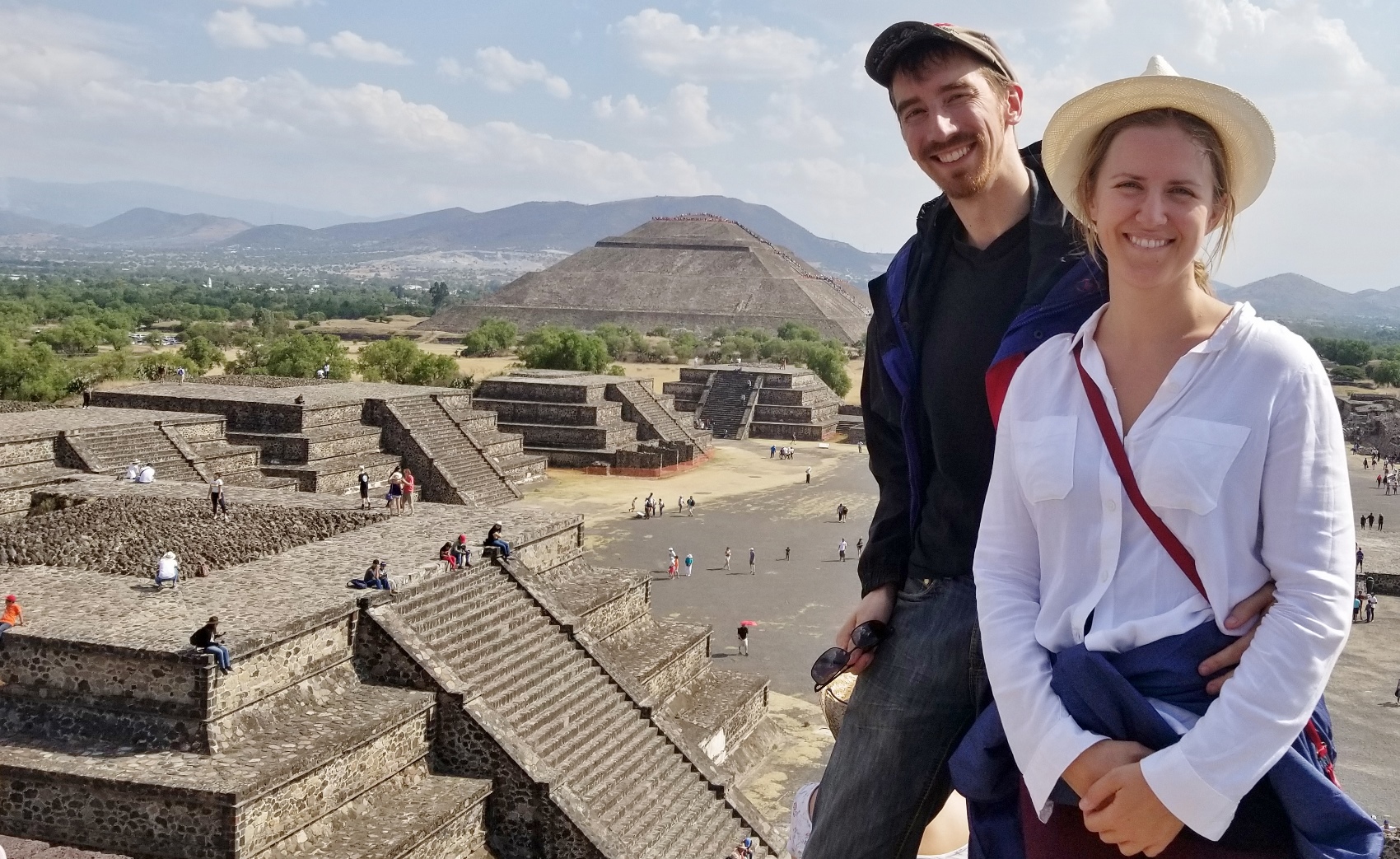
Standing on the steps of the Moon Pyramid with a view over the main plaza, with the Sun Pyramid behind us
Surprisingly, there’s only about three months left of our time abroad, living in Panama. With Christine on a teacher’s schedule, we don’t have much time to get away from the city and travel internationally – but in devoutly Catholic, Latin American countries, Easter can provide that opportunity for a vacation!
Our original plan was to put a new country under our collective belt – Nicaragua. Christine had a fellow Language Fellow friend living in the capitol city of Managua, so we quickly arranged a 4 day trip that covered Managua and the nearby tourist central of Granada. We were quite excited to see the nearby Masaya semi-active volcano, which Christine’s friend pointed out was only 15km from his home. Oh good! Everyone is okay with this, right? Nicaraguans don’t mind having bubbling lava cauldrons within murder-range of their homes? No? Okay then.
But obviously, the title says Mexico City and pyramids, not Nicaragua and volcanoes. So what happened? We were all set the morning of March 28th; we got to PTY airport with plenty of time, relaxed in our Priority Pass lounge with some complimentary drinks, and ambled casually to the gate when we figured it was about time to do so. The attendants at the gate scanned our tickets and then asked us to show our Yellow Fever certifications.
Wait, what? What certification?
Our hearts started to thump a bit as we stepped out of line and waited for a specialist to come over from her office to speak with us. A couple minutes later, we were told that Nicaragua requires a certification of health, stamped by the World Health Organization at least 10 days prior or more, verifying that you’ve received the Yellow Fever vaccination…if you’re coming from Panama or 11 other countries. We had thought that we had done our due diligence by looking up the CDC advisory page for Nicaragua. As you can see, it doesn’t even mention Yellow Fever, much less that its vaccination is mandated. But of course, that page doesn’t say anything about the requirement, because it’s written for Americans arriving from the USA. If we had searched for Panamanians traveling to Nicaragua, we would have found this page and things would have gone much differently. But we had failed to do our proper research, and now, there would be no trip to Nicaragua, no volcanoes, and no vacation. A lump rose in my throat as I stared down at my now-worthless boarding pass. We left the airport, found a Diablo Rojo bus and sat in thoughtful, frustrated silence for the two hour ride back to the apartment.
Christine, to her immense credit, didn’t give up. After three hours on a shaky VoIP phone call to Chase’s support line (she had purchased both our tickets via Chase’s travel portal) we discovered that we’d be able to get a complete refund in Copa Airline credits, valid for one year…complete, minus a $100 per ticket penalty. It was far better than we’d expected, though, and we quickly cast about online, searching for plane tickets for Friday, the 29th, that wouldn’t break our limited budget.
There was basically nothing, though. Panama might be a central travel hub for Latin America, but it’s a business hub… there’s no “last minute” cheap seats available anywhere. The only affordable option that kept coming up was Mexico City, where we’d be able to only spend an extra $220 for each ticket, on top of our credit, for a weekend getaway. We reasoned with ourselves though, that at least housing and food would be cheap – it’s Mexico City, after all!
So, the wheels of vacation turned in our favor thanks to Christine’s patience on the phone, and we were on a 9am flight to Mexico the next day. It would be her sixth time visiting the country, and my second… I loved the food and friendliness of the Mexicans on our visit to Oaxaca in 2015, so why not turn our disappointment from losing out on Nicaragua to excitement for the opportunity to visit one of the largest, most ancient cities in the world?
What kind of meat goes into tacos that you’re paying 17 cents apiece for? ….chicken and sausage, of course. Geez, they’re running a legitimate business here.
Mere minutes after leaving the MEX airport, we found a covered market next to the metro and the chance to eat 5 tacos for 15 pesos… about 90 cents or so. Although we’d be later teased that there was no way the chorizo and chicken in those tacos was safe to consume at those prices, they were slathered in onions, cilantro, and tomatillo sauce, so we were in heaven. Tacos in Panama City, for comparison, are usually one taco for $2.50, and that’s if you’re lucky. Have I mentioned before that Panama City is an insanely expensive place to get food? It is.
After checking in at the AirBnb of the wonderful Fabrizio and Mariana (we definitely recommend these two as friendly, hip young people with a cute little apartment) we immediately set off again to see if there was any sort of Easter-related activities we could partake in. Fabrizio told us that down in Itzatapalapa (I love the names of barrios and regions around the Central Mexico area) there might be a Passion reenactment going on, if we hurried. Well, we were too late for that (missed it by 15 minutes) but it turned out the main street of the barrio was athrong with people for a street carnival and fair. We found out that in Mexico City, Easter is such a huge holiday that kids are given two entire weeks off from school – the weeks before and after the holiday itself. We wandered the packed streets, eating cheap tacos all the way and examining the cheap (safe? maybe) rides and cheap trinkets that you could win with familiar shooting and ring toss style games. We rode an extremely fast Ferris wheel and while it was great at first, I found myself wondering if perhaps I had eaten too much cheap Mexican street food beforehand…
All officially licensed from the appropriate authorities, of course
There were so many things for sale next to the carnival – besides food of course, there was thousands of pieces of reddish pottery (which we saw in restaurants everywhere), wooden ladles at least a meter long (for stirring what, we wondered), all kinds of little plastic knickknacks from China, but more heartwarmingly, dozens of types of different little wooden children’s toys that looked hand made… perhaps cheaply made, and quickly, but wooden handmade toys for just a few dollars. Also, fried and spiced locusts! I remembered seeing those both in Jordan and Oaxaca the last time we visited.
At first I thought this might have been a temporary, paper maché addition for Easter… But nope, it’s steel and welded right onto the pedestrian walkway!
After a breakfast of fresh baked bread from Fabrizio the next morning, Christine and I took a bus from Estación Autobuses del Norte to one of México City’s most famous tourist sites – the ancient city of Teotiuacan. The line to purchase bus tickets stretched back for 20 meters and the buses themselves seemed to be arriving, filling in 15 minutes, and then speeding off with a cough of that famous Mexico City pollution. The ride itself was short, only 45 minutes, but we were all deposited a good half mile away from the entrance to the site at the side of the road and told to just walk a bit further up the path. Seeing the slow moving line of cars trying to get into the actual parking lot ahead of us, it seemed like this was probably a better option for both tourists and driver.
Another half an hour waiting in the entrance line (this would become a recurring theme on this, a holiday weekend in one of the world’s most packed cities) and having paid our 70 peso entrance fee, and we were free to wander the dusty paths of the archeological site. Hundreds of vendors had set up bags by the paths, or were even wearing their entire commercial ventures on their backs. Most of the items for sale were common trinkets like bracelets, shawls, and little statues, but I had been hearing an eerie sound for the past hour and was curious to figure out what was making it.
Mateo the jaguar seller
It turned out that the craftsmen had developed what I will call, in absence the knowledge of its proper name, the Jaguar Whistle. About the size of a fist (the medium sized one; they also came maybe 2 centimeters larger and smaller for plus or minus thirty pesos each way), it was brightly painted and sculpted as the snarling head of a jaguar, sometimes as a jaguar headdress with the scowling face of a warrior peering through the teeth. My chosen vendor, Mateo, was a good salesman and quickly taught me how to blow through one not with a straight breath, but with a buzzing “frtrtrtrtrt” roll through your teeth. The shape of the whistle shapes and deepens your breath and makes it sound just like a big cat’s raspy snarl. I’d never seen one before, and promptly paid my 100 pesos to receive a freshly painted (and smelly) new whistle. Mateo pointed out that all the vendors worked overtime to shape and paint thousands of new items right before major holidays, knowing that the tourist sites would see easily 10 times the usual amount of foot traffic, hence the sharp smell of the paint; the item I was holding had been made just yesterday. Well, no better way to help that paint dry faster then to blow on it constantly, much to Christine’s delight!
Praise the Sun!
Christine and I are more thrifty than educationally enlightened when it comes to most archeological ruin sites: we don’t pay for a guide or usually even a pamphlet (although we will take a free map if offered), we just make a beeline for the biggest, coolest looking thing we can see from the front gate. And in this case, it’s the Pyramid of the Sun. Wikipedia calls it the third largest known pyramid in the world (by volume, not height) with the largest being a massive step pyramid, also in Mexico, and the second being the Great Pyramid in Egypt. Oh well, at least I’ve seen two out of three now. The line was gigantic, and took about 1.5 hours to wait through (surrounded by Mexican children attempting to use their own jaguar whistles but only getting sad wisps of air through it; they hadn’t had the benefit of Mateo’s teachings so I showed a couple of them the proper blowing method. Their parents looked as thrilled as Christine!), carefully parsing our shared bottle of water and trying to keep our skin either covered by jackets or slathered in sunblock. Mexico City is at one of the highest altitudes I’ve ever been at, and the combination of thinner atmosphere and dry air was already wrecking havoc on us.
The moon pyramid, as seen from the steps of the Sun
By the time we got down the steep flanks of the Pyramid (so steep they had police officers helping people climb down the steps, and the “exit” steps were almost as slow-going as the “entry” steps due to cautious climbers) it was almost 2, so we mosied over to the Moon Pyramid at the end of the “Avenue of the Dead.” No one knows who the original builders and inhabitants of this religious complex were; even the name Teotiuacan was given by awestruck later cultures when the site was found again and is not the original name; it means something along the lines of The Place Where Men Become Gods, with the idea that any humans who could have built such impressive edifices must have been deified and raised into the heavens as a reward for their prowess. The names Sun and Moon Pyramid, likewise, are not original. Avenue of the Dead, though, seems a little silly and “edgy” for it to sound original; at least the Sun and Moon Pyramids are believable names!
We weren’t allowed to climb to the top of the smaller Moon Pyramid, only to a platform about halfway up it, but its position at the far end of the site allowed for some good pictures looking down the Avenue with all the little temples and the Sun Pyramid proudly overseeing.
That night, back at our Airbnb, the four of us were chatting together when the electricity suddenly went out on the entire block. It seemed like as good an excuse as any for us all to go and find a pub, so we took a half hour walk along the Paseo Reforma main Street to Regina Street, a pedestrian walkway with a lot of trendy little bars and nightclubs. I had the opportunity to try a locally made Imperial Porter which was expensive by Mexican standards (120 pesos or $6.66 at the moment) but was delicious. Christine tried a “Curada” which is pulque, a common Mexican fermented cactus water, mixed with a flavor of your choosing. After we tried Fabrizio and Marianas pitcher of Curada Zapote (mixed with the jet black and sweet zapote fruit) Christine thought that the Avena (oatmeal) one sounded good. Well, one thing was for sure, we definitely got more of the pulque flavor coming through on that one – but not to poor Christine’s benefit. Soon afterward Fab and Mariana caught us all a taxi home so she could lie down and rest her churning stomach.
Sympathizing with Christine’s upset stomach, Fabrizio cooked us an authentic Italian dinner at 1am!
The next morning was Easter Sunday and also April Fool’s day, so we began the day by heading to the Historic District of the city and seeing the almost completely destroyed ruins of the great temple of Tenochtilan, the Aztec/Mexica city that the Spanish “Nuevo España” had been founded on top of. Of course, Catholic Europeans would not have missed a chance to humiliate their captive locals, so after razing the great temple down to its foundations, they built an ostentatiously massive cathedral right next to it to send all their new converted-by-the-sword Mexica subjects to. My own obvious feelings on colonialism aside, the cathedral was quite beautiful on the inside and we listened to a sermon in progress for a few minutes from the rear galleries. There were police officers standing beyond the gallery making sure that tourists didn’t try to get unholy on the place and proceed any further to take more pictures and be inadvertently disruptive.
Outside the cathedral, however, some native people were holding a worship service of their own to Queztalacotl. Sans sacrifices, thankfully.
We caught the excellent Mexican metro from the Historic district down to the main central park of the city, where we had a relaxing 20 minute walk with several thousand of our new close friends, enjoying their holiday. Street clowns were out in force, drawing large crowds and bringing up children from them to pantomime with. Vendors of course were everywhere (sunglasses for 10 cents, anyone?) and people were walking more dogs than I think I’ve seen in half a year in Panama city.
nom nom nom statuary
Our destination was INAH, the national anthropology museum that we’d heard good things about. Admission was 70 pesos yet again (seems to be a common foreigner price in the city) and free for the locals on Sundays, so once again, the place was packed. The museum is laid out into 3 two story buildings, facing toward a sunny inner courtyard with a pool, with each of the three buildings covering a different period – the ancient pre-historical, the pre-Mexica cultures like the Toltec and Mayan, and then the last building being reserved for the most recent and final native culture, the Mexica (which most people know as the Aztec). Of course there are a lot more relics from that latter culture since it only ended 400 years ago vs thousands.
While perusing a time line of the Mexica’s wanderings, I noticed a Matt Groening cartoon on it! What are the chances…
While the majority of the relics and items being presented didn’t have English translations of their signs, Christine knows me well enough after a decade that she knew what I’d find interesting and translated for me if she thought I’d like something. Also, the larger signs introducing groups of exhibits together were usually written in both Spanish and English so every time we entered a new area, I’d immediately scout out its English signs so I’d have at least a basic idea of what was going on, and whether or not I should stay and turn my puppy dog “please translate” eyes on Christine. Overall, I’d say that for $3.86 the museum is definitely worth seeing for any English-only gringo that might find themselves in the city, and if you’re fluent in Spanish, it’s a must-see. We didn’t even have time to check out the second floors in each building or walk around much in the outdoor exhibits!
Oh don’t you worry, Teotiuacan, I hadn’t forgotten about YOU since yesterday…
There was enough time left in the evening to grab some delicious plates of mole-drenched tacos and some savory Micheladas (ingredients: 20 oz of dark beer, a half ounce of worcestershire sauce, and a salted rim – oddly addictive!) at the nearby Los Panchos restaurant and catch a bus back home. Tomorrow afternoon we’d be catching our flight back to Panama – and hoping that the country hadn’t initiated a yellow fever certification requirement while we were gone!
Well, at least we got to see Nicaragua from a distance (that’s the main lake in the country, with its two main volcanic islands in the middle)
Christine and her parents, at Tsugoi…with the Sushi Ark! 10* of every kind of sushi were brought aboard… (*6 kinds only)
While Christine’s parents were visiting us in late February, the four of us scored free tickets to Panama: The Musical, showing in the northwest part of town near the Canal. The show is billed as Panama’s first musical, with an all-Panamanian cast, and one articles states that even the ministry of tourism for the country put a reported $50,000 into the show. It’s already slated to run again in 2019 and 2020, which is really incredible support for the first national musical. Here are some photos (wallpapers, even!) from their official website.
The four of us enjoyed seeing it, and it was a great first-time presentation for a nation not yet known for having a Broadway style scene of its own yet. But since the show will go on again for at least two more years in Panama (and the fact they’re calling it a World Premiere here in PC means they have plans to travel too!) we also had a few thoughts about where the musical unfortunately had some problems.
First of all, the leading ladies, Gabby Gnazzo and Alexandra Cordoba, had great voices and were a joy to listen to. However, my linguistics-teaching girlfriend pointed out that it’s a Panamanian habit to not properly enunciate English language consonants, and these ladies, singing in their second (or even third, or fourth – who knows) language, bring that mild consonant slurring into their singing. Great voices, but very difficult to tell what they were singing about almost all the time. Far better than I could sing musicals in Spanish though, of course!
Thankfully though, the plot of the play was rather…simplistic. Now that 2018’s show has ended I feel okay saying that a mild spoiler is that it’s a standard “boy is in love with girl, bad guy wants to steal girl instead” style plot. Since the show is named “Panama: The Musical” all four of us had really been hoping that the story would focus on something uniquely Panamanian, something to make it stick out in one’s memory. It’s set in the 1920’s, which would have been a bright new time in young Panamanians’ minds with the canal newly finished and providing a lot of work to the economy. But it has a very USA style to it, which might have been a great way to bring in curious audience goers if the play had been in Spanish – “what was it like to be a worker with all the gringos back in the 1920’s What was life like for our young men and women back then?”
But because the play is in English, I have to assume the target audience is going to be short-term tourists, expats like Christine and I that live in the country, and highly educated Panamanians who speak English fluently. This, unfortunately, automatically limits the visibility for the play to the local audience.
Initially, we saw that the play’s tickets were being sold for as much as $60-80 per ticket…Broadway level prices! As time went on though, we saw they went on Gustazo and OfertaSimple, two local “Groupon” style deal sites. Both Christine and her mom applied for “four free ticket” drawings on the Panama Musical website…and both of them won four tickets. When we appeared for our free showing, we saw that for the matinee, there were only 20-30 people in a theatre that could hold two hundred.
I feel bad for Panama: The Musical because I worry they might have bitten off more than they can chew. I feel like a city, and especially an entire nation, should gauge the health of their community theatre…community…(hmm) before committing tens of thousands of dollars to showcasing a new interest in musicals. Why an English language musical as the nation’s first heavily advertised and even government subsidized showing? Why limit yourselves to only fluent English speakers?
Sadly, the show’s final fifteen minutes were particularly bizarre and strayed even into the disappointingly “campy”…camp. Without giving away the ending, let’s just say there’s a lot of Deus Ex Machina and rapidly trying to resolve the plot all at once. Our main sinister bad guy goes from about to win and cement his victory, to being whapped on the head from behind. You can almost hear the “wah wah wahhhh” trombone sound as he rolls his eyes back theatrically and collapses. Once again…it’s a very simple plot and I don’t think it spoils anything to hear that yes, the good guys win and the bad guys lose. No surprise.
The writers could patch things up a bit by removing some of the musical reprises and using that breathing space to slow down and pace out the ending, instead of making it feel rushed. They could potentially rethink the ending and make it a little less slapstick. It was just very jarring to have this serious love story with passionate (if sometimes incomprehensible lyrics) singing ended with slapstick, and it felt almost like an entirely different musical was bolted onto the last 15 minutes.
The front of the program says outright that the directors, producers, and writers view this show as a labor of love, and they know that it will need to be tweaked. As someone who wants to see more musicals all over the world, I have the best of hopes for them, especially since apparently the ministry of tourism itself sees this as something that they want to patronize. I sincerely hope that more money will be given to smaller, more local community theatres and their shows, to build an organic audience of local Panamanians that see theatre and musicals as a great way to spend their time and money both as an audience and even as actors.
But right now, now that the run has ended (I didn’t want to write this while the show was going on, so I waited til after it was finished to write a semi-critical review), while the play was an entertaining way to spend a couple hours, I’d unfortunately have to say that it would have been ridiculously overpriced at $60, or even $40. At its current level of sophistication, the show would be worth $15-20 – the sets, costumes and talent of the orchestra were great – it’s just the story of the show itself, and the pronunciation of the singers, that left us feeling like there were some major improvements that could be made.
But remember, as one of the opening songs points out…necesistas tener un sueño! 🎶
The cast wasn’t around to pose with after the show, so their in-theatre poster will have to do!