It was far less rainy and unappealing outside today – in fact it was just about perfect, weather and temperature-wise – but yet Scott and I failed to be able to take the ferry to Elephanta Island to see the ancient UNESCO-preserved caves. It was a morning of disappointments in fact – first, we tried to get some Masala Dosa at a restaurant place that Anita and Bart recommended to us but they told us that they could only serve us sandwiches (which were still tasty, though). Then, after getting a rickshaw to Andheri station again, we must have gotten on the train marked “stop at every station, between each station, and travel at 10km/hour” instead of the much faster one that I utilized yesterday. Perhaps because it was Friday, the trains seemed far more jammed full than yesterday – we experienced the terrifying crush of determined men dozens of time as they rushed in and out of the train at every stop. The jangly-bell singing troupe were on this train too (maybe they’re on all trains; who knows?) except they were ear-splittingly close to us, and we were locked elbow to elbow, standing room only, jammed against the back wall of a car and unable to escape.
Finally, we made it to Churchgate, the southernmost stop for the train route (and still no where close to the southern tip of Mumbai; apparently everything south of that last station was too important to tear up to lay down new tracks and buildings. The architecture on the buildings was indeed beautiful though, and there were lots of trees – and even a huge long open green space that almost no one was enjoying except to walk through the middle of.
It was only a 5 minute walk from Churchgate to the Gateway of India, and a quick pass through a metal detector. Some photos of the regal archway stucture, including its big sign commemorating King George), and a sadly unavailable ferry to Elephanta. We were told that the water level was too high to risk the trip, which was ironic because had we come yesterday, we would have been underwater at the ticket kiosk. However, they said that they had tried sending out one boat that morning, then “called him back” – they didn’t offer an explanation as to why or what had happened, but that was the end of our ferry hopes for the day.
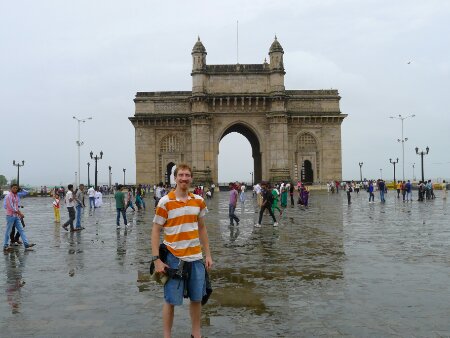
First picture upload attempt from the mobile wordpress app...!
We consoled ourselves with some tasty Akuri Toast at a nearby restaurant called Jimmy Boy (like most buildings, it looked very colonial both inside and out) and then headed back up near the Gateway to India to visit a few museums – first the modern art building, then the natural history museum. The first was your standard modern art – mostly print and lithography, ranging from 1910 to this year. Some was pretty and hopeful, like some art depicting a world without violence against women (a major problem in some parts of India, like Delhi) and others that were just plain weird. The museum was interspersed with signs, each with a couple paragraphs describing the genre we were about to each. They were filled with amusing jargon like “electrifying the human soul by illuminating the follies of (un)truths” which I’m pretty sure is the universally pretentious way that modern art museum curators write.
The natural history museum, however, was massive, and extremely enjoyable. Housed in a huge Indian-Saracen style building, it was very much like the British Field museum, and probably curated in a similar style. Almost every item was followed by a note that it belonged to the “Tata family collection.” So basically, the Tatas (who have a line of Indian cars here, much like the Proton that I drove in Malaysia) owned the entire museum. Scott and I each got an audio guide, which was narrated by a pleasant sounding British guy named Sunny Singh who probably narrated the Indian version of Nova on PBS. His voice was so relaxing that my jet-lagged brain briefly put me to sleep in the Gods and Spirituality room and almost pitched me into a nude sculpture of Vishnu, which probably would have caused a bit of a scene.
Continue reading this post…