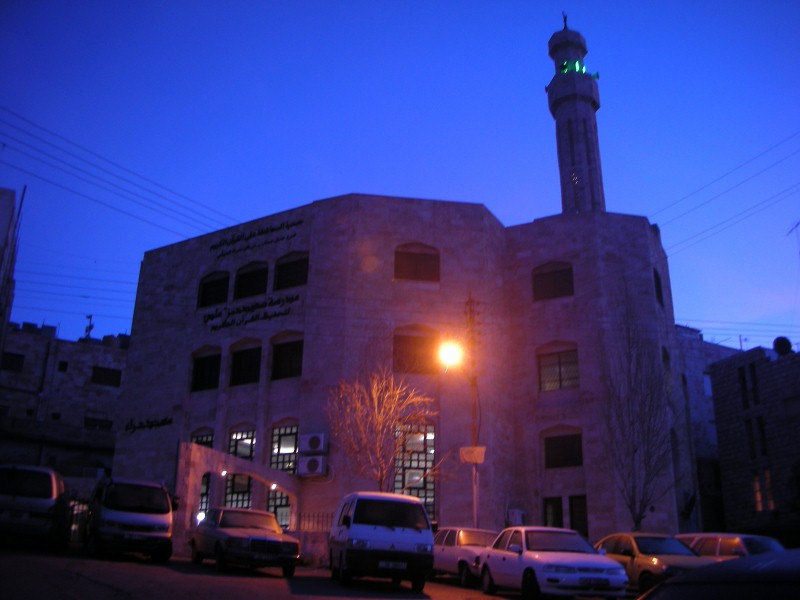
Soon after I returned to Jordan from America, I realized that it was odd that although I’d been in the country for almost a year and a half, I had not yet experienced a traditional Islamic prayer, or sulaah. For how much I’ve talked about trying new things, it should have been much higher on my list of ‘things to do’ than to not joined one of my numerous Muslim friends at prayer. Heck, I ate sheep’s brains for Easter last year before I’d been at a sulaah. I figured it was time to remedy that.
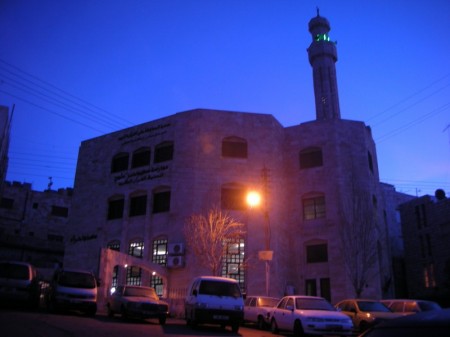
The Masjid (Mosque) minutes after completing the morning prayer. The timing is perfectly coordinating so that the sun’s first light strikes the building as prayer ends
Last week, I stopped by my neighbor Marwan’s supermarket and asked him if I could finally take him up on his offer to join him in prayer at our neighborhood mosque, Masjid Hira’a. His broad bearded face broke into a huge smile and he cried out, “of course you can, Mr Zach!” I sat down at his counter for an hour as neighborhood customers trundled around us, bundled against the January chill. He explained to me that the best “first time” sulaah would be the al-Fajr prayer, which is always timed daily to come directly before the first rays of dawn break over the horizon, wherever you may be. I chuckled inwardly at that; I think that everyone in Jordan, be they Muslim or otherwise, has intimate knowledge of that particular prayer when it’s blasted at the wee hours of the morning. He explained that it was best because it was the shortest; usually no more than 6-7 minutes long. “There is rohkta-tayn; two rohkta,” Marwan told me solemnly. “The other prayers in the day – and you know there are five – are either three rohkta or four. This one better for you, for the first.”
He got out a piece of paper and had me write down the exact method of al-Wudthu, the ritual cleansing that devout Muslims carry out before each of the five sulaah. Then he pulled out a battered old Qur’an with a seamed green cover, caressing it respectfully and gently laying it on a cloth on his counter. He smiled fondly at it, and told me that he had this Qur’an since he was a boy and his father gave it to him. As he opened it to the beginning (starting from the right-side, as Arabic is a right-to-left language), he frowned absentmindedly at some scrawls and scribbles in the margins of the first page that looked like a child had been doodling with a pen. “Is not good, this,” he muttered. “Not respectful to write in the Qur’an this way – I do not know where these come from.” I thought about who might possibly have marked up the Qur’an and then forgotten about it over the years…but of course I just nodded politely.
From his Qur’an, Marwan showed me, and then intoned the Surah al-Fatiha, the most important “chapter” in the Qur’an which the Prophet Mohammad (SAW)* instructed must be read before each and every prayer that is made. The first few lines of the surah, which start with “Bismillah al-raahman, al raaheem,” are a common utterance regardless of the situation, merely meaning “In the name of God, the all merciful and ever-merciful.” The rest was more of a jumble, but sounded quite pleasantly melodic. Technically, music of any variety was forbidden by the Prophet, so the humming chant of the sulaah is really the closest that it gets.
After giving me final instructions on how to carry myself, where to look, how to stand, and what to wear (the latter was pretty much the only thing that he said was up to me; the rest is fairly complex), I took my leave of the supermarket as Marwan happily told me, “As-salaamu alayk, akhi!” – peace be upon you, brother! However, because of scheduling issues and some mix-ups, I wasn’t able to finally attend until just this morning.
I rose at 5:15AM, when Marwan called my mobile and quietly told me to prepare myself in wudthu and meet him at his house gate next to the supermarket at 5:45. In the distance through my window, I heard the “waking adhan” calling all Muslims to arise and prepare, crying out dramatically, “Prayer is better than sleep!” I hadn’t eaten much the night before, and I was careful to avoid any alcohol. I was trying to take “purification” seriously in all things. Technically, even flatulence ruins the purity of wudthu so I didn’t want to take any chances by eating a big meal of falafel and hummous and fuul – three foods which are all made from beans!
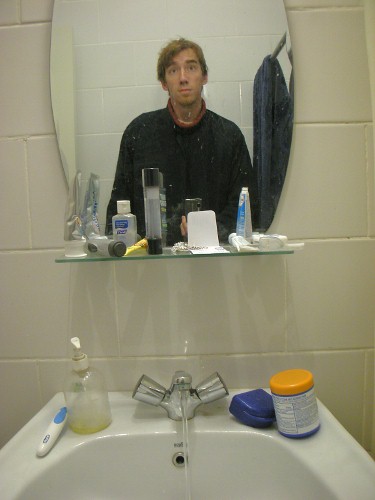
The water’s hot and ready and I am awake far too early. Oh well…”prayer is better than sleep” after all…
I put on my blue dishdash robe (this makes the third use of it in a year, I believe) and went into the bathroom with my piece of paper with Marwan’s specific instructions clutched in my hand. I stumbled sleepily on the edge of my flowing robe and banged my caving-sore hip on the door frame – but successfully refrained from saying anything uncouth for the sake of the situation. I stared down at the paper at what I’d written down as the warm water filled the sink in front of me. I took a deep breath, and tried to perform the following as gracefully as possible.
- Wash each of the wrists, first the right and then the left, with three circular motions
- Cup water in your right hand, suck it into your mouth, swish it around three times, and spit it out
- Suck water into your right nostril and then blow it out. Repeat three times. And then repeat with the left nostril (note: this one was really hard to do without coughing and choking)
- Wipe downwards across the face with upwards-facing palms, from forehead to chin. Repeat three times
- Using the left hand, wash the right arm from wrist to elbow, inside and out. Repeat three times, and then switch hand and arm
- Taking some water into palms, run hands from hairline to the nape of the neck and back the opposite way, keeping hands tight to the hair
- Clean out ears with the tips of each index fingers, from top to bottom
- Taking some water into palms, run hands from the nape of the neck around to the front of the neck
- Finally, use the left hand to clean the right foot from the toe to the ankle, carefully cleaning between the toes. Repeat three times, and then switch hand and foot
…I looked down at myself after I had finished this process and realized that my formerly-dry dishdash looked as though I had just purified it of its sins. I was thoroughly glad I wasn’t wearing a white robe instead, and that Marwan told me to just wear my usual leather jacket into the mosque to keep warm and cover the numerous splashes of water I was now covered with. I tried to review the words of the Surah Al Fatiha in my mind, and realized that I might need to a little help here, in case I was quizzed or something. I scribbled “Subhan rubi’ha al-aduheen x3″ and “Subhan rubi’ha al-3la x3″ in tiny letters across my left thumb, but I knew I didn’t have time to write anything else. I glanced at my clock and realized that one thing remained – Marwan had pointed specifically to the silver cross I wear on my neck and said, “You need to take that off when you pray in Masjid; take off all silver and gold.” He explained that it wasn’t because it was a cross, but just because almost all jewelry is forbidden for men. I slipped off the necklace and walked downstairs and and up the street a few meters to wait in front of Marwan’s dark doorway.
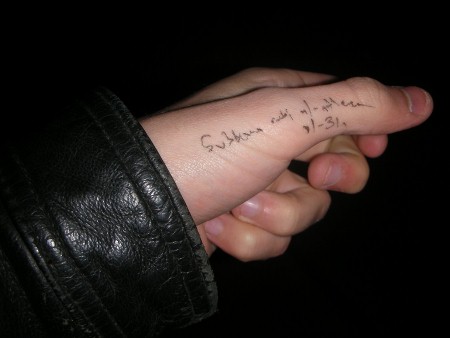
I don’t think this is forbidden, but I didn’t exactly advertise it to Marwan either!
I heard his deep voice intone above me from a window, “Zach” and then I heard the thud of sandal-ed feet on the stairs leading towards me and within another moment he was next to me, walking quietly and serenely in sweater, corduroy trousers, and a denim jacket. He smiled a quiet smile and asked me if I was ready for al-sulaah, and I shivered from the morning cold and nodded in assent. Without another word, we joined the flowing, shuffling stream of men next to us in the street and entered the warm glowing gate of the Hira’a Mosque, kicking off our shoes on a small footwear-barrier as we did so.
Continue reading this post…