Last weekend, I went up north with Silas and Haitham to see (and as it turned out, participate in) a traditional Muslim wedding ceremony. The two of them had already planned on going, and they invited me along after my depressing-sounding taxi stories from that night. I was a little surprised to receive an invitation from Haitham, since I had just met him a few days before, but he assured me that it wasn’t a problem, that no one would mind my attending. Haitham just told Silas and I to show up at his house in Zarqa the next morning, and he’d take care of everything else.
The bus station the following morning was hot, dusty, and on the east side of town, where I’d never been before. Silas and I shared a taxi over there, and he commented that it was a very different world compared to the west side of Amman, which is filled with western shops, commercialization, and most noticeably, uncovered women. “You won’t see a single uncovered woman in this conservative part of town. It just isn’t done,” Silas commented as the rattling, tiny bus pulled away from the station and roared into the sunrise.
We met Haitham outside his home in the quiet city of Zarqa. As it was a Friday morning, not many people seemed to be up yet, enjoying the day off. Silas and I relaxed in the front meeting room of his house, stretching out our sore muscles from being jammed into the tiny bus (probably broke both my kneecaps). We chatted with Haitham’s father, a cheerful older gentleman who spoke passable English and, coincidentally enough, was a veterinarian, like my mother. Haitham made the two of us some tasty sandwiches (there’s few things better than Arab hospitality) and drinks, and we passed an hour in the cozy little front room, waiting for the bus to Irbid to arrive.
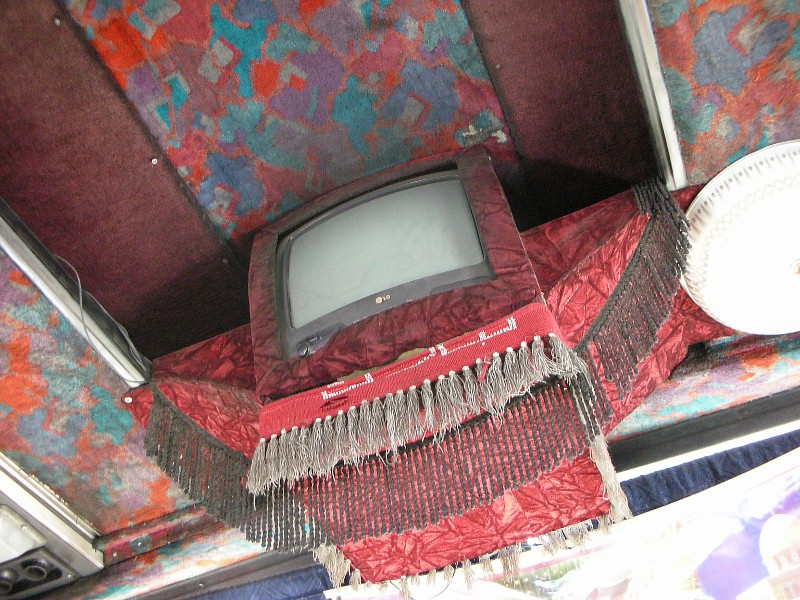
We met up with Haitham’s mother and sister at the bus station, and the six of us took the last seats in the front of coach bus. Thankfully, it was much roomier than the preceding one, with dark velvet shades pulled over all the windows and the typical decorative hangings all over the ceiling. I’ve come to expect an interesting decor inside vehicles here in Jordan; everything from Majid’s little Honda to the massive garbage trucks I’ve rode in have tassels, prayer beads, and thick plush covering all over every surface.
Haitham looked at me with mild curiosity as I pulled out my ever-present camera and started snapping pictures of the wind-swept desert hills and valleys as the bus left Zarqa. “What’s the point of taking pictures of the desert?” he asked me. “It’s just different from what I’m used to, that’s all,” I replied. He gazed out the dirty window into the sands. “Ever since we are little, we are taught that green is good, and the desert is a bad place,” he mused. “Even though we are surrounded by it and it makes up our whole lives, and we cannot escape from it. I am happy when the rains come for a few weeks each year, and when the sky fills with clouds and no one can see the sun.” I told him that in America, we have the nursery rhyme, “Rain, rain, go away, come again some other day.” He laughed at that, shaking his head in disbelief that children could be so flippant about the life-giving liquid.
Although I had been planning on sleeping for the bus ride, Haitham and I ended up discussing Islam and Christianity for the entirety of the trip, comparing interpretations of the holy books and asking each other questions about what makes people good – is it the shame of religion, or a natural impetus for harmony? I played the devil’s advocate here (somewhat literally!) and questioned Haitham’s interpretation, that without religion and the fear of an angry God, the world would be overrun with chaos. I asked him what he would do if he found out tomorrow that there was no God. He considered this thoughtfully for a moment: “In this situation, I suppose, I would try to be a good man and carry on the tenants of Islam. But, as time went on, I would begin to be angry and do bad things because I would have no fear of the next life. This is why we need religion, to be good people.”
When our coach reached Irbid, we transferred to progressively smaller vehicles as we wound our way up into the mountains, until by the time we reached our destination and stopped by a little dukaan (convenience store) for a jug of Pepsi, I felt like we were either going to break through the dirty wisps of cloud, or fall off the side of the cliff we were perched on. Feeling my knees creaking from being jammed into the truck of our most recent transportation (a minivan) I got out and stretched. A few pickup trucks rattled by, packed with wide-eyed children who stared bug-eyed at me, mouths agape. “Yeah, you might as well get used to people staring at us while we’re here; this definitely isn’t Amman,” Silas muttered behind me.
After a few more minutes and another couple hundred meters up the mountain, we came to the site of the festivites. The minivan squeezed the six of us out with a tired gasp, and rumbled away down the road, as a crowd of people descended on Haitham’s family, leaving Silas and I awkwardly staring at the ground for a few minutes until one of the men, a muscular man who introduced himself to us in perfect English as Mohammad, and invited us down the short hill to his house where the party was taking place.
Almost ceremoniously, Silas and I were led through a crowd of forty people, all of whom rose to their feet when we approached and lined up to shake our hands. Smiling and nodding, they grasped my hand and spoke, “Ahlan,” “Asaalammu Alaykum,” “Ahlan wa Sahlan,” “Marhabah,” as I tried to fumble my way passably through returning the proper response to each different greeting (it’s like a confusing game!)
At the end of the line, we met the patriarch of the family, and learned that this wasn’t just a wedding, it was a double wedding. The Old Man (which is what I’ll refer to him respectfully, since I never did catch his name, and usually fathers, especially older fathers, are merely referred to as “Father of (son’s name)”) was marrying off the last of his sons, of which he had 10 others and two other daughters. “Alf Mabrook!” (A thousand blessings!) I stammered to him, awed by this prodigious progenitor who was now smiling up at me. Of all of the Arab men I’ve met so far here, he seemed to fit the wise-and-venerable-grandfather more than anyone else: he wore a long, flowing blue robe, traditional hatta (headdress) bound with thick leather cords around his forehead, and a short, neatly-trimmed white beard. His face was incredibly weathered and lined, but as he beamed at me and pumped my handed happily, I quickly saw that they were all smile lines. As we all sat together, drinking the hot spicy coffee that I had been first introduced to at the Sheik’s residence, the Old Man never stopped smiling congenially at the throng of well-wishers around him, laughing, and shaking the dozens of hands that were being continuously proferred to him in blessings.
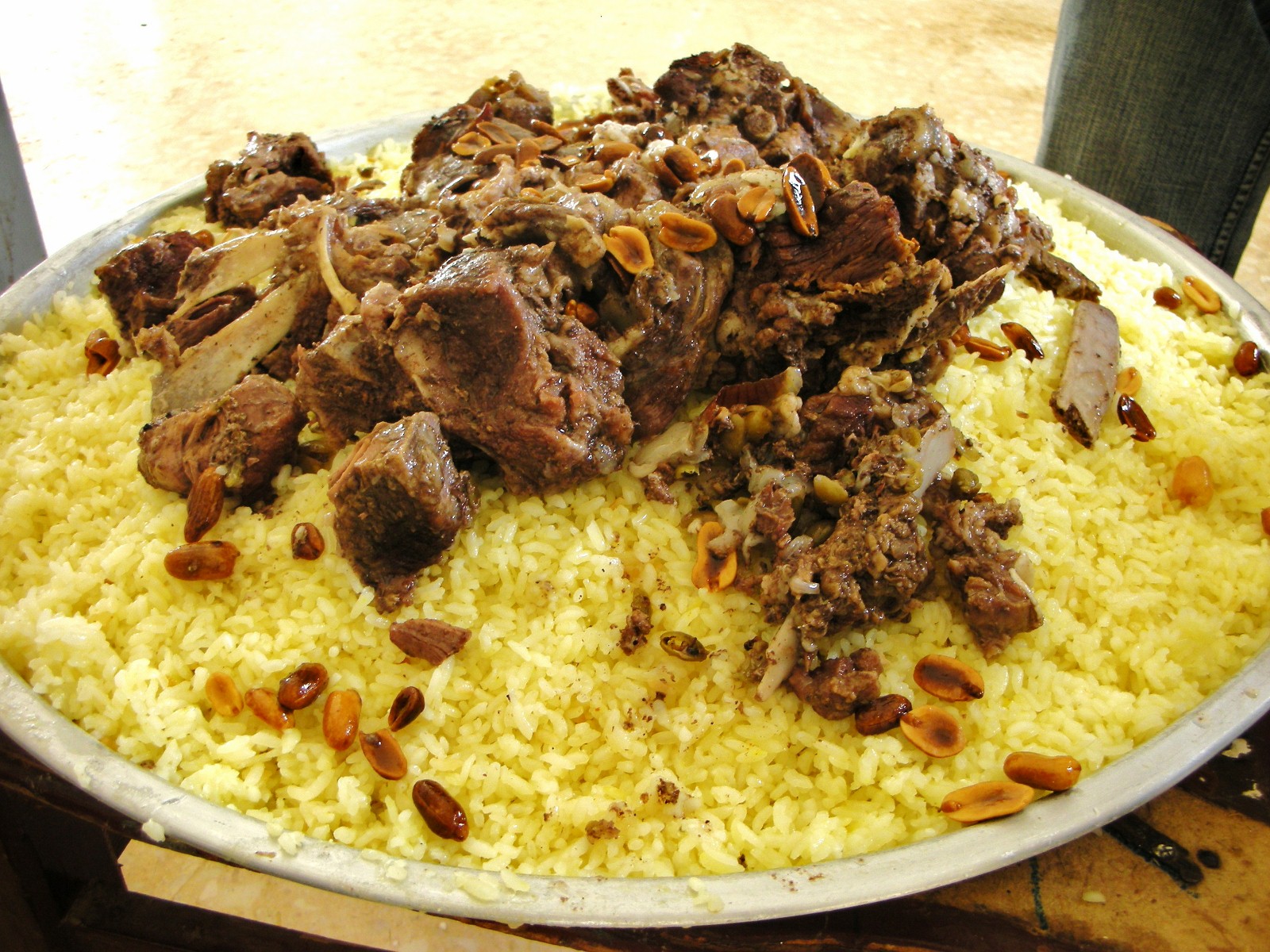
Mohammad and the Old Man were neighbors, and the party was split between their two houses, with us men sitting outside in a long patio in front of Mohammad’s residence, and apparently, the women cloistered within the Old Man’s house (I could hear them occasionally, and less occasionally an ornately covered head would peep out the door to look up at us. As I listened to Mohammad explain to Silas and I, there had been hundreds more people earlier in the day for lunch, but now people had gone home to prepare for the festival in a few hours. Suddenly, he recalled that we hadn’t eaten yet, leapt up, and led us four latecoming men (Haitham’s mother and sister having instantly vanished to join the other women when we had arrived) down the hill to the Old Man’s welcoming room, where a huge plate of Mensaf was set in front of us, complete with the delicious sour cream sauce, thick fluffy yellow rice, roasted peanuts, and roasted chunks of lamb (bones and all). Mohammad sent another man down the hill with us, who silently seemed to have the sole purpose of slicing up the lamb into smaller chunks and pouring more cream sauce over the rice.
Moments after eating, the “parade” began! People started pouring over the hill to congregate in the road outside the Old Man’s driveway, surrounding two young men in pinstriped suits that I deduced were the two grooms. Shouting and cheering, the crowd began singing and chanting, and the two men were lifted onto the shoulders of their older brothers and were carried briskly down the street towards the south.
Continue reading this post…