HeiseHeise.com

The Personal Blog of Zach Heise

House on the Rock, 2007

A random image. Reload page for more. Want more info?

Category: Social Commentary

  • An ode to power plugs

    You don’t know how much you miss not being able to look up the location of CPU fabrication plants in Israel when the question strikes your brain…until it’s taken away from you. However, I’m happy to report that I’ve got internet at my house again. So long to Orange Telecom, widely regard as a flaky provider, and hello to Umnia’s “Double Turdo” service, which has a less-known level of flakiness! Hello to 20GB monthly limits instead of 10GB, and 2Mb speed instead of 1Mb (or at least supposedly). The internet in Jordan is neither America nor Korea, but it’s good to be able to use Remote Desktop again and look up questions like the aforementioned. (Qiryat Gat, by the way.)

    The rant of the night is the lack of a standardized power plug in Jordan. This country has a ridiculous lack of standardization, and it seems to be the worse when it comes to just choosing a power plug to use. Check out this map:

    Poor little Jordan has at least 5 listed
    Poor little Jordan has at least 5 listed

    It’s one thing to have this entire country filled with so many plug standards I have to carry a sack of clinking adapters in my backpack to make sure I’ll be able to plug in my laptop where I need to work. That’s bad enough. It’s even worse when we have four different plug standards at the training center in Ayn al Basha!

    When I first came to Ayn al Basha, the only building that had electricity (or even existed for that matter) was the lime-green administration building. All the plugs in there are using the Italian “L” standard; three prongs in a straight line. Then when we built the first classrooms in September and October of 2008, the electricians put in the German “Schuko” style plug. Now, after I returned from America on my vacation, I discovered that some numbskull had wired my new classroom with British “MK” plugs – my most-despised type of plug that’s used here. Then, just a couple days ago while I was with the TOT class in the assembly room, I saw that the plugs there were using some weird hybrid of the USA “A” standard, combined with widened holes to fit the “Europlug.” Supposedly, it’s some sort of Chinese sub-standard. You know what really gets me? Aaron told me that the electrician that did up my new computer lab was the same one who installed the “Schuko” plugs in all the other classrooms last year, so he should have known better than to just stick another random outlet standard into the walls. It’s just a coincidence that because of their complexity, MK outlets cost twice and cables cost thrice more as any other type, right? Hmmm.

    The British MK outlet and plug are indeed the absolute worse, relics of the 1930’s with a plug that requires its own built-in fuse and an outlet box that usually has an utterly pointless power switch next to it. The pins on the MK are huge, ungainly, and if you are unlucky enough to step on one in the middle of the night you will beg for death. “They’re impossible to break, though,” some of my English friends here will say with a grin, and one even proudly showed me a thick ugly scar on his right foot where he drove an MK a centimeter through his sole while running across a room to answer a phone. The MK needs to die. Or at least, Jordan needs to stop using it – but it’s unlikely, seeing that it’s probably second after the Europlug in the number of buildings it’s used in.

    The Europlug – a bland, non-grounded little weak thing. Most lower-amperage devices in Jordan use this style of plug, and mercifully it seems to fit into most of the outlets found here. However, because of its lack of ground, it’s useless for computers. Also, they also feel like they’re going to fall apart in my hand. Pass.

    The “Schuko” plug would definitely be my favorite if the American “B” standard didn’t exist. Strong and sturdy with an ingenious way to add a ground wire to the system. Philip thought ahead when he had his house built and had each wall outlet contain two sockets – one using the Italian “L” plug and the other using the “Schuko.” The only problem with them is that they’re still too large for my taste. When I need to buy power strips (which is quite a bit), you can only fit four “Schuko” plugs on there, like the MK. If you tried to sell a power strip in America with only four outlets on it, you’d be tarred and feathered. By me, at least, if no one else would.

    The USA “NEMA 5” plug is by far the best of them all, and after having to work with this bizarre hodgepodge for the past year, I don’t think I’ll find much resistance to that claim. Our plugs and outlets are like our citizens: a well-grounded combination of strength, size, and electrical amperage. It’s no shock that we invented electricity, really, and it feels good to be able to say for once that America is indisputably the best at something besides starting wars. Without further ado…

    USA! USA! USA! USA!
    USA! USA! USA! USA!

    Glad I got that out of my system.

  • The TSA loses all sense of humanity

    So, in case you didn’t already hear about it, the TSA has released some more or less official plans on what they’re going to do following the antics of some Nigerian guy who attempted to explode himself and a plan using some sort of weird diaper with uncombined explosive compounds or some other idiotic idea.

    Basically, the TSA’s plan boils down to this – people coming into America from international flights can now expect random “surprises,” for example, not being able to move from your chair for the last hour of the flight – for any reason. Another great one they’re cooking up is not letting anyone use any electronic devices, or even have them in carry-on luggage. Imagine, say, a 14 hour flight to Jordan, without so much as an electronic song playing machine to keep you company. It’s enough to make me want to brush up on my saxophone skills and bring one of those aboard – if only! Pity that part of the plan is also to restrict international travelers to one carry-on bag only…previously, I’ve always brought my backpack as a “personal item” and then a second small piece of luggage as the official “carry-on.” I’m not sure how that’s affected but I’m sure I’ll find out soon.

    Seriously, how does not letting us use electronics on inbound flights keep us safer from diaper bombs? In my opinion, here’s what we should have had right after the 9/11 attacks: armed, trained National Guard-types in every plane, armed with rubber-bullet guns or some other sort of weaponry that wouldn’t depressurize a plane. Watch people standing up, moving around, and basically just keep watch. An ounce of prevention is worth a pound of cure.

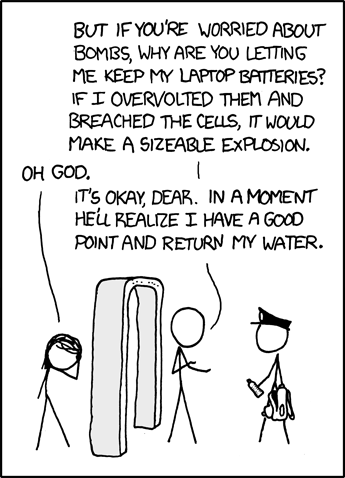
    It’s at times like this when only XKCD.com knows how to sum up a situation. And now that laptop-less paranoid world parodied below may very well have come.

  • Google Earth: 4x more satellite photos taken of Middle East cities?

    Google Earth is one of the niftiest free tools available to anyone who wants to get a bird’s eye view of this beautiful planet. Between the ability to fly effortlessly to any place in the world in seconds, to Google’s partnership with Panoramio to provide amateur photos from anyone who cares to upload them, to the ability to now view historical satellite photographs of an area, it’s a pure pleasure to be able to use.

    I use it a lot more now that I live in Jordan, however. The main reason for this is because for whatever reason, I can pretty much be guaranteed accurate, up-to-date imagery of Jordan and other Arab countries. Although Google didn’t have street names in Amman for my first five months in Jordan, they’ve added those since then – although their use is debatable since no person, be he taxi driver or King of Jordan, has any idea what 99% of the street names are in Amman. No one uses them, using major buildings or traffic circles as directional landmarks instead.

    When I came back to Madison a couple weeks ago, I wanted to see if they’d updated the Google Earth map to reflect the fact that my venerable Ogg residence Hall was demolished a year ago and since then two entirely new dorms have been built in its place. Google Maps (as in the website) is less effective here because it only provides a copyright date, which is always just the current year. Google Earth, however, informed me right away that downtown Madison, at an elevation of around 7 kilometers, hasn’t been updated since late August 2004.

    madison-GEarth
    Madison, WI, USA: Last updated late August 2004

    You can easily see the imagery date in every recent version of Google Earth, there in the lower left part of the screenshot I took. Compare that five and half year update span to this screenshot from Amman which I captured on the same evening.

    amman-GEarth
    Amman, Jordan: Last updated early July 2009

    This picture is from mid July of 2009. Since I was already in the Middle East, I flew around to other large capitol cities from other Middle Eastern countries.

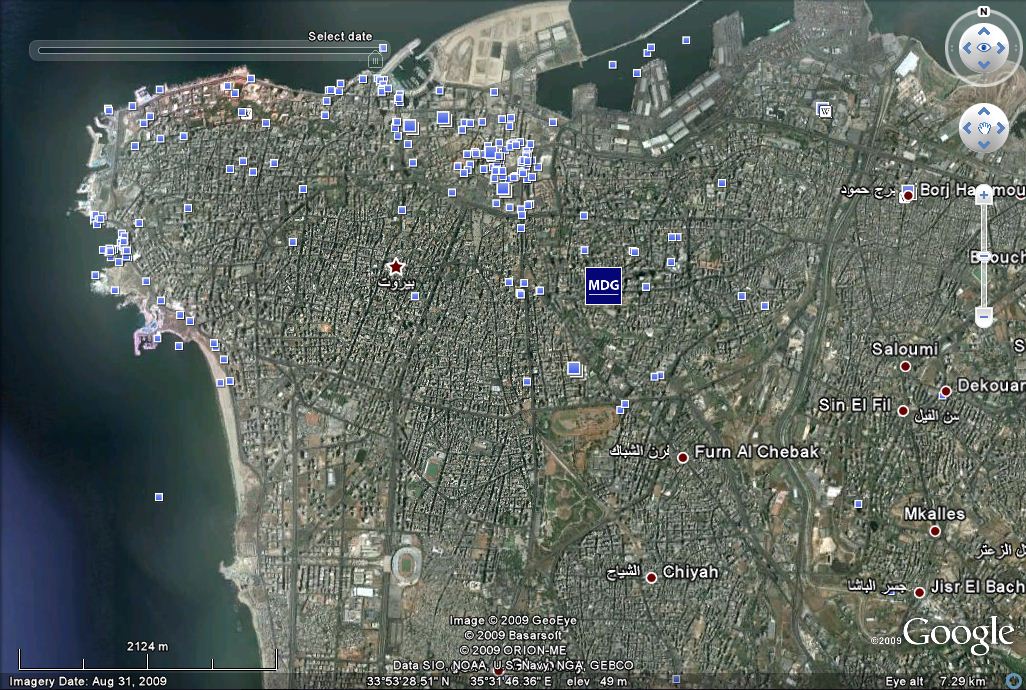
    beirut-GEarth
    Beirut, Lebanon: Last updated late August 2009
    Riyadth: Last updated late May 2009
    Riyadth, Saudia: Last updated late May 2009
    Tehran, Iran: Last updated late June 2009
    Tehran, Iran: Last updated late June 2009

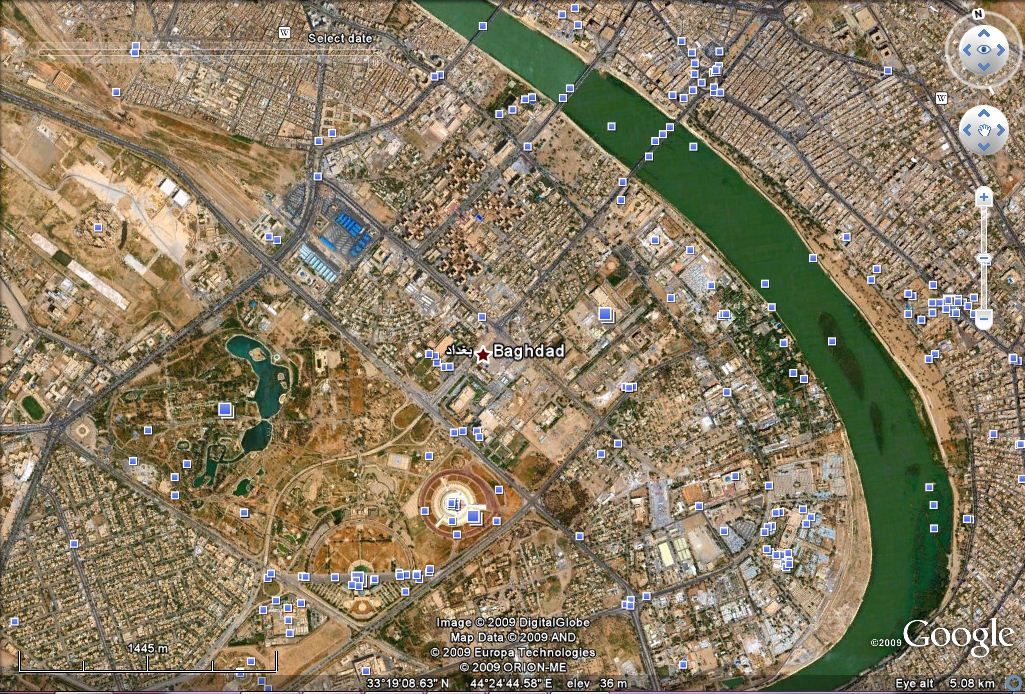
    Even more interesting, when I hovered over Baghdad, the former center of America’s “War on Terror” not even a date was displayed for the current photography. Using Google’s “previous imagery” function, I deduced that the last satellite photos that were given an official timestamp were from back in 2005. Out of the dozen searches I conducted, Baghdad was the only city that did not prominently display the date of its images in the lower left.

    Baghdad, Iraq: Last updated...???
    Baghdad, Iraq: Last updated…???

    So, it’s obvious that there’s merely more satellites posed over the relatively small area of the Middle East compared with the vastly larger North American continent, right? And it should therefore stand to reason that they just happen to be taking more pictures of everyone under their cameras. Not necessarily. These Arab capitols I’ve just shown you weren’t the only ones I photographed. Below are the two major cities of Jordan’s next door neighbor, Israel.

    Tel Aviv, Israel: Last updated early February 2006
    Tel Aviv, Israel: Last updated early February 2006
    Jerusalem, Palestine/Israel: last updated late November 2007
    Jerusalem, Palestine/Israel: last updated late November 2007

    So, in the span of a few hundred kilometers, we have five capitols of Arab nations, that have all had their satellite imagery updated within the past year. However, easily within that same range, we have a country that is considered Jewish that has pictures that are many times older. Why are there no satellite images of Jerusalem and Tel Aviv in the same time scale as the other cities? From the looks of the Arab pictures from May, June, July, and then August (and who knows for Baghdad) there was a definite system to these photography. Shouldn’t Israel be in there in, for example, April or September?

    Taking these screenshots reminded me of my trip into Jerusalem a few months ago. Our Palestinian driver from the border pointed out a zeppelin that flew high above the center of town. He told us that it was a security blimp, positioned up there to be able to focus down at the Muslim mosques below with high resolution cameras. Supposedly, they carefully keep logs and records by name on every Muslim who enters the mosques, keeping special care to note how devout they are to their prayers and how frequently they attend. How very generous of Israel to take up that responsibility!

    I’m not the first person to raise an eyebrow about Google’s satellite image-server policy. This article from the Arab News Blog questions the differences in resolution (clarity) of the images that are used over Iraq, Egypt, and Israel. In my own completely non-scientific article, I don’t speculate on resolutions and how easy it is to see various things in each city, but instead just how frequently things are updated. You can check all of this out yourself in Google Earth if you like; and if you don’t have it it’s free to download and useful for many more things than mere casual observations such as these!

    So, my friends and colleagues in the Arab and Persian worlds, feel free to shoot a jaunty wave up to the beautiful blue skies above you (or grayish, if you’re in Cairo) because you can rest assured that you’re being watched and photographed – perhaps even a bit more than your neighbors. For your safety and convenience, of course.

  • Residency Aquisition Plan B?

    I finally got the DVD from last year’s Christmas concert, a full eleven months later. Apparently the YWCA had been holding onto it pretty tightly; I had to call four different people in order to secure a copy, and only on the grounds that I would only have it for an hour – long enough to make a copy of it. The woman who gave it to me literally made me promise to return it to no one else’s hands but hers and she bemoaned how much effort it had taken from her to secure a copy from the Jordanian TV station that had originally aired it. In any case, I had it back to her in 40 minutes or so – long enough for me to run home in 5 minutes, make the dupe, and then run back.

    In other news, I had my first government-required blood test. Apparently this is a thing that they roll out every few years or so. My mother mentioned it to me even before I first arrived in Jordan, but no one ever asked me to get one before dutifully stamping my paperwork. This time, however, it was different. Maybe because of H1N1 or something, but they’re being much more strict about doing things in the official manner. I went to the good ol’ 8th Circle police station again (probably the sixth time I’ve been there) and the officer in charge of foreigner relations immediately told me to bring a sheet of paper with a blood test results from the Ministry of Health, a 20 minute taxi ride away.

    By this point, nothing surprises me about the Jordanian bureaucracy anymore, so I merely got into the taxi and went; no point in arguing. I paid my JD20 for the blood test, and went upstairs to the top floor. There, two maternal muhijabeh (covered with scarves) women fussed over me, asked me about my Arabic and about my children (surprised that I didn’t have any; they assume most foreigners here are married, apparently). Same as in America, I winced when they jabbed me, but it was over in a half second and they patted me on the head. I picked up the results this morning (I had passed, somehow; even without studying) and returned to the 8th Circle.

    The same officer of foreign relations chuckled when he saw me enter. He accepted my paperwork, commenting that he figured it was probably the same as last time. He looked up my passport file in the government database (I love having files in government databases) and frowned to his colleague, sitting in the couch on the other side of his office. He asked me why I had been coming in and out of the country so much and why I didn’t just get a permanent residency card. I didn’t really have an answer for him, so he winked and pointed over at the police officer on the couch. “Are you married?” he asked me. It’s a pretty common question here. When I told him no, he nodded to the other officer and told me, “That man over there has a pretty sister, what do you think?” Once again, I found myself strangely unable to form a response to a man’s question. There’s something about discussing someone’s sister, while both parties are wearing automatic handguns strapped to their chests, that just makes me quieter than usual.

    The man on the couch rolled his eyes. “He’s my younger brother, so my sister is his sister as well,” he grunted. I took a gamble and replied, “If that’s what it takes to get a permanent residency card and be a real Jordanian, sounds good to me – where do I sign?” The two of them crowed with laughter, slapped me on the back, and had me sit down for coffee. I learned that the main officer’s name was Aadel, which means “Justice” in Arabic, and commented it was convenient for his line of work. He told me that he remembered me from the first time he’d ever seen me, and sure enough – it was the same man that I had originally referred to as “Tony Soprano” back in September of last year. His brother dryly told me that I might as well be married into the family because of how often they saw me. As we talked, he occasionally paused to do his job, which seemed mostly to tell wealthy Jordanians that they’d need to have their Filipino housemaids tested at the Ministry of Health before he could approve their residency. After a large group of Filipinos, herded by a stern looking older woman, had left the office, I asked him if that was who he normally saw during his work day. He assented, telling me that it got pretty boring. The three of us chatted for a few moments about traveling around the area and police work in the country as we sipped our cardamom-filled coffee. I tried to get a picture with Aadel, but he told me it was prohibited and pointed to the camera above his door, staring down at him. He shook my hand warmly as I left, and I called him “nijma bil samooaht,” (A star among the heavens) which I felt was slightly more acceptable than the first thing I said to him a year ago (if you don’t remember the horribly embarrassing thing I told him last year, read the article linked above).

    Strange to think of how much my opinion of the police here have changed in the past year; I imagine that’s come with my grasp of the language so I can understand what they’re saying about me. Really, because of the emphasis on family, connections, hospitality, and honor here in the Arab world, it seems even easier to socialize with your average police officer here than it does in America (ironically, that could be because they will gladly stop and chat with you and get coffee while they should be guarding a street; I never said they were the most professional).

    There’s less than three weeks now before I return to America for a long vacation. I can’t wait to see how the country has changed in the year since I’ve last seen it. I can’t believe when I left before, Obama hadn’t even become president yet! It’ll be great to see how much everything has “change”d since he’s taken office…oh, wait.

  • Just say NO to Jewish-Arab racial mixing!

    Link to original article.

    Pause for a moment after reading that. Let the bile clear from your throat. Think about where you’ve heard things like “no racial intermixing” before. Warning of the “dangers” of it, and how it’s an “unnatural phenomenon.” Things like America’s old Jim Crowe laws et al. come to mind, perhaps? How about this one?

    Marriages between * and citizens of * or kindred blood are forbidden. Marriages concluded in defiance of this law are void, even if, for the purpose of evading this law, they were concluded abroad.

    Where’s that from? It’s from the Nuremberg Laws, ironically. In the original Nazi-created laws, the asterisks were “Jews” and “Germans.” And, to throw the Israeli propaganda department a bone here, the second part of Nuremberg, Section 1, Number 1 has not yet come to pass; inter-religious marriages are only recognized by Israel if they are performed outside the country. Bizarre, isn’t it?

    Let’s get a little bit more general here. This has (apparently) been going on for a long time in Israel, not just because of the perceived danger of “The Exploitative Arab” (Season Premiere at 9/8 Central!) to the “innocence” of the Jewess. If not for the fact that it’s vile and disgusting to degrade someone’s marriage “outside of the faith,” I’d find it amusing. You’d think that they would have at least waited a century before pulling literally identical propaganda tactics that their former Nazi persecutors did to them.

  • Iftaar Fall Concert

    As the women warm up with "You Will Be His," a very special lady joins them in the back (sssh, it's a secret!)

    After what Dozan wa Awtar billed as the first combination of Iftaar, plus singing concert, plus quiz game night (probably not hard to be first at that combination, actually) at Books@Cafe, I just returned home from a packed rooftop audience. It was a good night, even though the venue was a little bit cramped (with us in a corner of the outdoor cafe area) but the sound setup was quite powerful – even deafeningly so when I had the accidental misfortune of standing too close to one of their speakers and my ears rang for a good 5 minutes.

    We did a compilation of all of our other concerts since the beginning, most of which had been shortened for time limit purposes. Each one of the songs we sang had a question related to it which was put up on a projector sitting on the roof of the main building in front of the audience. Surprisingly, there were about 50 questions, and we as a concert only provided clues to half of them. The other half were related to questions our “DJ” asked in both English and Arabic, and to songs that were played over the speakers that people were asked to identify. There was a good mix of foreigners and locals in the crowd that night, which meant that the questions were mixed as well. Some questions, like “name the main character in this theme song” (Mickey Mouse Theme Song) might have been easy for the Westerners in the group, but when the choir danced out the opening number to an Arab cartoon named “Belle and Sebastian” I certainly know I was as baffled as the foreigners in the audience looked.

    During those small mini-intermissions where the audience was working on questions unrelated to our singing ability, the choir members milled about, chatted with friends in the audience, or in the case of Yanal and Nedy and I, sampled the local hot chocolate. Because it’s Ramadan, no alcohol can be served or purchased anywhere in the country for the entire month. Some more liberal businesses have been known to evade the rules, though, and I remember last year, Books@Cafe was shut down for the entire month of Ramadan for alcohol-serving infractions. I was helping Nedy grade some first-round quiz sheets that had come in, and Yanal handed me a white mug in passing and said, “Can you hold my hot chocolate for me?” I grasped the wet base of the mug and looked at him in confusion. “Yanal, this mug is covered in condensate…?” He looked at me blankly and said, “You know, my hot chocolate. Feel free to have some.” Following his directions, I quickly discovered that the mug contained neither hotness nor chocolate.

    Wait a second...
    Wait a second…

    Besides questions on songs we’d already done, and mp3’s courtesy of Yanal’s laptop, many of the singers in Dozan also did solo or small-group bits and pieces from musicals. Besides famous Western ones like Miss Saigon and Grease, there were also (apparently) famous Arabic musicals as well. I was a back-up singer for my English friend John’s rendition of “Bui-doi” from Miss Saigon and part of the militant men’s number of “Do You Hear the People Sing” from Les Miserables (which took me back to high school when I sang the same song in costume for one of my favorite performances of all time). The last act of the evening, though, was our director Shireen and I singing a little cut from Grease‘s “Summer Nights” which was a lot of fun. I wish they would have let me sing the whole song, but oh well!

    In other news, class has resumed at Ayn al Basha for the second year. I was there on the first day of class on Sunday. It was strange to be there as a technical support contractor and not a teacher for the first time, and many of my former Hardware students or other random people came up joyfully to shake my hand, and expressed their disappointment when I told them I wouldn’t be teaching this time around. I have so many other jobs to do now that I’ll probably only be at the training center one or two days a week to check over the computers and the network.

    I have to say, I was extremely impressed with how Jeff handled everything. With both Aaron and Ahmad on vacation, he handled the entire center and everyone’s questions with amazing professionalism and calm. In the half hour before classes started, he probably had 20 people milling around him, demanding to know why they didn’t get into this-or-that class for this-or-that reason (usually no one’s fault but their own for not properly filling out the application previously). As I observed from the sidelines, wrists-deep in a server case that needed to have hard drives replaced, I knew that if I was in his shoes there, I would have gone insane and started shouting epithets in Arabic and Wamidh would have to administer tranquilizers to me with an elephant gun. But Jeff held his ground with every demand and cajole and calmly took everyone’s questions in an ordered and logical matter. If I had been wearing a hat, I would have taken it off to him.

    We’re getting good turnout at EGT, or so I’ve heard. There was some worry as to whether or not people would show up because of Ramadan, but people are apparently coming to class as they should be. We had a little “celebration” party and iftaar at my house a week ago to commemorate the end of the first year, and Aaron and Jeff went over the policies of the new year with the teachers. It sounds like things are more strict now then previously in terms of attendance and behavior, but EGT has really built up a respectful name for itself and the students, both young and old, seem to have a craving for rules and order. After living in Iraq, a country that is decidedly unregulated in many respects, it’s probably a breath of fresh air to have a nice daily schedule to fall into.