HeiseHeise.com

The Personal Blog of Zach Heise

A random image

A random image. Reload page for more. Want more info?

Month: January 2010

  • Al-Fajr Prayer: Islam at dawn

    Soon after I returned to Jordan from America, I realized that it was odd that although I’d been in the country for almost a year and a half, I had not yet experienced a traditional Islamic prayer, or sulaah. For how much I’ve talked about trying new things, it should have been much higher on my list of ‘things to do’ than to not joined one of my numerous Muslim friends at prayer. Heck, I ate sheep’s brains for Easter last year before I’d been at a sulaah. I figured it was time to remedy that.
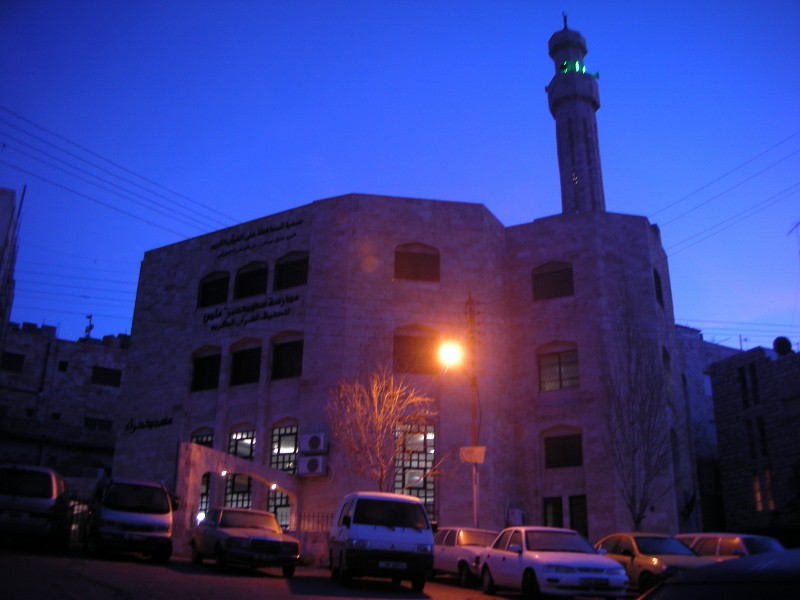
    The Masjid (Mosque) minutes after completing the morning prayer. The timing is perfectly coordinating so that the sun's first light strikes the building as prayer ends
    The Masjid (Mosque) minutes after completing the morning prayer. The timing is perfectly coordinating so that the sun’s first light strikes the building as prayer ends

    Last week, I stopped by my neighbor Marwan’s supermarket and asked him if I could finally take him up on his offer to join him in prayer at our neighborhood mosque, Masjid Hira’a. His broad bearded face broke into a huge smile and he cried out, “of course you can, Mr Zach!” I sat down at his counter for an hour as neighborhood customers trundled around us, bundled against the January chill. He explained to me that the best “first time” sulaah would be the al-Fajr prayer, which is always timed daily to come directly before the first rays of dawn break over the horizon, wherever you may be. I chuckled inwardly at that; I think that everyone in Jordan, be they Muslim or otherwise, has intimate knowledge of that particular prayer when it’s blasted at the wee hours of the morning. He explained that it was best because it was the shortest; usually no more than 6-7 minutes long. “There is rohkta-tayn; two rohkta,” Marwan told me solemnly. “The other prayers in the day – and you know there are five – are either three rohkta or four. This one better for you, for the first.”

    He got out a piece of paper and had me write down the exact method of al-Wudthu, the ritual cleansing that devout Muslims carry out before each of the five sulaah. Then he pulled out a battered old Qur’an with a seamed green cover, caressing it respectfully and gently laying it on a cloth on his counter. He smiled fondly at it, and told me that he had this Qur’an since he was a boy and his father gave it to him. As he opened it to the beginning (starting from the right-side, as Arabic is a right-to-left language), he frowned absentmindedly at some scrawls and scribbles in the margins of the first page that looked like a child had been doodling with a pen. “Is not good, this,” he muttered. “Not respectful to write in the Qur’an this way – I do not know where these come from.” I thought about who might possibly have marked up the Qur’an and then forgotten about it over the years…but of course I just nodded politely.

    From his Qur’an, Marwan showed me, and then intoned the Surah al-Fatiha, the most important “chapter” in the Qur’an which the Prophet Mohammad (SAW)* instructed must be read before each and every prayer that is made. The first few lines of the surah, which start with “Bismillah al-raahman, al raaheem,” are a common utterance regardless of the situation, merely meaning “In the name of God, the all merciful and ever-merciful.” The rest was more of a jumble, but sounded quite pleasantly melodic. Technically, music of any variety was forbidden by the Prophet, so the humming chant of the sulaah is really the closest that it gets.

    After giving me final instructions on how to carry myself, where to look, how to stand, and what to wear (the latter was pretty much the only thing that he said was up to me; the rest is fairly complex), I took my leave of the supermarket as Marwan happily told me, “As-salaamu alayk, akhi!” – peace be upon you, brother! However, because of scheduling issues and some mix-ups, I wasn’t able to finally attend until just this morning.

    I rose at 5:15AM, when Marwan called my mobile and quietly told me to prepare myself in wudthu and meet him at his house gate next to the supermarket at 5:45. In the distance through my window, I heard the “waking adhan” calling all Muslims to arise and prepare, crying out dramatically, “Prayer is better than sleep!” I hadn’t eaten much the night before, and I was careful to avoid any alcohol. I was trying to take “purification” seriously in all things. Technically, even flatulence ruins the purity of wudthu so I didn’t want to take any chances by eating a big meal of falafel and hummous and fuul – three foods which are all made from beans!
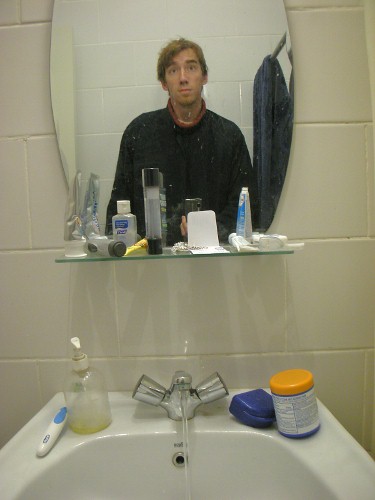
    The water's hot and ready and I am awake far too early. Oh well..."prayer is better than sleep" after all...
    The water’s hot and ready and I am awake far too early. Oh well…”prayer is better than sleep” after all…

    I put on my blue dishdash robe (this makes the third use of it in a year, I believe) and went into the bathroom with my piece of paper with Marwan’s specific instructions clutched in my hand. I stumbled sleepily on the edge of my flowing robe and banged my caving-sore hip on the door frame – but successfully refrained from saying anything uncouth for the sake of the situation. I stared down at the paper at what I’d written down as the warm water filled the sink in front of me. I took a deep breath, and tried to perform the following as gracefully as possible.

    1. Wash each of the wrists, first the right and then the left, with three circular motions
    2. Cup water in your right hand, suck it into your mouth, swish it around three times, and spit it out
    3. Suck water into your right nostril and then blow it out. Repeat three times. And then repeat with the left nostril (note: this one was really hard to do without coughing and choking)
    4. Wipe downwards across the face with upwards-facing palms, from forehead to chin. Repeat three times
    5. Using the left hand, wash the right arm from wrist to elbow, inside and out. Repeat three times, and then switch hand and arm
    6. Taking some water into palms, run hands from hairline to the nape of the neck and back the opposite way, keeping hands tight to the hair
    7. Clean out ears with the tips of each index fingers, from top to bottom
    8. Taking some water into palms, run hands from the nape of the neck around to the front of the neck
    9. Finally, use the left hand to clean the right foot from the toe to the ankle, carefully cleaning between the toes. Repeat three times, and then switch hand and foot

    …I looked down at myself after I had finished this process and realized that my formerly-dry dishdash looked as though I had just purified it of its sins. I was thoroughly glad I wasn’t wearing a white robe instead, and that Marwan told me to just wear my usual leather jacket into the mosque to keep warm and cover the numerous splashes of water I was now covered with. I tried to review the words of the Surah Al Fatiha in my mind, and realized that I might need to a little help here, in case I was quizzed or something. I scribbled “Subhan rubi’ha al-aduheen x3″ and “Subhan rubi’ha al-3la x3″ in tiny letters across my left thumb, but I knew I didn’t have time to write anything else. I glanced at my clock and realized that one thing remained – Marwan had pointed specifically to the silver cross I wear on my neck and said, “You need to take that off when you pray in Masjid; take off all silver and gold.” He explained that it wasn’t because it was a cross, but just because almost all jewelry is forbidden for men. I slipped off the necklace and walked downstairs and and up the street a few meters to wait in front of Marwan’s dark doorway.
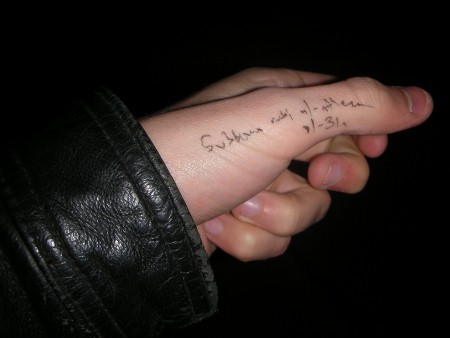
    I don't think this is forbidden, but I didn't exactly advertise it to Marwan either!
    I don’t think this is forbidden, but I didn’t exactly advertise it to Marwan either!

    I heard his deep voice intone above me from a window, “Zach” and then I heard the thud of sandal-ed feet on the stairs leading towards me and within another moment he was next to me, walking quietly and serenely in sweater, corduroy trousers, and a denim jacket. He smiled a quiet smile and asked me if I was ready for al-sulaah, and I shivered from the morning cold and nodded in assent. Without another word, we joined the flowing, shuffling stream of men next to us in the street and entered the warm glowing gate of the Hira’a Mosque, kicking off our shoes on a small footwear-barrier as we did so.

    (more…)

  • Zubiya Cave and the Fountain of Bat Guano

    Over a year ago, Pat asked Philip and I if we wanted to go spelunking with the boy scout group that he was a leader for. Neither of us had time at the first invitation, but having only gone spelunking once before, I was definitely interested and told Pat to keep me posted on possible repeat dates. Well, there was another invitation put out, but the date fell during the time I was in Tajikistan last year and once again I had to miss out. Although Pat and his family returned to America for the 2009-2010 school year, his legacy lives on through the Zubiya Cave Expedition of 2010.

    My friend Joanna had already been to the cave with Pat and the scouts last year, and she told me and fellow spelunker Margie to dress warmly. I borrowed the car from Aaron and picked Margie and Joanna up from their house at about 8 in the morning, dressed in 4 layers of (old) clothes that I didn’t mind utterly destroying with mud and bat feces. We had our sandwiches, our Coca-Cola, brownies I’d baked the night before, and I had my Nescafé to keep me awake during the two hour trip. Margie tried to convince me that drinking Nescafé is the equivalent of drinking hot chocolate sludge, but I couldn’t bear to part with it. I’m no coffee thouwaq (gourmet).

    It was almost exactly a two hour drive to reach the cave, and it was quite easy to find thanks to the excellent driving instructions that Pat had left for us. The only problem came at the end, where we weren’t entirely sure we should park. I turned the car around in a driveway, as two older Arab men and a similarly-aged woman gazed at us from the steps of a small brick building. I decided that it couldn’t hurt anything to ask for directions, and the three of them offered to escort us back in their car and then lead by foot to the cave itself. We certainly weren’t going to turn down an offer like that, so we waited for the three of them to pile into their old maroon sedan and drive at a stately pace back up the road about a 100 meters.

    We piled all of our gear into backpacks as I introduced ourselves more properly to our new guides. Their names were Abu Haitham, and Abu and Umm Ali (Abu means father, and Umm means mother). They asked me with familial concern if we had brought enough food and enough lights, and after I tried to dispel their worry in my broken Arabic, the trio turned off the road and led us off the road into the dew-moistened and wonderfully green grass of a tree-lined meadow.

    Messrs. Abu Ali and Abu Haitham amble along through their beautiful countryside
    Messrs. Abu Ali and Abu Haitham amble along through their beautiful countryside

    After a few minutes of walking – or sliding – through the grass and mud, we came suddenly upon the limestone maw of the cave. There were no signs, no guards, no rails – the only sign that this place had ever been discovered before were a few spray painted arrows and the ubiquitous small sacks of garbage. Margie dug into her pack and pulled out a third headlamp which she handed to me. Our guides looked reassured to see us all with lights, and me with my biking helmet (I’m paranoid about my height and pointy stone ceilings, okay?!) and together the six of us descended into Zubiya Cave.

    I was pleasantly surprised that we weren’t immediately up to our ankles in water. On the way up we had voiced fears that because of the rains that had swept through the country during the past week, it might be dangerously damp in underground caverns, especially in the more temperate north of Jordan. There was plenty of mud, though, and I joked with the other men that I was going to be several centimeters taller thanks to the new stilts I was wearing on my soles. I noted that they were all just wearing sandals and figured that they certainly would know better than us about what to wear. All three of them told me that they had lived in the area all of their lives, but then admitted that they’d actually never been in this cave before, although they knew their children had been. I gave Abu Ali one of my flashlights and the three of them cautiously trudged behind us, muttering incomprehensible things as Umm Ali attempted to not step on her abiya robe and drag it through the mud.

    Pat originally sent a black and white map to me, so I added some colors after we got back...
    Pat originally sent a black and white map to me, so I added some colors after we got back…

    The first path we walked along was obviously well-traveled – wide and dusty, with many footprints. The light of the grated entrance vanished within seconds after we rounded the first corner, and instantly we became helpless without our headlamps and flashlights. Stalagmites, huge, brown and round, hedged our footsteps and deeper down into the darkness in front of us we could hear faint squeaking and if we stopped walking for a moment we could detect the softest rustle of wings.

    Only a few meters into the cave, there's still enough light to make the flash get all confused
    Only a few meters into the cave, there's still enough light to make the flash get all confused

    After walking what was probably 15 meters into the cave, we came to the edge of a small cliff that split into three separate paths. It was here that Umm Ali looked like she’d had enough. She took a tentative step down one of the cliff paths, stumbled a little, then straightened up regally and intoned, “khulaas” which means “That’s it.” The two men looked at each other, and then told me that they would go back now with her as well. I told Abu Ali to hold onto the flashlight and use it to get out. He thanked me and squinted into the unknown gloom while waving the feeble beam ineffectually at it. “This is a dangerous path, so I ask of you to take care,” he told me, his voice clearly telling me that he would like nothing more than the three of us to give up, turn back, and join him and his wife for tea and biscuits. I told him that Joanna was an extremely experienced spelunker who knew the cave very well (it was a good thing that she couldn’t understand what I was saying, or else the horrified look in her eyes may have given my white lie away) but the old man was mollified and smiled. He invited us to come back to the house when we were finished, and vanished into the shadows, waving the paltry beam of my 2 dinar flashlight in front of him.

    All three of us were starting to feel the strain of coffee and Coca-Cola on our innards and indeed had been since before we entered, but we didn’t want to immediately follow behind our erstwhile hosts and heed nature’s call in the bushes outside the cave. We exchanged pained looks and debated on what we should do. “Let’s just follow along quietly behind them, not making a sound, and wait for them to away from the cave mouth,” I suggested as I started rapidly towards the entrance, which was followed by the sound of Joanna making “pthbbtth! pthbbbbbth!!” noises. “There are bugs flying into my mouth!” she retorted to my raised eyebrow.

    We crept back (almost) silently to the main entrance. I motioned to the other two to stand back, and I went all the way up to the metal bars of the security door that has probably never been closed. I heard their voices up above us and I scurried back to my companions, and we stumbled back into the wider chamber we had just vacated.

    Arabic Word of the Day: the colloquial word for bat is "wutwut" which is probably the most awesome thing ever.
    Arabic Word of the Day: the colloquial word for bat is "wutwut" which is probably the most awesome thing ever.

    Needless to say, “vacating” needed to take place and I’m not ashamed to admit that we made do like the bats obviously had been doing all around us. I heard one chittering above me and felt like I was being watched by a small, furry voyeur. There were plenty of tiny little alcoves and chambers all around us that it was like the cave was designed for that exclusive purpose. Feeling much better, we struck out towards the east of the cave, stopping to pile a small cairn of stones at the edge of the cliff as a marker. These rooms we were traversing now were extremely large, with ceilings at least 15 meters above our heads in some places. I could see the spidery ends of plant roots above us just barely in the glow of my headlamp, and I dug my remaining flashlight out of my backpack to use as an auxiliary light source. Between the previously-shown map that I was constantly annotating, my camera, the light, and a pen, I found that my hands were quite full most of the time! However, this part of the cave (shown on the map in light baby blue) was a cakewalk compared to what we were about to get into.

    Our first steps out of the baby blue were in the northwestern section of the cave where things started to narrow on us for the first time. That entire section, as you may be able to tell by reading the fine print, is up on one end, and then a drop on the other into a lower chamber. I didn’t even try to lift myself up into the orange section on the left, as it was almost a foot above my head, I wasn’t wearing any gloves, and I didn’t really know what was up there. However, all three of us were able to shimmy down about 2.5 meters into the yellow-colored room marked “below” on the map. That room was quite small in all dimensions (I was barely able to keep from hitting my head) and filled with strange pits in a ring shape all around us. It looked unsettlingly like the site of numerous unfinished burials.

    After we made our exit from the Up and Down cave chambers, the real fun started. That long orange path to the south was the toughest we’d done yet, about 15 meters of crawling on our hands and knees in a maze of stalagmites, the ceiling pressing down on us just centimeters above our heads. I was happy to be wearing my helmet! There was some confusion at first about where to go, because the map said “? Under here” and I was about ready to try to crawl under a pile of rocks like a trilobite before one of my companions stopped me and pointed out the small shaft above us. We never did make it back to that pile of rocks, and I still don’t know what “? Under here” really meant.

    We reached our first major junction at the end of this long path, and came to something even more interesting in the red section. Yes, red does mean bad. As we crouched there in the pale glow of each others’ lamps in the wider yellow section of the map, I could barely see anything down the red path – there was nothing visible but a mass of stalactites jutting out at us like broken teeth. Without batting an eyelash, Margie volunteered to venture down this “path,” if you can use that term, and see if it got any wider or continued farther on. As Joanna and I shined lights down behind her, she reported some “tight squeezes” but didn’t sound alarmed. We ventured down after her. And this happened.

    How do I manage to find myself hanging upside down between limestone columns all the time?
    How do I manage to find myself hanging upside down between limestone columns all the time?

    Yes, although it looks like I might as well be stuck between two mud blocks, these things really were stone and had the durability of it. I had to flop about, fishlike, kicking my legs feebly as Joanna and Margie watched with amusement. After my feet finally gained purchase on another pillar behind me, I was able to kind of squirm around until my newly-broken body dribbled out the other side. Both Joanna and I described it as “being birthed.” There was nothing in this little room to to the side though, but I used a key to mark “2010 الأجانب” which just says “2010 foreigners!” I was all excited at the thought of squeezing into an undiscovered location, but then peered into a tiny impassable crack into the farthest wall (on the map, it’s actually the farthest south east part of the cave) and saw more Arabic writing, Mohammad and Ahmad and realized that some tiny Arab child had already somehow squeezed his way in there. Better luck next time.

    Before stopping for lunch, we tried the last chamber that doubled-back north again, and found a mysterious, miraculous pool that Joanna stared at for a moment before commenting that Pat told her that it was called the ‘Fountain of Youth.” I didn’t even see it at first; it took a minute of peering onto the ground before I realized that this puddle filled with bat poop was actually what she was referring to. “And then Pat drank out of it,” Joanna added. I thought of Pat and and his love of “roughing it” and outdoors experiences and realized I wasn’t actually that surprised. His immune system hardened after years in Egypt and Jordan, he had obviously survived his “miraculous” beverage…but none of us were going to follow in his footsteps.

    I hadn't expected the Fountain of Youth to be quite so...chunky.
    I hadn't expected the Fountain of Youth to be quite so…chunky.

    Food always seems to taste more delicious in a cave, perhaps because you really appreciate the fact that you’re enjoying a delicious flavor while you’re surrounded by rock, dust, and bat dung. We crouched under the low ceiling in the small central room that connected the previous two chambers, headlamps pointed inwards, and ate our sandwiches, chips, fruit, and the much-anticipated brownies. Thankfully for me, the girls had brought hand sanitizer to share; I didn’t want to even estimate what I had on my hands but they were kind of a greenish-white color.

    After repacking our now-empty bags into our rucksacks, we connected back into the four-way intersection shown on the map, and were intrigued by what looked like a black gash on the wall, marked on the map only with the words “Narrow crack” and one of those maddening question marks. We all wanted to know what was on the other side of that question mark. And so began the most dangerous part of our journey.

    (more…)

  • An ode to power plugs

    You don’t know how much you miss not being able to look up the location of CPU fabrication plants in Israel when the question strikes your brain…until it’s taken away from you. However, I’m happy to report that I’ve got internet at my house again. So long to Orange Telecom, widely regard as a flaky provider, and hello to Umnia’s “Double Turdo” service, which has a less-known level of flakiness! Hello to 20GB monthly limits instead of 10GB, and 2Mb speed instead of 1Mb (or at least supposedly). The internet in Jordan is neither America nor Korea, but it’s good to be able to use Remote Desktop again and look up questions like the aforementioned. (Qiryat Gat, by the way.)

    The rant of the night is the lack of a standardized power plug in Jordan. This country has a ridiculous lack of standardization, and it seems to be the worse when it comes to just choosing a power plug to use. Check out this map:

    Poor little Jordan has at least 5 listed
    Poor little Jordan has at least 5 listed

    It’s one thing to have this entire country filled with so many plug standards I have to carry a sack of clinking adapters in my backpack to make sure I’ll be able to plug in my laptop where I need to work. That’s bad enough. It’s even worse when we have four different plug standards at the training center in Ayn al Basha!

    When I first came to Ayn al Basha, the only building that had electricity (or even existed for that matter) was the lime-green administration building. All the plugs in there are using the Italian “L” standard; three prongs in a straight line. Then when we built the first classrooms in September and October of 2008, the electricians put in the German “Schuko” style plug. Now, after I returned from America on my vacation, I discovered that some numbskull had wired my new classroom with British “MK” plugs – my most-despised type of plug that’s used here. Then, just a couple days ago while I was with the TOT class in the assembly room, I saw that the plugs there were using some weird hybrid of the USA “A” standard, combined with widened holes to fit the “Europlug.” Supposedly, it’s some sort of Chinese sub-standard. You know what really gets me? Aaron told me that the electrician that did up my new computer lab was the same one who installed the “Schuko” plugs in all the other classrooms last year, so he should have known better than to just stick another random outlet standard into the walls. It’s just a coincidence that because of their complexity, MK outlets cost twice and cables cost thrice more as any other type, right? Hmmm.

    The British MK outlet and plug are indeed the absolute worse, relics of the 1930’s with a plug that requires its own built-in fuse and an outlet box that usually has an utterly pointless power switch next to it. The pins on the MK are huge, ungainly, and if you are unlucky enough to step on one in the middle of the night you will beg for death. “They’re impossible to break, though,” some of my English friends here will say with a grin, and one even proudly showed me a thick ugly scar on his right foot where he drove an MK a centimeter through his sole while running across a room to answer a phone. The MK needs to die. Or at least, Jordan needs to stop using it – but it’s unlikely, seeing that it’s probably second after the Europlug in the number of buildings it’s used in.

    The Europlug – a bland, non-grounded little weak thing. Most lower-amperage devices in Jordan use this style of plug, and mercifully it seems to fit into most of the outlets found here. However, because of its lack of ground, it’s useless for computers. Also, they also feel like they’re going to fall apart in my hand. Pass.

    The “Schuko” plug would definitely be my favorite if the American “B” standard didn’t exist. Strong and sturdy with an ingenious way to add a ground wire to the system. Philip thought ahead when he had his house built and had each wall outlet contain two sockets – one using the Italian “L” plug and the other using the “Schuko.” The only problem with them is that they’re still too large for my taste. When I need to buy power strips (which is quite a bit), you can only fit four “Schuko” plugs on there, like the MK. If you tried to sell a power strip in America with only four outlets on it, you’d be tarred and feathered. By me, at least, if no one else would.

    The USA “NEMA 5” plug is by far the best of them all, and after having to work with this bizarre hodgepodge for the past year, I don’t think I’ll find much resistance to that claim. Our plugs and outlets are like our citizens: a well-grounded combination of strength, size, and electrical amperage. It’s no shock that we invented electricity, really, and it feels good to be able to say for once that America is indisputably the best at something besides starting wars. Without further ado…

    USA! USA! USA! USA!
    USA! USA! USA! USA!

    Glad I got that out of my system.

  • Training of Trainers begins

    I just completed my first full day of “TOT,” or Training for Trainers, the new program sponsored by the UNIDO and ISG organizations. It was a great feeling to be back in front of Iraqi students with Wamidh at my side, although very different to only have four of them instead of eighteen. Technically, the first day for them was yesterday, but they had informational meetings with Jeff and Wamidh all day going over EGT policies. I happened to wander into our freshly-completed conference room, a new building now sitting where only bags of concrete, garbage, and dog droppings were 4 months ago. The new building has nice overhead office lights, a tile floor, and a sliding glass door. I sat down in the corner to watch Jeff lecture and Wamidh translate, and Jeff had me stand up, introduce myself to the ~45 TOT students and describe what it was like to be a teacher on the site. I was pleasantly surprised to see four women in the group, and I was told that one of them would be in the IT class with Wamidh and I.

    Rain, lightning, and even hail had been coming down on us for two straight days now (the closest Jordan usually gets to ‘winter’), but all of the new students arrived bright and early as collective group on a school bus. I quickly learned that they had a very different mindset than the IRD-sponsored refugees that still make up the majority of the students. All of them are vocational trainers and teachers themselves from the Baghdad area that have been sent by the Iraqi government over to Jordan specifically to receive higher levels of training and new skills from EGT. Some of the training classes will be three months long, and some, such as mine, will only be one month. After their training is done, they will return to Iraq. Three of my four students have been computer teachers for many years, but only with computer software, and not repair. The difference between their general attitude towards education and that of many of my former students was astounding. These were fellow teachers and listened carefully, asked relevant questions politely, and were (almost) punctual after break times.

    It’s going to be a little tough to get between Ayn al Basha and Whitman on Mondays and Wednesdays when I have to teach at both, but I definitely want to give these four teachers as much information as I can in the short month that I’ll have them as students. I’m glad that they have a strong base in using Windows XP already, which will help them out when we switch to Windows Server operating systems (UNIDO specified for some reason that they should be taught primarily network-related information).

    At the end of the first class; comparing the insides of a computer from 2002 versus one from 2009
    At the end of the first class; comparing the insides of a computer from 2002 versus one from 2009
  • Back to Ayn al Basha

    I’ve been back in Jordan for a little over a week now, and my internal schedule has more or less readjusted back to normal. However, I have a feeling that a large percentage of that may be because the internet at my house has not worked since my return. Not having funny cat videos, tech reviews, and Facebook at my house has remarkably reduced my ability to stay up until the late hours of the morning. I may be getting a full 8 hours of sleep for the first time in a decade!

    Wajih has invited me to be the teacher of another technology class down at Ayn al Basha. This is with a new NGO contract, not with IRD this time but with some organization called UNIDO. Today is the big day, in fact – their representatives are going to be coming onsite in only a couple hours for a ribbon-cutting or some sort of equivalent. Classes are supposed to start next week on Sunday. As opposed to my previous training course with the IRD contract, this time I’ll only have 4 students instead of 18. Apparently UNIDO hand-picked them for this class and they’re supposed to have fundamental knowledge of computers already, which is why I’ve been told to step it up a notch and discuss Windows Server vs. Linux Server, installing patch panels, and the differences between Cat6 and Cat5e network cable (the former I’ve been installing for the past 4 days; it’s so tough and thick that my hands have practically been bleeding).

    It’s amazing how much this site has grown in the past year. I still remember my first trip down here with Philip, way back in late 2008, when it was nothing more than a dusty old tile factory site. Now, between the IRD contract and the new UNIDO group, we’ll be teaching 20 different classes in 15 different classrooms. We have a sewing class and two computer labs, a welding facility, and a huge garden – the courtesy of Nicholas’ legacy before he left 4 months ago.

    I look forward to seeing how far along it can get before I inevitably move onto the next stage in my life.

    Before I get out of Aaron’s office and get back to work on the last few touches on my new classroom, I suppose I should do some quick research on different available Internet Service Providers, just in case there’s a better deal out there than my old now-expired Orange contract. Frankly, I’m leaning towards Umnia’s “UMax” service, because who can resist an advertisement like this?

    DOUBLE TURDO SPEEDS!!!

  • The safest flight ever

    For the third time now, I’ve said goodbye to my friends and family back in America and returned to Jordan. I kept myself busy in my last few days in the country, attending (and helping host) Ty’s New Year’s Eve From The Future bash (where I dressed in a dishdash, because in the future all people wear robes, anyway) and then Ty’s Lords of the Trident metal concert in Madison. The band is great – they were recently featured in The Onion AV Club – and here’s a video that my cousin took at the concert.

    Ty drove me to the Memorial Union bus stop in the early afternoon on Monday and saw me off. I had already said farewell to my parents a few days ago; this actually marked the first time that they hadn’t been able to take me themselves. At the airport, I was worried that because of the aforementioned CrotchBomberMan that security might be different in the airport, but nothing seemed out of the ordinary. They did tell us to take all electronics out of our carry-on bags instead of just laptops (which meant I had to dig out my iPod, Game Boy, and external hard drive) but maybe that’s unrelated.

    I spent the three hours waiting in the terminal watching “2010: The Year We Make Contact,” the lesser-known sequel to “2001: A Space Odyssey.” We had meant to watch it during our futuristic new year’s party, but had been too tired after the ball drop to do anything except fall asleep on Ty’s couches. Getting old, I guess. 23 and 24 year olds aren’t as young as they used to be.

    Our airplane was named Prince Hashem bin Abdullah, after one of King Abdullah’s sons. I was directed to my requested window seat, which was exactly halfway along the plane. I even had a wall to my back so I looked forward to not getting pummeled in the spine for the next 14 hours. My seatmate was an unassuming Arab man who looked to be in his mid thirties. He didn’t speak English beyond a few words and sentences and seemed quite shy until we were in the air and I introduced myself in Arabic. He warmed up to me then and we chatted about Jordan, America, and our families.

    As I knew that he would, he gave me his phone number and invited me to visit him and his family. I gave him mine as well, and as he slid the piece of paper into his wallet, I noticed his Jordanian driver’s license and commented on the military-issue cap he was wearing in the photograph. He was quiet for a moment, looked around at our sleeping co-fliers and told me that he was actually working with the military now, on security assignment to Royal Jordanian as one of the air marshals for the flight. He told me he’d been doing flight security for a couple years now, but as he showed me the photographs of his two young children on the digital camera he’d purchased in America, he told me with a smile that he was looking forward to being at the end of his tour and leaving the military so he could spend time with his family. Maybe I’ll become a farmer, he mused.

    (more…)