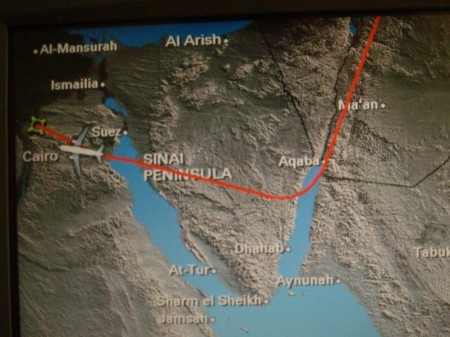
I’m on the train now, returning from the city of Alexandria back to the steamy capitol of Cairo. The train this time is air conditioned at least, unlike our ride up which felt like a sauna. Haitham had to give me some of his extra medication just to keep me from gasping like a fish out of water. It’s been two successful days in the Lighthouse City…although I didn’t get to see everything I wanted to I think I got pretty close.
Yesterday morning didn’t start off too well, though. Besides the nauseating ride from 6 til 9 AM to reach Alexandria in a train car that smelled too much like old fish, learning to understand Haitham’s apartment negotiation style with room managers was a trial in and of itself. Within minutes after our fishlike train pulled into the gaudy Alexandria Station, taxi drivers scented new blood and converged on us. Waving their arms in a way which they must have believed was “welcoming,” they began to undercut each other in their bid to both drive us and take us to their uncle Mohammad’s apartment tower which was conveniently located “with a sea view.”
Haitham’s advice to me for negotiating was “be quiet and let me do the talking,” which was similar to the Cairo strategy. The first taxi driver was a grizzled and bestubbled old sheikh who had the most incredible “R” rolls in his dialect that I’ve ever heard. It seemed that a machine gun was going off in our tiny black and yellow Peugot every time he opened his mouth. Haitham was completely calm and collected, and agreed to visit the apartment buildings our driver conveniently happened to know of. The first one he showed us had interesting wallpaper and carpeting, until I actually opened the encrusted window drapes and saw it was actually mold patterns etched into the woodwork like some sort of horrific alien creature. He led us out into the balcony and had us lean over the edge. Peering around the moldering edge of the building, I could just make out a sliver of blue-green ocean crashing against large rocks. There was ash mounded around the ashtray on the table, and a black streak on the ceiling above it, making it appear as if a small volcano had gone off in the room and the sulfuric smell wasn’t too far from this guess. “How much do you want for it?” asked Haitham cheerfully. I bit my tongue and tried not to inhale too deeply. Thankfully, the owner wasn’t willing to drop below 120 Egyptian Pounds (about $21.66) for the two of us and our driver took us to the next place.
In this second building, which was much cleaner and had an actual sea view, Haitham got as far as handing over our passports for the owner to photocopy before we hit a wall. The driver wanted another 10 pound tip for “recommending” the place, something which Haitham thought should be settled between the owner and the driver, not between him and our wallets. By this point, 45 minutes after our arrival, I was semi-conscious on one of the grimy couches and wasn’t able to protest to Haitham that our time was more important than the pound-equivalent of 1.32 Jordanian Dinars. I woke when the two men started screaming at Haitham, making the driver’s “R” sounds really start to sound like a machine gun. They must have roared and cajoled him for 5 minutes before they finally gave up and Haitham and I left. I have to admit I was less than pleased with Haitham and told him as much out on the street as we sat on our bags on the sun-swept boardwalk along the Mediterranean. “Can’t you see that our limited time in Egypt and Alexandria is worth more than a lousy JD and change?” I growled at him. “Man, they would have charged us for the room key and to use the electrical outlets!” he protested in return. I told him he had one more chance to get an apartment, otherwise we’d just go back to the hotel sections and have to pay a lot more. He promised that he’d be more forgiving with our next try.
A man on the street wandered past us at that moment and coincidentally, he too also knew someone with an apartment! We walked another 50 meters or so along the street and Haitham, true to his word, accepted the deal and tipped the finder five pounds for baksheesh. This new apartment of ours was by far the best, and totally acceptable for 135 pounds. After seeing the previous two, I was able to ignore the cigarette burns in the carpeting and even the weird blue-paint hand prints on the wall (better than alien mold colonies, I figured). There were huge gaudy and golden paintings and frescoes dedicated to Allah, Mohammad, and Mecca all over the walls, and the furniture were plush faux-velvet burgundy monstrosities that smelled of cigarettes and sweat. Needless to say, they too were burned. Haitham informed me that things like hostels and hotels were only for foreigners, and that touring Arab youth and families would always take a cheap apartment instead. “Why settle on a single expensive room,” he said, “when you can have two bedrooms, a kitchen, a balcony, and a couple bathrooms?” I had to admit that although the place would have been condemned had it been in America, he certainly had a point on the bargain aspect.
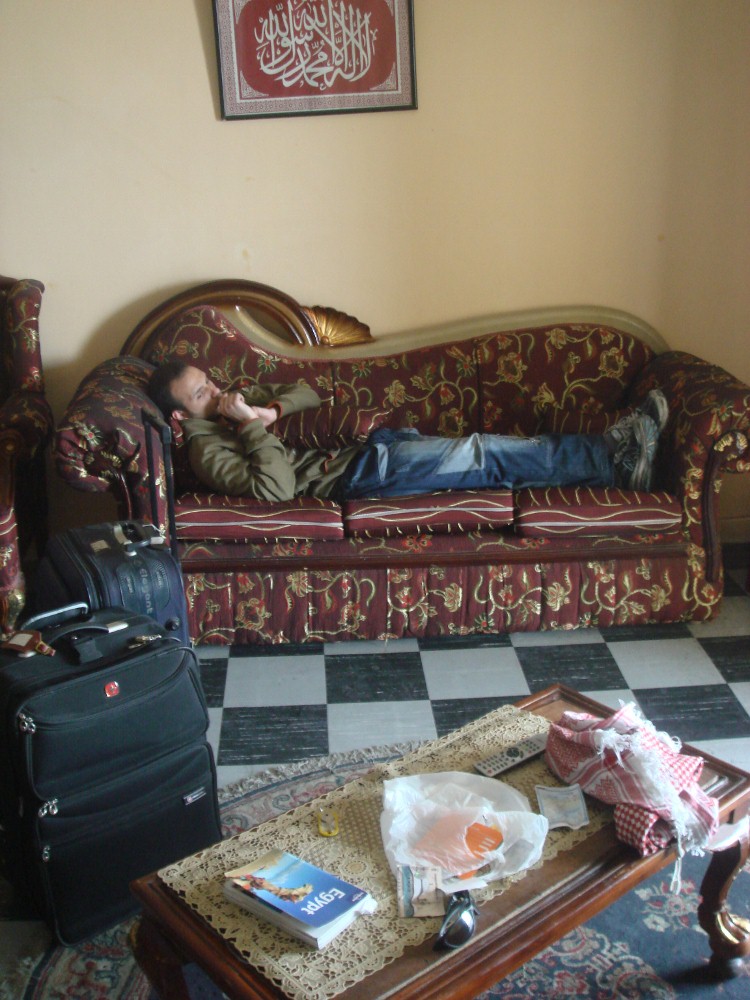
Relaxing in our conservative and mildewing living room
Our first visit was to the Catacombs, or Kom al Shuqqafa. The map in our guidebook intrigued me with such words as “Gallery of Tombs,” and “Mourner’s Triclinium.” Haitham snagged us a taxi after lunch at KFC, and we were delivered to the Roman Columns at the site’s gate. No cameras were allowed inside, but apparently they only meant “actual cameras as used by foreigners,” and not Haitham’s mobile phone. Per usual, Haitham got in for 2 pounds, and I paid 40 for entrance.
The omnipresent honking and shouts of vendors on the street were abruptly cut off from us as we descended a spiral staircase down into the murky depths of the crypt. Old halogen lamps placed at specific intervals showed slick gray walls, which deposited slick gray silt on my shirtsleeve when I accidentally rubbed against one. At the bottom of the shaft, the walls were pockmarked with square holes, called loculi, which had held one person or even a whole family near the end of the Egyptian/Roman empire in the first centuries after Christ. The focal point of the crypt was the tomb of its original inhabitant, a dual tomb for a Roman nobleman who lived in Egypt with his wife. The amazing thing about this tomb is that it’s supposedly unique with showcasing carvings and paintings on the wall that depict the “Romanization” of Egypt, with the Egyptian god Anubis wearing Roman armor and holding a spear. The statues of the Roman couple outside the tomb follow Egyptian statue standards, but are in Roman attire. These incredible finds were made accidentally when a donkey fell through a weak spot in the streets above only a hundred years ago and landed in the loculi chambers. Scholars figure that when the Empire started to fall on hard times, this tomb was “mortgaged” and the clay walls were widened and hollowed out to fit first other single persons, and then later entire families, finally holding about 300 corpses when it finally vanished into the pages of obscurity.
As we left the Catacombs, Haitham explained to me his distaste for monuments and fallen kings and Pharaohs. “The Qur’an teaches that God does not want us to linger on these past infidels,” he said. “We should look at these people and remember that they did not know God or Islam and therefore burning in hell right now. It doesn’t matter how great or important they were when they were alive. All that’s left from them now are moldy tombs and broken stones.” He didn’t go so far as saying that I had an un-Islamic “unhealthy obsession” with these ruins, but I definitely could tell that he found my behavior and fascination with these things to be strange. I chuckled and reminded him that I didn’t expect that either him or I would be remembered or visited for thousands of years after our passing, but perhaps someday or cultures will be poked at with the same tweezers that the Egyptians are treated to now – if anything is left of them besides non-biodegradable Pepsi bottles, that is.
I wanted to visit the Greco-Roman Museum mentioned in my guidebook, but when the taxi arrived at the building, I found a turbaned Sheikh by the half-open door who explained that the museum was closed. I protested that it was still early in the day, to which he replied “look inside and see.” I followed his instructions and discovered that the ceiling had been totally ripped away, the walls were in tatters, and the floor was a twisted mass of rebar and pipes. “How long will it be this way?” I asked the man. He estimated about another 4 years until completion of the remodeling project. It appeared I’d have to save that for a later trip.
By this point, Haitham was exhausted and we were both very hungry. To cheer up my dejected spirits, he bought me a few tami’yaa sandwiches from a vendor near the Corniche. I made the discovery that tami’yaa is like the familiar falafel I’ve eaten so frequently in Jordan, except made from fried fava beans instead of Garbanzo beans. Fava beans are also the main ingredient of my favorite Arab dish, fuul, so this was a pleasurable and tasty discovery. Combined with tomato and vinegar salad and a few sliced and fried potato strips inside the sandwich, and you have a meal fit for a king. When Haitham told me he was going back to the apartment to nap, I decided that I would use my new, fava-powered energy to walk down the Corniche for a few kilometers to reach the distant spit of land that had once held the mythical Pharos, the Alexandrian lighthouse and Wonder of the Ancient World.
Seagulls buzzed above my head and the crystalline tropical waters of the Mediterranean were only meters from my tired feet. I found what looked to be a public beach, and after painfully deciphering the handwritten Arabic signs, determined that although there was a fee for usage of a chair or umbrella, entry was free. Two Egyptian toughs, young men that looked like 1950’s greasers approached me as I entered and demanded two pounds as an entrance fee. Now, I’m not going to be stingy and say that I would refuse the equivalent of 36 cents as a fee, but I firmly refused on the grounds that it was neither written nor did these two look like they were authorized to be taking it from me. “Go! Go! Two pound or go!” they insisted, waving me towards the gate. An older Hefner-esque man in a pink collared shirt came up to me and asked in English if I needed any help. I explained to him that I didn’t want to rent an umbrella or a chair, but that I only wanted to wade in the sea for a few minutes to relax my tired feet before continuing on my journey. He sharply rounded on the greasers and told them to back off, to which they complied, laughing and clapping me on the back. I gratefully thanked my rescuer, but decided that I shouldn’t tarry with him any longer when he tried to sell me a rental car for a low, low price.
The sea felt amazing on my feet. I squinted to the northeast towards Istanbul and remembered my previous Mediterranean experiences last year on my way to Tajikistan. I can now say I’ve seen it from both the North and South! Shells crunched underfoot, and I scooped up a handful of the detritus from the coastal seabed. The contents of my hand revealed hundreds of shells and shell fragments; nothing had yet reached the level of what we’d call sand. It was like getting a foot massage – although the crunchy sea bottom dug into my feet, it was just enough pressure to be to quite comfortable.
A brash young voice suddenly called out “Hey mister what’s your name?” and I turned from my reveries. A group of six or seven children in their early teens stood on the beach next to my shoes, stared back at me excitedly. I chuckled; after three days in Egypt I had a pretty good idea of what to expect. I waded back to the shore and squatted down in the sand next to them to chat. The older kids in their later teens came up more cautiously, and everyone wanted to know how many movie stars I personally knew. “Have you met Sylvester Stallone before?” one asked eagerly, punching the air with his little brown fists. Another asked about Van Damme and I had to admit that their knowledge of classic American movies was probably better than mine!

One of them had just purchased a 'Sarq' as a pet; some sort of magpie variant I believe
As I left the beach, a few of the children asked if they could come with me to the great castle by the sea. I told them I didn’t mind, and they scampered along beside me, still chattering away and doing the things that kids do (throwing pine cones at each other and tugging at my shirt to point me proudly towards particularly tall buildings). I found the reactions of so-called “adults” quite interesting. As in most places in Egypt, there were several armed policemen or soldiers lounging on the railing on the sidewalk. Their gazes swept over me and my clothes, then with narrowed eyes over my little companions. Then they would roar at the kids, “Get away from him and leave him alone!” Every time, the kids would slink away across the street for a few minutes until I passed by the grumpy officer, then come back to join me. Other adults would ask me skeptically, “Are these children pestering you? We are very sorry.” Each interaction like this must have occurred two or three times on our walk towards the Qaitbey Fort. Each time, I would patiently explain that if I was bothered by something, I’d do something about it and I wouldn’t need someone to do it for me. Saying it in Arabic usually helped, too. Continue reading this post…