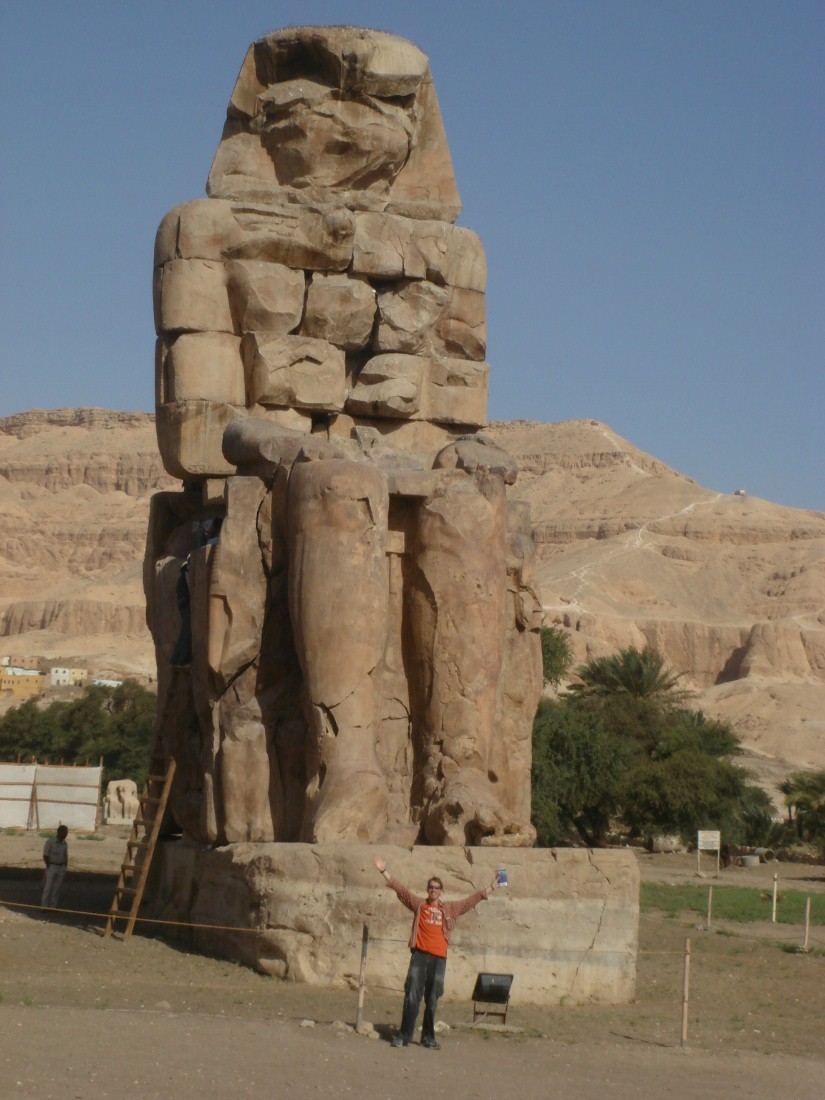
I haven’t often found myself in situations where I’m the only Arabic speaker in a group of foreigners. In fact, when I’m in Jordan, I usually find that I’m either one of many, or I’m just so poor in comparison that I just clam up and let the other Arabic-speaking foreigner have at it. Not today, though! Today, I became the unofficial guide and negotiator for an entire ferryload of foreign tourists.
The train ride from Luxor to Aswan was mercifully short. It seemed to be the dirtiest train car I had ever set foot in; my ticketed seat number had two smashed and funky-smelling sandwiches crushed into my cup holder. I gingerly sat down and tried not to inhale too deeply. A man across the aisle gave me a friendly smile after watching my obvious discomfort and told me in English that I could go ahead and move if I wanted to; the car was only half full. I gratefully took his advice and moved one seat forward, almost immediately falling asleep after my long day of hiking through mountains, temples and tombs. I stayed awake long enough to remember to get out my ticket, and when I awoke three hours later in Aswan, I noted that the conductor had gingerly taken it from my hand, checked it, and then gently tucked it into my shirt’s breast pocket.
The man who had spoke to me earlier paused outside the train car and waited for me. Introducing himself as Mohammad, he asked what I was doing in Aswan. I already had a pretty good idea where he was getting at, and told him that I was looking for the so-called night military convoy and a convoy bus that could take me to Abu Simbel. Unsurprisingly, Mohammad happened to own a hotel a few blocks from the train station and offered me a place to rest for the next few hours while he arranged for me to join a convoy bus.
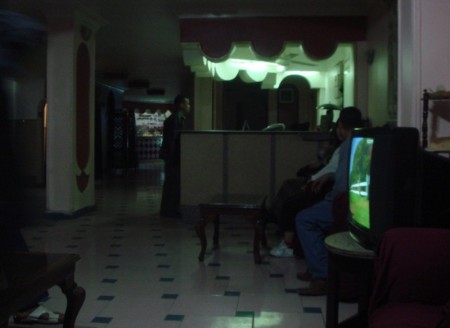
Not a bad place to spend a few hours, if you don't mind the neverending thump of bland techno below you
I spent the next few hours curled up in velveteen armchair in the dim and smoky Queen Hotel, half-asleep and drowsily answering questions from two enthralled young Egyptian hotel employees, who couldn’t decide whether me or the Arabic-dubbed Planet of the Apes movie on the television was more interesting. Finally, to distract them, I asked where the throbbing, floor-shaking music was coming from. They led me outside to a small trapdoor next to the street. Normally I wouldn’t be found crawling into trapdoors at 2 in the morning in southern Egypt, but I was too tired to think of safety precautions properly.
We came out into a room that was even smokier and dimmer than the hotel, if that were possible. It was a scene out of the various argeilleh bars in Amman, with a half-dozen bored-looking and heavily mascaraed young Arab women with long black hair were gyrating slowly on a platform at the other end of the hall. A dozen young and middle aged men were lounging at counters and smoking hookah and watching them with the same interest that one gives a fresh, well prepared salad. Heads swiveled towards me when I entered, a few people chuckled, and one or two made hand gestures for me to enter and sit by the stage. I nodded politely, then feigned having a telephone call and fled back upstairs to the relative non-sleeziness of the hotel lounge.
When the bus arrived, I paid Mohammad the 100 pounds he asked for without complaint and bored the quiet and darkened bus. As it was 4 in the morning, everyone was in that drowsy, somewhat grumpy mood you can’t help but be in after you drag yourself awake just long enough to get somewhere else. The numerous potholes in the streets of Aswan weren’t making it any easier to drift back off again.
Who should I find on the bus in the seat behind me but the two Chinese students I had met the previous day on the way down to Luxor? We sleepily commented on what a small world it was and made small talk about what we’d seen in our separate day, waiting for the queue outside the military checkpoint at the edge of town to fill up. Finally, at around 4:30, someone decided there were enough tourists to warrant the trip and all twenty buses lurched into motion.
As the hours passed, the bus slowly filled with light and I could make out more of the passengers inside. It appeared to be an even mix of Caucasian and Asian people, but I didn’t hear a single conversation in English, so I slowly guessed at the nationalities to be French and Italian. It was amusing to see everyone clutching the same Lonely Planet in their hands that I had, except in four or five different languages.
Our driver Kamal exuberantly announced our arrival at approximately 8 in the morning. “EXKEEZE ME! HELLO! MY FRIEND! MY FRIEND!” he bellowed repeatedly as he shifted into park. “WE HERE NOW AT ABU SIMBEL! YOU BACK HERE AT 9 AND FIFTY! BUS ONE EIGHT ONE!” I’m not kidding, he really did say “exkeeze.” Low muttering filled the bus; we had just been on this bus for four hours and we were being given less than two hours at the site itself? What could be done, though? We exited the bus and threaded our way through the buses to the ticket counter.
As my traveling companions and I walked up the neatly-swept asphalt path, I enjoyed breathing clean air for the first time in a week. After all these cities with unregulated pollution, I was beginning to understand that Amman is, comparably speaking, one of the modern jewels of the Arab world in that regard. Here in Abu Simbel, though, I could look down into the crystal-blue waters of the Nile, now much higher than they would have been in the time of the temple’s constructor Ramses II. One of the most incredible things about the Abu Simbel temples is that because of the rising water levels due to the Aswan High Dam, they actually deconstructed the entire site and moved it 65 meters higher, and 200 meters back. Look here for more info on that.
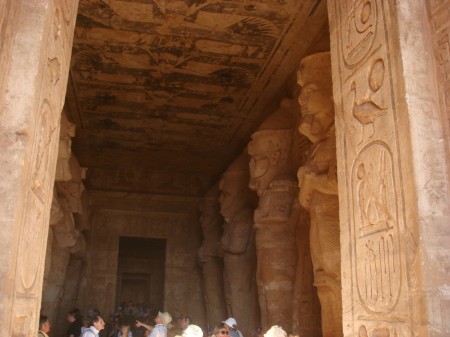
Leaning in over the doorjamb and taking pictures of the inner room is as good as photography gets in Egypt
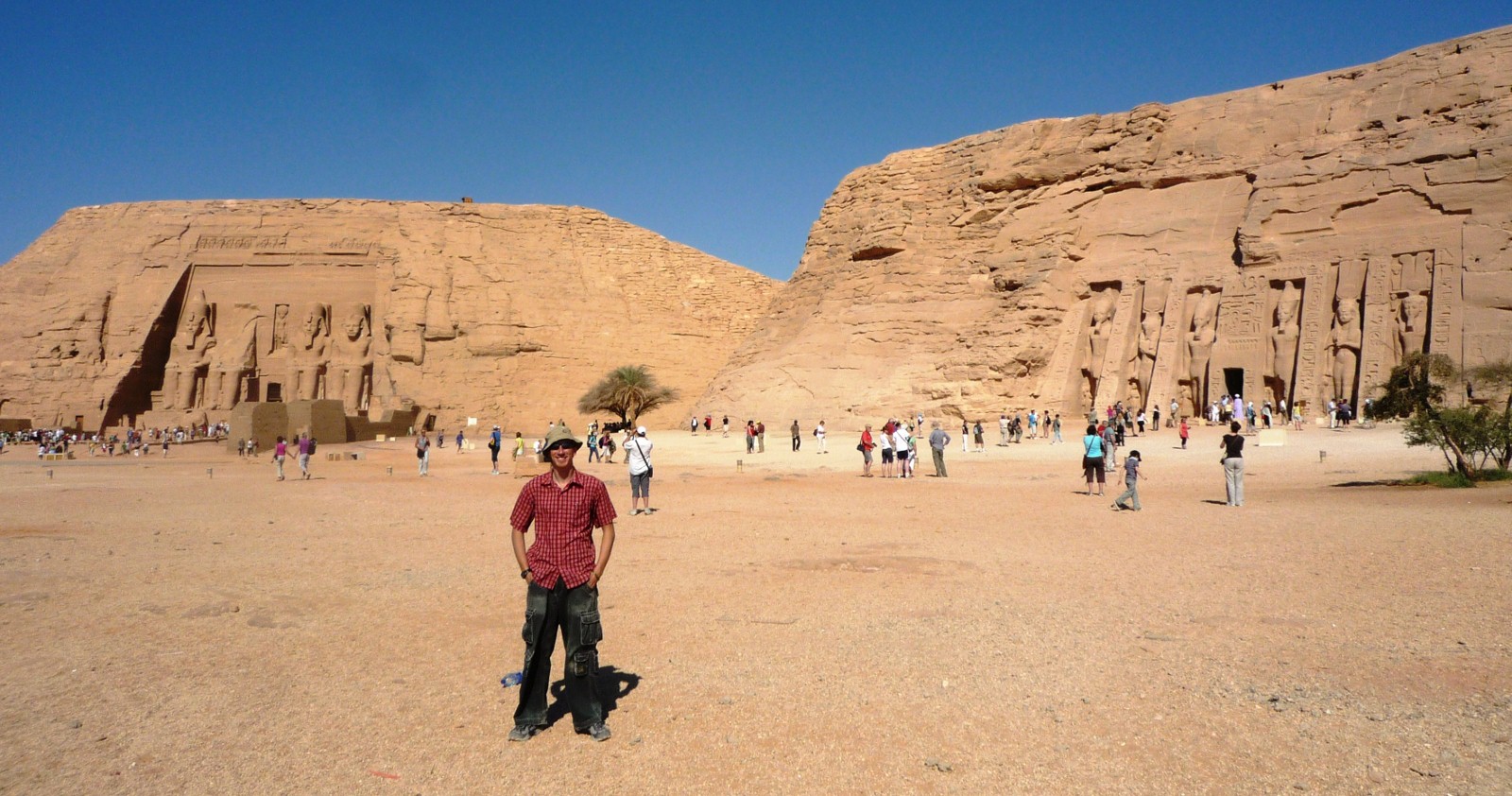
Rounding the corner, we all gasped in appreciative awe as the three (formerly four) massive statues to Ramses II came into view, one by one from right to left. The tourists were already in full swarm mode around the fallen sandstone blocks from the destroyed statue, which for aesthetic purposes had been left in pieces during the reconstruction. I rested my hand on one of the Ramses’ giant toes and stared up into his nostrils. He didn’t seem to notice me and continued gazing into the southeast like he had been for the past 3,254 years. I’m sure that Ramses II himself would be pleased that such care was taken into preserving his largest and grandest legacy.
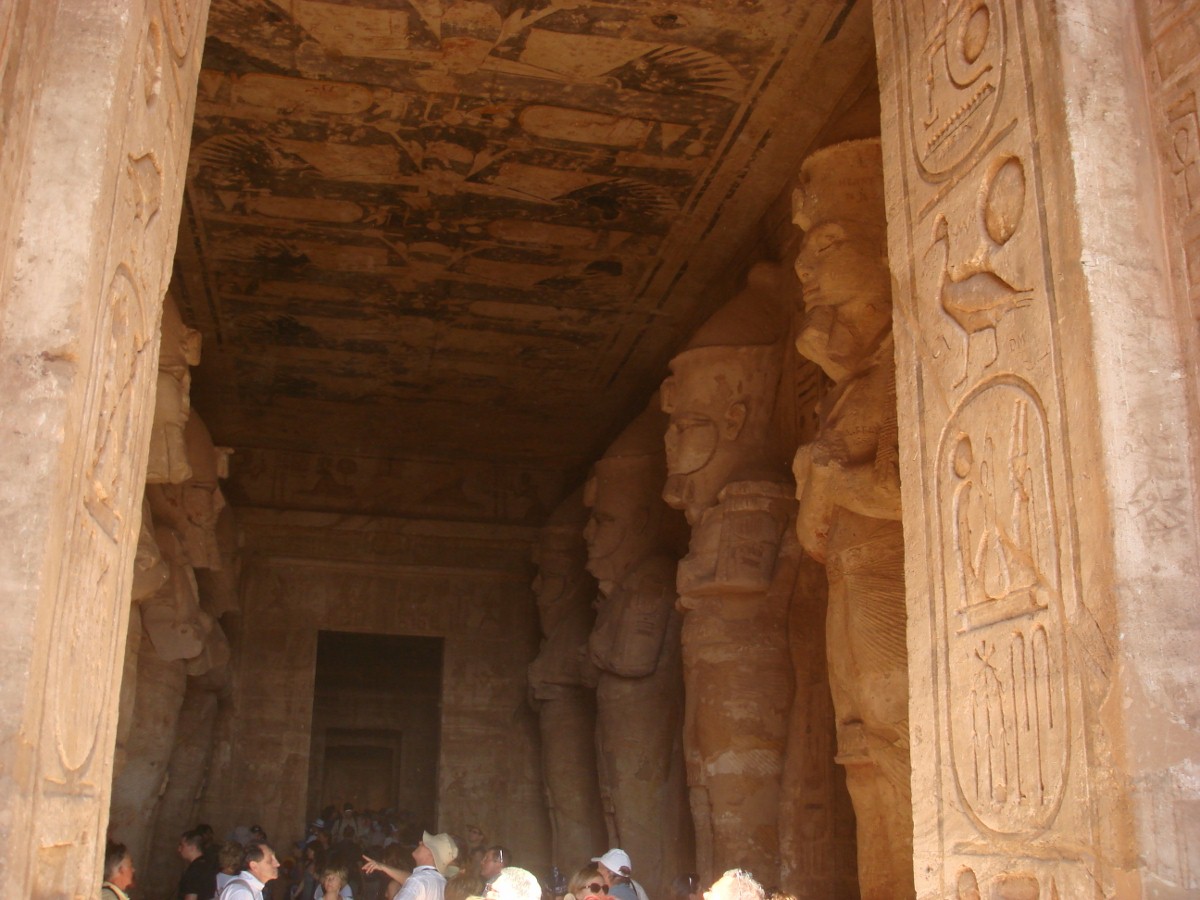
Both of the temples, the larger temple from Ramses to the main gods and the smaller to his wife/Nefertari, had large signs forbidding photography. After yesterday’s hassles in Luxor, I was a broken and beaten man, and I meekly kept my camera holstered as my companions and I followed the winding lines of tourists through the yellow, lamp-lit corridors, etched with thousands, if not millions, of hieroglyphs and pictures depicting Ramses in all his triumphant glory. The main room had more statues to the pharaoh, but the side rooms had apparently been used for storage, possibly for tribute to the king from the conquered Nubians to the south. The temple definitely seemed to showcase Ramses’ god-like power over his subjects, but also his sensitive side and his wish to be pleasing for the gods. You’d probably need to be an Egyptologist to figure out the subtle differences between what made this a temple versus a tomb, though.
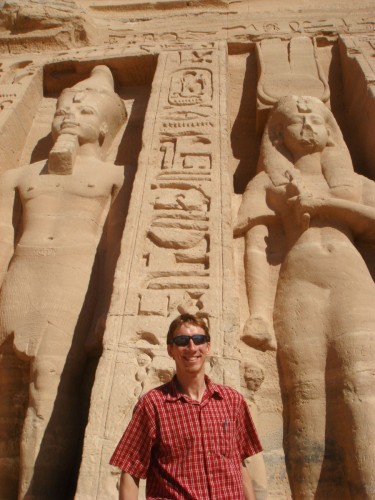
Proportionally speaking, I'm about at the right height (slightly below knee level) to be one of the prince statues
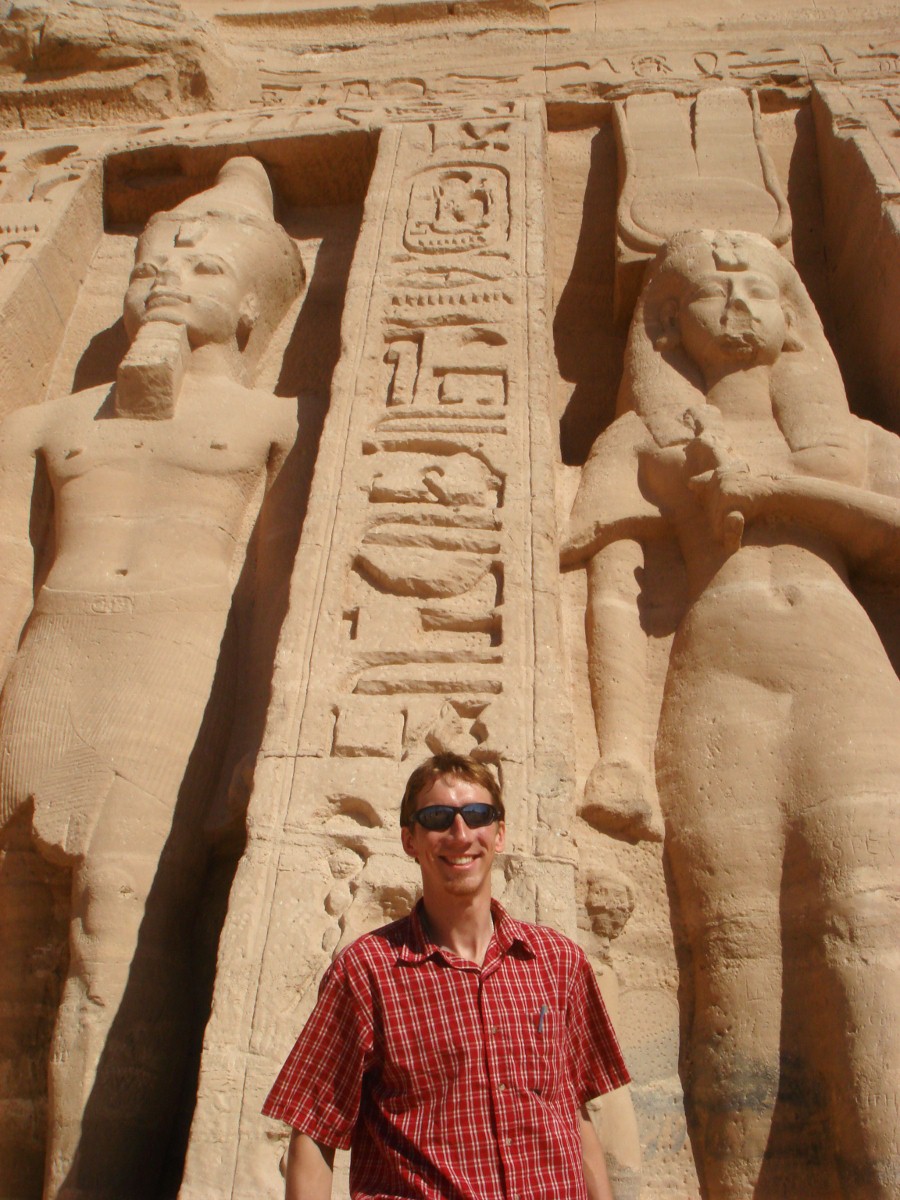
The nearby temple of Hathor was a gift from Ramses for his favorite wife, Nefertari. Scholars have always shuffled between calling it Hathor’s temple or Nefertari’s temple. Basically, in the same way that the pharaoh got to be a representation of a god here on earth, that means his wife often was portrayed as one as well, and Hathor was a favorite. The carvings and reliefs on these walls were even more interesting than the standard “tribute-giving” etchings in the larger and more famous temple. Here it showed Ramses and his wife giving each other flowers, Nefertari worshipping the gods, and all kinds of cute love scenes, like the two of them in a boat on a trip down the Nile. The books are quick to point out that Nefertari must have indeed been a special favorite and companion to Ramses, because it’s one of the few places where a pharaoh carved representations of a woman at the same height to himself. The picture above shows Ramses on the left, and Nefertari on the right, with her Hathor-style headdress.
Time was running out, and my three main companions – Carol, Chen, and Kenji – took our last few minutes to back up as far as we could, all the way to the chain-link fence at the edge of the hill, so we could take in the full magnitude of the temples, now being lit in full brightness by the late morning sun. Behind us, the water lapped gently against the green reeds on the shore. Somewhere directly below us, now deep underwater, was the original and ancient construction site that Ramses II had gazed upon and regally proclaimed his pleasure at his edifices.
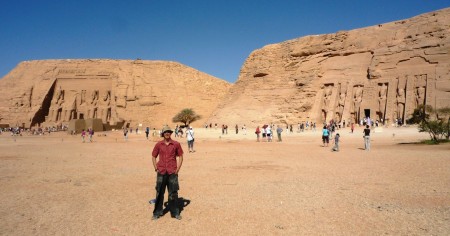
Kamal was glancing at his watch when we returned, and started the bus moving before the last Chinese tourist had even gotten both legs into the vehicle. I had come to expect it from my past week in Egypt, but several other people looked mortified at this. Kamal happily shouted “EXKEEZE ME!” at us, and announced that we would be making a brief stop at the Aswan High Dam. Some of the Italians looked a little bored by this prospect, and three quarters of them elected to stay behind, literally waiting on the curb, when we arrived at the dam after the 3 hour return trip.
Kamal went about collecting the 20 pound fare from everyone. I asked him, in Arabic, exactly what there was to see at the dam. He stared at me, agog, and asked me where I learned to speak Arabic. I patiently explained the same story about my work and life in Jordan that I’ve told probably three times a day for the past year and a half, albeit in abridged form. There’s a museum, he told me. What he neglected to mention is that we wouldn’t be visiting the museum. No, we merely exited the bus in the center of the huge dam, surrounded by several other groups of somewhat skeptical, bewildered tourists who all seemed to be silently wondering – we paid $3.75 apiece to stand on a dam with a road already going over it? I looked at the swollen artificial body of water, Lake Nasser, on one side, and walked to the other, and looked at the tiny Nile River that would eventually stretch all the way up to delta I’d seen a few days earlier. “TEN MINUTE” bellowed Kamal from somewhere over to my left, and I saw the bus parked under the shade of a tall, obviously transplanted tree in the middle of the median. And that was it. When we picked up the Italians, who had been sunning themselves in the parking lot, I told them dryly that they had probably made the wiser choice. But Kamal and his fellow bus drivers had a captive audience. Who knew how much things actually cost when you have a driver to collect it for you?
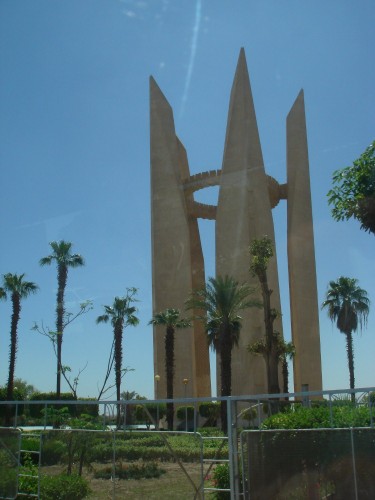
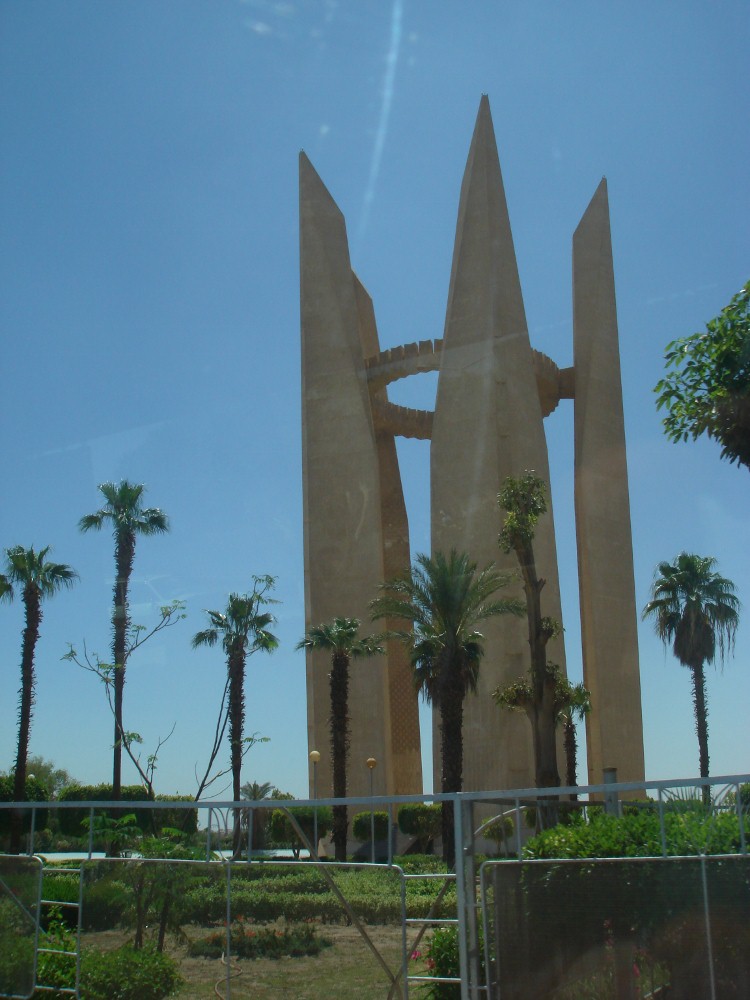
What are these massive spires next to the dam? Who knows; you'd have to convince Kamal to actually stay at a place for longer than 10 minutes
The final stop is where things got interesting. Kamal kept throwing me little grins in the rear view mirror, as if he and I now shared some sort of magical secret that comes from being able to speak poorly-pronounced Arabic. Within another twenty minutes, we had arrived at the parking lot for the Island of Philae, which judging by the travel book seemed like a pretty interesting place. The other tourists had heard me talking with him, and some of them were now throwing me a few extra glances. I hadn’t showered since Alexandria though, and they really could have been looking at me for any number of less-than-flattering reasons. I focused on trying to stay as unnoticeable as possible.
No luck, though. “EXKEEZE ME!” cried Kamal, slapping me on the back. “Translate for me, brother,” he asked me in an aside. The two of us explained to the group that we would have an hour and a half to take the ferry over, see the Island and temple, and return. “No, two hours,” I grunted at him, and asked the little crowd what they’d prefer. Mutinous chatter in Chinese and Italian was unintelligable to Kamal and myself, but he got the drift. “Okay good good! TWO HOUR!” he agreed. He told me to talk to the traffic officer at the nearby ticket booth when we returned, who would radio him to come by with the bus.
Suddenly, I found myself leading the busload of tourists. For better or for worse, I had been unofficially nominated as the “guide” for the group. Getting the tickets to the island itself was easy, as it was managed by the Egyptian Tourism Authority, but then all hell broke lose when we were directed to the dock, filled with little long ferryboats and lounging dark-skinned captains who sauntered forward toward us with a confident air. The last thing a tourist wants to see is a vendor with that confident smirk on his face.
Carol explained to me that when she had come to Egypt previously, the ferryboat had been 5 pounds per person for the round trip. “That was two years ago, though,” she trailed off. I counted up our little band of tourists, and matched the lead captain’s confident and firm handshake with one of my own. This was going to be interesting. Continue reading this post…