Would you believe that Photoshop doesn't support right-to-left typing? I had to make this in Microsoft Word.
For the past 10 months, I’ve used an iPod Touch to synchronize my mobile life with my computer here in Jordan. I picked it up a few days before leaving for Jordan because I didn’t want to pay AT&T the ludicrous sum of $80 a month for a phone that wouldn’t even work properly overseas without doing something called “unlocking” it. I may be a tech person but I tend to avoid phone tech like the plague so this was news to me. So I kept using my aging Motorola Razr V3, and still use here in Jordan now, but the iPod does everything else. Music, email, calendar, photos, and most importantly, a single file in the “Notes” section of the iPod that I’ve simply titled “Jorabic Words.”
This file contains approximately 300-400 tiny lines of text that I’ve recorded throughout my time here, adding a new line whenever I hear an important word and happen to have an Arab nearby to tell me what it means and how important it is. If I scroll back down through it, the first word is…let’s see here…ah, here it is, at the bottom: “fathi” which means “empty.” But therein lies the problem – I wrote it just like that, without the actual Arabic accenting and pronunciation, because that was all I could do. Until 1.5 weeks ago, your iPhone or iPod could not handle any of the right-to-left Semitic languages, like Arabic or Hebrew.
Now, for most people this is a non-issue, and I’ll admit that I’m one of those people. But it was the single largest annoyance ever that I had with my favorite electronic handheld device, even more than the glitch 5 months ago that made the date and time reset every time I plugged it into a computer so I lost all my appointments and alarm clocks, and I had a dim view of that one after missing my carpool to work a few times.
What really burned me was that Apple had the nerve to market a device, in the Arab world, the Umma, without adding Arabic language support to it. It’s only either the 5th or 6th most widely spoken language in the world, guys.* How can you sell a phone to a region and it is literally impossible to input the native language on it, and when it comes to outputting it from a website or something, it’s completely broken up and segmented, which is actually harder to read for a poor guy like me who has enough trouble as it is putting the letters together into pronounceable words.

What is this, Apple? You can handle Chinese, which is right-left AND up-down, but not Arabic?
Sure, Apple may argue (if they cared) that anyone who can afford an iPhone in the Arab world can probably speak English and they’d probably be right, too. But what about the people who just need it to communicate, or read articles or news that might only be available in a particular language? For example, I email Ahmad’s older brother, Majid, all the time with short messages in Arabic from my laptop, but I can’t do that from my iPod, I either have to drag out the ‘top or call him and attempt to use my mangled language skills to communicate with him. I’m sure there are hundreds of Arab businessmen and Expats all over the Arab world who need to do the same thing, daily, and Apple just smirks and then partners with Orange (worthless excuse for a Telecom provider that it is) to release a crippled smartphone.
But now the OS 3.0 software has been released, and after I coughed up my $9.95 for the software update, all has been forgiven on that front. The iPod now perfectly displays and connects Arabic text, and allows me to input not just the letters, but all of the various symbols (َ ِ ً ٍ ْ ُ ٌ) for pronunciation above and below the letters. I have no idea how to use them, of course – I don’t speak or write the proper, “Qur’anic” or “Fuhsah” Arabic, but the stunted street Arabic that the average speaks and writes to get their point across without having to perfectly dot out hundreds of tiny little lines and squiggles next to the letters. That’s why I titled the file as “Jorabic” instead of Arabic – the regional differences mean that probably a good 20-30 percent of the words I’ve recorded there would be useless in Morocco. However, next time you’re a bookstore, pick up a copy of the Arabic Qur’an and look inside it. See all the tiny little doodads above and below the thicker squiggles? That’s “Fuhsah,” which might as well be a second language to me, and frankly, it is one.
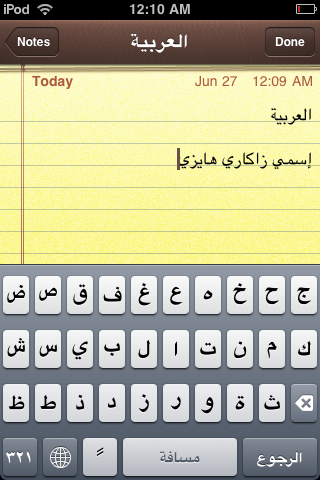
إسمي زاكاري هايزي - My Name is Zachary Heise. At last!
So that’s my main “Review” of the iPhone/iPod 3.0 software, because this firmware has already been beaten to death like a horse with reviews and the Internet is running out of room. However, one thing that people don’t talk about is the speed of the update when it’s put on different Apple devices, unfortunately. Most of the reviews you’re likely to come across are for the latest and greatest iPods and iPhones, but I’m running everything on a First Generation iPod Touch – the one without the speaker – and with the slowest processor of them all, running a 412 Megahertz compared with the later gen’s 533 MHz system. So for all you other old-school iPod users out there, be forewarned – some things are going to be a little slow on this new update. The new “Spotlight” search function, for example, has a definite lag when inputting text (in either language, I found, but more so for Arabic) and when performing the search. Also, the cute little “ripple” effect that Apple uses to close/minimize a running Application disappears about 70% of the time now when exiting an App, just causing the App to unceremoniously dump me back at the home screen – a sure sign of a crash-quit instead of a proper close. I wish I knew more about how Apple’s internal indexing program worked for “Spotlight” on the iPhone – is it like on OS X and Vista, which has a database, or does the iDevice actually rescan the whole little 8GB/16GB drive whenever it searches? I wish I had more information on this.