HeiseHeise.com

The Personal Blog of Zach Heise

Dinner in Tajikistan

A random image. Reload page for more. Want more info?

Category: Uncategorized

  • Down at the Jordan Museum

    It’s been a busy week since returning from Egypt. Within a few hours after finishing my last blog post, I found an email from the choir reminding me that we had our Easter/Spring Concert coming up in only a few days. We had two shows with the Amman Symphony Orchestra, and one of the “kid’s shows” that we’re known for throughout the city (not really, but we did have a host of orphan children that came down from the Hamzet Wussl orphanage to see us).

    The choir concerts were held in the Jordan Museum, a large structure down in Wadi Abdoun within easy walking distance from my house (in fact, I can see it down below me when I stand on my roof). The building has been under construction for years with a grant from Japan, but only recently was given minor details like electricity and a roof. Just like last year’s performance in a half-constructed Maronite church, Dozan wa Awtar seems to have a talent for picking out interesting new venues that we can literally say no one has ever seen before.

    We’re really lucky to have some great professionally-trained soloists with us, like Joe and Allyss. Their skill really shines in our presentation of Gabriel Faure’s “Requiem” The video of Libera Me below, courtesy of my friend Maya, really showcase’s Joe’s baritone vocal talent.

    We all look pretty serious in that one. To switch things up a notch, here’s a video from our last show on Friday, where instead of black suits we’re in loose white outfits with multicolored strips of cloth all over us. The main idea of this, said our director Shireen, was that we could help the kids learn about different vocal parts by showing them visual cues. You’ll see some of the kids raising up little pieces of paper during the video; earlier in the concert one of the activities Shireen had scheduled was to raise one color when they heard men singing, and the other when they heard women. Apparently they liked that so much they decided to do it for the duration of the concert.

    Yeah, that’s me in the front row, probably the first and last time I’ve been featured in that position. Being 1.9 meters tall tends to relegate you to the rear. But, I got the speaking role because I was the only male choir member who showed up to the kid’s concert planning meeting; it was me and a whole group of altos. I was apparently outvoted on what color each section should wear; in order to challenge “gender stereotypes” it was revealed that all of the manly, deep-voiced bass section would be wearing hot pink sashes. Sigh.
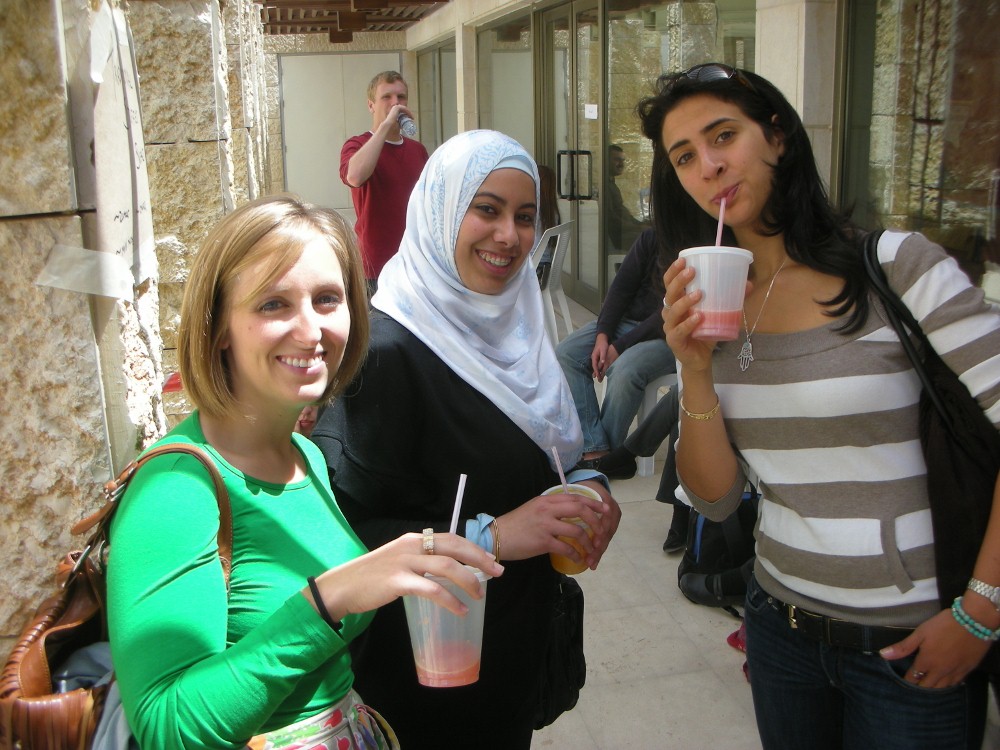
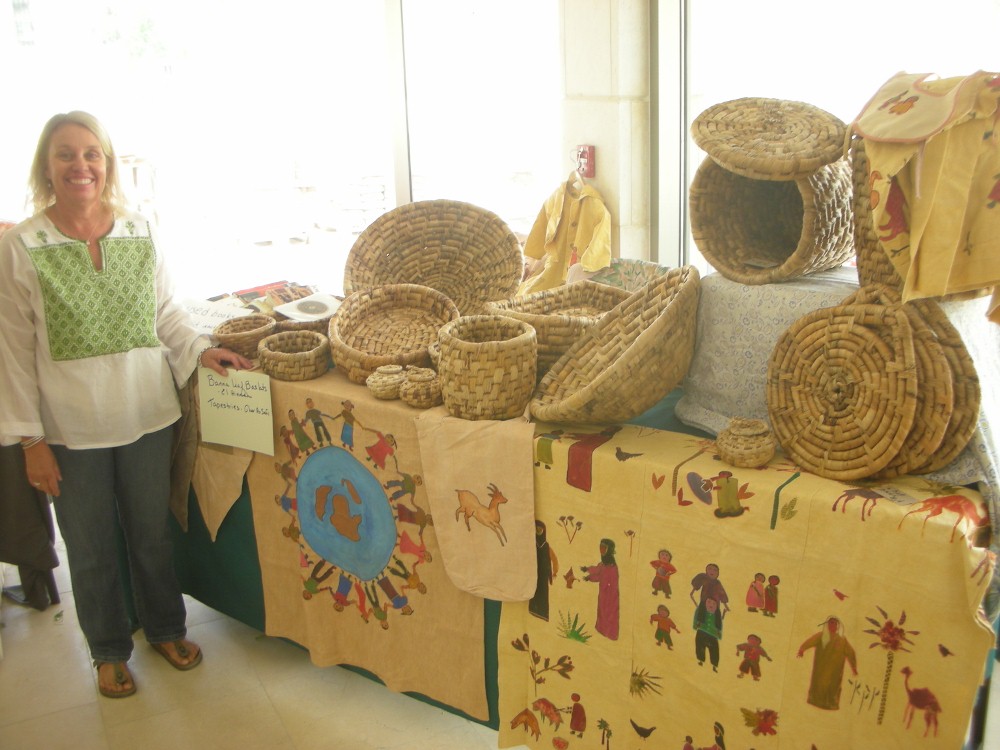
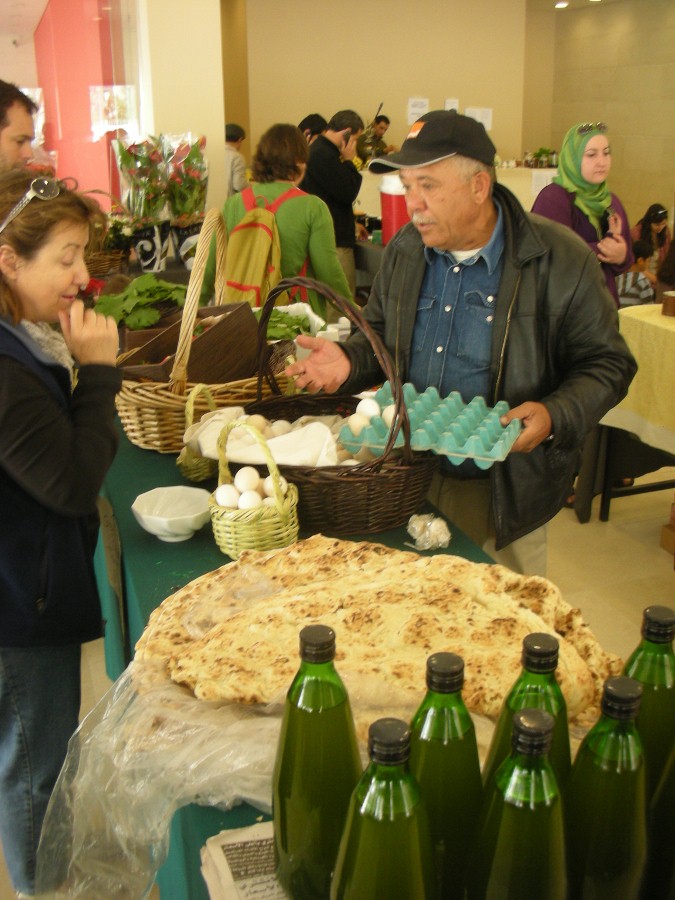
    A few days afterward, Dan and I went down to check out the first Souq al Balad, a cooperative craft and organic food market that Entity Green is deeply involved in organizing. Surprisingly enough, it was also held in the Jordan Museum, on the other side of the courtyard where I had sung just the day before. The weather was beautiful, and with picnic tables out under the shaded and vine-covered terrace, it was like we had opened up a swanky new restaurant right there in the middle of downtown Amman.

    All of my coworkers had come down before Dan and I (lucky folks with cars) and could be found browsing the selection of crafts, coffees, and natural soaps, vegetables, and honeys. Lillie, our primary organizer, was handing out flyers to visitors and Winkie could be found chatting with some of her friends and hooking together a new rug. Aaron and I sampled some amazing cheesecake (I eventually went back and bought four more slices; at a mere JD 1.25 for American-style desserts I thought I was dreaming) and some of my fellow choristers were lured by my invitations that I’d given to them during the concert rehersals (after all, they knew exactly where to go!)

    SEO time! If you’re in the neighborhood, check EGT’s extremely well-designed webpage for more information and directions to the museum.

    Edit: February 1, 2013: Well, the link above no longer works; the website I wrote back in 2009 has been taken down as EGT no longer does training. I’ve also fixed the videos so that they’re self-hosted, instead of using Facebook’s finicky program. Hope you don’t mind, Maya!

  • The Archbishop of Canterbury

    It’s been a busy weekend. Dozan wa Awtar had me up early this morning to practice for a special performance tomorrow night at the King Hussein Cultural Center, hopefully to have the choir gain some more sponsors. It’s only a short, four minute show – more like a presentation than anything else – but it will be the first time since I’ve been with Dozan that we’ll be performing a true “show choir” like dance routine for one of the songs. Some of my friends in the choir are a little nervous about that, but of course I’m entirely in favor of this being the first of many! Hopefully we’ll be the smash event at tomorrow’s show.

    Bishop Williams greets everyone outside Aheliya's main gates
    Bishop Williams greets everyone outside Aheliya's main gates

    Besides the morning practice, the exciting event of the day was a visit from Rowan Williams, better known as the Anglican Archbishop of Canterbury. As the primary church that I attend here in Jordan is Anglican, this is major event for my fellow congregants, both Arab and expat, and there was a large turnout of about 75 people at the Aheliya Girls’ School next to the church for a meet and greet with the Archbishop. This small amount of people were exclusively invited, there was no public announcement of this gathering, but Pastor Lex let us know a few days ahead of time. That morning, His Grace had held a service at the Baptism Site and placed a cornerstone for a new Gothic-style church funded by HRH Prince Ghazi, who’s apparently an appreciator of that particular type of architecture (who could blame him?). That service was attended by approximately 600, or so I’m told, and tomorrow morning he’s going to be holding a regular Sunday service for the Arabic congregation of the Anglican Church, in the same building that our English congregation meets in the night before.

    The last time I had been in the Aheliya School was almost a year ago, when Whitman held the Fiddler on the Roof musical in the school’s auditorium. This is the first time I’d seen the place filled with so many students, high school-aged girls and boys in their best school uniforms to greet the Archbishop and his entourage of purple-robed Bishops from all over the region.

    We were all milling about outside, enjoying the wonderful Jordanian February weather, when Bishop Williams appeared, wearing the traditional simple black robe with a purple sash. He looked similar to his Wikipedia pictures – yes, I did do the obvious simple research before meeting the man; I wanted to be able to know which gray-haired gentleman he was, after all – and he and the other Bishops glided towards us easily, chatting amicably and smiling for the half-dozen TV cameras and journalists that buzzed around them. His eyebrows gave him a somewhat owlish appearance, but his manner was immediately warm and empathetic as he greeted us, shaking hands and exchanging a few words with each person before Arab men in gray pinstripe suits gently moved him onto the next group of people.

    Inside the building, servers flitted about noiselessly with platters of hot hors d’oeuvres and sweet tarts, as well as juice and the mandatory mouth-scalding Arabic “visitors” coffee. A friend of mine encouraged me to go up and introduce myself to the Archbishop. I replied nervously that I wasn’t Anglican and I wouldn’t know what to say if he suddenly quizzed me on the formation of the Church Doctrine or something!

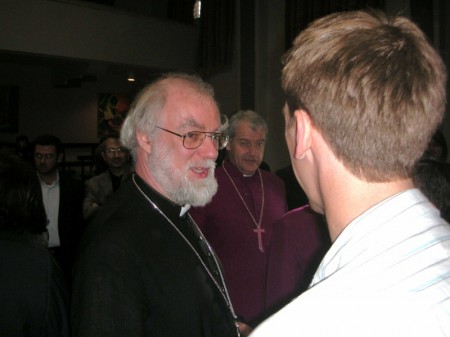
    Archbishop Williams stopped to have a little chat with me...
    Archbishop Williams stopped to have a little chat with me…

    I shook the Bishop’s hand and introduced myself, saying that I was from America. He smiled and asked me what part, to which I replied Wisconsin. “Really!” he chuckled. “I stayed there a night in a seminary once while I was traveling through America.” Very neat that he’s been to our comparatively-unknown state. I asked him if he’d be able to stop by and visit our English-speaking service after the meet and greet. He shook his head somberly and said that he knew he was going to be in meetings and ceremonies for the rest of the night, but that of course he wished he could. I realized then that when you’re the Archbishop, or the Pope or something, your professional life is nothing but a series of meetings and ceremonies. He patted me on the back in a friendly manner, and then he had moved on to the next group of people waiting for him.

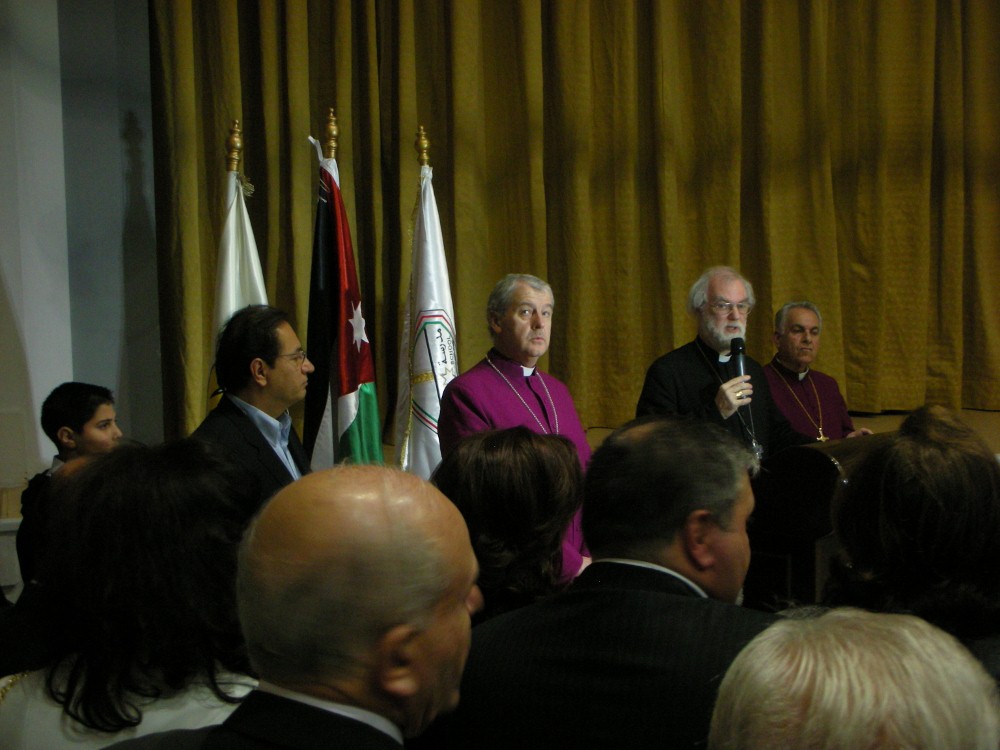
    From left to right: the Mayor of Amman, the Bishop of Ireland, and Archbishop Williams
    From left to right: the Mayor of Amman, the Bishop of Ireland, and Archbishop Williams

    About forty minutes into the gathering, the Archbishop was joined at the front of the room by his traveling companion, the Bishop of Ireland. After being introduced by the principal of the Aheliya school and the Bishop of Jordan, His Grace gave a small speech about his love of Jordan (this being his third visit) and his pleasure that it was always a safe and welcoming country for all Christians, Muslims, and everyone else to enjoy. He made a momentary comment about how he and the rest of the church were very concerned with staunching the flow of Arab Christians leaving Jordan for the West, saying that these original Christians were incredibly important to the stability of the region. I loved listening to his voice, a deep, warm, and musical baritone which must be amazing to hear sermons in. Check out some of the clips with him on Youtube and you’ll see what I mean.

    The last thing I saw before I left to go and attend my regular church service across the street was one of the Aheliya students singing a song in Arabic on the stage, of which I only understood the title, Wahtuhnnee, which roughly translates into “My Country.” As I approached the exit, I was passed by a group of black robed and cowled men; members of the Orthodox contingent of Jordan who kissed their Anglican counterparts twice on each cheek. Privately, I wondered why they were so late to the festivities; by the schedule of events the Archbishop was only going to be at the school for another fifteen minutes or so.

    I know that the Archbishop is doing a tour of the Holy Land (it seems to be a primary reason for religious leaders of all denominations to visit) and that he’ll be entering Palestine today. I hope you enjoy the rest of your time here, Your Grace!

  • Jordan’s national snow emergency

    Snow! In Jordan! Lots of it! Expect massive delays, stocking up on fuel reserves, and chaos and flooding in the streets! Also…school cancellations!

    This is what we residents of Amman were treated to via word of mouth, newspapers, and radio announcements. With all of the talk, you might have thought that the second coming was about to take place. While it’s true any snow at all is cause for hubbub in Jordan, when I got the 6 AM wakeup call from one of the other Whitman teachers to notify me that school was canceled, I was expecting Wisconsin-levels of snow, perhaps piling up outside my window. On the second floor. I exaggerate my expectations slightly here, but when I looked out and saw nothing more than the same dreary drizzle that has been coming down steadily for a week, I had to chuckle a little. Primary schools in souther Wisconsin aren’t shut down unless the principal is knocked out with a hailstone the size of a basketball.

    Just because Whitman was canceled didn’t mean that my training lectures in Ayn al Basha would be so lucky. I tried sending a text to Aaron, explaining to Aaron about how bad the weather was, and how I was worried I might step in a puddle and make my socks wet, and he texted back, “nice try.” As we drove north towards the training center, I caught a glimpse of snow on the side of the road and even stuck to the back of one car. It was the first time I’d ever seen snow in Jordan that hadn’t been in a grocer’s icebox.

    Several teachers called in to fearfully tell Aaron and Jeff about how dangerous it would be for them to leave their houses now, but Aaron, having also grown up in the Midwest, wasn’t having any of it. Not that EGT could do anything about it anyway, even if we wanted to give the students a day off; we’re bound by IRD’s and ISG’s policies. As Wamidh and I taught our lesson on Windows Server 2008, the pounding roar of the rain on the aluminum roof above us was almost deafening and we frequently had to shout to make ourselves heard. I now understand why people in America use padded shingles on houses. However, we didn’t have to put up with it long. Only a couple hours into the lesson and just before lunch, Aaron stopped by our classroom, clutching a green umbrella to shield from the pounding rain and shouted that both IRD and ISG had made the call and that the students were to be sent home for the day.

    (more…)

  • Al-Fajr Prayer: Islam at dawn

    Soon after I returned to Jordan from America, I realized that it was odd that although I’d been in the country for almost a year and a half, I had not yet experienced a traditional Islamic prayer, or sulaah. For how much I’ve talked about trying new things, it should have been much higher on my list of ‘things to do’ than to not joined one of my numerous Muslim friends at prayer. Heck, I ate sheep’s brains for Easter last year before I’d been at a sulaah. I figured it was time to remedy that.

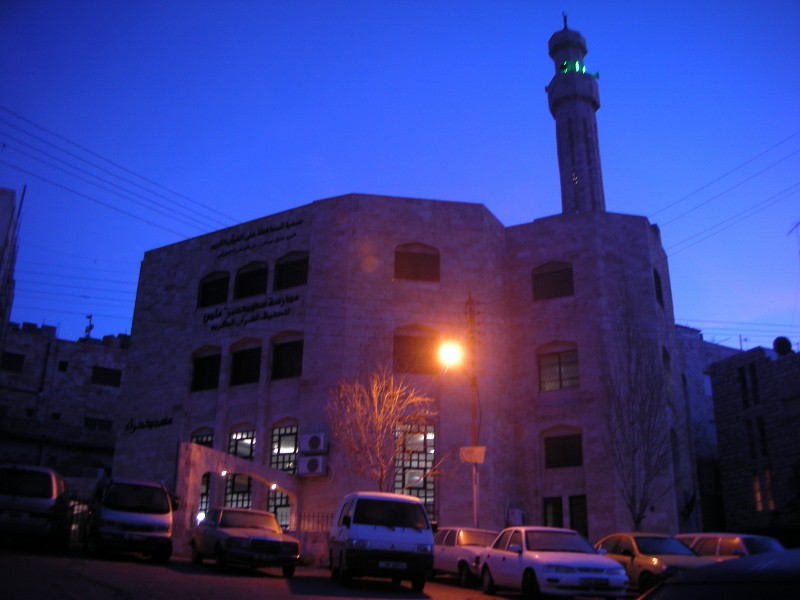
    The Masjid (Mosque) minutes after completing the morning prayer. The timing is perfectly coordinating so that the sun's first light strikes the building as prayer ends
    The Masjid (Mosque) minutes after completing the morning prayer. The timing is perfectly coordinating so that the sun’s first light strikes the building as prayer ends

    Last week, I stopped by my neighbor Marwan’s supermarket and asked him if I could finally take him up on his offer to join him in prayer at our neighborhood mosque, Masjid Hira’a. His broad bearded face broke into a huge smile and he cried out, “of course you can, Mr Zach!” I sat down at his counter for an hour as neighborhood customers trundled around us, bundled against the January chill. He explained to me that the best “first time” sulaah would be the al-Fajr prayer, which is always timed daily to come directly before the first rays of dawn break over the horizon, wherever you may be. I chuckled inwardly at that; I think that everyone in Jordan, be they Muslim or otherwise, has intimate knowledge of that particular prayer when it’s blasted at the wee hours of the morning. He explained that it was best because it was the shortest; usually no more than 6-7 minutes long. “There is rohkta-tayn; two rohkta,” Marwan told me solemnly. “The other prayers in the day – and you know there are five – are either three rohkta or four. This one better for you, for the first.”

    He got out a piece of paper and had me write down the exact method of al-Wudthu, the ritual cleansing that devout Muslims carry out before each of the five sulaah. Then he pulled out a battered old Qur’an with a seamed green cover, caressing it respectfully and gently laying it on a cloth on his counter. He smiled fondly at it, and told me that he had this Qur’an since he was a boy and his father gave it to him. As he opened it to the beginning (starting from the right-side, as Arabic is a right-to-left language), he frowned absentmindedly at some scrawls and scribbles in the margins of the first page that looked like a child had been doodling with a pen. “Is not good, this,” he muttered. “Not respectful to write in the Qur’an this way – I do not know where these come from.” I thought about who might possibly have marked up the Qur’an and then forgotten about it over the years…but of course I just nodded politely.

    From his Qur’an, Marwan showed me, and then intoned the Surah al-Fatiha, the most important “chapter” in the Qur’an which the Prophet Mohammad (SAW)* instructed must be read before each and every prayer that is made. The first few lines of the surah, which start with “Bismillah al-raahman, al raaheem,” are a common utterance regardless of the situation, merely meaning “In the name of God, the all merciful and ever-merciful.” The rest was more of a jumble, but sounded quite pleasantly melodic. Technically, music of any variety was forbidden by the Prophet, so the humming chant of the sulaah is really the closest that it gets.

    After giving me final instructions on how to carry myself, where to look, how to stand, and what to wear (the latter was pretty much the only thing that he said was up to me; the rest is fairly complex), I took my leave of the supermarket as Marwan happily told me, “As-salaamu alayk, akhi!” – peace be upon you, brother! However, because of scheduling issues and some mix-ups, I wasn’t able to finally attend until just this morning.

    I rose at 5:15AM, when Marwan called my mobile and quietly told me to prepare myself in wudthu and meet him at his house gate next to the supermarket at 5:45. In the distance through my window, I heard the “waking adhan” calling all Muslims to arise and prepare, crying out dramatically, “Prayer is better than sleep!” I hadn’t eaten much the night before, and I was careful to avoid any alcohol. I was trying to take “purification” seriously in all things. Technically, even flatulence ruins the purity of wudthu so I didn’t want to take any chances by eating a big meal of falafel and hummous and fuul – three foods which are all made from beans!

    The water's hot and ready and I am awake far too early. Oh well..."prayer is better than sleep" after all...
    The water’s hot and ready and I am awake far too early. Oh well…”prayer is better than sleep” after all…

    I put on my blue dishdash robe (this makes the third use of it in a year, I believe) and went into the bathroom with my piece of paper with Marwan’s specific instructions clutched in my hand. I stumbled sleepily on the edge of my flowing robe and banged my caving-sore hip on the door frame – but successfully refrained from saying anything uncouth for the sake of the situation. I stared down at the paper at what I’d written down as the warm water filled the sink in front of me. I took a deep breath, and tried to perform the following as gracefully as possible.

    1. Wash each of the wrists, first the right and then the left, with three circular motions
    2. Cup water in your right hand, suck it into your mouth, swish it around three times, and spit it out
    3. Suck water into your right nostril and then blow it out. Repeat three times. And then repeat with the left nostril (note: this one was really hard to do without coughing and choking)
    4. Wipe downwards across the face with upwards-facing palms, from forehead to chin. Repeat three times
    5. Using the left hand, wash the right arm from wrist to elbow, inside and out. Repeat three times, and then switch hand and arm
    6. Taking some water into palms, run hands from hairline to the nape of the neck and back the opposite way, keeping hands tight to the hair
    7. Clean out ears with the tips of each index fingers, from top to bottom
    8. Taking some water into palms, run hands from the nape of the neck around to the front of the neck
    9. Finally, use the left hand to clean the right foot from the toe to the ankle, carefully cleaning between the toes. Repeat three times, and then switch hand and foot

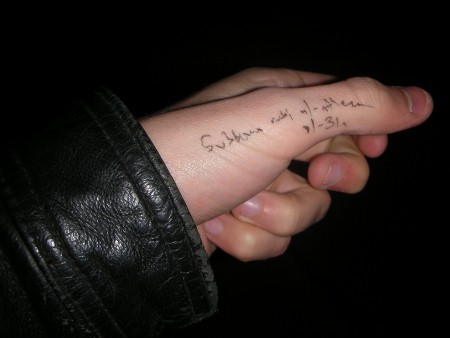
    …I looked down at myself after I had finished this process and realized that my formerly-dry dishdash looked as though I had just purified it of its sins. I was thoroughly glad I wasn’t wearing a white robe instead, and that Marwan told me to just wear my usual leather jacket into the mosque to keep warm and cover the numerous splashes of water I was now covered with. I tried to review the words of the Surah Al Fatiha in my mind, and realized that I might need to a little help here, in case I was quizzed or something. I scribbled “Subhan rubi’ha al-aduheen x3″ and “Subhan rubi’ha al-3la x3″ in tiny letters across my left thumb, but I knew I didn’t have time to write anything else. I glanced at my clock and realized that one thing remained – Marwan had pointed specifically to the silver cross I wear on my neck and said, “You need to take that off when you pray in Masjid; take off all silver and gold.” He explained that it wasn’t because it was a cross, but just because almost all jewelry is forbidden for men. I slipped off the necklace and walked downstairs and and up the street a few meters to wait in front of Marwan’s dark doorway.

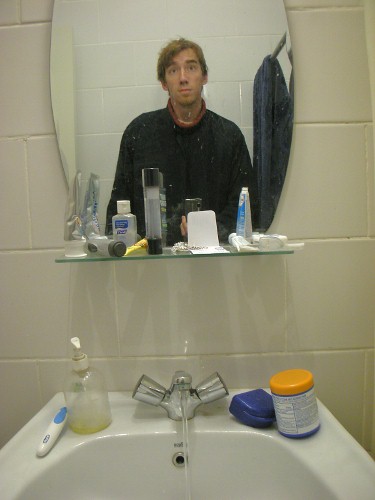
    I don't think this is forbidden, but I didn't exactly advertise it to Marwan either!
    I don’t think this is forbidden, but I didn’t exactly advertise it to Marwan either!

    I heard his deep voice intone above me from a window, “Zach” and then I heard the thud of sandal-ed feet on the stairs leading towards me and within another moment he was next to me, walking quietly and serenely in sweater, corduroy trousers, and a denim jacket. He smiled a quiet smile and asked me if I was ready for al-sulaah, and I shivered from the morning cold and nodded in assent. Without another word, we joined the flowing, shuffling stream of men next to us in the street and entered the warm glowing gate of the Hira’a Mosque, kicking off our shoes on a small footwear-barrier as we did so.

    (more…)

  • An ode to Schwarma

    I just read a cute article about “Schwarma Reem,” which was one of the first restaurants I considered a favorite after arriving in Jordan last year. The article was written by Michael Slackman and featured in the “World” section of the New York Times, and talks about the small size of the establishment, the pack of clientele outside its cheery red gate, and hints at how fabulously wealthy its current owners must be. Go on – give it a read. Clicking the link will open up a new tab.

    A picture I took of Reems last year before they added their big overhead sign
    A picture I took of Reem's last year before they added their big overhead sign

    Personally, although I still love Reem’s and visit the restaurant at least once a week (hard not to when I walk past it every day), I’ve graduated to more expansive food tastes – which is to say, different schwarmas from different restaurants. As tasty (zakki) as Reem’s is, they’re just getting too small and too expensive compared to what you can get just down the block. Also, they only serve the lamb/goat schwarma even though every single other schwarma stand I’ve seen also adds chicken to their menu. There’s a particularly nice one that’s down the street from Whitman in Swefiyeh – the lamb schwarma are the same price, but twice the size and with even more meat.

    You just can’t beat the atmosphere of Reem’s, though. One thing that Slackman didn’t mention was the less-legal businesses that have sprung up around Reem’s to feed off of the massive press of people that converge there every night from 5 til 2 in the morning. There’s an old sheikh that has a pirated computer program “business” that he sets up each evening in the parking area right in front of Reem. He sits in his chair in front of two or three huge racks of discs with things like “Arabic Language Photoshop” and “Arabic Cracked Windows XP with Service Pack 3” or “Study Qur’an Now” written on them. To the left and right of Reem’s doors are men with slicked-back hair that have spread a few dozen DVD cases with the latest releases on the concrete sidewalk. Anyone trying to reach the cashier has to dance around these smiling vendors, dodge the elbows of at least 5-6 people who don’t realize that when you finish ordering, you move, before you finally are able to stretch out a hand, like a drowning man reaching for a life preserver, and clutch the metal windowsill. If you don’t grab right on and slowly drag yourself forward out of the next half dozen people who are trying to do the same thing at the same, you will be carried away on the human current and have to start all over again.

    (more…)

  • A week of Thanksgiving

    As one of the most important holidays of the American year, Thanksgiving is not taken lightly (pun intended). However, I lucked out this year with not one, but three different “Thanksgiving” feasts from three different groups of people.

    Abu Eid, the plumbing teacher at the Ayn al Basha site, invited the office staff over to his residence in As-Salt to enjoy a veritable bounty of Arabic treats that his wife had prepared. As a Roman Catholic, his house is filled with all kinds of statuettes and angels, and he was more than happy to pour a glass of whiskey for whomever was interested. Jeff and Aaron hit on this opportunity to learn more about the joys of 4-H, such as what it means, and how they could get involved with it. At least I’m sure that’s what they intended to do with the information I gave them. Abu Eid was his usual boisterous Arab self, and refused to let us empty our plates before filling it up with more roasted chicken, white creamy leban, and even lasagna. Although I’m not even counting it as one of three (because I’d already eaten), Brittany had me and other friends over to her house later that same evening and she served another dinner, with spiced scrambled eggs, beef kielbasa sausages, and fried potatoes. It was like some sort of paradise.

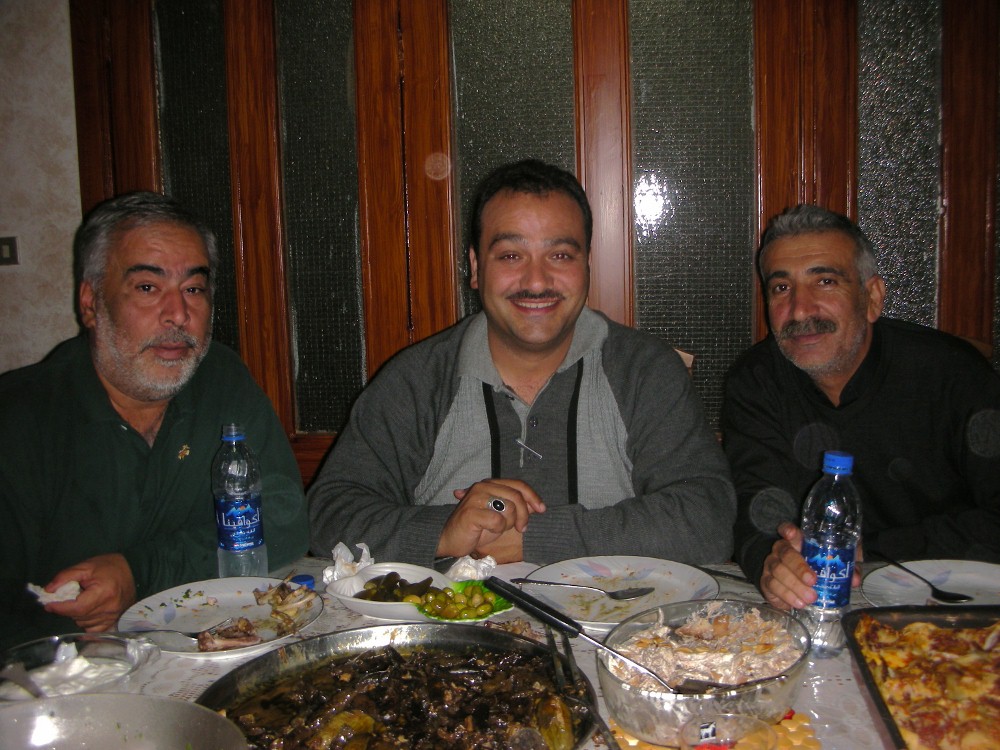
    Wajih, Khalil and Maher (the accountant) enjoy the well-endowed spread
    Wajih, Khalil and Maher (the accountant) enjoy the well-endowed spread

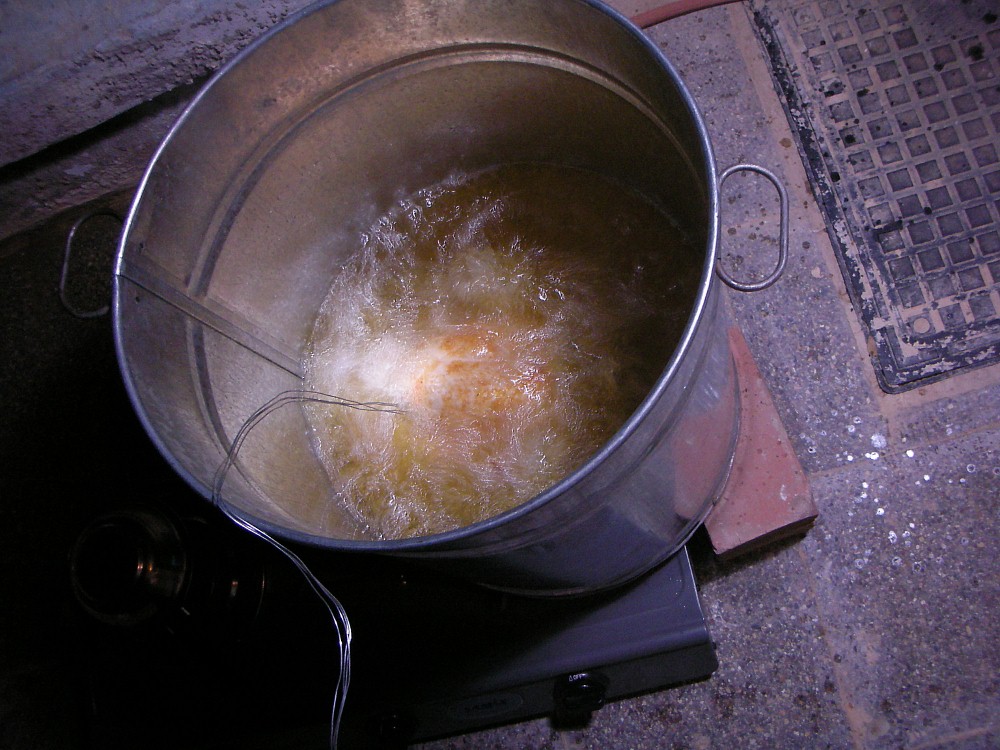
    The next day, I discovered that I was to be the unsuspecting host of the next feast, when Lillie and Aaron informed me that they were coming over at 4 in the afternoon to roast a giant turkey in oil on my friend porch. Even though I was caught by surprised, I was never going to pass up a big fat bird roasted in mazola corn oil. I had just gotten back from the last 80 K bike ride of the season with Sa’ad and the rest of the Cycling Jordan crew when my “guests” started showing up (to be honest, I felt like more the guest in my own home).

    Jeff was the Frymaster General for the bird, taking charge of turning it in its giant pot, suspended over the flames of Philip’s gas stove. Lillie took care of the deserts (as it was also Jeff’s birthday, too) and Aaron made the traditional green bean casserole. I soon realized that they weren’t throwing a combination going-away party for me and Jeff’s birthday party, but this was their trial-run for frying a turkey before going to Wadi Rum to hang out with Suliman for the weekend, like we had done last year. I’m definitely sad I won’t be able to join the gang for that always-excellent camping trip, but at least I got to experience a delicious turkey dinner for free…although I did have to do all the dishes.

    The oiliest turkey you ever shall eat
    The oiliest turkey you ever shall eat

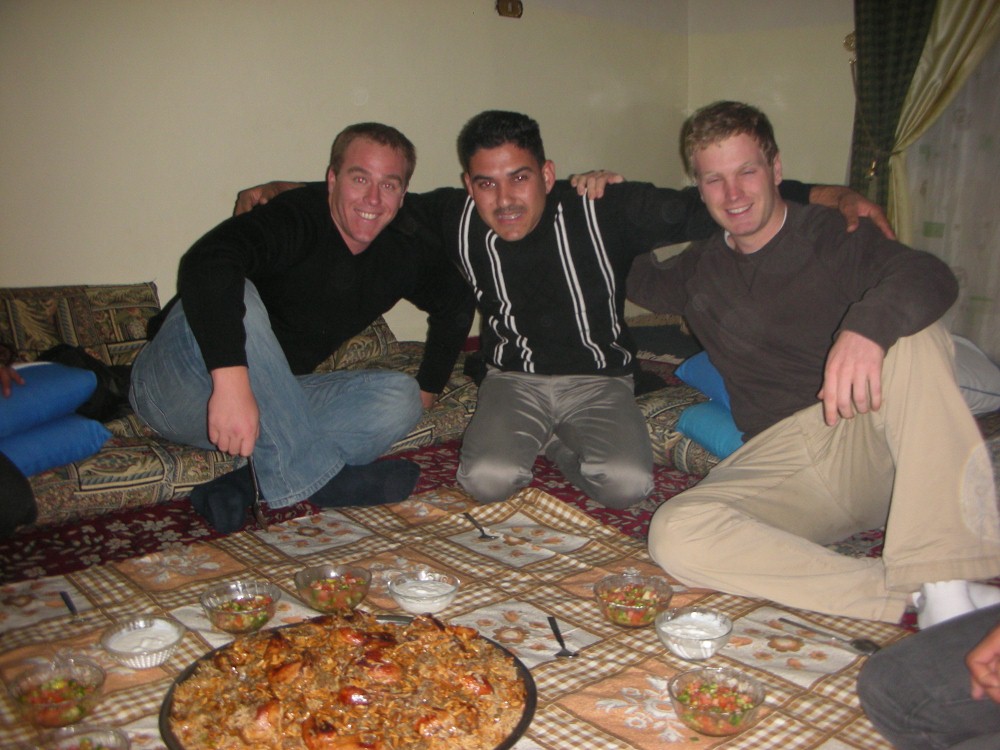
    Then finally, this last Sunday, Jeff, Aaron and myself had “a big dose of Belladee” as they described it. I had gone to the Ayn al Basha to finish up some last things before taking my leave, and I discovered that Heasham, my replacement as Info Tech teacher, had invited Aaron and Jeff to dinner at his house after work. As the two of them were my ride home, I of course had little choice but to succumb to Heasham’s entreaty to eat kibseh at his father’s farmhouse.

    Belladee in Arabic means “country-like” and that’s a good name for the sort of friendly gathering that you get with a dinner like this. I’d eaten in similar styles at last year’s wedding in Tibna, and with the Sheikh in Ghor Safi. Heasham and his older brothers welcomed us proudly to their house, where their father, a huge Sheikh of a man wrapped in a long gray dishdash and a bright red keffiyeh. After the traditional welcome, we were served the traditional coffee which has so often burned the top off my mouth, which was traditionally shaken after one gasping cupful to signify that one would be enough. If you don’t “shake after drinking” they’ll just keep filling your glass, over and over. The Sheikh and his elder sons took definite interest in us and asked a lot of questions about the economy in America, how we enjoyed work in Jordan, and why we weren’t married to nice women and making lots of children (I’m not kidding about that last one). When the kibseh arrived, the six of us knelt around the giant bowl of rice and roasted chicken and dug in with our right hands shoveling the food into our mouths. The Sheikh enjoyed my usage of Arabic, and was enthralled with my iPod Touch and the Arabic “dictionary” I’ve spent the past year writing on it.

    Aaron, Heasham, and Jeff enjoy the "picnic dinner" of kibseh
    Aaron, Heasham, and Jeff enjoy the "picnic dinner" of kibseh

    As we were finishing up with the delicious spread, Jeff and Aaron turned to me in wicked delight after learning that this was not only a vegetable farm, but also a goat farm. “Really!” chuckled Aaron. “Then Zach’s going to go out and show us how to milk a goat; he’s a professional at this.” Of course then the conversation had to turn to how many goats the Abu Zach owned, what their output was, and how they were cooked. I apologetically told the men that I was ignorant of these matters these days and glowered darkly at my colleagues across the room, who were grinning broadly.

    Thankfully, Heasham informed them that it was too dark to see the animals now, but Aaron cheerfully assented to be shown the goats “next time.” As we were leaving the farm, he commented to Jeff and I under his breath, “Well, they paid attention to Zach most of the time and stayed focused on him while we ate. The plan worked perfectly.” I realized then that I had been brought along as a diversionary object, but I had enjoyed myself and meeting Heasham’s family, so I certainly didn’t mind.

    Two more days at Whitman rounded out my final week in Jordan for 2009, from Thursday’s meal at Abu Eid’s til now. I’m currently sitting in the Queen Alia airport, two and a half hours after I was supposed to fly out of the country to my transfer in Istanbul. Bassem picked me up from my house at about 3:30 in the morning, as we expected my flight to leave at 6:30 as posted. However, when I arrived, my heart sank to see that it had been “Canceled.” Not even delayed, just outright canceled. Why? Because of fog in Istanbul, the planes leaving from the country had all been grounded. When I asked when it would be possible to get my flight to Chicago, the controller shrugged apologetically and told me to come back 24 hours later and try the same flight again.

    Now, I’m not going to miss my family’s excellent meal just because the Turks don’t want Americans to celebrate Thanksgiving with their loved ones. So, I picked up my bags, went to the other side of the airport (which takes all of five minutes; O’Hare this is not) and booked a direct flight with Royal Jordanian to fly me directly to Chicago at 10:45 AM. Being four hours late is better than being a day after!
    Insha’allah, there won’t be any further problems and I’ll see you all next year!