HeiseHeise.com

The Personal Blog of Zach Heise

A random image

A random image. Reload page for more. Want more info?

Month: March 2010

  • Valley of the Kings: “Please no photo!”

    I have a bone to pick. If you’re going to get a camera, become one of the millions of camera-owning people out there, be it a point and shoot or an SLR…learn how to configure it. And then follow the rules of places you visit and photograph.

    I’ve just spent the past day in a rather grumpy mood because of new rules and regulations in the Valley of the Kings that prevent any photography. The rules are from only last year in August, and the guards are extremely strict about them. Basically, all of us that love taking pictures artistically and capturing the nuanced dark angles and shadows that come from standing inside a 3,500 year old tomb are out of luck. Why?

    Because of people that can’t turn off their flash. The colors in the ancient paintings and carvings are rapidly fading and being damaged by ongoing light exposure and the millions of schmucks who have taking bland, poor contrast photographs of a bright white wall with some faint etchings and pale colors. Because really, that’s all they’re going to see when they use flash photography in these places!

    So, the Egyptian Tourism Authority, over the years, first banned all flash photography, and when it became clear that people were apparently too careless to follow this single rule, they just banned all photography. And recently enough that it grates on me that I’m just barely too late to take my own photographs.
    Yep...this is as close as I was able to get to taking pictures of the tombs
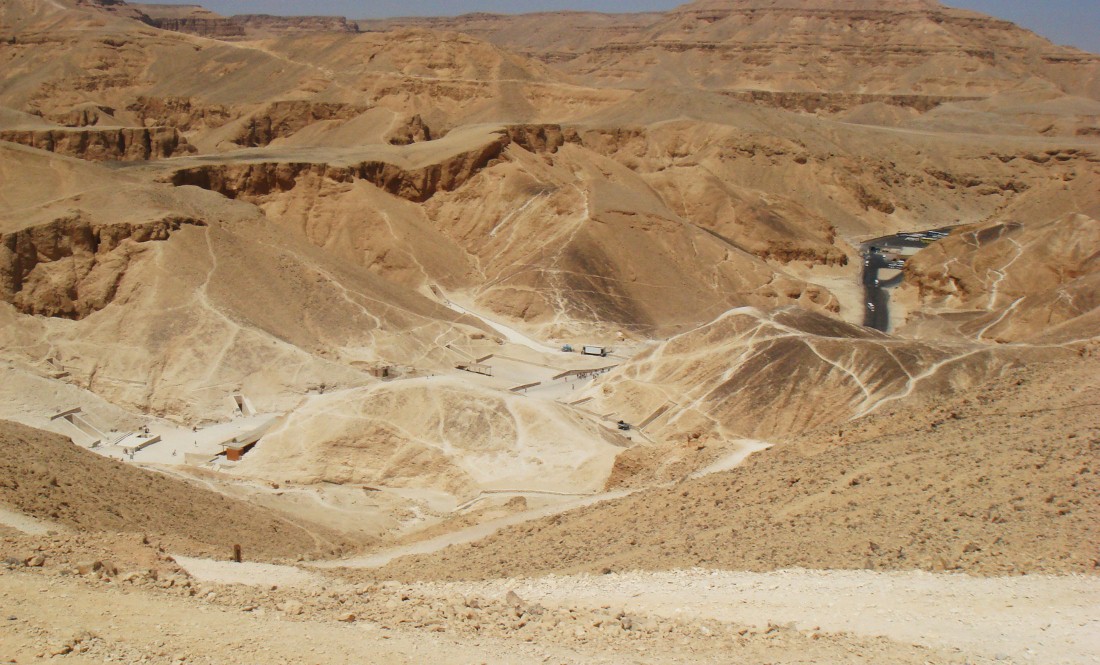
    Yep…this is as close as I was able to get to taking pictures of the tombs

    After my last entry, I rejoined Haitham at the Australian Hostel back in downtown Cairo, just barely long enough to grab some dinner and then hurry back to the train station for our 1st-class ticket to Luxor. It turned out that we were sharing a “cubicle” room with 4 other travelers: a couple of Arabs and a couple of visiting Chinese/Taiwanese students. Unfortunately, the six chairs, all facing each other, didn’t recline a single millimeter and we all spent a cramped and uncomfortable (but quiet) night speeding through the desert towards Luxor, the home of the famous tombs of the Valley of the Kings.

    We (meaning Haitham) were able to negotiate a private taxi for the day, and a ferry to take us the short distance from Luxor across the Nile River to the West Bank. The price for the day, for the two of us, was a very competitive 120 pounds, although before Haitham worked his magic they wanted 175. It wasn’t until our driver Saleem dropped us off at the ticket booth up in the mountains for the Valley that I discovered that I should hide my camera deep inside my backpack, less I lose it. The weather was hot and dry, much more than we had experienced in Cairo or Alexandria, and I was happy to have a hat and sunblock with me. Haitham boasted that he could tough it out, but it didn’t take long before he would stop at the bottom of hills, panting and glistening in the heat and waving me to “hold up just one minute, please, I’m dying here.”
    One of the twin Colossi of Memnon near the Nile shore, before entering the Valley. They think that the largest temples ever created was here, but was washed away because of its proximity to the Nile
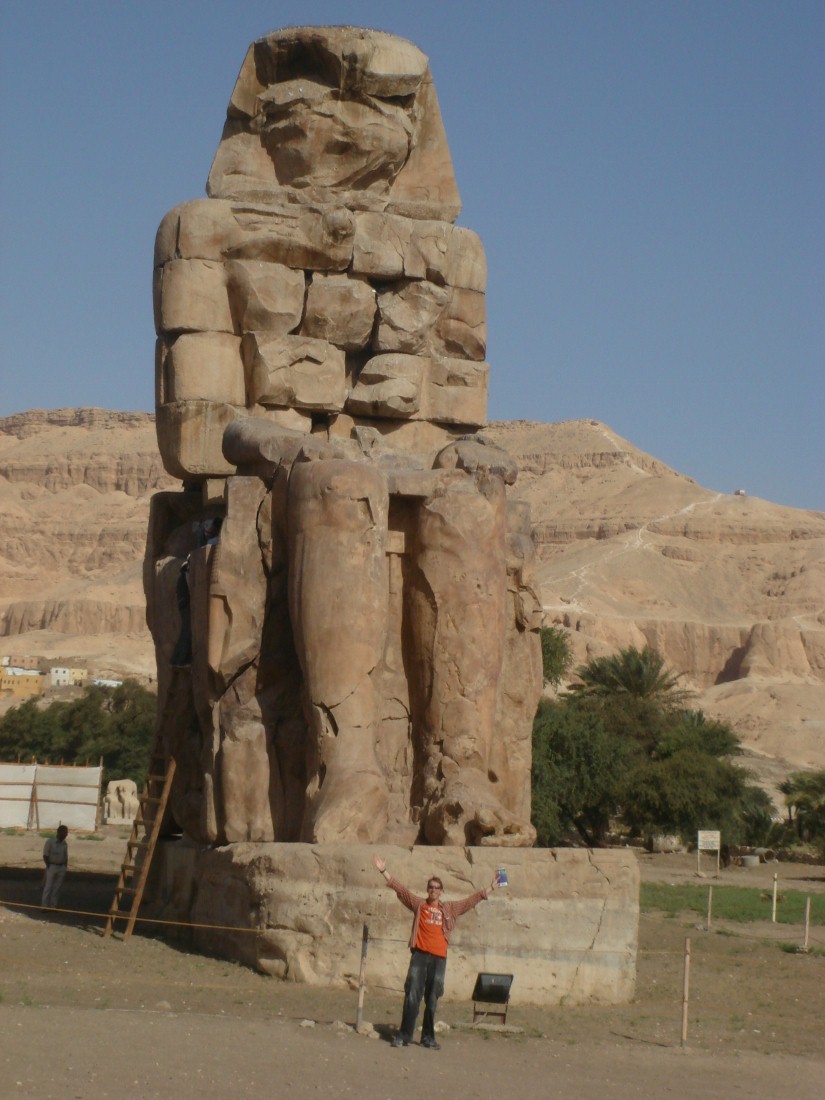
    One of the twin Colossi of Memnon near the Nile shore, before entering the Valley. They think that the largest temple ever created was here, but was washed away because of its proximity to the Nile

    And hills there were aplenty! The ancient pharaohs of Egypt had loved this location for its easy seclusion and secrecy within the hills outside the ancient capitol city of Thebes, and also because of the orientation of the valley itself allowed the last glimmers of the sunset to fall upon their eternal resting places, something that was just too symbolic to pass up. Thousands of years later, gravel pathways, staircases, and handrails have been added, but if you take the time to actually look up into the hills surrounding you, away from the 21st century chaos that has descended upon the valley, you can imagine that there are still many more tombs waiting to be discovered up there. Or at least, you might guess that if you didn’t already figure that the Egyptian Government already used echolocation and sonar on pretty much everything within a 20 kilometer radius from here.

    The ticket booth told Haitham and I that all but two of the tombs were on a “single ticket” concept. Haitham and I pay 2 or 80 pounds, and then we get tickets that are each good for seeing three of the tombs. The tomb guards all have little hole punchers on straps that they use to monitor how many tombs each ticket-holder has seen. So, I told Haitham to buy two, and I would do the same. I figured that if they weren’t going to let me take pictures, this would probably be my last visit to the Valley, so I was going to see as many painted and carved pieces of rock as possible!

    As we were buying our tickets, a commotion occurred at the window next to us. A short elderly man with wispy white hair, watery blue eyes was engaged in a heated argument with the ticket seller in perfectly-enunciated Arabic. I didn’t catch all of it, and Haitham told me it was because the man was speaking in Classical Arabic. “He’s a Tunisian albino,” Haitham breathed in wonder. “The ticket sellers are refusing to sell him the 2-pound ticket because they don’t believe he’s an Arab.” The poor man was turning bright red in frustration. “I am a Tunisian!” he roared. The ticket seller regarded him with a bored expression. “Many foreigners can speak Classical Arabic like you do; you’re not one of us,” he replied in Egyptian Arabic. Although it took a few minutes, the man eventually got his proper ticket and was admitted to the site with us. He told Haitham that his own dialect was so vastly different from Eastern Arabic that he has no choice but to speak Classical when he visits the rest of the Arab world, and this wasn’t the first time his Arab-ness was called into question.

    The lines of tourists were pretty bad, but not awful. After seeing the crowds at the Pyramids, I had expected there to be a lot of tourists, but I was still surprised at how many people had made it all the way down to Luxor. I should have realized that the Luxor-Aswan route was completely standard for all the tourist buses. We had passed by about 30 in the parking lot on our way in. In one tomb in particular, the spectacularly-hidden final resting place of Thutmose III, not even the electric fans could prevent us all from getting literally slicked-over with glistening sweat. I felt like I had leapt in a lake. Haitham, being medically minded, put his shirt over his mouth and whimpered something about catching all of the airborne illnesses that all these people were exhaling. Normally I regard his hypochondria with wry amusement, but the place was so ghastly hot and humid that I took his advice.

    We didn’t bother with the overpriced KV62, or Tutankhamen’s tomb. It was an extra 100 pounds for foreigners and the guidebook panned it as not nearly as interesting as his treasures in the Egyptian Museum. We did, however, venture inside the tomb of his nearest neighbor, Ramses VI, the pharaoh who was buried right above him. This tomb was an extra 20 pounds for me, but it had some spectacular blue-accented paintings and particularly well-preserved carvings of the sky goddess Nuit on the ceiling. Also, the extra ticket requirement meant that it was blissfully uncrowded, with merely a few other tourists strolling up and down its single straight corridor, sandals whispering between the wooden slats and the stone floor. Haitham subtly tried to take some pictures of the sky goddess on his camera-phone, but the second guard appeared from around a pillar as he did so, grabbed his arm, and lectured him sternly on the consequences of taking pictures. He told him that people were fined 100 pounds per picture, the camera would be examined and each picture from inside the Valley would be deleted. In an Arabic aside that the guard probably assumed I wouldn’t understand, he told Haitham that he’d let him off without fine or deletion this time because he was an Arab, but any foreigner wouldn’t be given such a chance.
    (more…)

  • Alexandria: The parts Lonely Planet didn’t mention

    I’m on the train now, returning from the city of Alexandria back to the steamy capitol of Cairo. The train this time is air conditioned at least, unlike our ride up which felt like a sauna. Haitham had to give me some of his extra medication just to keep me from gasping like a fish out of water. It’s been two successful days in the Lighthouse City…although I didn’t get to see everything I wanted to I think I got pretty close.

    Yesterday morning didn’t start off too well, though. Besides the nauseating ride from 6 til 9 AM to reach Alexandria in a train car that smelled too much like old fish, learning to understand Haitham’s apartment negotiation style with room managers was a trial in and of itself. Within minutes after our fishlike train pulled into the gaudy Alexandria Station, taxi drivers scented new blood and converged on us. Waving their arms in a way which they must have believed was “welcoming,” they began to undercut each other in their bid to both drive us and take us to their uncle Mohammad’s apartment tower which was conveniently located “with a sea view.”

    Haitham’s advice to me for negotiating was “be quiet and let me do the talking,” which was similar to the Cairo strategy. The first taxi driver was a grizzled and bestubbled old sheikh who had the most incredible “R” rolls in his dialect that I’ve ever heard. It seemed that a machine gun was going off in our tiny black and yellow Peugot every time he opened his mouth. Haitham was completely calm and collected, and agreed to visit the apartment buildings our driver conveniently happened to know of. The first one he showed us had interesting wallpaper and carpeting, until I actually opened the encrusted window drapes and saw it was actually mold patterns etched into the woodwork like some sort of horrific alien creature. He led us out into the balcony and had us lean over the edge. Peering around the moldering edge of the building, I could just make out a sliver of blue-green ocean crashing against large rocks. There was ash mounded around the ashtray on the table, and a black streak on the ceiling above it, making it appear as if a small volcano had gone off in the room and the sulfuric smell wasn’t too far from this guess. “How much do you want for it?” asked Haitham cheerfully. I bit my tongue and tried not to inhale too deeply. Thankfully, the owner wasn’t willing to drop below 120 Egyptian Pounds (about $21.66) for the two of us and our driver took us to the next place.

    In this second building, which was much cleaner and had an actual sea view, Haitham got as far as handing over our passports for the owner to photocopy before we hit a wall. The driver wanted another 10 pound tip for “recommending” the place, something which Haitham thought should be settled between the owner and the driver, not between him and our wallets. By this point, 45 minutes after our arrival, I was semi-conscious on one of the grimy couches and wasn’t able to protest to Haitham that our time was more important than the pound-equivalent of 1.32 Jordanian Dinars. I woke when the two men started screaming at Haitham, making the driver’s “R” sounds really start to sound like a machine gun. They must have roared and cajoled him for 5 minutes before they finally gave up and Haitham and I left. I have to admit I was less than pleased with Haitham and told him as much out on the street as we sat on our bags on the sun-swept boardwalk along the Mediterranean. “Can’t you see that our limited time in Egypt and Alexandria is worth more than a lousy JD and change?” I growled at him. “Man, they would have charged us for the room key and to use the electrical outlets!” he protested in return. I told him he had one more chance to get an apartment, otherwise we’d just go back to the hotel sections and have to pay a lot more. He promised that he’d be more forgiving with our next try.

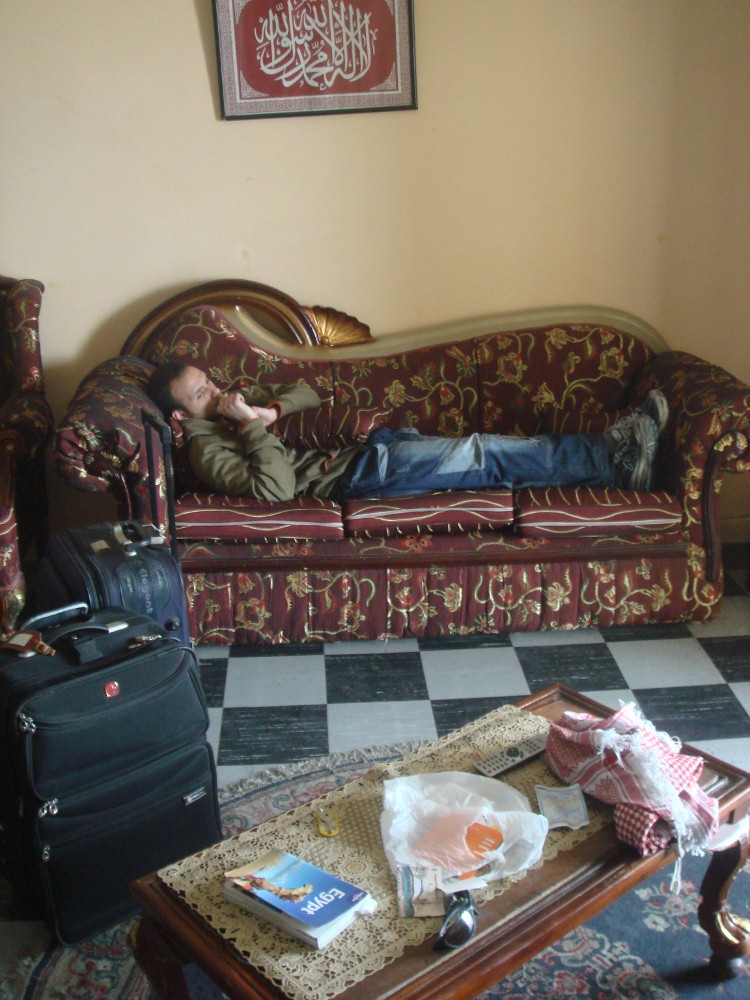
    A man on the street wandered past us at that moment and coincidentally, he too also knew someone with an apartment! We walked another 50 meters or so along the street and Haitham, true to his word, accepted the deal and tipped the finder five pounds for baksheesh. This new apartment of ours was by far the best, and totally acceptable for 135 pounds. After seeing the previous two, I was able to ignore the cigarette burns in the carpeting and even the weird blue-paint hand prints on the wall (better than alien mold colonies, I figured). There were huge gaudy and golden paintings and frescoes dedicated to Allah, Mohammad, and Mecca all over the walls, and the furniture were plush faux-velvet burgundy monstrosities that smelled of cigarettes and sweat. Needless to say, they too were burned. Haitham informed me that things like hostels and hotels were only for foreigners, and that touring Arab youth and families would always take a cheap apartment instead. “Why settle on a single expensive room,” he said, “when you can have two bedrooms, a kitchen, a balcony, and a couple bathrooms?” I had to admit that although the place would have been condemned had it been in America, he certainly had a point on the bargain aspect.

    Relaxing in our conservative and mildewing living room
    Relaxing in our conservative and mildewing living room

    Our first visit was to the Catacombs, or Kom al Shuqqafa. The map in our guidebook intrigued me with such words as “Gallery of Tombs,” and “Mourner’s Triclinium.” Haitham snagged us a taxi after lunch at KFC, and we were delivered to the Roman Columns at the site’s gate. No cameras were allowed inside, but apparently they only meant “actual cameras as used by foreigners,” and not Haitham’s mobile phone. Per usual, Haitham got in for 2 pounds, and I paid 40 for entrance.

    The omnipresent honking and shouts of vendors on the street were abruptly cut off from us as we descended a spiral staircase down into the murky depths of the crypt. Old halogen lamps placed at specific intervals showed slick gray walls, which deposited slick gray silt on my shirtsleeve when I accidentally rubbed against one. At the bottom of the shaft, the walls were pockmarked with square holes, called loculi, which had held one person or even a whole family near the end of the Egyptian/Roman empire in the first centuries after Christ. The focal point of the crypt was the tomb of its original inhabitant, a dual tomb for a Roman nobleman who lived in Egypt with his wife. The amazing thing about this tomb is that it’s supposedly unique with showcasing carvings and paintings on the wall that depict the “Romanization” of Egypt, with the Egyptian god Anubis wearing Roman armor and holding a spear. The statues of the Roman couple outside the tomb follow Egyptian statue standards, but are in Roman attire. These incredible finds were made accidentally when a donkey fell through a weak spot in the streets above only a hundred years ago and landed in the loculi chambers. Scholars figure that when the Empire started to fall on hard times, this tomb was “mortgaged” and the clay walls were widened and hollowed out to fit first other single persons, and then later entire families, finally holding about 300 corpses when it finally vanished into the pages of obscurity.

    As we left the Catacombs, Haitham explained to me his distaste for monuments and fallen kings and Pharaohs. “The Qur’an teaches that God does not want us to linger on these past infidels,” he said. “We should look at these people and remember that they did not know God or Islam and therefore burning in hell right now. It doesn’t matter how great or important they were when they were alive. All that’s left from them now are moldy tombs and broken stones.” He didn’t go so far as saying that I had an un-Islamic “unhealthy obsession” with these ruins, but I definitely could tell that he found my behavior and fascination with these things to be strange. I chuckled and reminded him that I didn’t expect that either him or I would be remembered or visited for thousands of years after our passing, but perhaps someday or cultures will be poked at with the same tweezers that the Egyptians are treated to now – if anything is left of them besides non-biodegradable Pepsi bottles, that is.

    I wanted to visit the Greco-Roman Museum mentioned in my guidebook, but when the taxi arrived at the building, I found a turbaned Sheikh by the half-open door who explained that the museum was closed. I protested that it was still early in the day, to which he replied “look inside and see.” I followed his instructions and discovered that the ceiling had been totally ripped away, the walls were in tatters, and the floor was a twisted mass of rebar and pipes. “How long will it be this way?” I asked the man. He estimated about another 4 years until completion of the remodeling project. It appeared I’d have to save that for a later trip.

    By this point, Haitham was exhausted and we were both very hungry. To cheer up my dejected spirits, he bought me a few tami’yaa sandwiches from a vendor near the Corniche. I made the discovery that tami’yaa is like the familiar falafel I’ve eaten so frequently in Jordan, except made from fried fava beans instead of Garbanzo beans. Fava beans are also the main ingredient of my favorite Arab dish, fuul, so this was a pleasurable and tasty discovery. Combined with tomato and vinegar salad and a few sliced and fried potato strips inside the sandwich, and you have a meal fit for a king. When Haitham told me he was going back to the apartment to nap, I decided that I would use my new, fava-powered energy to walk down the Corniche for a few kilometers to reach the distant spit of land that had once held the mythical Pharos, the Alexandrian lighthouse and Wonder of the Ancient World.

    Seagulls buzzed above my head and the crystalline tropical waters of the Mediterranean were only meters from my tired feet. I found what looked to be a public beach, and after painfully deciphering the handwritten Arabic signs, determined that although there was a fee for usage of a chair or umbrella, entry was free. Two Egyptian toughs, young men that looked like 1950’s greasers approached me as I entered and demanded two pounds as an entrance fee. Now, I’m not going to be stingy and say that I would refuse the equivalent of 36 cents as a fee, but I firmly refused on the grounds that it was neither written nor did these two look like they were authorized to be taking it from me. “Go! Go! Two pound or go!” they insisted, waving me towards the gate. An older Hefner-esque man in a pink collared shirt came up to me and asked in English if I needed any help. I explained to him that I didn’t want to rent an umbrella or a chair, but that I only wanted to wade in the sea for a few minutes to relax my tired feet before continuing on my journey. He sharply rounded on the greasers and told them to back off, to which they complied, laughing and clapping me on the back. I gratefully thanked my rescuer, but decided that I shouldn’t tarry with him any longer when he tried to sell me a rental car for a low, low price.

    The sea felt amazing on my feet. I squinted to the northeast towards Istanbul and remembered my previous Mediterranean experiences last year on my way to Tajikistan. I can now say I’ve seen it from both the North and South! Shells crunched underfoot, and I scooped up a handful of the detritus from the coastal seabed. The contents of my hand revealed hundreds of shells and shell fragments; nothing had yet reached the level of what we’d call sand. It was like getting a foot massage – although the crunchy sea bottom dug into my feet, it was just enough pressure to be to quite comfortable.

    A brash young voice suddenly called out “Hey mister what’s your name?” and I turned from my reveries. A group of six or seven children in their early teens stood on the beach next to my shoes, stared back at me excitedly. I chuckled; after three days in Egypt I had a pretty good idea of what to expect. I waded back to the shore and squatted down in the sand next to them to chat. The older kids in their later teens came up more cautiously, and everyone wanted to know how many movie stars I personally knew. “Have you met Sylvester Stallone before?” one asked eagerly, punching the air with his little brown fists. Another asked about Van Damme and I had to admit that their knowledge of classic American movies was probably better than mine!

    One of them had just purchased a "Sarq" as a pet; some sort of magpie variant I believe
    One of them had just purchased a ‘Sarq’ as a pet; some sort of magpie variant I believe

    As I left the beach, a few of the children asked if they could come with me to the great castle by the sea. I told them I didn’t mind, and they scampered along beside me, still chattering away and doing the things that kids do (throwing pine cones at each other and tugging at my shirt to point me proudly towards particularly tall buildings). I found the reactions of so-called “adults” quite interesting. As in most places in Egypt, there were several armed policemen or soldiers lounging on the railing on the sidewalk. Their gazes swept over me and my clothes, then with narrowed eyes over my little companions. Then they would roar at the kids, “Get away from him and leave him alone!” Every time, the kids would slink away across the street for a few minutes until I passed by the grumpy officer, then come back to join me. Other adults would ask me skeptically, “Are these children pestering you? We are very sorry.” Each interaction like this must have occurred two or three times on our walk towards the Qaitbey Fort. Each time, I would patiently explain that if I was bothered by something, I’d do something about it and I wouldn’t need someone to do it for me. Saying it in Arabic usually helped, too. (more…)

  • What’s this Istanbul doing in my Cairo?

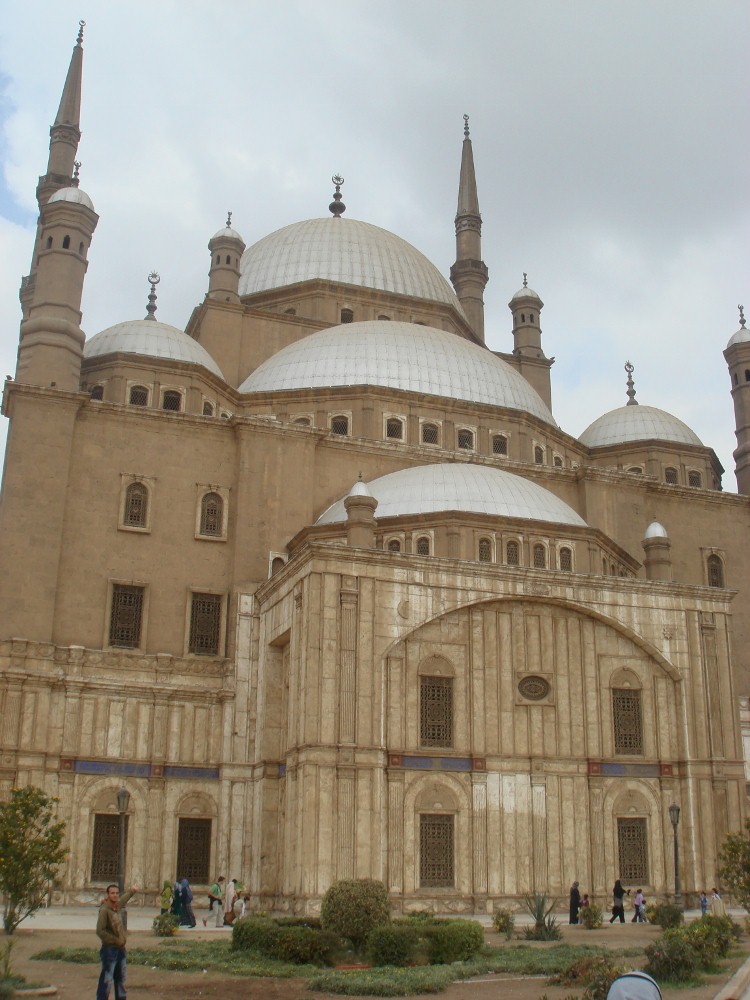
    For our second day in Cairo, I figured that Haitham and I should head east toward the old city’s Citadel, a massive building with jagged spires looming over the poor concrete buildings on the edges of the city with the desert hill’s farther east and beyond. Haitham was willing to spend the “extra” money for the taxi, and after he successfully convinced the driver that he was an Egyptian and should be charged thusly, we were able to travel the few kilometers within a few minutes, even in the horrendous morning traffic. When we arrived…something about the Citadel seemed awfully familiar!

    Haitham visits Istanb----wait a minute!
    Haitham visits Istanb—-wait a minute!

    We trudged up the far side of the mountain and through the tourist and student queues. Like the pyramids, the place was packed with students on school trips. I couldn’t help but being pleased by this, although the children’s incessant “what’s your name mister?” was beginning to wear on me after literally the two hundredth time, I was happy to see that the schools were paying attention to Egyptian’s knowledge of their country’s history.

    I reminded Haitham that Egypt is the primary subject for Western children when they’re learning about ancient cultures and the Middle East, and that every kid has always dreamed of seeing the pyramids. “It’s the same for us,” Haitham chuckled dryly. “Egypt’s film and television industries are the largest in the Arab world; they control our media and they never forget to let us know what the greatest country is and who’s in charge.” I recalled a friend of mine in the USA had taken a class on Egyptian Arabic, and mentioned that to Haitham. “Well, thanks to television and music, anyone who speaks Arabic with the Egyptian dialect can be understood anywhere in the Middle East.” I wish the same could be said for my well-practiced Jordanian accent!

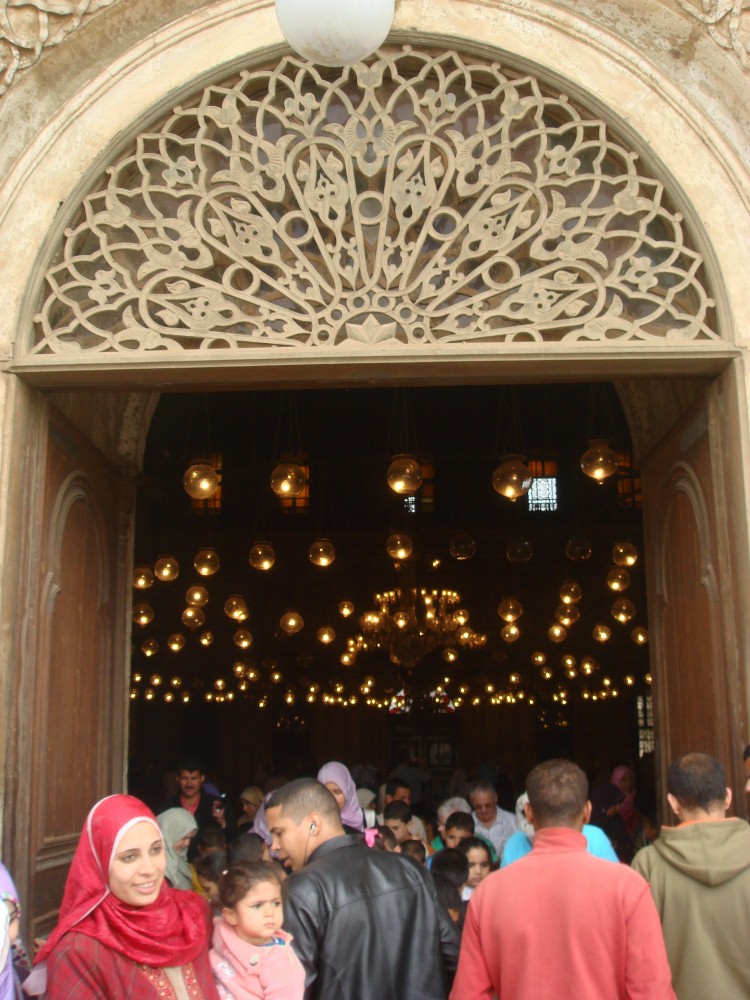
    Entering a Turkish-style mosque always makes me think they've somehow acquired hundreds of fairies to light the building
    Entering a Turkish-style mosque always makes me think they've somehow acquired hundreds of fairies to light the building

    The centerpiece and the spires of the Citadel are from the Mosque of Mohammad Ali, which is covered in Turkish domes and icicle minarets on the outside, and filled with the familiar low-hanging globe light fixtures on the inside. Even Haitham, jaded from his experiences in the supposedly fabulous mosques of Saudi Arabia from his pilgrimage, was impressed with the grandeur of the place. Although the once-gleaming lamp holders had faded and the carpet was threadbare in places from thousands of tourists and worshippers, the mosque retained its dignity.

    It's all about the colors, patterns, and geometric symplicity - it's no wonder that Arabs made mathmatics beautiful!
    It's all about the colors, patterns, and geometric symplicity – it's no wonder that Arabs made mathmatics beautiful!

    (more…)

  • “Mister, will you be our friend?”

    A car lightly sideswiped Haitham as we were groggily crossing Talaat Harb street after grabbing our sandwiches this morning. It spun him around and he fell back onto the curb, panting slightly. I’ll give the driver credit; he stopped in his car, opened his window, and peered out at us silently. I should note that he was watching my reaction, not Haitham’s – he barely glanced at the man he’d hit. When I didn’t run at him clutching my passport and roaring “lawyer” he steadily accelerated away and vanished into the heavy traffic. We certainly weren’t in Jordan anymore. And I thought the traffic in Amman was bad!

    So what should two foreigners do in Egypt first? The pyramids, of course. Haitham didn’t want to take a taxi, or the metro, or a combination of both, so we found the local’s bus system hidden under a highway overpass and waited about half an hour for it to slowly load up with people so that the bored-looking driver could stop chain-smoking and start driving.

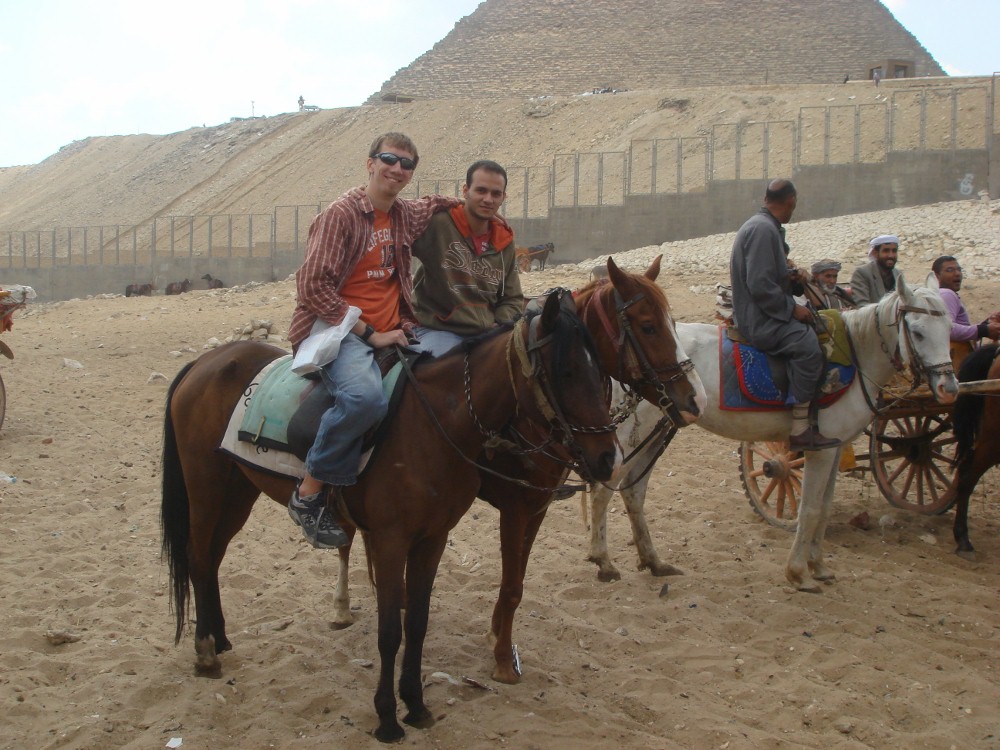
    What can you say about the pyramids that hasn’t already been said? It was exciting to see them slowly rise like mountains, shimmering in the Cairo haze, over the tops of the apartment buildings. Specials on TV never show them within the context of the ever-growing city around them, which made it all the more unreal. Then we got off the cramped microbus and came crashing back to the reality of the poor Giza district around us. Within minutes, three different men had tried to haggle with Haitham to have us rent horses to ride around the enclosed, fenced-off desert surrounding the pyramids. Haitham was all for it, but I took one look at the bony, sad-looking nags penned up in the shadow of the pyramids and tried to convince him otherwise.

    About a hundred years ago, this would have looked intrepid. Now it's just 80 pounds + guide.
    About a hundred years ago, this would have looked intrepid. Now it's just 80 pounds + guide.

    In the end, we ended up renting a couple horses for an hour, and unwillingly found ourselves renting a “guide” as well, who helpfully pointed to the large things dominating the skyline and said “These – pyramids.” Haitham’s horse seemed slightly healthier, but my horse kept tripping over things – rocks, sand, its own legs, air molecules – which I found somewhat alarming. We had to pay this guide’s admission fee into the pyramid site, and then it was time for my first fun experience with Egyptian pricing.

    Egyptian historical sites love foreigners’ money. They really do. And good ol’ President Hosney Mubarak (yes, that’s the same root triconsonant as the American president, Barack means “bless” and Mubarak means “blessed”) really wants to help out his Egyptian countrymen (who all are united in hating his corrupt guts) so he makes sure that while the prices for historical sites are written out for foreigners in English, clearly stating that the pyramids are 60 pounds to enter, written next to it in Arabic is the 2 pound price for Egyptians and all other Arabs. I assume that the vast majority of foreigners who visit the pyramids don’t read Arabic, so they never know the price difference.

    Haitham thought he could get me in for the price of an Egyptian; he explained that he had done the same for his friend James, who had lived in Jordan a few years ago and traveled to Egypt with Haitham. I figured it couldn’t hurt to try, so I hid quietly around a corner as Haitham went up to the counter to easily secure two 2-pound tickets, with الهرامات (al-Haramat, the pyramids) written on it. Meanwhile, my eyes meandered over the never-ending flow of tourists in, out, and around the security checkpoint-scanner gate. A couple of people whom I thought were Wisconsinites stopped nearby, and looked at the ticket prices on the wall. “Sheiza” one of them muttered disgustedly, proving that they were probably more likely to be original Germans than ancestral Germans like my countrymen.

    The “I’m Arab” ticket didn’t work. Haitham passed through without difficulty, but then the burly officer/bouncer grabbed my ticket out of my hands and waved it at me, and then at Haitham when he tried to pull me through. “Does he look like one of us?” he grated to Haitham in Arabic. “Where is this foreigner from?” I answered him in Arabic, “I’m Jordanian, can’t you tell by my accent?” It was, after all, noticeably Jordanian. The man cursed under his breath, puffing up his medal and badge-covered chest. “I’m just a poor student traveler,” I told the man in Arabic, trying to calm him down, but the word I used for poor, “miskeen,” is more frequently used for downtrodden and people with bad luck, and Haitham told me later that he thought the man was going to punch me in the face in anger. As I went back to get my foreigner-priced ticket, Haitham told me that the bouncer kept cursing, told him that foreigners were never miskeen compared with Arabs, never deserve anything but foreigner pricing and that Haitham should be ashamed of himself for trying to “help” me around the 30x higher pricing. Well then!

    He had a point, of course. If Haitham hadn’t suggested trying to get me in for cheap, I wouldn’t have bothered with the extra hassle of rule-breaking. Paying the equivalent of 11 USD to see the most famous ancient ruins in the world was not going to break my budget and I didn’t protest any further. It wouldn’t be the last time he’d try to “help” me, though.

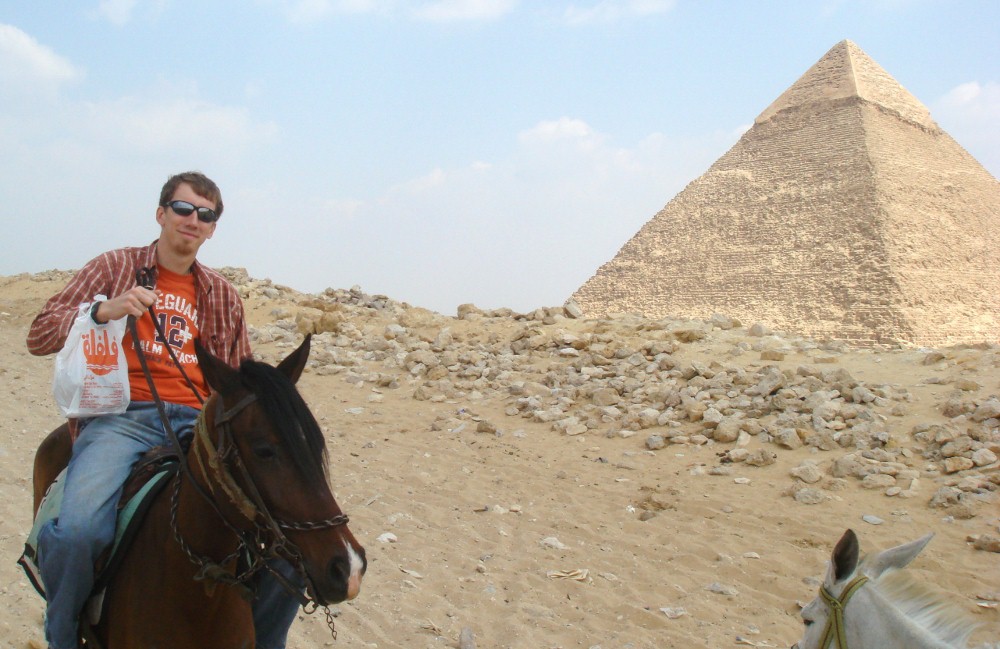
    Khafre's Pyramid and and the Unknowing Galloper
    Khafre's Pyramid and and the Unknowing Galloper

    We rejoined our horses and Farghut, our knowledgeable guide. Haitham wanted to immediately burst into a gallop, but I was still feeling sick, since even before leaving, and I loudly protested the thought of forcing this poor, near-death animal and myself to suffer any further by heaving ourselves across the sand and probably crashing headlong into an ancient monument. It’s true; you practically trip over ancient monuments out here. Farghut appeared amused with this suggestion and suddenly slapped my horse on the rear, completely without my suggestion that perhaps we should wait on this idea. “No! No! NOOOOOOOOOOO” I screamed – in a very manly way, as my horse’s joints suddenly creaked into action and I was flung forward in the saddle. Egyptian saddles, I should note, are not like American “beginner” saddles and I would not consider myself anything but a beginner at horseback riding. I was in for the ride of my soon-to-be-ended life.

    (more…)

  • No one stops an American

    Egypt, the crown of the Arab world. Cairo, the jewel of the crown. And the Egyptian Museum, the center of Cairo and the archive for most of the greatest works and achievements of the ancient world. And here we are, only a few blocks away from it in a small, cramped-but-clean room in the Australian Hostel.

    Haitham and I left Amman at 3:30 promptly, thanks to the punctuality of the al-Moomayez taxi. Unfortunately that will be the last time I have anything good to say about this taxi service. I used them throughout 2009 to get me to the airport while praising them to friends and colleagues for their price and quality of service. The standard dingy yellow taxi wants JD25, but Moomayez only needs JD9 since they follow the meter! I would tell them. Today, however, the operator told me blandly that we would be required to use the Mercedes to get to the airport, instead of my usual Toyota, at twice the price per kilometer. I ranted at her for a few minutes, then hung up. Regardless of my rage, our JD20 chariot was waiting for us at exactly the time specified. Haitham was in shock that a transport service in Jordan would actually be on time. As for me, “being on time” for a taxi service shouldn’t be a charge that requires a double increase in fare prices all at once. Farewell, Taxi Moomayez.

    Our driver was a huge hoout of a man who definitely had his seat pushed back all of the way. I made sure to offer him one of the brownies I’d made for Haitham and I, knowing that otherwise the delicious smell of chocolate might drive him insane and send us careening off the road. He and Haitham chatted amicably while I busied myself with taking the cornucopia of pills that Haitham had brought me, in the order he specified.

    Like a kid in an amazing cancer-filled candy store...
    Like a kid in an amazing cancer-filled candy store…

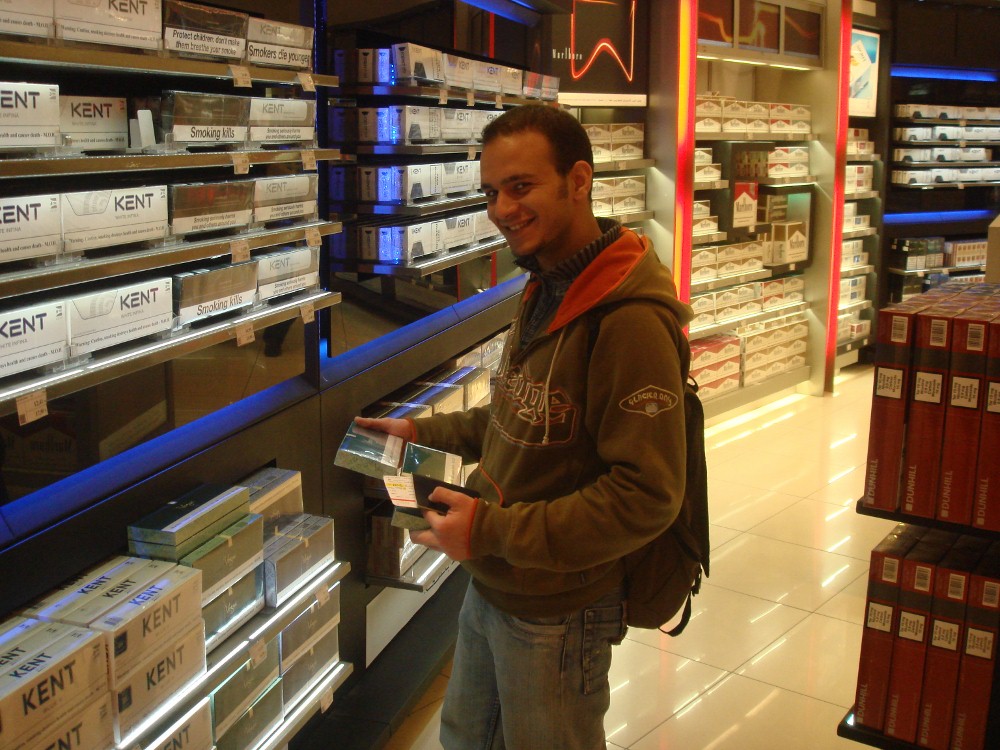
    This was Haitham’s first time in an airport, and he was curious to see the duty-free shop. However, he railed against the prices, noting as I already had that the prices here might be without tax, but because of the rip-off nature of airports the price was essentially the same as in Zarqa’, although better than Amman. We found our flight and boarded right away, seated in the back of the plane behind a group of Westernized Ammani high school students on their way to a conference. Their clothes and 100% American accent made them stand out in stark contrast to the rows of robed men and women who sat quietly throughout the rest of the aircraft.

    As the plane roared and picked up speed on the runway, Haitham gazed out the window, muttering to himself rapidly in Arabic, words that I couldn’t quite make out. At the second the wheels left the runway and we became airborne, he moaned briefly in a single monosyllabic utterance and his hands twitched briefly on the armrests. Once we were safely aloft, he only briefly paid attention to the flight, only while going through some brief turbulence which caused him to look up sharply from his music player and question to me as to why we were shaking and vibrating. Personally, I was more interested in the complimentary sandwiches being served to us – for a short hour-long flight, I was pleased with the treatment.

    You're not going to believe this but yes, we did have to take this ridiculous roundabout detour around Israel instead of just flying in a straight line to Cairo
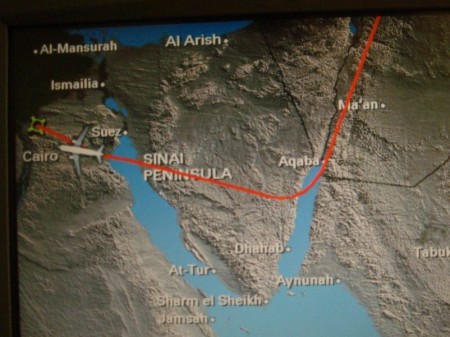
    You're not going to believe this but yes, we did have to take this ridiculous roundabout detour around Israel instead of just flying in a straight line to Cairo

    We descended through the roiling black clouds above al-Musr to a twinkling carpet of gold and red sparks, the lights of the buildings and cars below. They stretched as far as the eye could see in all directions. Haitham definitely seemed to be discomforted by the landing, and when you think about it, it’s perfectly natural to be alarmed when you see the earth rushing up to you with uncontrollable and implacable speed. I told him, “There’s going to be a bump when we land.” He whirled in his seat to stare at me. “Will it hurt?” I paused, then nodded as the plane touched down. “You tell me.” Along with all the other Arabs on the plane, he burst into applause, a cultural trait that I’ve gotten used to.

    After a short bus ride from plane on the tarmac back to Cairo’s airport, I paid my $15 for the Egyptian visa (Haitham did not require one; the first thing of many he would be receiving for nothing or almost nothing in our journey) and we strode purposefully with our luggage through the relatively quiet airport towards the door. The final customs check and declaration were interesting. A tall, elderly woman asked Haitham to open his bag to have it checked, and I naturally followed suit and opened my bag on the table next to his and waited for her to finish with him.

    Once the customs woman finished making sure that Haitham wasn’t importing anything dangerous or illegal in his socks, I called to her that I was ready. She looked at me, uncomprehending, and a short man with gold piping on his sleeves rushed over to her and hissed, “Why did you stop that American!?!” She backed away from him, pleading that she hadn’t stopped me and that she didn’t know why I’d opened my bag. Haitham came forward and tried to explain that I had just been following his lead, but commented drolly that it was interesting that Americans didn’t get their luggage checked. The officer paled and his bushy mustache bristled under his bulbous nose. “That’s not true at all,” he insisted, glaring at my friend. Haitham merely shrugged and gestured for me to close my bag; we left the airport without further incident.

    Now the question of the night still remained: how were we to find our way to the Australian Hostel? It seemed that we had several options in front of us. If we had booked for three nights online at the hostel, they would have found us and picked us up for free from the airport directly for 60 pounds, the equivalent of 8 JD. Now, of course, we were being swarmed by eager taxi drivers who I’m sure would have liked nothing more than to escort us to our location for twice that. Haitham wasn’t having any of that, of course. He quickly found us a bus to our destination on Tahrir Street that had a fare of 1 pound per person. We brought our luggage inside, and when the bus’s assistant protested, Haitham gave him another 2 pounds and bought a third ticket for our good friend Luggage. He quieted down at that, and joked with Haitham that for that, they’d alter the route and take us straight to Tahrir.

    It was definitely a joke because it took an hour by bus, plus another hour of walking, just to find the hidden hostel. After disembarking near that famous Egyptian Museum previously mentioned, we wandered about blindly for a long time randomly asking strangers for directions until we found someone who let Haitham borrow his phone. Thankfully, that was all it took to direct Haitham up the (apparently) famous Talaat al-Harb street, past the KFC (of which there are apparently many!) and to the small alley with the Australian Hostel building.

    I like this room they’ve put us in. Tall ceilings, a nice red silk curtain over the balcony, and obviously, free and serviceable wireless Internet. Haitham is in the middle of praying at this moment so I’m trying to type as quietly as possible so as to not disturb him. He found which direction Mecca is, which ironically happens to be about 2 degrees to my right so it almost looks like he’s prostrating himself at the foot of my bed, directly towards me. I won’t tell him that, of course, or at least not for another few minutes while he’s busy…

  • Headed for Musr…

    It’s been a year in the making, but Haitham and I are only a few hours from being airborne from Jordan to Egypt, or Musr as it’s called in Arabic. The two of us originally started planning this last year when our friend Silas was still in Jordan, but things never panned out and we had to put it on hold for quite awhile before we could try again this spring.

    We’ve got a pretty good chunk of time allotted for the trip. Haitham was able to take off of work until the 2nd of April, and thanks to Whitman’s spring break, I’m going stay a few days beyond his departure and won’t get back to Jordan until the evening of the 5th. It’s the first time Haitham has ever been on an airplane, so I’m looking forward to seeing how my buddy handles his premiere flying experience.

    I wish I could say that I’m as physically healthy as I am excited for the trip. I came down with some sort of mild cold/fever yesterday, the day before this trip, and my head feels like its stuffed with cotton balls. Haitham is currently napping somewhere else in the house; he came straight to my place from his 3rd shift job at Hikma, Jordan’s largest pharmaceutical company. He was able to bring me some powerful anti-fever medication and my head now pleasantly feels like it’s been stuffed with cavorting kittens, gently batting at my cerebrum with their fuzzy little paws.

    We’ll be taking the Al-Moomayez taxi to the airport at 3:30, and our flight is scheduled for 5:40 – (insha’allah, as we must always say). The trip schedule has not yet been fully finalized but we’re definitely doing a few days in Cairo, a few days in Alexandria, then taking the train line along the Nile River to Upper Egypt to see the Valley of the Kings and the awe-inspiring Abu Simbel temples along the border of Sudan.

    Here’s hoping for a gentle and turbulence-free journey…I’d like to keep my head kitten-free for as much of the trip as possible!