HeiseHeise.com

The Personal Blog of Zach Heise

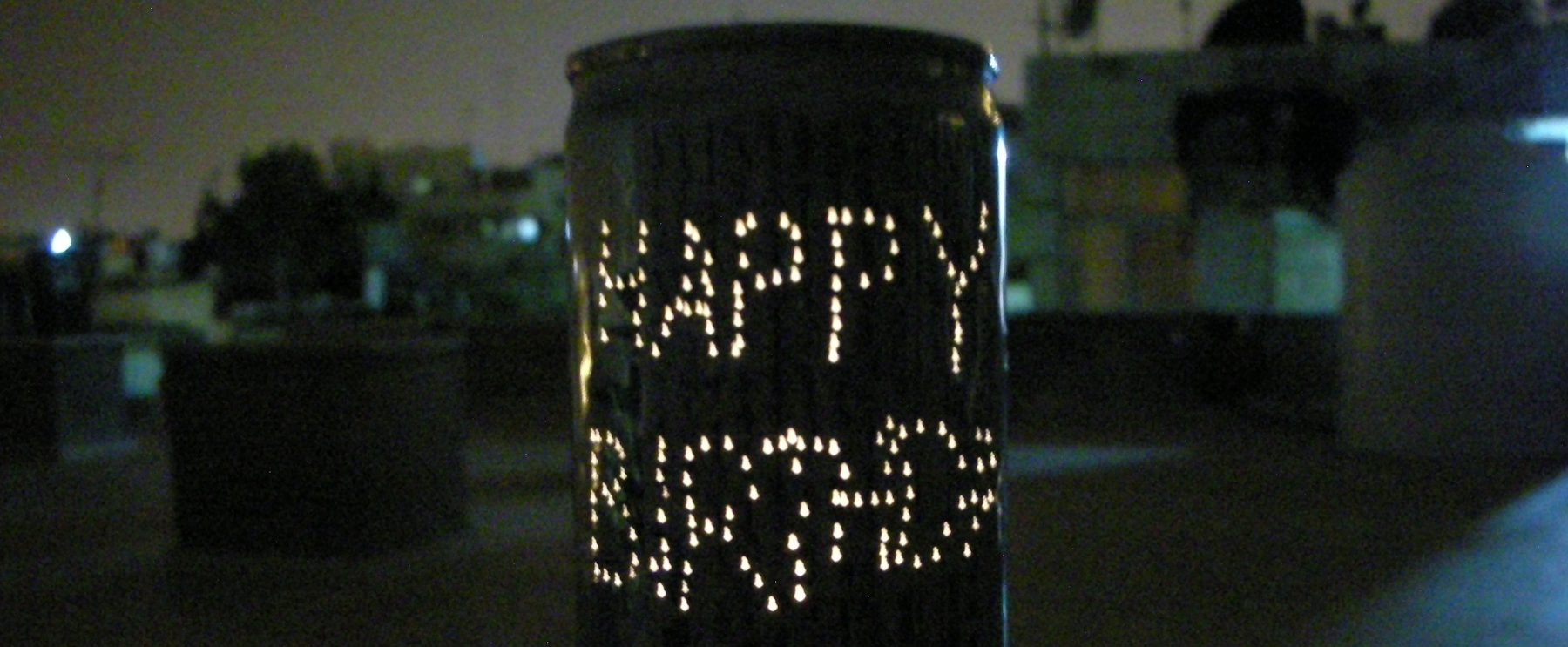
Birthday - can art
Birthday – can art

A random image. Reload page for more. Want more info?

Month: May 2009

  • The return to Kalai-Khumb

    I awoke in the early morning with extreme stomach pains and diarrhea. It seems that the pain I had started feeling the previous day had gotten worse, and I found myself regretting drinking that appetizing-looking mountain stream water, which I should have realized was filled with somewhat less-appetizing bacteria which were now having a party in my intestine. Malik provided me with pretty little yellow pills, which I eagerly gulped down with some ever-ready tea, and prayed that the road would somehow magically feel less bumpy.

    Thankfully, the pills seemed to do their trick, and I felt much better as we pulled into the same little roadside teahouse we had stopped at three days earlier by the river, where we were greeted as old friends by the waitress and served Beef Things With Onions, which besides their unusual appearance, were quite tasty – but at that point, I was happy to have some digestible food in my stomach. I asked Farahnush what the cafe’s name meant – “Cheel Tan,” to which she replied, “It means ‘forty bodies.’” This made my stomach somewhat more queasy again, and I excused myself to go check out the hydroelectric plant above us on the hill, which powered the nearby village of Rushon. Who names a cafe “Forty Bodies” no matter what language it’s in, anyway?!

    Lounging at the Forty Bodies Cafe. Careful, Farahnush...don't lounge too comfortably or they may "collect" you...!
    Lounging at the Forty Bodies Cafe. Careful, Farahnush…don't lounge too comfortably or they may "collect" you…!

    We returned to Kalai-Khumb as the sun was beginning to set, only to find the Homestay hostel we had stayed in previously was completely full. In a town this size, this did not bode well and we were afraid that the Niva might end up being our cottage for the night, but luckily Malik was persist in his search for alternative housing, and he found a new homestay house which was just nearing its completion. He came back out to us in the truck, reporting that the inside was clean, new, freshly painted – but the running water hadn’t been hooked up yet. The toilet was of the “rustic variety” – a metal, roofless shack next to the river out back. I suddenly found myself very grateful that my illness’s unpleasant symptoms had ceased. The place had electricity though, and oddly enough, an unplugged old ice cream machine in the front parlor (no ice cream though, darn it). I would have happily spent the evening writing up more blog entries for posting upon my return to Dushanbe, except that a fast-moving thunderstorm blew over for 20 minutes and completely knocked out the power to the entire village.

    This was of no matter to the residents of KK, though – of course, they had existed here in this village for thousands of years without electricity or running water, and until the lines were fixed again, a day without it didn’t matter one bit to them and it was business as usual. We had our dinner by candlelight, and Farahnush and I decided that we wanted to climb the interesting-looking mountains to the north of the village (or more specifically, I wanted to climb them and Farahnush decided to go with me to make sure I didn’t do something crazy). I had tried to climb one of them the morning of our previous stay, but had run out of time before we had to continue – I figured, if there’s mountains to be climbed, I wanted to be in on this! So we hitched up our trousers and hit the slopes, to the shock of the children playing in the playground below, who clustered about us as we headed towards our chosen rock-covered giant.

    It didn’t take long for this to turn into a somewhat questionable idea. As before, the sun vanished quickly over the mountains, leading us with a hazy blue glow to the west which did less and less to illuminate our rocky goat path as the minutes passed. “Are there bears in these mountains? We are next to Russia, after all,” I asked. “You know, these are questions you should have thought of earlier,” Farahnush retorted. Wisely, she elected to wait for me on a rocky outcropping while I bravely told her that I expected to reach the top in 30 minutes or so, and be back in an hour. “Don’t do anything crazy, okay?” my sister pleaded as I scrabbled up the rockslide on all fours, bypassing the goat path entirely in my quest to use every last moment of light available to me. I peered down at the ground me as Farahnush’s head disappeared below me. The children, who had been previously playing energetically with a soccer ball in the field which spread before me like a rocky patchwork quilt, were now quiet and still, clustered together near the edge of the mountain and staring up at us.

    "At least he looked cheerful before he died of exposure," they'd say about him.
    "At least he looked cheerful before he died of exposure," they'd say about him.

    I can’t resist an audience, unfortunately, and this goaded me to climb even faster. After 15 more minutes of climbing, I suddenly realized that if I kept climbing, there would be a good chance I would either die, or at least have to spend the night on the top of the mountain. The slick, now almost invisible rocks beneath my hiking boots were wet from the recent rain, and I had no water, no light, and Malik and Saeed didn’t know where we were. I took out my camera, switched it to video mode, and composed a touching, heart-wrenching eulogy about myself with instructions to distribute my possessions upon the recovery of my body from the top of the mountains, which shan’t be published here for the sake of my remaining dignity. Then I tucked in my shoelaces and kept climbing.

    After another five minutes, and the realization that the children were now shouting for help below, I realized I was being an idiot and I turned around and started to pick my way back down the mountain. I called out for Farahnush as I descended, telling her to go on without me and that I’d meet her at the house, but I heard no response. It was now almost completely dark and I dug out my trusty iPod and switched its brightness to maximum, holding it in front of me like a index card-sized torch. I signaled with it every few minutes, waving and calling for Farahnush to assure her I was stupid, but alive. I slid down the steep mountain, but thankfully those goats had a few more brains than me, making their path narrow but safe. I’d never been more glad to have those hiking boots than at that moment, and finally, 20 meters from the ground, I barely made out the dark shape of Farahnush waiting for me at the bottom, where she explained that she had almost fallen off, but one of the children had come up to lead her back down. “You know, they told me that some tourist died in these mountains in the village last year,” she told me severely. “Good to know; we’ll have to try earlier in the day next time!” I replied enthusiastically. I’ll probably never learn. But I just love climbing mountains.

    Malik and Saeed were waiting for us by the house when we returned, worried about our safety but amused by my description of my bravely stupid adventure. Farahnush’s feet had gotten extremely muddy during the journey, her father helped her start to wash her feet with buckets of water in the otherwise useless bathtub, with me holding a lighter for them to see.

    He's quite tiny, even kind of adorable. Maybe I would have tried to keep him as a pet if he hadn't ended up on the bottom of Malik's shoe
    He's quite tiny, even kind of adorable. Maybe I would have tried to keep him as a pet if he hadn't ended up on the bottom of Malik's shoe

    As the water ran down the drain, I idly moved the light around the room, exploring it in the darkness. I glanced a yellow leaf in the bathtub, then realized that leaves aren’t supposed to move or have legs. I looked more closely, then straightened up and said as calmly as possible: “Farahnush, don’t panic or make any sudden moves, just move your feet out of the tub immediately.” As she obeyed, I shined the light back into the tub, revealing the small yellow scorpion that was a dozen centimeters from her left foot. Farahnush let out a small noise, and I noted the small size of its body, pinchers, and striking tail. It was still moving towards the drain when Malik leaned in with his slipper and bashed it twice, leaving it mangled and twitching. Farahnush decided that her feet were clean enough, and I warned her as we were adjourning for the night that she should check under her bed and cover her shoes before sleeping. I sure did.
  • Khorog, Tajikistan’s mountain capital

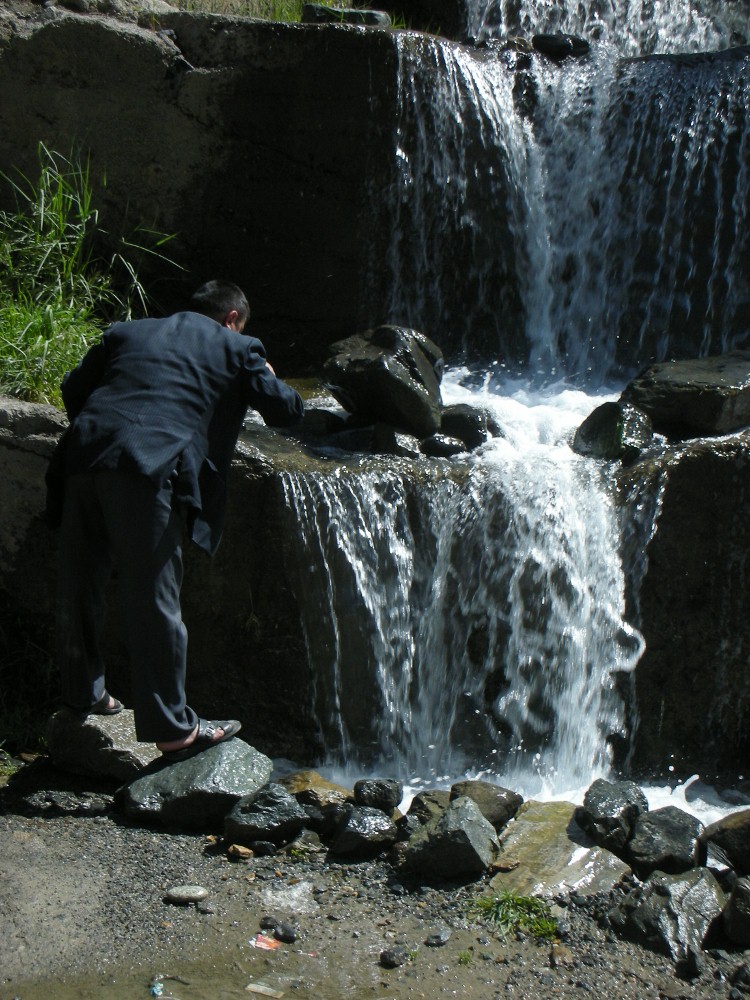
    We arrived in Khorog in the middle of a sunny afternoon on the following day. The city isn’t the capital of the country, of course, but of the Gorno-Badakhashan province, which makes up almost 50% of Tajikistan’s entire landmass, as well as many of its most beautiful mountains in the Pamirs. We were greeted by cheerful stone signs in both English and Arabic posted high up in the mountains above us, large markers formed by rocks that looked like pebbles from our vantage point far below, but each must have been at least a meter in diameter. After leaving that morning from Khali-Khumb, the trip progressed beautifully uneventful. We only stopped twice – once to get lunch at a small cafe/teahouse by the side of the road near the village of Rushon, and once to take a drink from a picturesque little mountain stream. Hmm. More on that later.

    This may turn out to be a bad idea
    This may turn out to be a bad idea.

    We checked into our hostel, which was excellently located on the very edge of one of the tributaries of the Panj, close enough that when the host served us tea in our bedrooms, you could dump the dregs of it directly out your window, straight down into the river. We didn’t spend too long at the hostel; we wandered through the local park, filled with tall, stately poplar trees and tall, windswept grasses. I picked up some authentic Pamiri handicrafts, made by local women, and sampled some “Cola,” which at first I thought was Cola-Cola (as it had the same logo) but was informed that it was an Asian equivalent. And you thought that fake iPods were the only hoaxes that came out of China, you silly fellow!

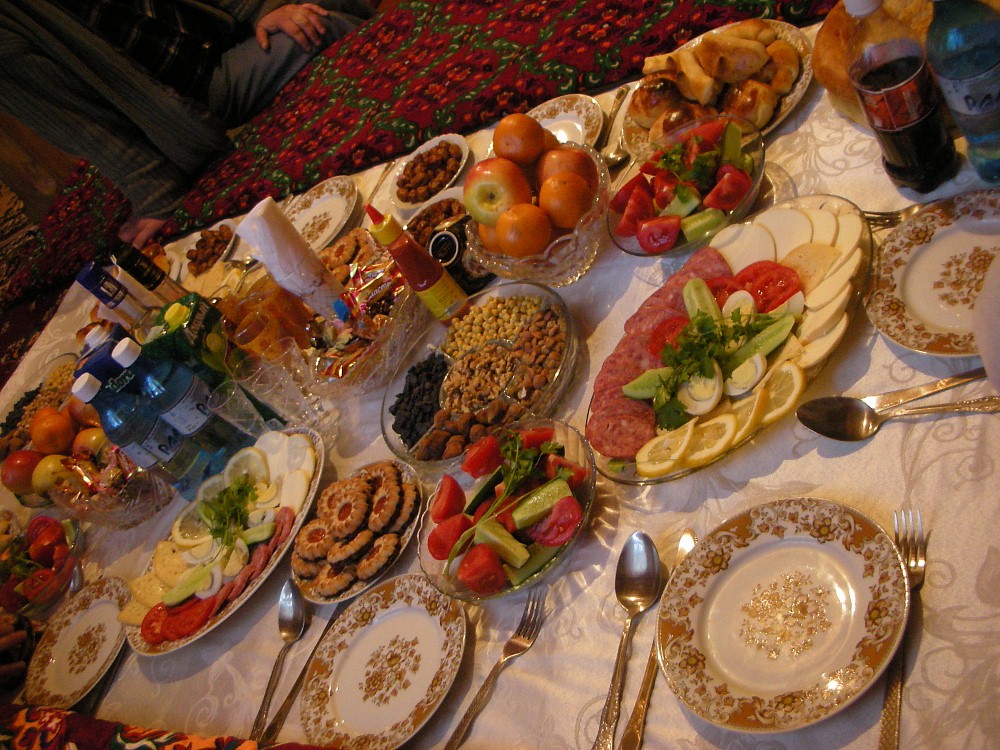
    The highlight of the evening was meeting with Malik’s friend and colleague Booribek, who ran an NGO in the area and had worked with Malik and the American embassy for years. The four of us were invited at Booribek’s insistence to a local Pamiri home, where we were fed enormous amounts of delicious food by our hosts, who spoke a little English and were thrilled that we had come to visit. The meal probably had four or five courses to it, including soups, vegetable platters, pastries, and grilled yak with a mushroom sauce. I had never tried yak before (that I know of) and we were told of its nutritional value and its extremely low cholesterol level, apparently about 6-7%, compared with beef’s 25%. Our little group talked long into the night as we ate, discussing the historical significance of the teahouse, which was designed in the original style of the Pamiri people as a pentagram as part of their Zoroastrian faith. We talked about similarities between Christianity and Islam, and our hosts asked me how I liked the Pamirs so far. Full of yak and vodka, I replied that they were beautiful and the hospitality couldn’t be beat. Booribek and Malik were interested in investing in tourism for the region, and wondered if I had any pointers for them, at which I replied truthfully that they needed to embrace the rituals and customs of Tajikistan and the Pamirs and serve more food like this – they’d have no problem making happy customers. The Tajiki currency, the somoni, is equal to about about $.25 at the moment, so I estimated the full meal, service, and detailed explanations of the building at being worth at least 120 somonis per person.

    And this is just the first course, which was on the table when we arrived!
    And this is just the first course, which was on the table when we arrived!

    We slept soundly that night with the gentle sounds of the small river below us and the creaking of our stout old wooden hostel, awakening early to visit the local botanical garden, which is famed for being the second highest in the world at 2,320 meters above sea level. Our guide, another one of Malik’s friends, showed us around for an hour, explaining that the different sections of the garden were filled with trees from 3 different continents, including North and South America. He also dryly pointed out the construction site for President Rahmon’s new “vacation home,” a multi-million dollar venture that struck me as a disgusting when large percentages of his populations are missing modern toiletries and communications. Farahnush and I sampled a local plant that he told us was an edible medicine for the Pamiri people (or at least I think he did; Farahnush was translating for me) but quickly spat it out. Like most medicine, just because it was edible didn’t mean that it tasted even remotely pleasant.

    The day’s main journey was farther south along the Panj to the Garm Chashma, the Russian word for Hot Springs. It took about two hours to slowly traverse the usual rocky roads, but I noted that the river here had changed color from muddy brown to a light, almost tropical-looking blue, for which no explanation could be found. I speculated that perhaps that this was the natural color of the water, but it was slower moving here and therefore less likely to be filled with mud stirred up from the rapids found farther west. We smelled the strong sulfur of the springs before we saw them, but arrived momentarily at a large white gate which greeted us with the traditional Tajik greeting: “Хуш Омадед!” – Khoosh Omaded, which is the equivalent of “Pleasant Welcome!”

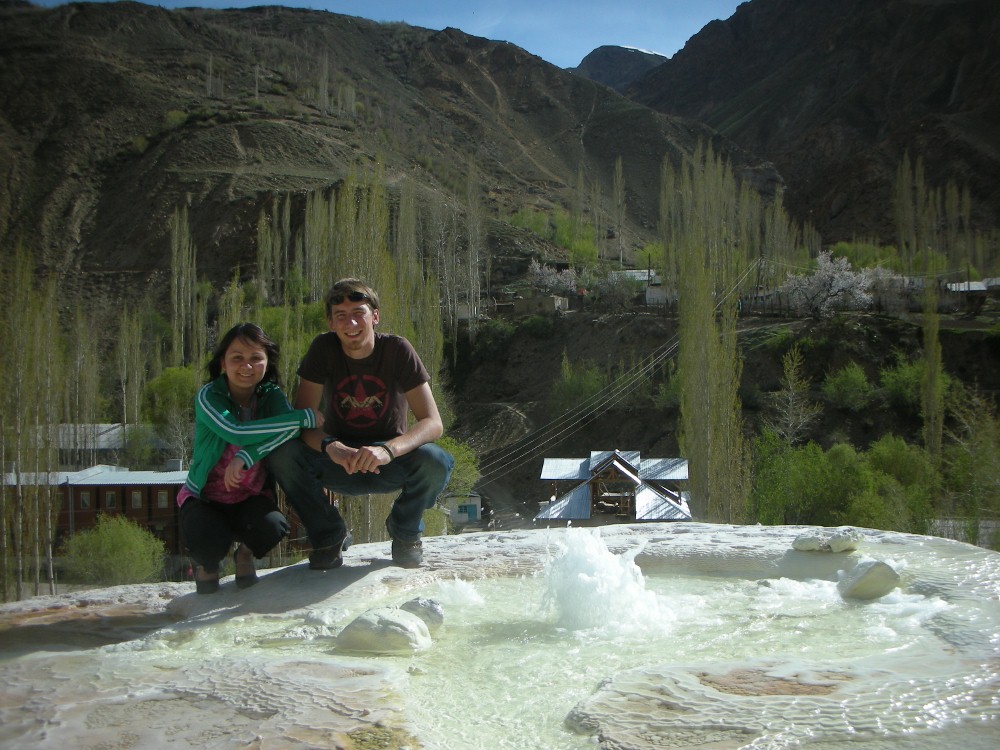
    The springs sat high upon their huge white mount of sulfur deposits, forming the usual stalactites and vapor spilling out into the chilly mountain air. Trenches had been dug up and down the mountain, feeding the almost-boiling water into bathhouses and the nearby resthouse. A small pool had been dug as a reservoir for the freshest, hottest water, but Saheed, Malik, and myself couldn’t go in there – it was apparently the hour for women, so the three of us lounged in the men’s bathhouse, which we had to ourselves. The water glowed eerily from reflections from the corrugated tin roof above us – tin roofs are by far the standard out there in the rural areas of Central Asia; they’ve practically turned their use into an art form – and I dangled my feet into the water and poured the water into my hair. I wanted to go up and take some more pictures of the main collection pool, but by that time a group of large, naked Russian men had decided it would be a good time to use the pool, causing me to quickly vacate the area within moments and join the others at the resthouse for tea and Nescafe. I tried to find out the name of the Hot Springs so I could locate it later on a map, but the resthouse keeper misinterpreted Farahnush’s question and thought she was asking for the word in Tajik. “Garm chashMAH! chashMA!!” he told her repeatedly, and we retreated with our question unanswered. Interestingly enough, both eastern farmers and the border guards often mistook Farahnush for a foreigner or American because of her clothes and how easily she spoke English with me. I wondered if she gets that a lot since her return from the USA. Even now, I haven’t yet been able to discover the name of the place, although I located it on Google maps.

    This is probably the only appropriate picture I can show you of the hot springs. *shudder*
    This is probably the only appropriate picture I can show you of the hot springs. *shudder*

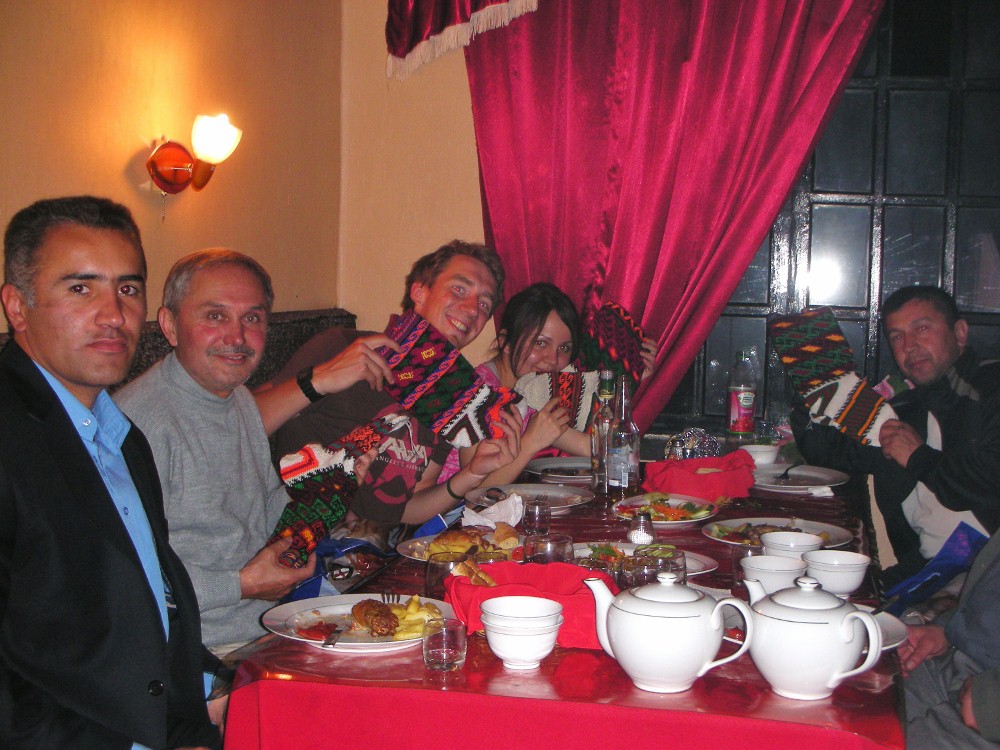
    The final event of our trip to Khorog was dinner with all of Malik’s friends together at a local restaurant, where we had Pamiri beef and of course, vodka. Malik’s friends, all from around or in the Khorog area, presented the four of us Dushanbe city-folks with gifts to commemorate our visit; hand-made stockings with color designs on them, perfect for those cold Jordanian nights and the tile floor back at home. The food, vodka, and constant elaborate toasts to each others health and journeys were excellent – but how can any food compare with the deliciousness that is yak? I’ll be convincing my parents to start a yak farm as soon as I get back to America, that’s obvious. Hopefully they get along with goats!

    Oddly though, my stomach was starting to feel kind of funny. And not funny in a good way…

    The guests recieve colorful stockings as gifts from their Pamiri hosts. My hair only looks like that because it's filled with sulfur from the springs
    The guests receive colorful stockings as gifts from their Pamiri hosts. My hair only looks like that because it's filled with sulfur from the springs
  • Landmines along the Afghanistan border

    On the second day of my time in Tajikistan, I was taken out of the city to see some of the sites around it, like the lower mountains over the roaring Varzob River and its teahouses, and the ancient earthen castle in the village of Hissor, Malik’s hometown. However, our main plan was to take me to the far eastern reaches of Tajikistan, into the Pamir Mountains. On Friday evening, I was introduced to Malik’s friend Saeed, who would be joining us in our trip with his all-terrain, Russian-made Lada Niva truck. Saeed was a tough-looking Tajik with a steely eye and crew cut, but he was quick to laugh and was always interested to have Malik or Farahnush translate what I was saying, or have me try to teach him a few words in English. After a delicious dinner of homemade Osh (pilaf) from Rayhon, we went to bed early, with Saeed sleeping on the floor in the living room on a mattress which looked a lot like an Arab farsha.

    We left early on Saturday morning in Saeed’s truck, and headed for the mountains in the south, a series of beautiful green rolling foothills that went on for kilometers, vibrantly green and with almost no trees on them. Surprisingly, they lack any trees, which made the morning sunlight catch every fold and curve in the earth in a pattern of shadows, making these low mountains a sun-warmed blanket of gently waving grass, thrown over giants sleeping below.

    I can't help being this poetic. Just call me Rudaki.
    I can't help being this poetic. Just call me Rudaki.

    One thing you definitely have to look out for in Tajikistan is potholes in the road. And lots of them, some of the size that could break a sedan’s axle in half if you’re traveling at the right speeds. We weren’t worried about that in the Niva, but for everyone’s health and well-being, Saeed did some pretty amazing maneuvers to avoid the worse of them. Clearly a man who knows his way around Tajik highways. The other thing to look out for is the Tajikistan “БДА” – which is pronounced “Bee Dee Ah” and is the spectacularly corrupt road police force, stationed every dozen kilometers on major highways, which checks documents, passports, registrations, and anything else that could possibly not be 100% perfect, so they can extract a bribe from you to ignore it. The combination of potholes and police made the trip a little slower than it would have been otherwise, but I didn’t mind that much as the fantastic scenery more than made up for it.

    Our party stopped briefly in the city of Kulob for lunch, meeting up with one of Malik’s friends in the area and visiting the tomb of one of the famous Iranian Sufi intellectuals. Farahnush and I checked out a mysterious golden monument in the center of the city, which thanks to her translation for me from a gardener, we learned that it was dedicated to the Kulob’s 2,700th birthday from a few years ago. Fairly amazing when you compare the age of a city like that to anything we have in America, or even in the most of Europe. On the way out of town, I asked Malik if we could pick up a map of the area – like the majority of foreigners, I had absolutely no idea how the country was laid out or where we were going. The only map we could find on short notice was a large, laminated wall map, but the advantage of this was that I could mark it up with a sharpie to keep track of our route. This would be our last major city for several days as we traversed the wilderness between Kulob and Khorog, our final destination, so we filled an extra gas tank to put in the trunk; better to be safe than sorry. For the first time, I saw a less modern way to fill a car’s tank – attendants dragged buckets of gasoline over to the car, and poured it through a funnel directly into the tank. It seemed pretty large risk of flammable danger to me, and the smell of raw gasoline fumes exposed to the air were quite potent, causing Farahnush to wrap her head with her new red keffiyeh until we were done outside. “Don’t worry, we use fuel pumps like everyone else in Dushanbe,” she pointed out.

    Well, I suppose it was done like this for decades in America...
    Well, I suppose it was done like this for decades in America…

    We left Kulob behind and the road went from “usable by your average car” to “possibly dangerous” within a matter of minutes, and the amount of traffic dropped to a trickle. The brilliant afternoon sun shone into the car brightly and the snow-covered mountains in the distance grew ever closer as we bounced along over the boulders in the road, finally coming to a roadblock and sign telling us we were entering the risk zone along the Panj river, the border and only separation between Tajikistan and Afghanistan. I was required to give up my passport for a few minutes so they could register me in an archaic, dusty green book that looked like it had been used by the Soviets (and in fact, it probably had been). The others had their passports glanced at briefly as well, but mine was the main interest – the bored guards flipped through it curiously, as American tourists in this part of the country are extremely rare.

    Within fifteen minutes we came in sight of the mighty Panj – a roaring muddy brown torrent that rages for a thousand kilometers before emptying into the Aral Sea far behind us. At this particular point, the river looked quite wide, and very dangerous as well – about 20 meters of rapids crashing against huge rocks below us. Cows grazed unconcernedly in the road as our white truck barreling past them, and farmers wearing the traditional toqi hat casually flicked long sticks at them to move them higher into the rocks. I squinted over the river towards the sunny cliffs, realizing that I was looking into the infamous country that was the site of the original “War on Terror” started almost a decade ago. In the media, we hear of the death and destruction in the south, around the capitol of Kabul – but nothing could be further from what we saw here. Nothing but cows, grassy fields, and broken cliff-side, stretching away in all directions. If you didn’t mind the distance and lack of more westernized amenities, you couldn’t ask for a more picturesque place to live.

    Except for the landmines. I was drinking from my seltzer water bottle (which is the norm in Russia/Central Asia instead of the regular uncarbonated variety in America and Jordan) and almost choked on it when we passed an angry-looking yellow sign with a descriptive drawing of someone’s leg being blown off at the knee. I couldn’t read the Russian lettering on it but the meaning was clear – don’t get off this road, and don’t go down to the water. Malik explained to me that during the slow collapse of the Soviet Union, the area was seeded with landmines along the border to prevent migration between the countries. The area of land is just too large to cover with a fence or with guards – although we did occasionally see border guards, groups of three with machine guns patrolling the road every few dozen kilometers. Instead, the threat of death or maiming by mines had to serve the intended purpose of warning civilians that to go to the river is to gamble with their lives.

    Uh...I'll keep my knees intact, thanks.
    Uh…I'll keep my knees intact, thanks.

    We continued to see the signs, placed every couple of kilometers, for about 30 kilometers. I would occasionally see gaping holes in the road, 5 meters deep at least, surrounded with crude rock barriers to prevent cars from nosediving into them during late night drives. I joked that they were landmine blasts, but it was more likely that it was the result of landslides or sections of the mountain collapsing. The river roared hungrily below us, sometimes 2 meters away, sometimes 40. No guardrails here besides distantly-spaced concrete blocks with faded Cyrillic on them: there would be no AAA, no quick response; nothing to save you here if you suddenly slid from the road into the mighty Panj.

    (more…)

  • The shady streets of Dushanbe, Tajikistan

    The plane arrived at the silent, tree-lined Dushanbe runway at approximately ten past three in the morning, spilling its tired passengers out onto the tarmac where a bus quietly transported us to the small airport main building. Although all flights into Dushanbe from the west come in at this hour, the airport had only posted two officers to handle passports and visas. I waited in line with everyone else for about half an hour, wondering if I had everything I needed in order to get into the country. Besides the dozen Tajiks in the group who were quickly processed and entered, the rest of the passengers mainly looked to be made up of American and British business contractors who talked quietly with each other with the bored air of those who have been in airports far smaller at far earlier hours.

    Suddenly, through the crowds, I spotted Malik, my host and father of my exchange “sister,” Farahnush. He waved to me eagerly from the other side of the turnstiles and I left the line to embrace him. “Did you pick up your visa yet?” he asked expectantly, seeing that I was waiting in the passport-check line. “Uh,” I replied helpfully, to which Malik produced a stack of papers and told me to go through a rough wooden door on the far wall, which I had actually thought was a bathroom or a closet.

    For the next hour, I was shuffled between various desks of tired-looking officials, who glanced at my paperwork, made some marks on it, and then dropped it into another pile. Malik came in to join me at some point in my vigil, and his fast, musical-sounding Tajik conversation with the clerks sped things up. He and I were surprised to learn that my entry visa would cost me $57, instead of $15 which we had originally thought. It wouldn’t be until the next day that we would discover that they had charged us for a Commercial-level visa, as opposed to the Tourism-level visa which I was supposed to receive. We should have paid closer attention to what the crafty airport officials were sticking into my passport.

    At long last, we were free of the airport and Malik and I drove to his home through the darkened streets of Dushanbe. The sun was just starting to rise, dimly illuminating the wide streets and the huge hanging willows and Chinnar trees over them. I noted that people, dressed conservatively in long, flowing clothing, were sweeping out the gutters on each street with brooms made of branches and twigs. As the first light of the sun broke over the mountains surrounding the city, the Russian/Tajik billboards along the sides of the road became readable (but not translatable for me) as we pulled up to the apartment.

    Although it was almost 5 in the morning, I was greeted affectionately at the door by Farahnush and her mother, Reihan, who although having never met me before, embraced me warmly and welcomed me to their home. Farahnush, who has no biological brothers but three sisters, was very happy to see me as well, although she was worried about why we had taken so long at the airport! Although Farahnush and Malik are the only ones in the family that speak English fluently, they had no difficulty translating our passport troubles to Reihan, who shook her head and tsk’d disapprovingly. I was escorted into their warm kitchen and was fed baklava with honey, juice, and candy, then directed towards my bedroom, where I collapsed instantly, practically on top of my luggage, and slept deeply until 11.

    When I awoke, I began the day properly by touring Dushanbe with Farahnush and Malik. Our first stop was lunch at a Choykhona, which is Tajik for “Teahouse,” the standard café which forms a central part of Tajik community, business, and life. Every city or village in the country, no matter how small, has a teahouse, and so it made sense that Dushanbe chose to send their sister city of Boulder, Colorado, an elaborate and ornately-decorated teahouse. My family visited this teahouse last summer while Farahnush was still with us, and it was interesting to see how closely the food, drink, and culture differed from its American descendant. One thing I find particularly interesting about the teahouse culture is its close connection with flowing water, which can almost always be found near a teahouse in some form. In the case of this teahouse, our tables were suspended over a stream which trickled by musically underneath us as we ate kebabs, mulberries and round loaves of bread while drinking the traditional choy seeoh; black tea.

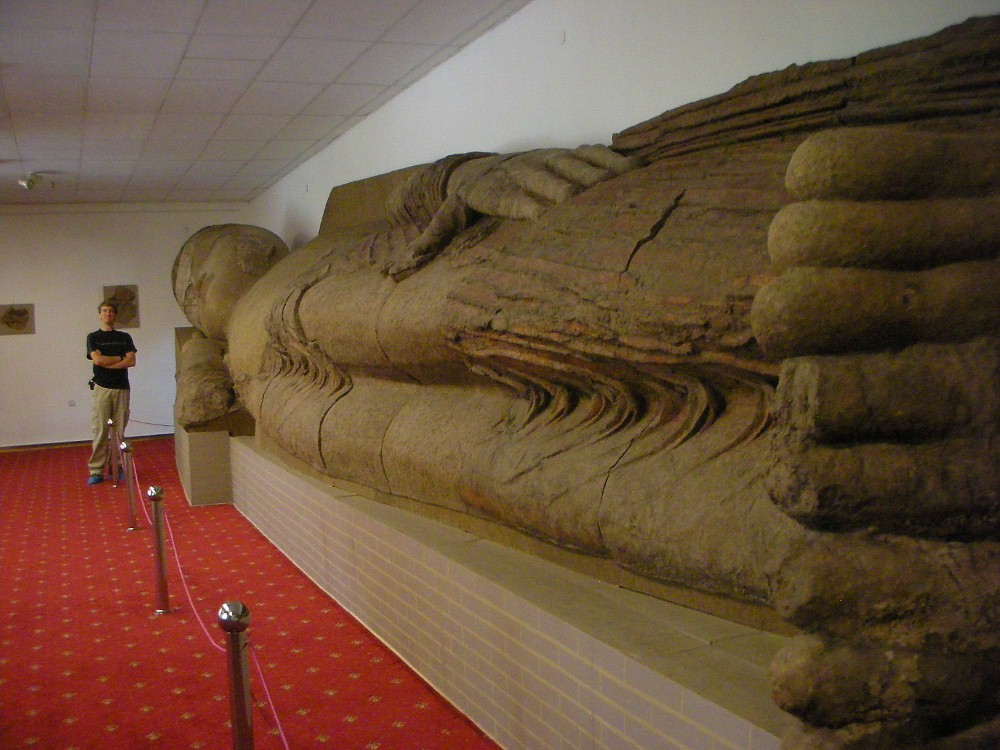
    Wisconsin has a lot of trees, but during my time in Jordan I had almost forgotten what it was like to walk down a cool, shady-green street with hundreds of ancient trees hanging over you. Another characteristic of all Tajik towns is the wide, deep gutters on either side of each road, which you can usually count on being filled with rushing water from somewhere in the town, which in turn allows the trees along the curbs to flourish. The three of us next visited a history museum, containing artifacts, clothing, and armor from thousands of years of Tajik culture. Most impressive was the massive 10-meter long statue of a reclining Buddha that was discovered only recently in northern Tajikistan; a stone figure so large that he had to be sliced into pieces in order to get him into the museum where he could be reassembled.

    The proportion in this picture is kind of off, but I'm about the size of one of his fingers
    The proportion in this picture is kind of off, but I'm about the size of one of his fingers
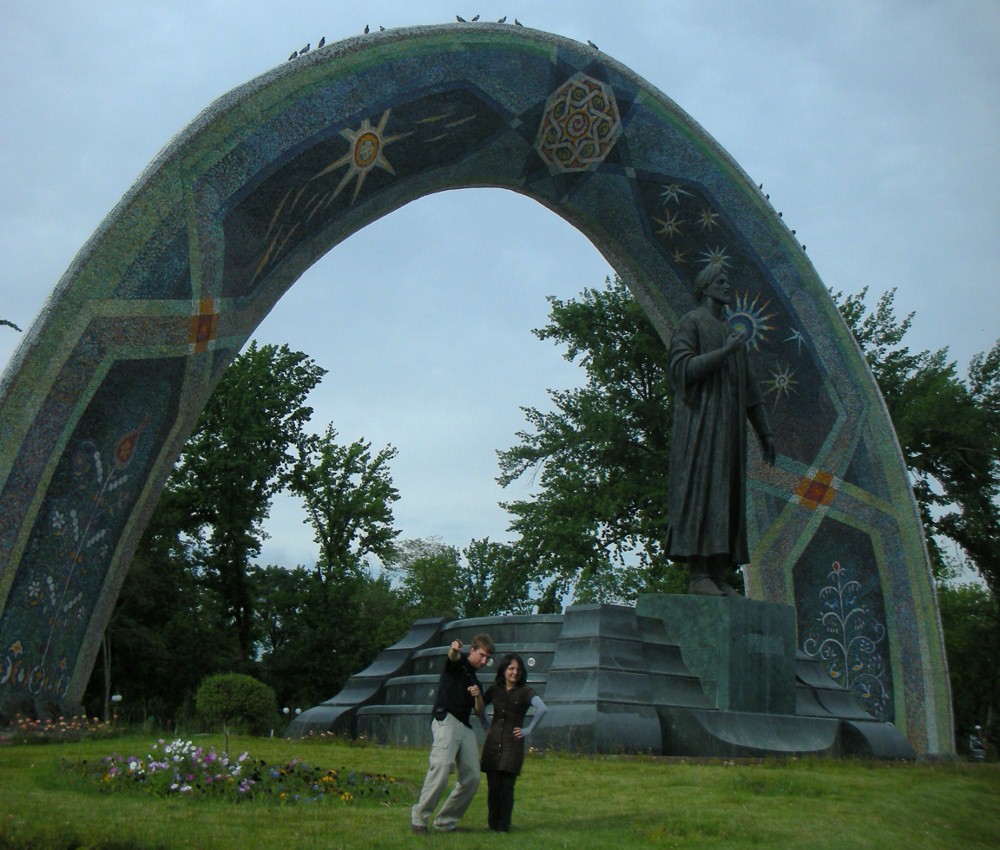
    Farahnush, Malik and myself stopped by a garden to pose with Rudaki, a famous Persian/Tajiki poet
    Farahnush, Malik and myself stopped by a garden to pose with Rudaki, a famous Persian/Tajiki poet

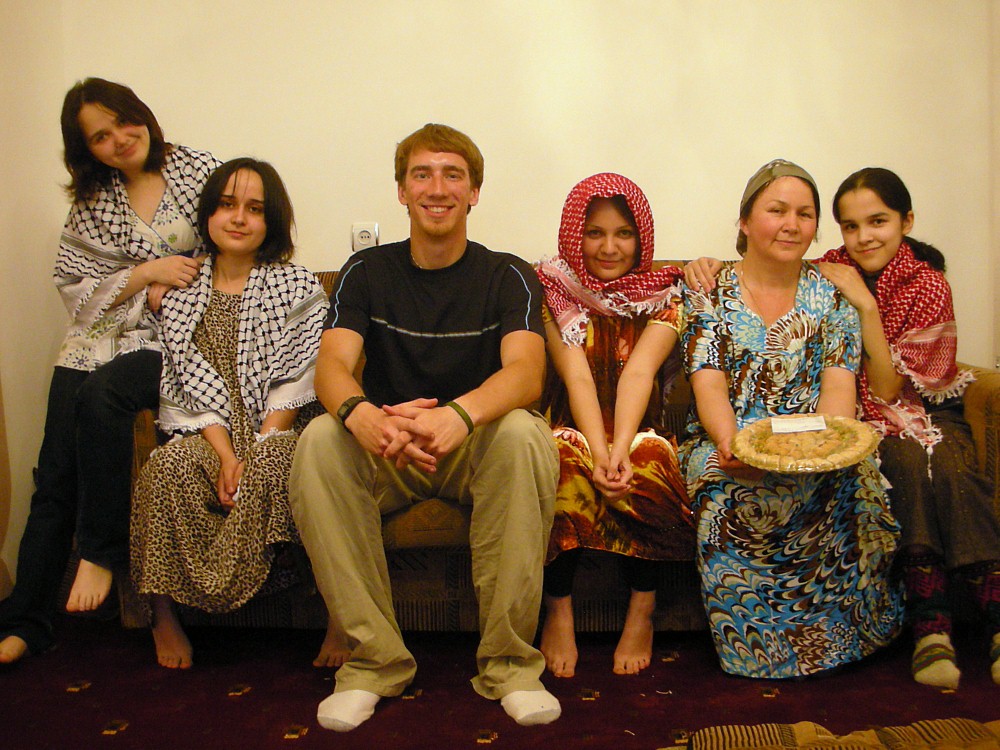
    Back at home, I met the rest of the family; Farahnush’s elder sisters Sayora and Shazoda, and her little sister Tahmina. After dinner, I presented my adopted family with gifts I had brought for them from Jordan – red Jordanian and black Palestinian keffiyehs, and Jordanian baklava from downtown Amman. Like me, 24-year-old Sayora apparently has a political streak in her, and her eyes lit up when Malik translated to them that the keffiyehs had Palestinian connections and she pounced on one happily, while I told her that wearing that in Jordan will automatically put you on the side of the Palestinians, which she seemed very pleased about.

    Black and red keffiyehs from Palestine and Jordan, and baklava too
    Black and red keffiyehs from Palestine and Jordan, and baklava too

    The final event of the evening was a party at the American Embassy of Tajikistan, at which Malik is an employee. Malik brought Shazoda (clad in the other black keffiyeh) and me to the gates, where we were led through a pink rose garden and to the Marine guards’ barracks. As in all embassies (of the American variety at least), cameras were confiscated at the front desk for security reasons, or else I would have pictures to show you. The American and British football teams were having a match that evening, as well as live music provided by a British band (who also kindly picked up everyone’s bar tab). I sampled Russian beer for the first time and met several interesting international businessmen and world travelers. I was in such a rush of meeting everyone that Malik led me towards that I didn’t even catch the name of the energetic, slender woman who bounded about greeting people as they arrived and shouting words of encouragement to the competing sports teams. She was pleased to hear that I was a teacher in Jordan, working with refugees, and she strongly encouraged me to look into the Foreign Service if I was interested in continuing my work overseas. It wasn’t until later when someone else mentioned, “So you met the Madame Ambassador?” that I realized that I had been talking with Tracey Jacobson, the American ambassador herself!

  • Safely arrived in Tajikistan

    NOTE: This post is now deprecated by the one following it. Thanks!

    It’s been a whirlwind of exciting activities the past few days, more than I could ever hope to write at the moment while I’m experiencing it. My journeys through Istanbul yesterday, and Tajikistan today, have been very informative on both a cultural and linguistic sense. I saw the Hagia Sofia and the Blue Mosque, Sultanahmet, as well as the Grand Bazaar, named Kapliçarşi – or as we would say it, Kaplicharshi. I even had a few minutes to dangle my feet in the Mediterranean Sea before going back to the airport to catch my night flight to Tajikistan.

    When I arrived at 3:20 in the morning, there were some difficulties with figuring out what do or where to go in the small airport (in which their was a severe derth in English-speaking employees, but no matter) but my host, Malik, showed up just in time to present the official invitation paper to me. After my late nap into this morning (I didn’t go to bed until 5 or so), Farah, Malik, and I drove around Dushanbe and they showed me the sites and museums in the city, and I went to a party at the American embassy for a concert. Malik works there as an NGO contract supervisor, and I enjoyed meeting his colleagues.

    I don’t know what the entire plan is for tomorrow, but I know it will involve checking out one of the forest parks in the lower mountains outside of the city, and Malik is having me get up early. The extra +2 time zone change here puts me 10 hours ahead of Wisconsin, and hopefully it won’t take more than today for my internal clock to adjust to the change.

  • Istanbul: Majestic Monuments, Pushy People

    I can’t believe it’s already been almost two weeks since I arrived in Central Asia, and I haven’t had the time to even post one good-sized blog entry about the trip. I’ll remedy that with a couple now, but in order to prevent confusion on the dates of my experiences, I’ll be backdating entries to their original occurrence date. I’ll post the rest, and update these entries with photographs, when I get back to Jordan. For now though, let’s start with my day in Istanbul, Turkey.

    The plane ride went smoothly and was very short, navigating neatly around Palestine to avoid having to deal with Israel and “their” airspace. I was surrounded by Italian tourists in the small plane; most likely the religious faithful on their way back to Rome after following Pope Benedict to Jordan the previous weekend. Because of the time of day, I spent most of the time napping, and awoke with a jolt as the plane started its steep decent over southern Turkey. My knowledge of Turkish geography was very limited, and continues to be so – until looking it up the night before, I had thought that Istanbul was the city in the middle of Turkey, which I now know is actually the capitol, Ankara.

    In the airport, I was dismayed to discover that my Jordanian dinars were entirely useless. My limited vocabulary of Turkish phrases consisted of me pointing helplessly at the JD50 note in my hand and pointing towards the sign that said “exchange” in multiple languages. I tried 5 different exchange offices in the airport, at which every official took one look at the unfamiliar currency and shook their heads silently. I was just about to head towards the bright exit sign, with the most familiar Turkish word, Çıkış, or “Chukush” as we would pronounce it. Suddenly, I was poked from behind by a guy in a uniform, who grandly asked me in passable English where I was planning on going. It seemed like he worked for the airport, so I told him helplessly that I just wanted to find a way from the airport to Hagia Sofia and the Sultanahmet “Blue Mosque.” He officiously steered me through the luggage-bearing crowd to a rental car window and suddenly I realized his game. The rental car man also spoke English, of course, and told me that it would be 100 Turkish Lira, or about 63 USD, to take me to the sites included picking up me at…(here he inspected my plane ticket) 6:30 PM so that I could catch my flight to Dushanbe at 8:30. I balked at this, but he was more than insistent; he was downright pushy. He rang up the fee without even asking for my confirmation and extended his hand for my credit card. I weighed my options: I had no guidebook and no idea about what was normal in this country, but everyone knows that tourist locations love to gouge people, especially ones “fresh off the boat” such as myself. What choice did I have that wouldn’t take an hour of me hunting around looking for a better option? I paid the money and was escorted to the parking lot to meet my driver, Murod.

    Murod was a shifty fellow who laughed a little too much and spoke only a half dozen words in English, three of which were “tip” and “give me?” I raised my eyebrow and communicated with him well enough to tell him that I didn’t have any smaller lira denominations now; I had just arrived. He laughed for several minutes at this, told me “later” and “6:30” and I was dumped from the car in the parking lot between the Hagia Sofia museum and the extraordinary Sultanahmet Mosque. Backpack in hand, I started for the latter, joining the throng of camera-toting tourists maneuvering through the gardens towards its massive wooden gates.

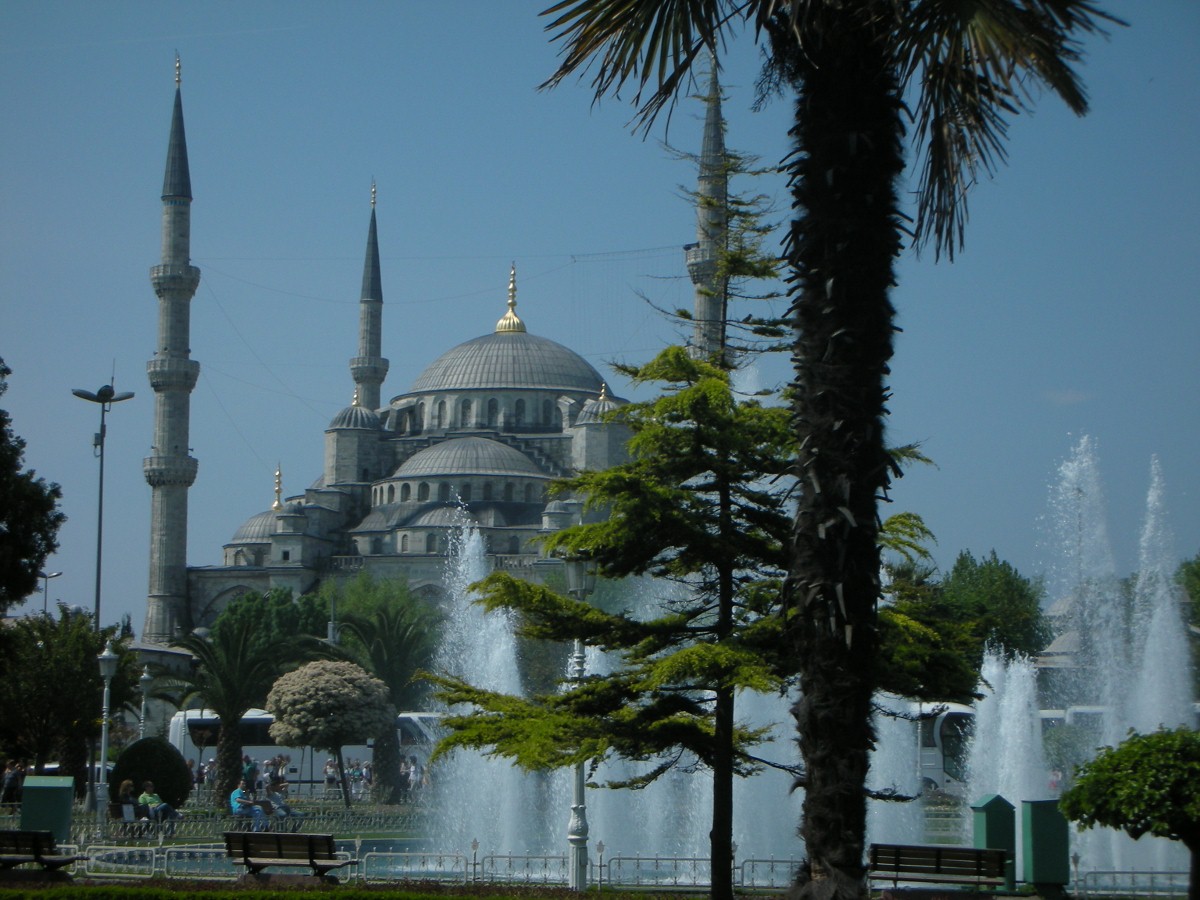
    An amazing combination of Asia, Europe, and somehow, Disney World (that last one is just a gut feeling)
    An amazing combination of Asia, Europe, and somehow, Disney World (that last one is just a gut feeling)

    The mosque is one of those locations that neither words nor pictures can describe; you just have to see it for yourself. The outside of the building looks like they took a regular domed mosque with a few minarets and stretched the entire place into a cavernous interpretation of the Neuschwanstein Castle in Germany. The line was long but moved quickly, and as far as I could tell there was no fee or gate guard – people just walked in line, saw the huge interior chamber, and left. As I expected, we were stopped outside the door and asked to remove our shoes, and even provided little plastic bags for us to put them into. Of course, they weren’t designed for size 13 hiking boots and even with one boot in each bag, the weight tore the straps off within minutes and I was left to pathetically stuff my baggies under each armpit, where they hung like bizarre waterwings.

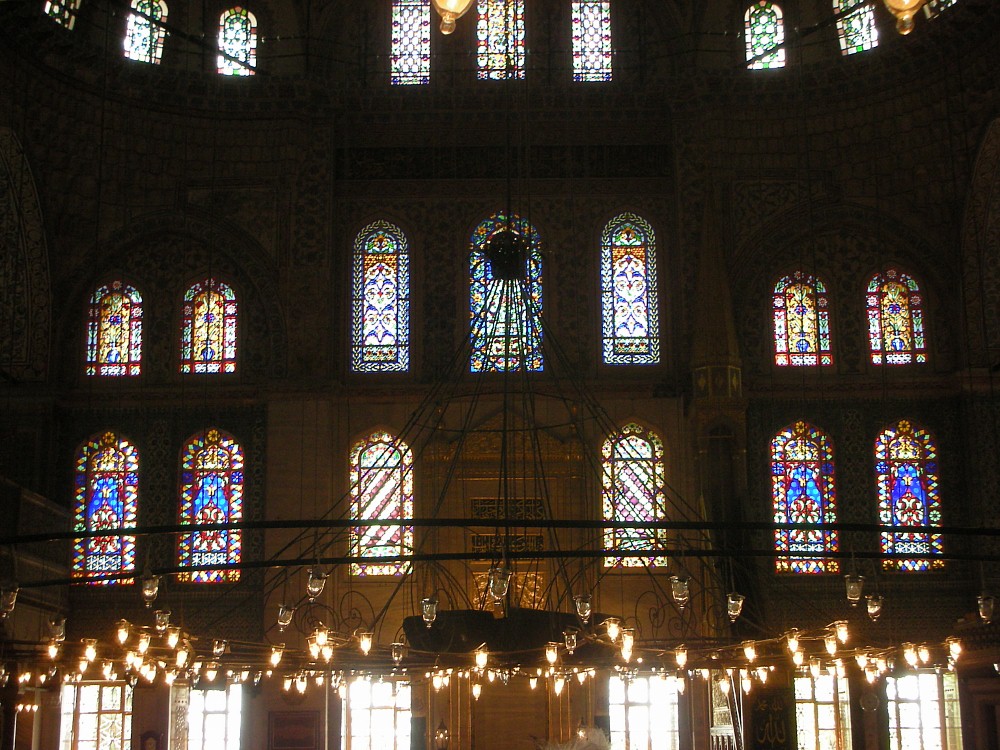
    Glowing fairy-globes and intricately-cut stained glass windows crown the masterpiece that is the Sultanahmet
    Glowing fairy-globes and intricately-cut stained glass windows crown the masterpiece that is the Sultanahmet

    The first thing thing you see after crossing the threshold are the walls on the opposite side of the chamber, which pull your gaze upwards to see the ceiling – and what a ceiling it is! Countless thousands of intricate mosaics and patterns of leaves, flowers, and Arabic lettering cover the interior of the domes and minarets above you. The sheer amount of effort that it took to paint that room, which looks about a cubic kilometer in size, must have been staggering. Like the Kaneeseh al-Zeitoon in Damascus, the mosque is supported by four huge stone pillars, two of which are accessible to us tourists, and the other two on the far side of the room overlooking the Mediterranean Sea are separated by a gate to divide the faithful and the khafereen (infidels). The infidels far outnumbered today’s faithful, though – I could only see maybe a dozen Muslims kneeling near the glass, compared with at least 200 of us on the other side. A hundred small porthole-like windows ring the main dome, providing the majority of the limited light in the room, as well as a large and particularly ancient-looking series of low-hanging chandeliers suspended just above our heads, which seemed to be made of cast iron and were filled with incandescent bulbs that looked like they were probably about as old as the mosque was. And the place was almost entirely silent. Besides the swishing of our socked feet and the hushed murmurs in a half-dozen languages of tour guides leading their charges about, any uttered sound was quickly swallowed up by the thick red carpet that covered the floor.

    Using my amazing solo camera skills that I picked up in Britain two years ago, I was in the process of attempting to balance my camera against my shoe on an alcove to take a picture of myself and the ceiling in the mosque when two young Asian women took pity on me and asked me if I needed any help with my act of vanity, and whether I could take their picture for them as well. The three of us spent the next few minutes figuring out light settings for the room and how to use the exposure and autofocus properly – it helped that one of them had almost the exact same model of camera as me, too. They introduced themselves as Satomi and Ayumi, Japanese flight attendants who had just came into Turkey the previous night on a flight that had some extra seats. They were surprised to learn that I was working in Jordan, and Ayumi exclaimed that she had just been there with her airline, Dubai Air, last month. The three of us agreed that it would be better to sightsee together, and of course our obvious next destination was the Hagia Sofia, which was only a few minutes walking distance away from us.

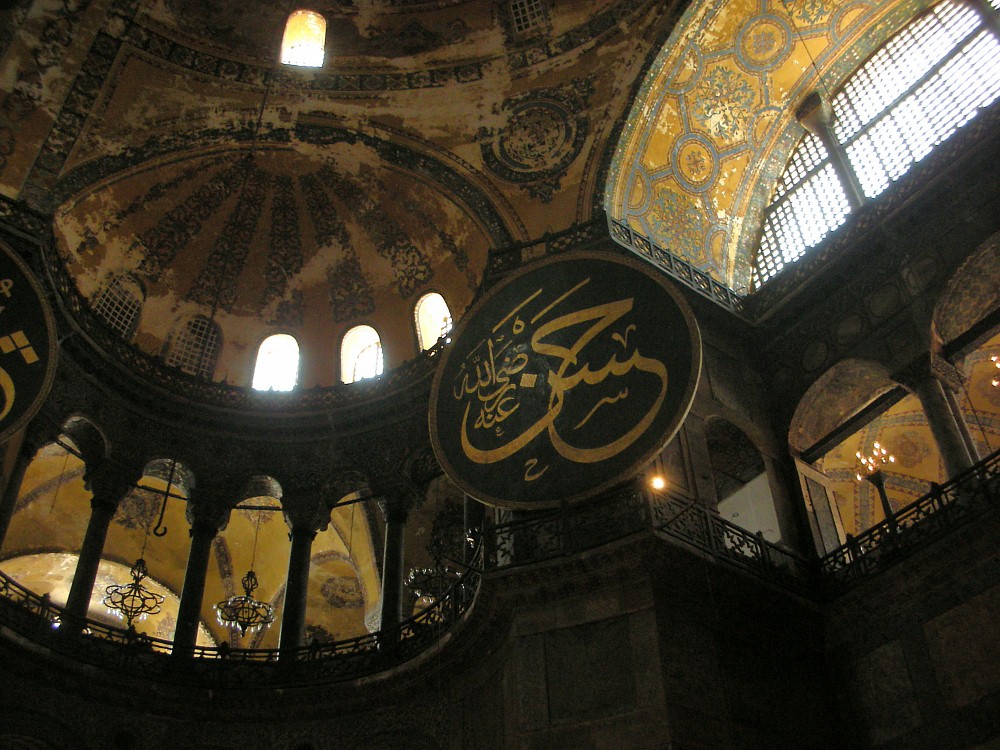
    The Hagia Sofia, while not nearly as impressive on the outside as the Sultanahmet, is nevertheless just as lovely on the inside, if not more so. The three of us acquired a guide, Barish, at the gate, who repeatedly insisted that he was licensed. My Japanese companions only had euros with them, and Barish reminded them that the ticket gate would only take lira, but that he would buy their tickets for them if he was hired, a fact that played a definite role in our taking him on. After passing through the requisite metal detectors, we found ourselves on a sunny sidewalk outside of the gray stone building of the museum. Bashir explained that this site was the home of the first true Christian church in the world, built by Saint Paul in the decades following Christ’s ascension, but that original wooden church had been burnt to the ground after only a short time. Over the centuries, the church was rebuilt in stone several times, and after the Muslim conquest it was converted into a mosque, the minarets were added, and it existed this way for centuries until the past few decades, when it was more recently turned into a museum and tourist attraction.

    Four huge shields with important Islamic names on them...this one says حسين, or Hussein
    Four huge shields with important Islamic names on them…this one says حسن, or Hassan

    (more…)