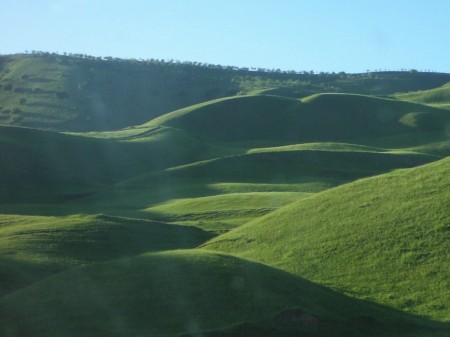
We arrived in Khorog in the middle of a sunny afternoon on the following day. The city isn’t the capital of the country, of course, but of the Gorno-Badakhashan province, which makes up almost 50% of Tajikistan’s entire landmass, as well as many of its most beautiful mountains in the Pamirs. We were greeted by cheerful stone signs in both English and Arabic posted high up in the mountains above us, large markers formed by rocks that looked like pebbles from our vantage point far below, but each must have been at least a meter in diameter. After leaving that morning from Khali-Khumb, the trip progressed beautifully uneventful. We only stopped twice – once to get lunch at a small cafe/teahouse by the side of the road near the village of Rushon, and once to take a drink from a picturesque little mountain stream. Hmm. More on that later.
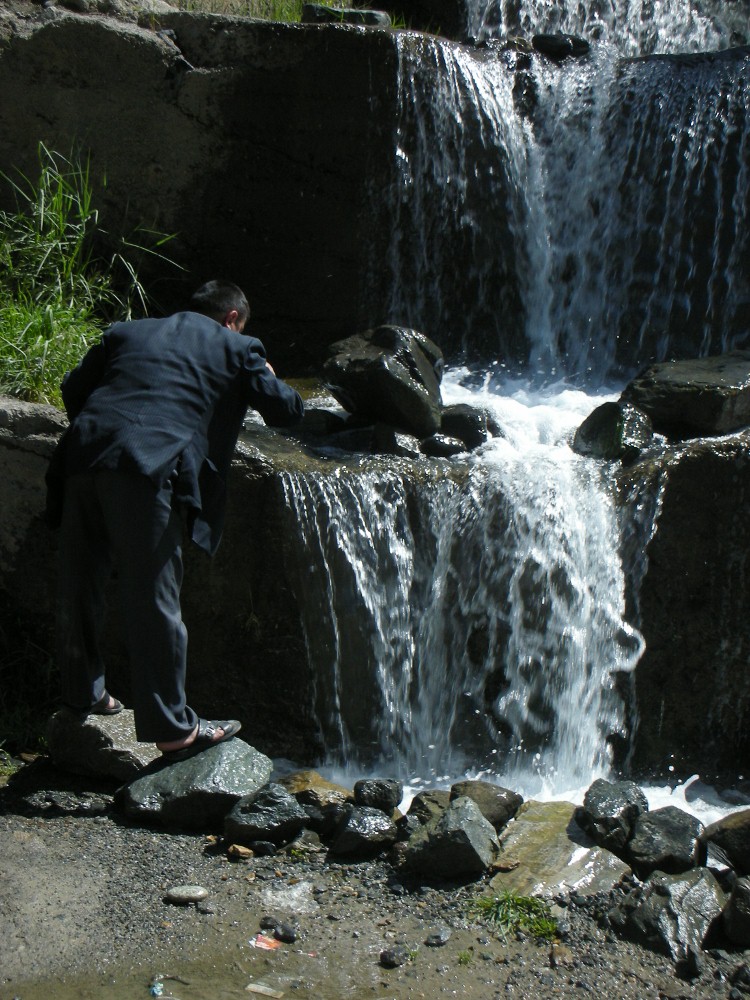
This may turn out to be a bad idea.
We checked into our hostel, which was excellently located on the very edge of one of the tributaries of the Panj, close enough that when the host served us tea in our bedrooms, you could dump the dregs of it directly out your window, straight down into the river. We didn’t spend too long at the hostel; we wandered through the local park, filled with tall, stately poplar trees and tall, windswept grasses. I picked up some authentic Pamiri handicrafts, made by local women, and sampled some “Cola,” which at first I thought was Cola-Cola (as it had the same logo) but was informed that it was an Asian equivalent. And you thought that fake iPods were the only hoaxes that came out of China, you silly fellow!
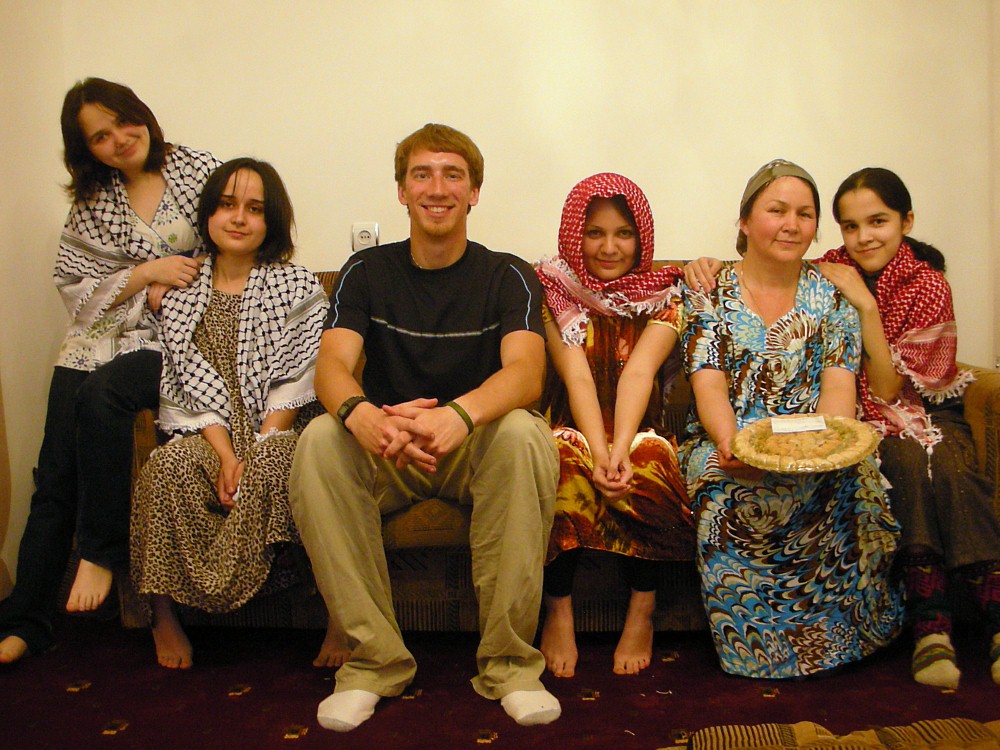
The highlight of the evening was meeting with Malik’s friend and colleague Booribek, who ran an NGO in the area and had worked with Malik and the American embassy for years. The four of us were invited at Booribek’s insistence to a local Pamiri home, where we were fed enormous amounts of delicious food by our hosts, who spoke a little English and were thrilled that we had come to visit. The meal probably had four or five courses to it, including soups, vegetable platters, pastries, and grilled yak with a mushroom sauce. I had never tried yak before (that I know of) and we were told of its nutritional value and its extremely low cholesterol level, apparently about 6-7%, compared with beef’s 25%. Our little group talked long into the night as we ate, discussing the historical significance of the teahouse, which was designed in the original style of the Pamiri people as a pentagram as part of their Zoroastrian faith. We talked about similarities between Christianity and Islam, and our hosts asked me how I liked the Pamirs so far. Full of yak and vodka, I replied that they were beautiful and the hospitality couldn’t be beat. Booribek and Malik were interested in investing in tourism for the region, and wondered if I had any pointers for them, at which I replied truthfully that they needed to embrace the rituals and customs of Tajikistan and the Pamirs and serve more food like this – they’d have no problem making happy customers. The Tajiki currency, the somoni, is equal to about about $.25 at the moment, so I estimated the full meal, service, and detailed explanations of the building at being worth at least 120 somonis per person.
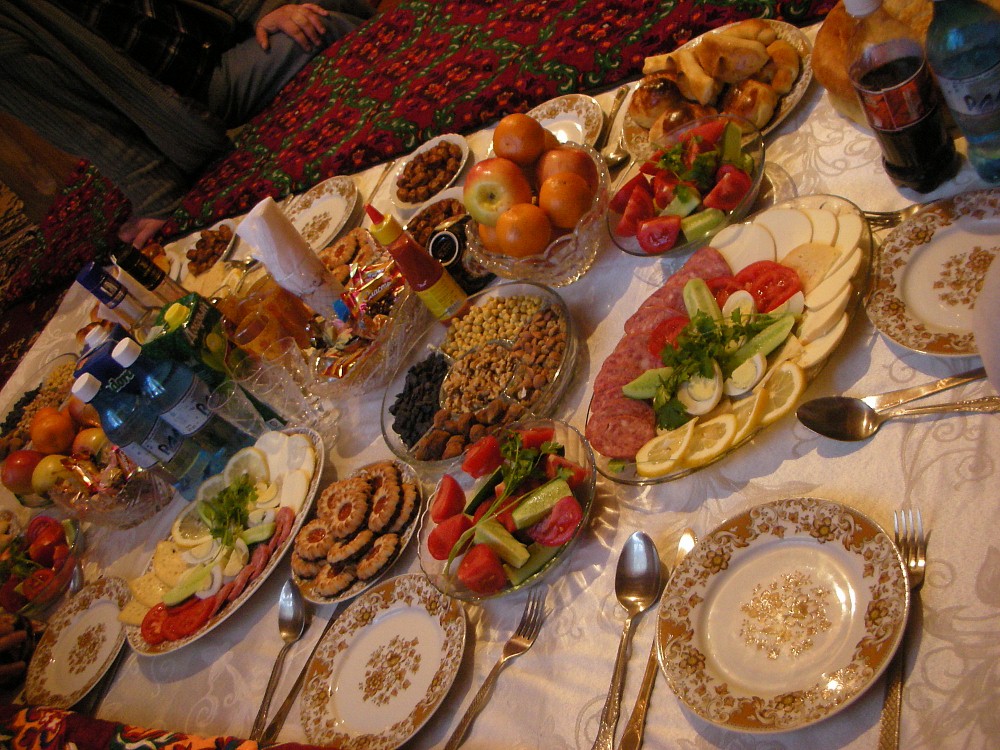
And this is just the first course, which was on the table when we arrived!
We slept soundly that night with the gentle sounds of the small river below us and the creaking of our stout old wooden hostel, awakening early to visit the local botanical garden, which is famed for being the second highest in the world at 2,320 meters above sea level. Our guide, another one of Malik’s friends, showed us around for an hour, explaining that the different sections of the garden were filled with trees from 3 different continents, including North and South America. He also dryly pointed out the construction site for President Rahmon’s new “vacation home,” a multi-million dollar venture that struck me as a disgusting when large percentages of his populations are missing modern toiletries and communications. Farahnush and I sampled a local plant that he told us was an edible medicine for the Pamiri people (or at least I think he did; Farahnush was translating for me) but quickly spat it out. Like most medicine, just because it was edible didn’t mean that it tasted even remotely pleasant.
The day’s main journey was farther south along the Panj to the Garm Chashma, the Russian word for Hot Springs. It took about two hours to slowly traverse the usual rocky roads, but I noted that the river here had changed color from muddy brown to a light, almost tropical-looking blue, for which no explanation could be found. I speculated that perhaps that this was the natural color of the water, but it was slower moving here and therefore less likely to be filled with mud stirred up from the rapids found farther west. We smelled the strong sulfur of the springs before we saw them, but arrived momentarily at a large white gate which greeted us with the traditional Tajik greeting: “Хуш Омадед!” – Khoosh Omaded, which is the equivalent of “Pleasant Welcome!”
The springs sat high upon their huge white mount of sulfur deposits, forming the usual stalactites and vapor spilling out into the chilly mountain air. Trenches had been dug up and down the mountain, feeding the almost-boiling water into bathhouses and the nearby resthouse. A small pool had been dug as a reservoir for the freshest, hottest water, but Saheed, Malik, and myself couldn’t go in there – it was apparently the hour for women, so the three of us lounged in the men’s bathhouse, which we had to ourselves. The water glowed eerily from reflections from the corrugated tin roof above us – tin roofs are by far the standard out there in the rural areas of Central Asia; they’ve practically turned their use into an art form – and I dangled my feet into the water and poured the water into my hair. I wanted to go up and take some more pictures of the main collection pool, but by that time a group of large, naked Russian men had decided it would be a good time to use the pool, causing me to quickly vacate the area within moments and join the others at the resthouse for tea and Nescafe. I tried to find out the name of the Hot Springs so I could locate it later on a map, but the resthouse keeper misinterpreted Farahnush’s question and thought she was asking for the word in Tajik. “Garm chashMAH! chashMA!!” he told her repeatedly, and we retreated with our question unanswered. Interestingly enough, both eastern farmers and the border guards often mistook Farahnush for a foreigner or American because of her clothes and how easily she spoke English with me. I wondered if she gets that a lot since her return from the USA. Even now, I haven’t yet been able to discover the name of the place, although I located it on Google maps.
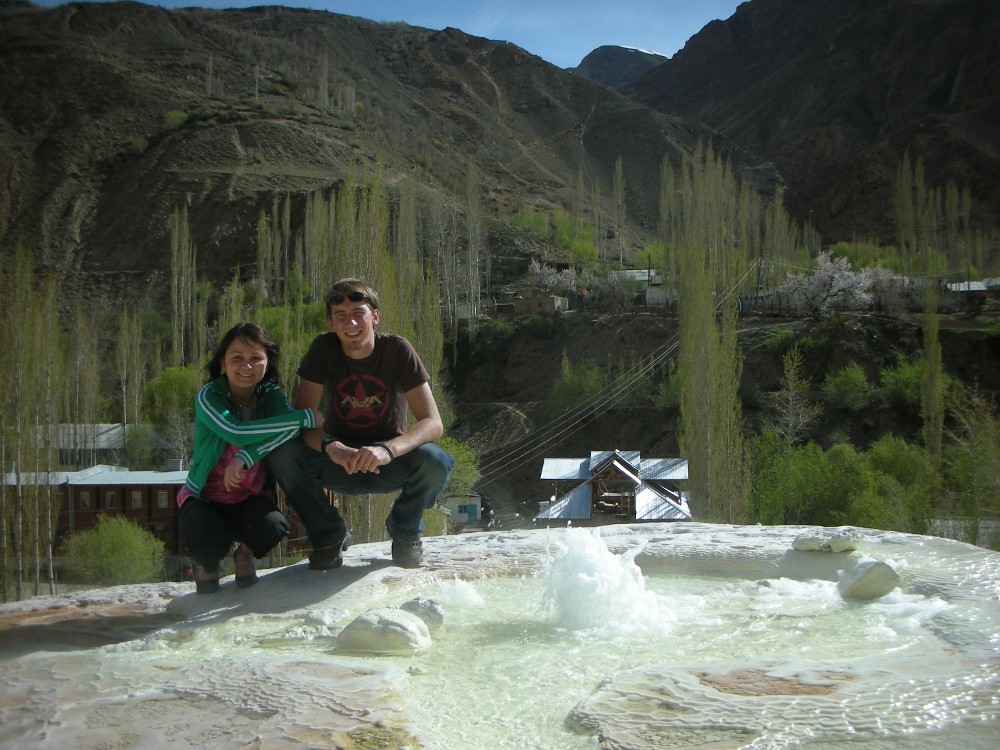
This is probably the only appropriate picture I can show you of the hot springs. *shudder*
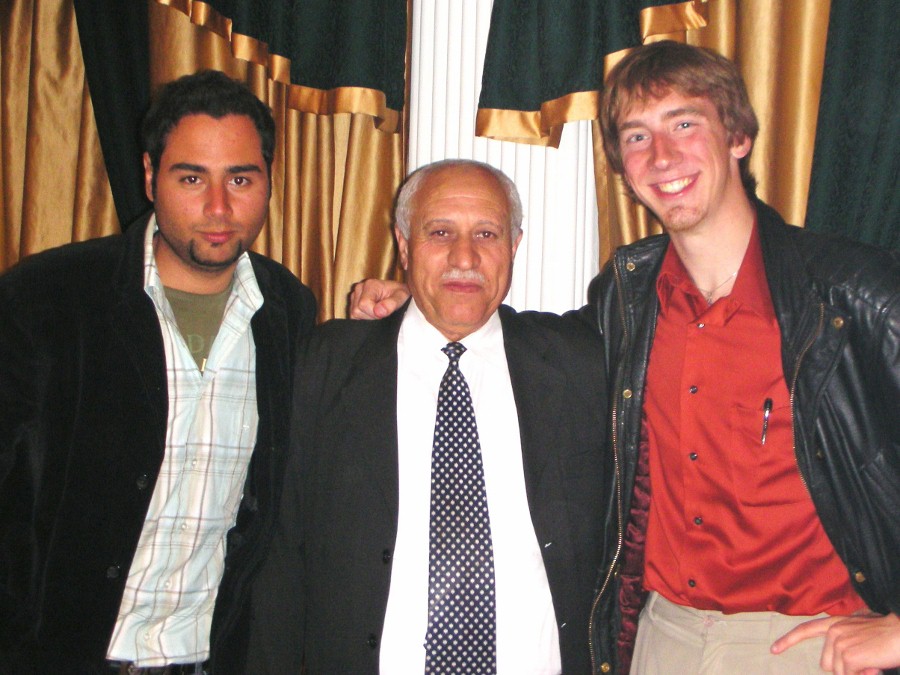
The final event of our trip to Khorog was dinner with all of Malik’s friends together at a local restaurant, where we had Pamiri beef and of course, vodka. Malik’s friends, all from around or in the Khorog area, presented the four of us Dushanbe city-folks with gifts to commemorate our visit; hand-made stockings with color designs on them, perfect for those cold Jordanian nights and the tile floor back at home. The food, vodka, and constant elaborate toasts to each others health and journeys were excellent – but how can any food compare with the deliciousness that is yak? I’ll be convincing my parents to start a yak farm as soon as I get back to America, that’s obvious. Hopefully they get along with goats!
Oddly though, my stomach was starting to feel kind of funny. And not funny in a good way…
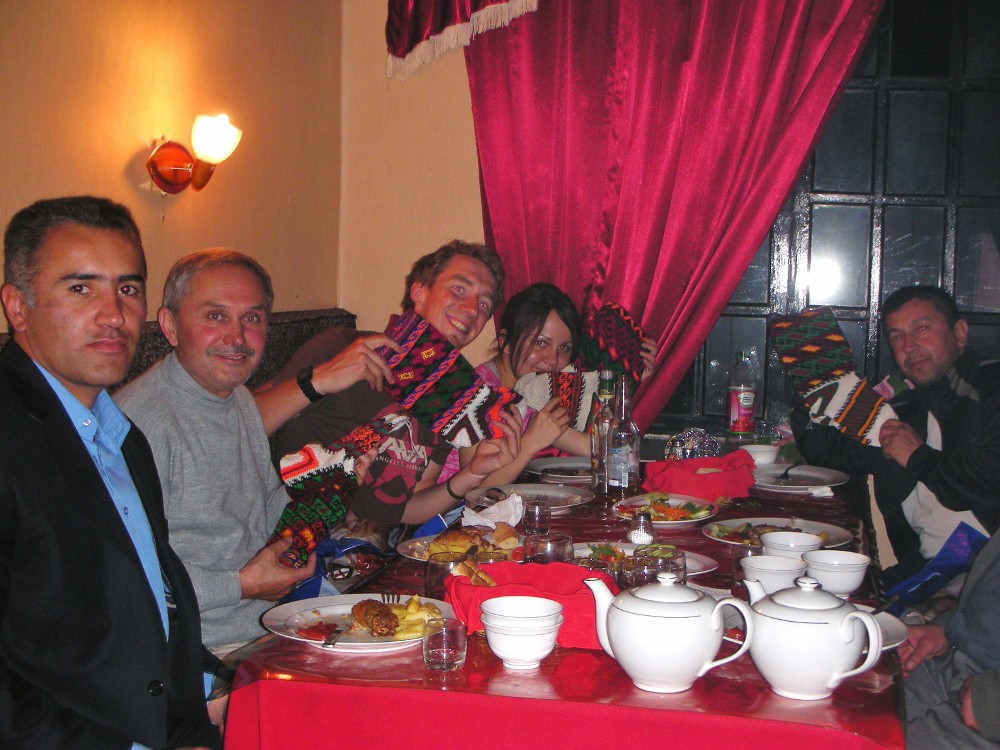
The guests receive colorful stockings as gifts from their Pamiri hosts. My hair only looks like that because it's filled with sulfur from the springs