I would have included this update on last weekend’s trip to Syria in my previous blog entry, but instead my time and awakefulness (new word?) ability consumed by monitoring hose lines all night. So, without further ado (and making this the first month when I’ve done ≥10 blog entries since May 2007) here’s my take on that lovely country “up nort” – Syria.
The back-story behind our trip was that Dozan wa Awtar was invited to Syria back in January to sing in an international choir, with our own concert as well as a “combined choir” with the choirs of Lebanon and Syria, each of whom had their own performances as well. For us Americans (and many Western, war-loving countries in general), it’s a tough time getting into Syria. As in, $131-visa-needing, wait-in-line-all-day kind of tough. But, as Shireen and Hala pointed out, we azjnubeean (foreigners) would be safely ensconced in a protective group of Jordanians so all we needed to do was provide our passport numbers, smile big, and we’d have nothing to worry about.
Except, in my case, there was that mix up last month when I accidentally washed my old passport in my pants, requiring me to get a new one. And a new passport number than I had previously provided. I only got my new number a week beforehand, leading me to get a nervous feeling in my stomach that the entire choir was going to get held up by me and my stupid pants-washing. Even though the 35 of us were together, we were still cautioned that there would probably be a long wait. “Bring a book,” Hala suggested. “A really big book,” one of the other Americans muttered darkly.
We left at 10 from Amman, right after Silas and I nearly had heart attacks when Hala informed us that they hadn’t received our faxed passport copies from the previous day. This meant holding up things for 15 minutes while we ran into a bank to resend them again, which was probably a bad omen or something. But everyone was excited enough to be traveling that no one seemed to mind (and plus, in the Arab world, you don’t leave on time. You just don’t). I picked a seat in the back of the coach bus with Silas and some other friends, and ate an orange as the bus rolled out into the desert past Zarqa.
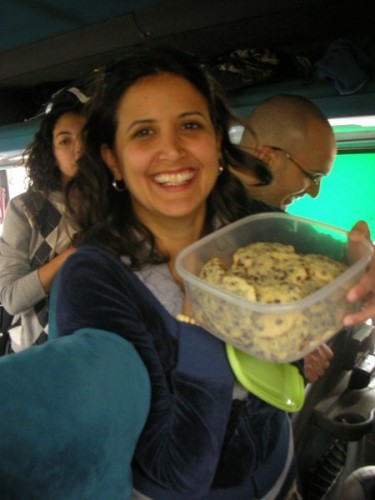
Dona made cookies for everyone to share
I quickly lost track of the conversation (Silas and I were the only non-Arabs in the back of the bus, and they were talking way too quickly and slangishly for us to figure out the jokes) and with the exception of the massive potholes that fill every non-airport road in Jordan, would have drifted off to sleep. Silas tried to listen in for the most part, as it was “good Arabic lessons,” which I always half-disagree on because I feel rude asking my friends to re-translate all their conversations afterward to see how close my mental approximations of their speech is. It was a short ride up to the border, made shorter when Yanal continuously erupted into loud, roaring Bedouin songs, which every other Arab on the bus clapped and sang along to on the bus, while the rest of us got the “translating internally” looks on their faces. You know the one I’m talking about; when you cock your head, furrow your brow and frown, and mouth words while shrugging at your other azjnubee friends.
We reached the Jordan/Syria border at quarter to one, at which point we had to shell out for our “Jordanian Departure Fees” – yes, that’s right, you have to pay Jordan money to leave the country, something which all the travel guides for the country tell us. Ironically enough, it costs JD8 for a Jordanian to leave his/her own country, while it costs the rest of us only JD5. This marks the first, and only time ever, that I have seen a Jordanian pay more for something than a foreigner. The wait wasn’t bad here at all – we just filled out a piece of paper, a soldier came onto the bus to look at our new red stamps that said we had paid our dinars, and the bus continued moving through the barricaded no-man’s-land section. The whole process probably took about half an hour for the whole bus.
How welcoming is a cement wall for your first view of Syria? Surprisingly enough, the Jordanian side is the greener side of the fence
Syria’s checkpoint area seemed to be a lot larger and well-manicured compared with their neighbor, probably because they knew that people were going to be spending many more hours enjoying those strips of land. We all filed into the checkpoint building which was large and warehouse-like, to begin the process. Here we were given a large blue form to fill out, with information including “Father and Mother’s names,” which I dutifully filled out in both English and Arabic, knowing that I could win a few brownie points that way if I spelled them properly. Half-jokingly, I suggested that we should sing “Zahret al-Madaen” for the officers, which was greeted with a chorus of “NO WAY.” Keegan, having traveled to Syria before, pointed out that they are very suspicious of foreigners who know Arabic, especially ones who might know it well enough to sing in it. I quietly slunk over to a corner of the room and played video games on my iPod with Janell while the surly, brown-coated Syrian military poked at our passports and forms as if they expected George W Bush to pop out of them with a bouquet of flowers.
The Jordanians quickly were passed through in only about 20 minutes, and they vanished out of the building to the duty free to stock up on Syrian duty-free liquor and beer, which is about a quarter of the price of the Jordanian stuff despite being identical. Got to love those government taxes here (300% on alcohol). The only Arabs left with us were Shireen, who kindly waited with us because she is super-cool, and Ala’, who is Iranian and therefore has to wait in line at probably every border at the planet because every guard seizes up at the sight of an Iranian passport (this is not the same Ala’ that I’ve spoken of before; we have two of them in the choir). In the end though, the Syrians finally realized that we weren’t spies/terrorists/pig farmers and let us through, in a little under 3 hours. Everyone “in the know” in the group agreed that this was by far a new record, especially for a group this large.
In case I didn’t mention it all the months ago when I arrived in Jordan, the city water pipes of Amman only run once a week. What day of the week it happens on depends on what part of town you’re in, and in the case of the cafe it’s Wednesday. I thought that we had taken care of all of our plumbing requirements first when Pat hooked up the hot water heater, and then when Abu Eid installed the new sink, but I discovered tonight while I was making burritos for some friends that we had completely run out of water. Why? The two 200 gallon tanks on the roof were somehow, mysteriously empty.
This being Tuesday night, I said to myself, “no problem, I can stick it out for a half day without the water, I’ll just get my shower at 1 in the morning or so, when the pipes activate at midnight and I can fill the tanks a little and heat some water.” I checked it expectantly at half past midnight, expecting to see the bottoms of the tanks filled with sweet my’ee (water) and ready for me to activate the heater. There was no water. The hose leading from the spigot outside wasn’t even dripping and all was completely, horribly silent.
So at around one in the morning, I find myself on the roof, banging around with a wrench and screwdriver that I had found in the house and shed, trying to figure out what the problem was. It turns out that there is some sort of problem with the water-measuring device, a flotation device like in a toilet that can tell when the tank has gotten full enough to stop before overflowing. It has apparently been stuck in the “full” position for at least a few weeks, because without Philip here there’s no way that I can be using 400 gallons of water a week. That would be insane, even for my pleasurably long showers (which I’ve gotten better at weaning myself off of in this water-poor country). I knocked it around for a good hour, pulling on it and trying to release its connector from the pipe inside the tank.
I couldn’t figure it out though. What with the 2nd EGT graduation being tomorrow, I knew that I needed to have a shower for class tomorrow so that I could look my best, since I’d be wearing nice clothes and be posing for a million pictures with my students and IRD. Most worrying to me was that if I didn’t get this fixed in the next 22 hours, the water would shut off in the city pipes to me at exactly midnight the following night and I’d be completely without water for an entire week. There are water trucks that drive around the city, preying on situations exactly like that with their long powered pump hoses for roof tanks, but I didn’t want to find out how much those charge. We’ve needed to use them at the Ayn Al Basha office before, but that’s with 200 students to take care of instead of one resident.
So I came up with a simple solution – run a second hose up to the roof, stick it into the top of the tank, and just monitor it to make sure it wouldn’t overflow. It took another 15 minutes to find a hose that was either a) long enough or b) not filled with holes, but finally I had the length I needed, and it was a simple process. Except that the attachment is a tension/pressure instead of screw nozzle, which means that it blows off unexpectedly and the spigot blasts water all over the ground until I hear the noise and run downstairs to shut it off.
So I just got my shower now, at 4 in the morning. Hopefully, Galen and Ghalib, Philip’s plumber friend, can take care of this issue within the next 20 hours, or I’ll just have to hope that I can get the tanks filled properly from the hose this week. At least I know that I can go to graduation in 5 hours smelling like a neatly-showered rose instead of a greasy wahhsh (monster) that stumbled out of the woods.
Many months ago, when I originally arrived in Jordan, I was told about the traditional Arab affinity for firing off weaponry at weddings and the dangerous consequences that have resulted from it, but without any specific details. A couple nights ago, I was sitting with Wamidh at his house, after he and his wife invited me over for dinner, and he started showing me some videos on his computer, including this one here.
Here’s a link in case the Firefox Flash Bug is preventing you from seeing the embedded video.
It was the first time that I’d seen video-recorded evidence of the horrible mistakes that can happen when guns are a major part of a wedding ceremony. Wamidh read the Arabic description to me from the side of the Youtube page; it seems that the man had just finished shooting off a 9mm into the air, and his two-year-old son picked it up off the table and started waving it around, trying to be “like daddy” like any little kid would want to do. As you see, the kid shot it directly upward and into his stomach. The man was taken to the hospital, but he had already died on arrival, as the bullet had gone up and through his heart.
This all happened in the city of Aleppo, Syria, which is only a few hours north from where I’m about to be heading now for the weekend. Dozan wa Awtar has an international choir concert in Damascus, Syria’s capitol, where we’ll be singing with the national Syrian and Lebanese choirs. More information when I get back on Sunday!
Mere minutes after my return to Amman from Ajloun and Um Qais as documented in my previous post, I went to bed. I knew I would need the extra sleep in order to wake up at 3:30 in the morning to prepare for the Easter morning church service on Mount Nebo. I had invited my friend Mika several weeks ago, and she in turn invited along two of her friends, David and Bart. You’d think that the dark streets of the old part of Amman would be fairly quiet at 4:30 in the morning when we started walking to the church near 1st circle, but then you remember that the morning call-to-prayer has just gone off like clockwork as it always does at this time in the morning. The streets weren’t full, to be sure, but there were definitely about a dozen men in the street, usually wearing the long, flowing robes common among sheikhs. I was a little worried that we wouldn’t make it in time, but the two buses were waiting, idling softly in an alleyway. I almost missed them but Mika must have been slightly more awake then me and pointed them out.
The rest of the bus seemed semi conscious, or maybe they were just doing better jobs of voice modulation than we were. In any case, I felt that those extra 4 hours of sleep worked miracles and I made it all the way to the mountain without passing out in my seat. The sun was just beginning to rise, giving the world a blue-gray tint as we walked up the stone path to the meeting room on the summit. I had seen the same room a month ago with Christine when it had been a mosaic viewing room, but now the place was already packed with people, standing room only, all the way to the doors. Mika got a seat, and us three guys took turns rotating around limited standing room at the back of the chapel. I leaned against a veiled electronic keyboard and almost knocked it over, or that is, it would have fallen had there have been any place for it to land that wasn’t already occupied.
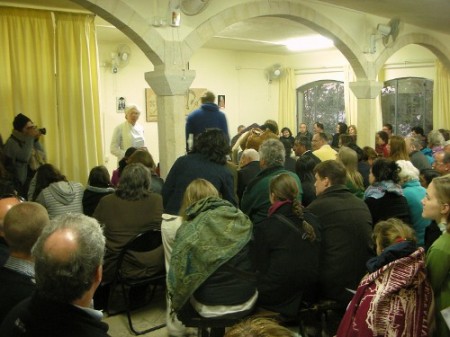
Pastor Lex can draw a crowd for his service: standing room only!
I’ve found that Pastor Lex’s sermons are a very interesting blend of Biblical lessons and historical storytelling, some of the most interesting I’ve heard. In my youth, my old Lutheran church had fiery sermons about life messages, but Lex provides a new spin on things, in my opinion, by providing the larger geopolitical context that surrounded the actions of the disciples, Jesus, and the leaders of the Jewish people. During the communion I was excited by the thought that our 150-person congregation would go outside and enjoy the morning sunshine, and indeed figured we’d have to because of the difficulty of moving around in the tiny room, but to no avail; Lex was able to maneuver us successfully without sending us out into the wind. The windows on the far side of the room were an accurate gauge of the wind speeds – judging from the pine trees waving frantically like flags, it may have been better that we were all huddled in there.
Mika had originally proposed a plan of having an Easter brunch with our guests, of the kind that us Midwesterners like to have on Easter at 10:30 or so, involving ham, eggs, and buttered rolls. Ham…even the thought of sweet, delicious, hard-to-find pork products here in Jordan was enough for me to sign onto anything she suggested. But, as David and Bart pointed out, they had rented a car for their travels a day before, and it was a shame for a group of foreigners to have access to a car and not make use of it. So it was decided that we would visit Jerash, then come back and have a dinner of some kind. This day was shaping up to be a more leisurely, less frenetic version of the day last month that Christine went to Madaba, Nebo, Jesus’ Baptism site, and then Jerash. Jerash had been closed then, but I knew that since it was only 10 there was no chance that I would miss it a second time!
Lucky Mika and Bart got in for half a dinar each since she had an Aqamma (residency) card, and he had his Jordan University student card. Poor David and myself made ourselves a little more poor but got to feel good about helping Jordan tourism with our JD8 tickets. David’s job here is scientific-research related, studying the behavioral systems of ants to determine the stability of an ecosystem, so I was surprised he didn’t have aqamma as well, but it kind of funny to watch him crouch and peer at the ground every few minutes, poking under leaves and grass and explaining to us what the ants he saw were doing, and his hypotheses about their actions.
According to David, this ant is unlike North American ants, with extended hind legs, a raised abdomen, and most eerie of all, true eyesight instead of smell – because the desert heat destroys pheremone trails.
Jerash is be known throughout the world as one of the best-preserved examples of Roman ruins, but why is that? My speculation on that is the difference between the ancient Bedouin mindset, compared with the rest of the world and Italy in particular. Italy just kept on growing, developing, and expanding, and much of the ancient Roman architecture vanished under modernized improvements. However, the nomadic, sheep-herding Bedouins had no interest in destroying the past; they past through with their flocks, camped, and kept moving. Jerash has only been “discovered” since 1920, and archeological work on it has been occurring continuously since then. The bees buzzed complacently over the yellow-and-red fields of poppies between the ruins, utterly unaware of the hundreds more ruins that rest beneath the flowers. As we four walked through these fields, I’m surprised that none of us were stung at all; I literally could feel bees bouncing off of my legs as we waded.
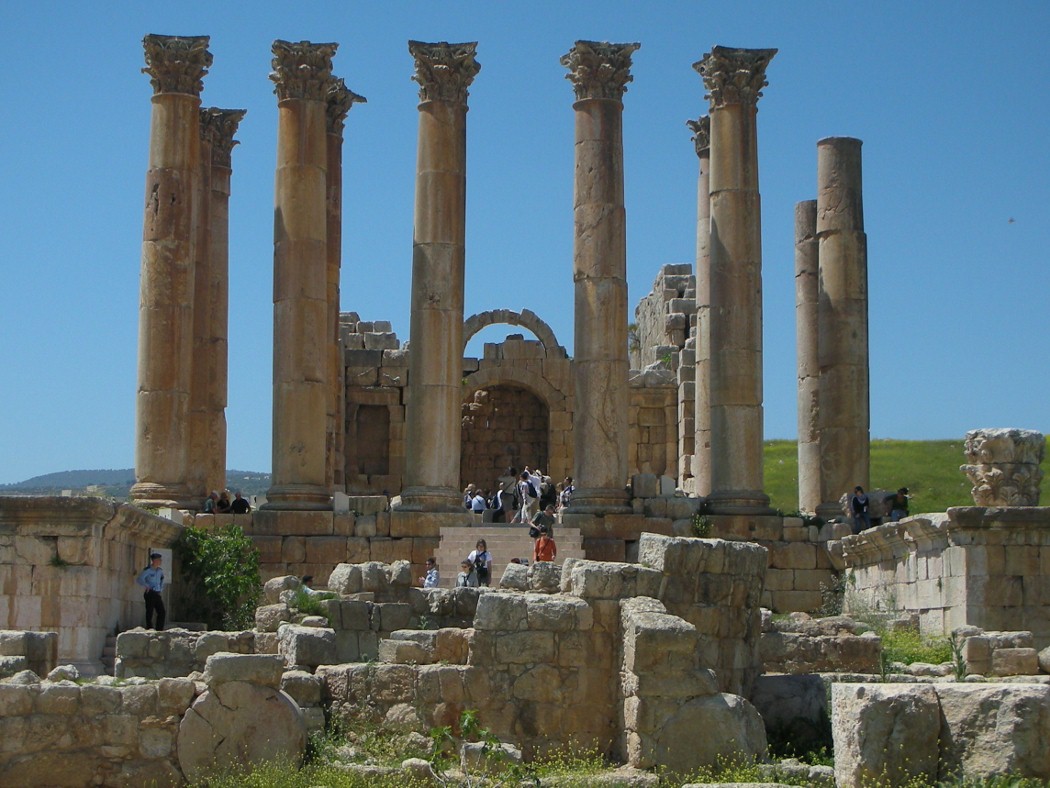
The largest and most impressive ruin in the site is the Temple of Artemis, who was more than likely the patron goddess of the ancient city. David, who had visited Jerash before and had a guide, knew some special things about it. Or, to be more specific, he knew a guy who knew a guy who had paid for a guide here once before, so it was almost like we were receiving first-hand knowledge. Almost. He led us over past a gesturing vendor who had set up shop inside the temple itself, over to a column on the south wall. Curiously enough, the column had a spoon and a pebble wedged underneath its bulk, which David told us to take a close look at. We peered at it…and saw that it was moving. I squinted back up at this massive column again, which undoubtedly weighed at least 6-7 tons. The spoon though, was clearly waving up and down, a sign that the column was swaying in the breeze. We all laughed (nervously, perhaps) and backed away from it. Sure, it may have been standing for several thousand years, but no one wanted to tempt fate.
We explored the entire Temple of Artemis before moving on, all the way from the very bottom in a series of underground passageways, accessible by a otherwise unnoticeable door in the base of the alter. There were no lights down there, and some very odd smells in certain parts of it. Light filtered down on us from above from chinks in the stone, making me wonder nervously again how strong the floor was above us. I had a feeling that if a giant tourist group came in all at the same moment (as pictured above) we might run into trouble, trouble like the floor collapsing on top of us. Apparently, enough moisture had gotten down here during the recent rainy season that there were little plants and moss sprouting all over in the cool darkness, and with a little light balance change on my camera, I was able to capture the green glow in the air.
My favorite photo from the trip; Mika gazes into the sunlight from the tunnel passageways
It was at the Temple that we met Rachael, a young woman from Australia traveling through the Holy Land with her brother, who had left for the day to go to Syria. Rachael heard us talking about the tilting pillar and assumed that perhaps we were a guided tour (David laughed at this) but of course, journeys are always better with new friends, so she joined our little group soon afterward for the rest of our explorations. I recall in Britain two summers ago, meeting a Korean student studying in Liverpool, and thinking how cool it must be to be a foreigner working or living in a foreign country – now, years later, the four us of were happy to show traveler around our “home” here in Jordan with the pride that only pseudo-natives like ourselves can have.
It’s a generally accepted fact in America that when you say “Middle East” you are inferring “desert” in the same breath. Throughout our lives we are generally conditioned that everything “over there” is sandy, dry, and generally a lot like the American southwest, except a lot bigger and filled with people in turbans. But after spending the better half of my long Easter weekend in the northern reaches of Jordan, I have to wonder: is North Jordan even in the same country?
I mentioned this last month when Christine and I had our brief trip into Jerash, but all of Jordan north of Amman is completely different looking. In the south, you’re lucky if you can find a few short, scrubby trees by the side of the road to have a picnic under like so many Ammanites do, but in the north, hills covered in trees and wildflowers of many varieties are nothing to write home about. However, I knew that once the summer sun hit the wildflowers of the north, there wouldn’t be much left save to sweep into a dustbin. I asked Dozan wa Awtar a few weeks ago if anyone wanted to join Silas and myself in a trip to the north in a post-concert celebration, and Ala’ and another American named Janell decided that they would go with us. That is to say, the trip wouldn’t have gone very far without Ala’, as he was driving!
Leaving at 5:45 probably wasn’t required, but as Friday was Good Friday for Orthodox Christians like Ala’, we knew we needed to be back in Amman by 6 so that he could get to church. So I purposely planned the trip for as early as I thought we could safely hit the road without all of us dying in a sleep-induced flaming car crash. Janell and Silas brought snacks, bless them, and I kept everyone awake and focused with loud and increasingly redundant exclamation of “Wow! It sure does look different up here!” I like to think I was performing an important role.
We reached the still-empty parking lot of Um Qais at 8. From this corner, the ruined city looked like nothing more than a windswept, grassy hillock with a few curious-looking boulders on the top, but after paying our 3 JD admission to the smiling guard (the kitaab kezzab (lying book) said it would be 1 JD) we found that the whole area swept down the hill into a large, crumbling city with a definite separation of histories – from the early Roman periods to the later Byzantine. Um Qais was originally a Roman city named Gadara, and was populated as part of the Roman Decapolis from 218 BC to 747 AD, when it was destroyed by earthquakes and abandoned.
The first thing that we noticed were, of course, the flowers. Basem had mentioned to me that there was a kind of flower, whose English name he couldn’t recall, that spread like feathery red wildfire over the hills, and now that I saw it myself, I recognized them as poppies. That, combined with the yellow flower that I had already seen last month in Jerash, made the hills practically glow with color. The four of us had just finished checking out a ruined archway near the entrance, when suddenly we heard the sound of 20 voices roar out “ALLAHU AKBAR!” – the phrase that probably every American knows as “God is the Greatest,” although it’s become unfortunately infamous for other reasons. As Silas and I ducked for cover (just kidding) Janell peaked around the corner and saw a troop of what looked like Jordanian Boy Scouts march down the steps into the park. They were followed by a tall, stocky guy in camo who casually swung a meter-long machine gun, complete with a sniper scope, over his shoulder. I don’t think I’ve ever been that close to live, loaded military hardware like that before.
I'm half-happy, half sad that there wasn't a full audience in the theatre to bask in our amazing performance…
Next on our path was the South Theatre complex, the better preserved of the two in the city. Almost everything, with the exception of wooden planks that cover the stage, is original and authentic, carved from solid blocks of huge black basalt stone. Because of its position and west-facing front, it was comparably shielded from the elements compared with the North Theatre, which suffered greatly over the centuries. We climbed all over the cracked seats, and put on a small production for ourselves – a kickline, something we never would have attempted had there actually been other tourists around. We climbed the 30 meters up to the highest seats and looked over the back, realizing that the boy scout troop was actually there to pick up litter; I gave them serious respect when I saw them running about with bags, excitedly piling cans and wrappers like treasures and racing to beat their fellows to a new piece of garbage. As they saw us poke our heads above the rubble on the top, they waved to us happily and shouted “hello! hello, how are you!”
I’ll admit that I have a propensity for coming up with post names that rhyme. Naming these posts, especially when I write them more frequently, is the toughest part of keeping a blog; naming things never comes easily for me. When I was a kid, my dad pointed out that I didn’t need to keep naming documents File_01.txt, Home_Pic_02.jpg, etc; that “we live in an era in which we can have longer than 8 character filenames.” I’ve gotten a little bit better, but I still order folders by date and one-word topic summary on all my computers. This comes from being an obsessive-compulsive organizer; my future children will be named Boy_01 and Boy_02 for simplicity’s sake.
One of the many advantages of working at a vocational training school is that you’re surrounded by professionals who are experts in their respective fields. As a teacher, I not only allow but encourage my students and other people at the campus to bring their personal computer to me for us to work on in class. Philip and I got a free TV that was found on the side of the road and Hattam, our electronics teacher, replaced its burnt-out power supply. Nicholas gives us free vegetables from the gardens he teaches in. It’s a good system.
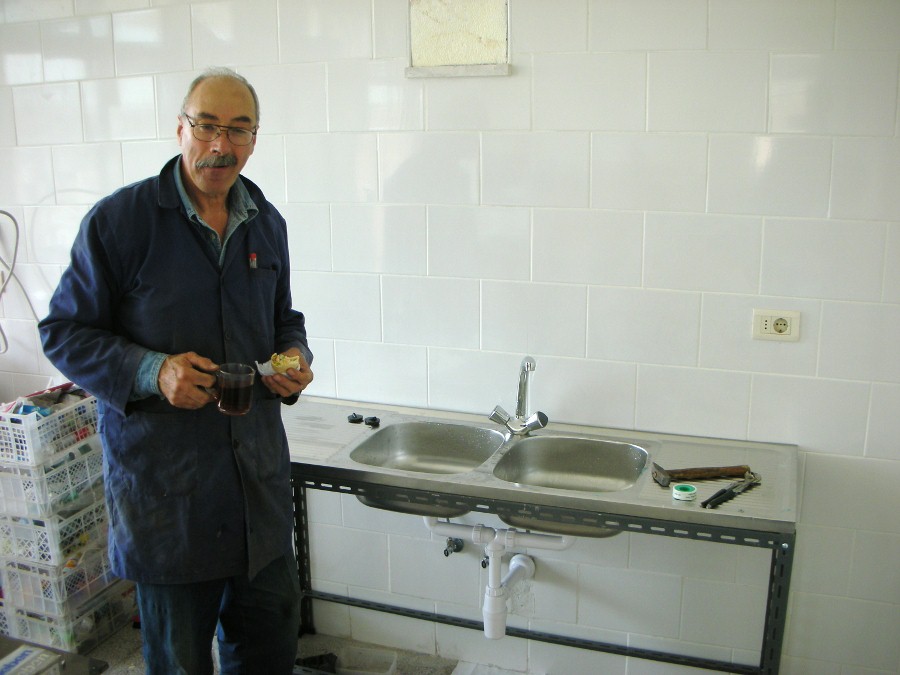
Yesterday I reaped the benefits of vocational trainers yet again when the plumbing instructor, Nahzeeh offered to finally install one of the last major necessities to our house’s upper floor – the kitchen sink. Nahzeeh prefers to be called Abu Eid, the Arabic kunya, which literally means “Father of Eid.” It’s a very common practice for a man to take the name of his firstborn son and everyone including Khalil and Wajih do it. Abu Eid took care of all of the part procurement for Galen and I, all we had to do was pay him for the parts and he’d do everything else. The whole process took about 3 hours, which included building a metal frame to house the sink, installation, and then adding in the plumbing work.
The metal frame took the most time to complete because there were some problems with the load-bearing metal bars Abu Eid was bolting together. Their sharp edges cut his hands open several times. I’d be helping him hold a piece of metal, then he’d pause and stare at his fingers curiously as he started dripping blood on the floor. “Uh, can I get you a bandaide there, Abu Eid?” I’d ask him. “No problem!” he replied cheerfully for the first few times, but at my insistence, he finally gave in and bandaged his fingers. I couldn’t shake the image of having to drive a bleeding, cheerfully smiling Abu Eid the hospital in a manual transmission car that I neither know how to drive nor am legally allowed to in Jordan. I asked him skeptically whether we could do anything about these knife-like edges on the bars, and he told me he’d bring over some rubber sheeting to cover them up to prevent our ankles from looking like his hands.
After we mounted the aluminum sinktop over the frame, I cautiously tested its strength, causing it to sag like an old man falling over against the wall. Abu Eid slapped me on the back cheerfully and told me it would be fine once we had bolted it to the wall. I had new images in my mind of having to drive the maid to the hospital after the sink collapsed and crushed her feet as she did the dishes. Abu Eid, seeing my hesitation, offered me his falafal sandwich, which did make me feel a little bit more confident about things (and less hungry). He drilled holes in the wall to screw the frame into, and sure enough, the sink felt perfectly sturdy like the one downstairs. He’s the ma’lim, after all, I shouldn’t have worried!
One of the funniest, most energetic teachers at Ayn al Basha. Besides me, of course.
In another ten minutes, he had the pipes hooked into the bottom of the sink, and with a flourish, he motioned for me to test the line. A rush of brown water spat from the faucet, as Abu Eid had expected – he calmly removed the nozzle, banged it against the top of the sink a few times, and the clog and color problems were solved. For the amount of the sand in this part of the world, a proportionally small part of it gets into our pipes. Regardless; there’s a reason why most people, including myself, drink bottled water here. I never would pay $1.25 for it in America, but I will happily pay 40 geruush for a 2 liter jug of it here.
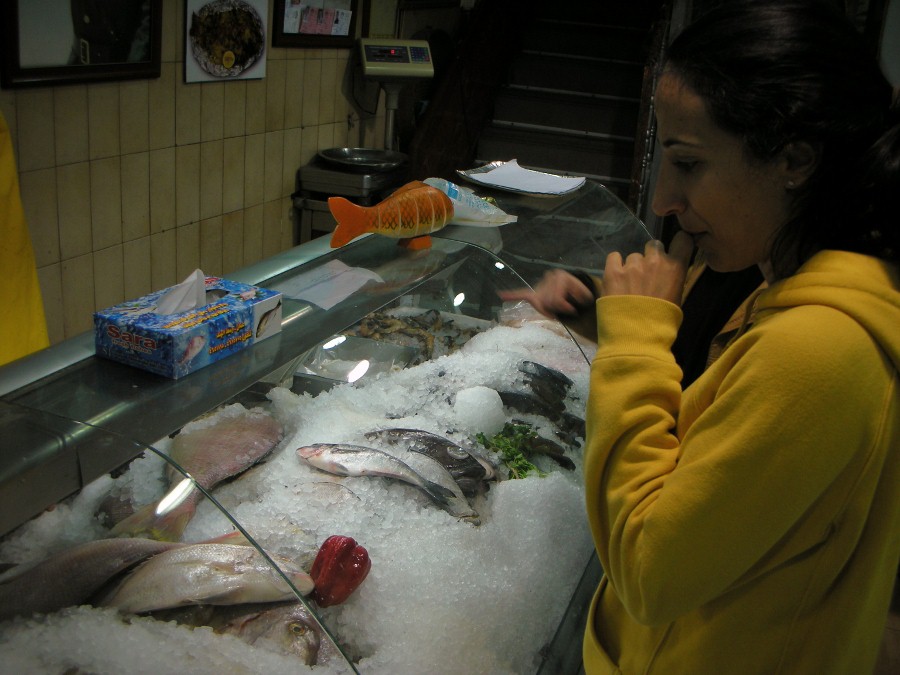
Later last night, I went out with Manal, a friend from choir, and some of her friends to a seafood restaurant down in Wust al-Bellad, the city center, although the name literally translates to “Middle of the Country.” I told her that I didn’t really like seafood, and she assured me that she was the same, until she ate at Auberge. The restaurant, like most in Amman, is dim, filled with thick argeillah smoke, and packed with people. I had barely taken my seat before Manal and her friend Reem led me back outside onto the street and down a narrow alleyway to – a fish shop? They explained that the restaurant owner lets other people serve their food in the restaurant, but you just need to go out and order it yourself. Massive fish, each weighing several kilos and ranging in color from yellow to red to black, stared at me with blank, dead eyes from their ice beds. Reem and Manal haggled with the proprietor, speaking too quickly for me to understand, and then ordered some falafal from another stand nearby. The employee, a young Egyptian guy, flirted with the two girls and gave them extra falafal “for being so pretty,” I purposefully stayed out of the way so as to not impede his generosity.
"Should we get the one with 2 cm eyes or 4 cm eyes?" No matter what the kind, fish taste better than they look.
The fish took almost an hour to arrive, but perfection takes time. When the massive trays were carried into the building, I saw that they hadn’t just ordered a massive fish, but also a plate of spiced shrimp and what looked like little rubber gaskets. I asked what they were, and was told that they were squid. Having never had squid before, I was a little suspicious of things that looked like they should be in Abu Eid’s toolbox, but found them quite tasty. “This is great!” I told the table. “So these things are the suction cups then?” This was met with odd stares, “No, it’s just pieces of the squid cut into cross-sections.” Way to be worldly and sophisticated, Zach. One of the other dinner guests with us, a young doctor, used his surgery skills on the fish in front of us, and cut out its spinal cord and held it up for us to see – it was about a foot long in length and each rib spar was as thick as your little finger. What a beast!
As today is Friday, it meant that I’d finally have a chance to go biking with Cycling Jordan for the first time in 3 weeks, since the first half of the month was completely consumed with choir practice. The original plan was for our advanced group to check out the Azraq Nature Reserve in the Eastern Desert, but due to the high winds and dust storms that have been cycloning through Jordan for the past week, we had to reschedule that trip for another time. This kind of weather, called “Khamseen” – the Arabic word for “fifty” which is a reference to the average number of days the weather patterns last – can be spectacular to watch, but not so fun to be trapped in. Just the other day I was walking down the street near home, and the light drizzle of rain that came out of nowhere caught the fine blowing sand made it look like the road was steaming – very cool. In Ayn al Basha, the ground is much more dusty and large cyclones can spin through the campus, making the windows rattle and making the room too dusty to breath. However, it’s already getting hot enough that leaving the windows closed can make working in a classroom for 5 hours intolerable. I can only imagine what it’ll be like in July: heatstroke, here we come.
Anyway, so instead of the reserve, Sa’ad lead our advanced group out to the west through Wadi Seer. Like so many places outside of the drab buildings of Amman, the Wadi is lovely, a green trench carved through the brown desert that culminates in one of Jordan’s numerous water reservoirs. Although I’d heard of the Wadi before, and heard it announced on buses, I didn’t know that it was as easy to get to as just continuing to go west after the 8th Circle and only a few minutes after the police station faded behind us, we were suddenly balancing on the edge of a huge gorge. Wadis tend to sneak up on you like that; one minute you’re in the crowded streets of Amman and then suddenly you’re overlooking a cliff.
The highlight of the trip (although the other 12 bikers may disagree with me) was going straight up the slope of the Wadi onto its opposite side. Heiko groaned when we turned towards it and told me, “This is the worst mountain in the world.” This coming from a skilled German outdoorsman should have worried me a little, but the thin air perhaps was preventing me from thinking clearly. We stopped for a photo op at the bottom of the hill, and some police officers pulled up behind us and asked Sa’ad what we were doing. He explained that we were going up the cliff, and they laughed. It wasn’t a mean laugh, not really, but more like a laugh of, “boy, bike riders sure do have a few screws loose.” Sa’ad had requested that I follow behind and make sure everyone was doing okay, so I waited and took a few pictures, commenting to the officers that it looked beautiful from here, “schikillu jameela min hawn” – they laughed at this and one of the called, “ANTA jameel!” – you’re the beautiful one. I laughed at this and replied, “3lla takeeahti” – literally, upon my hat. A common Arabic expression of gratitude for a compliment is “3lla rassi” – upon my head. But since I was wearing my helmet, the joke was not lost to the officers who roared with laughter at this.
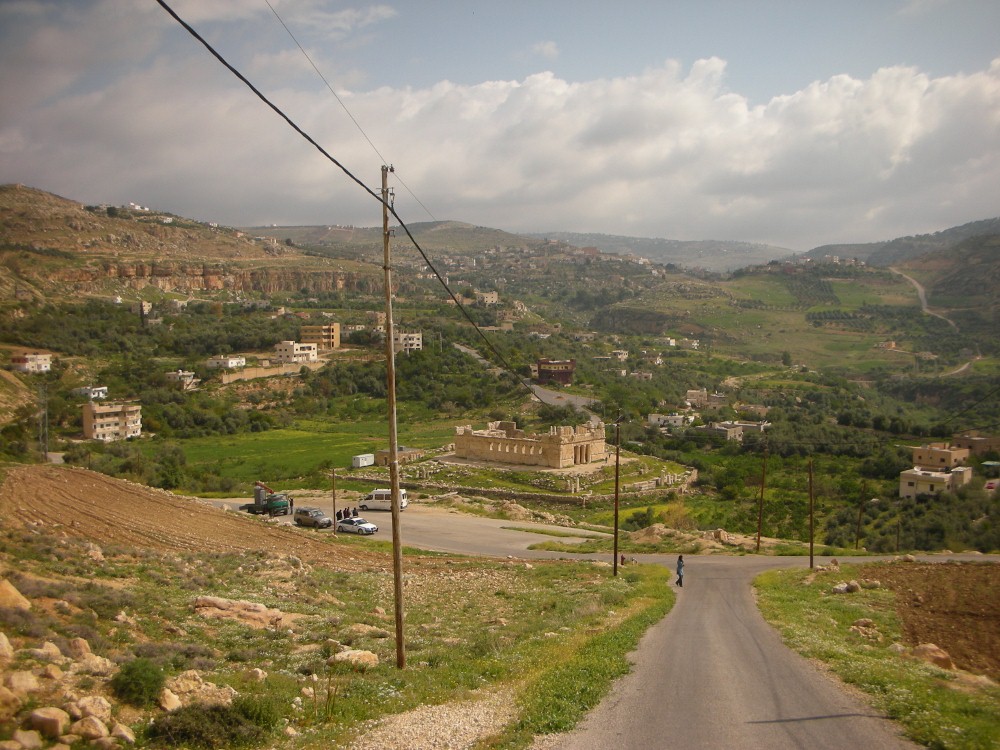
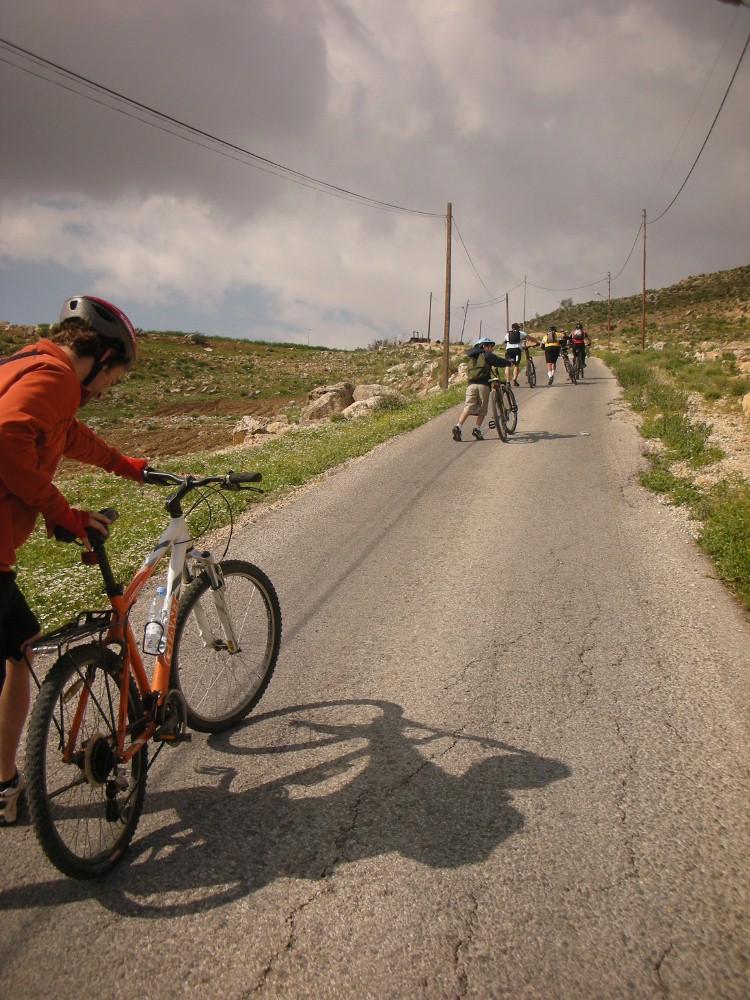
About 20 meters up the hill. An old castle, Qasr Iraq, guards the wadi basinThis photo has not been doctored; no weird angles were used. This is a really steep slope.
Then it was time for the hill itself, and Heiko wasn’t kidding – this was a rough hill. Although all of us are experienced, tough riders, 12 of the 13 had to end up getting of their bikes and walking them up the slope to the top. This was a hill so steep that I’m sure that not every car has been able to get up it either. I made it about 20 meters up the slope before I finally dropped off the side, exhausted. But I made up my time behind everyone by jogging it, half-carrying the lightweight aluminum frame. For 10 minutes, the only sounds in the hill were the chirping of birds, the yelling of some donkeys eating somewhere in the bushes, and our panting. The view was exquisite, even halfway up. At the top, Kamal had collapsed in a heap – I remembered what he had said during the Dead 2 Red about having to lug around your muscles everywhere, and realized that I was quite happy to be of the lightweight, spindly variety. Less wind resistance!
On the other side of Wadi Seer, stone walls line the hills as Palestine stretches away into the horizon
From that point on, the trip was offroad – unpaved gravel with small boulders. There weren’t any more uphills like that first one from then on, but the constant downhills on gravel were pretty exhilarating/terrifying. Thankfully, Sa’ad just got a truckload of new Trek bikes in last week, and the advanced riders were taking them all out for a spin. There wasn’t a single flat tire or broken chain among us; a first for one of our advanced rides. With the exception of the mountain donkeys and a few random Bedouin huts in the cliffs, there was no sign of habitation out here until we reached the reservoir and dam. By this point, the group had separated into two distinct units – the main group, and myself with Sa’ad’s son and a few others. We almost would have gotten lost at the reservoir, but I was keeping in constant contact with Sa’ad to make sure we were on the right path. There were many more people here at the water, fishing, picnicking, and just enjoying the tranquility, than there had been on the entire rest of the path so far.
We rendevoused with the rest of the group after the dam, and suddenly found ourselves back in Shoona, only a few kilometers from the farmhouse. I didn’t recognize the area exactly, but after the dam the vegetation changed abruptly like a switch had been flipped – before, the brush had been dry, stubbly, and sparse, but now we entered the rainforest-like climate that I’ve come to associate with the farm and Shoona, with towering palm trees, bananas, and brightly colored flowers. The khamseen weather had followed us back down in the valley, and at some points, it felt to me like pushing the pedals was harder on the flat roads than they had been going up the wadi cliff!