I can’t tell if they’re being ironic, but this “update your WordPress blog now” (for once, missing the soothing British tones of whats-his-name who has been doing all the .x videos for as long as I can remember – please find him, give him a scone, and bring him back) is filled with hipsters doing hipster stuff…having beards that clearly exist for the purpose of “please notice my beard”, blogging about coffee, and constantly using Apple products. I didn’t see a single PC featured in this video, and only one Android device.
I’m curious, WordPress…do your statistics show that the majority of your users are on iPC computing devices? Otherwise, you might want to revise your videos to show a bit more diversity.
Well, we’ve made it to New York City and Christine’s cousin’s apartment! We’re officially finished with our time in India and I have to say, as fun as it might sound to be in a giant country’s giant capitol city for their Independence Day…if you only have one day in said capitol, do your darndest to avoid it in Delhi, India.
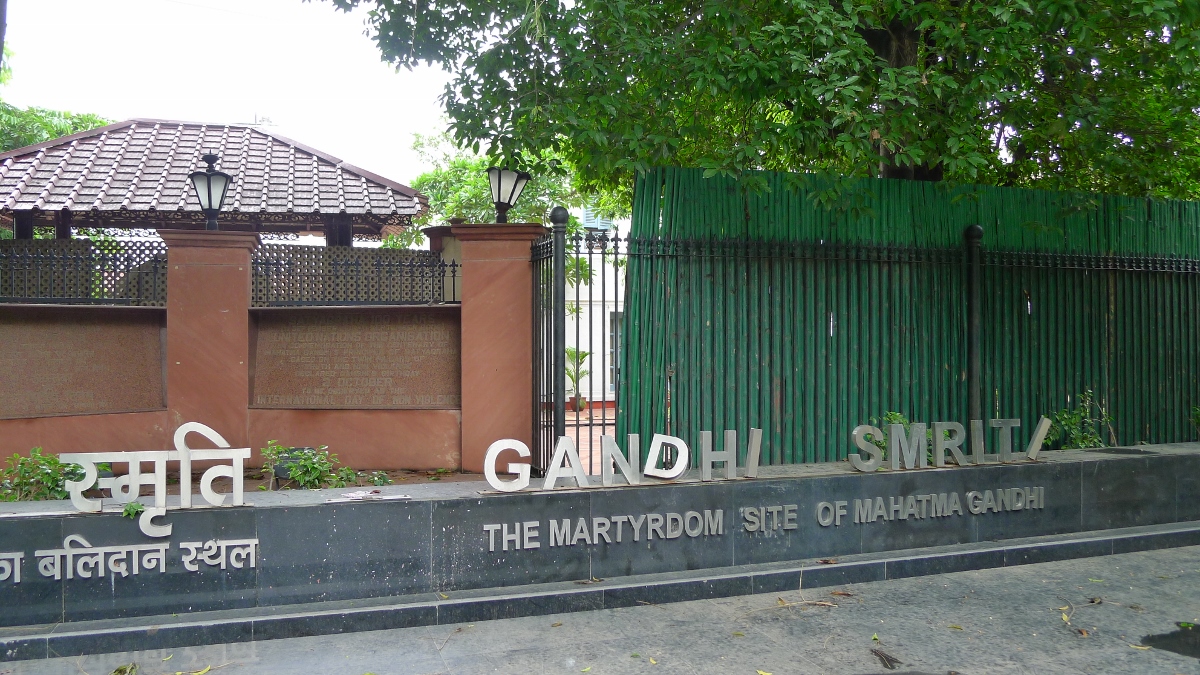
We had hoped for a leisurely day of sightseeing a museum or two, and Mahatma Gandhi’s memorial site…but every single thing was closed. We had looked for restaurants for lunch around noon, but everything was locked and barred. The streets were almost empty, and it in no way felt like India’s second most populated city (although if you’ll recall our feelings about socializing from the end of my previous post, this was definitely a positive). A turbaned Sikh rickshaw driver told us as we were walking to the Gandhi memorial that he was positive it was closed, but we had been told back at the hotel that it should be open. “I will take you there myself,” he replied “if it is open, then no charge for my driving you. If it is closed, then 20 rupees.” Well, it only took 45 seconds and it was probably the easiest 20 he’d made in a while.
This is, unfortunately, the closest we got to the main thing we came to Delhi to see
He did, however, tell us what would be open – the fabulous Gundawara Sikh Temple, and at no charge, too. “80 rupees, or 50 if you’ll just stop by my friend’s shop…” This is a common strategy in India. Stores will give rickshaw or taxi drivers either a commission or a fuel voucher for bringing tourists to them, but in least at Delhi with us, the drivers were upfront with us that they were willing to pass the cost savings onto you if you had the time to spare. And he knew we probably did, because everything was closed.
So that’s how we ended up at a huge rug store, run by a Muslim in a long white robe who literally danced with happiness when he saw us. “My name is Happy!” he proclaimed, then twirled on one foot and snapped his fingers in the air. “Please my friends, enjoy a cup of tea with me while we show you the finest silks in Delhi!” He danced all over a pile of rugs that his employees spread on the floor for us, and we let him talk to us for 10 minutes when we politely found a way to excuse ourselves and get back out to our waiting Sikh taxi. “But my friends your tea has not yet arrived!” Happy (or Kursheed, in his own language) said plaintively. “I’m sure those two will be happy to drink it instead,” I replied, pointing to another couple tourists were being hesitantly ushered through the door by a rickshaw driver. Happy must give out the best coupons.
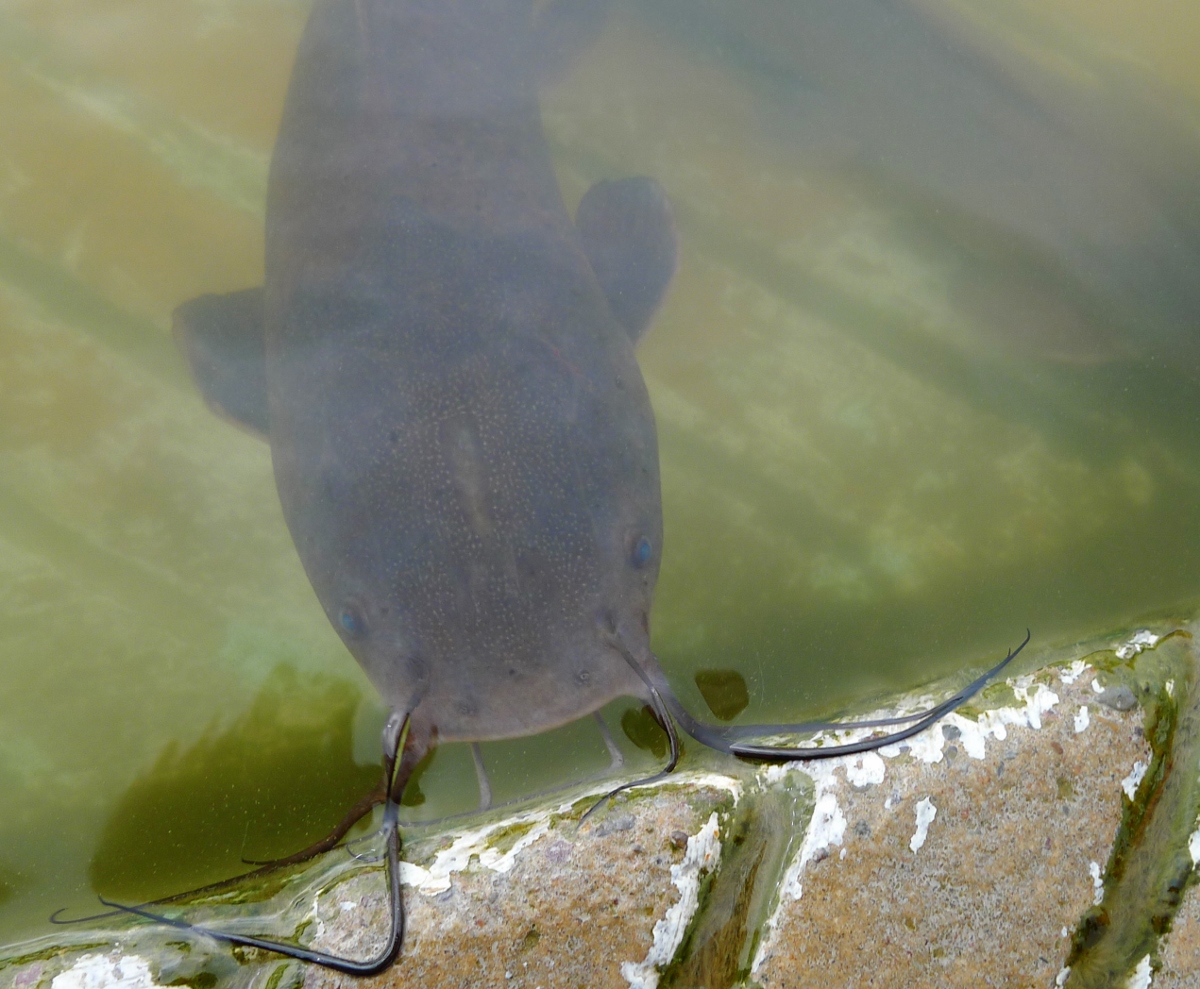
The pool was filled with curious catfish, like this fellow, and koi
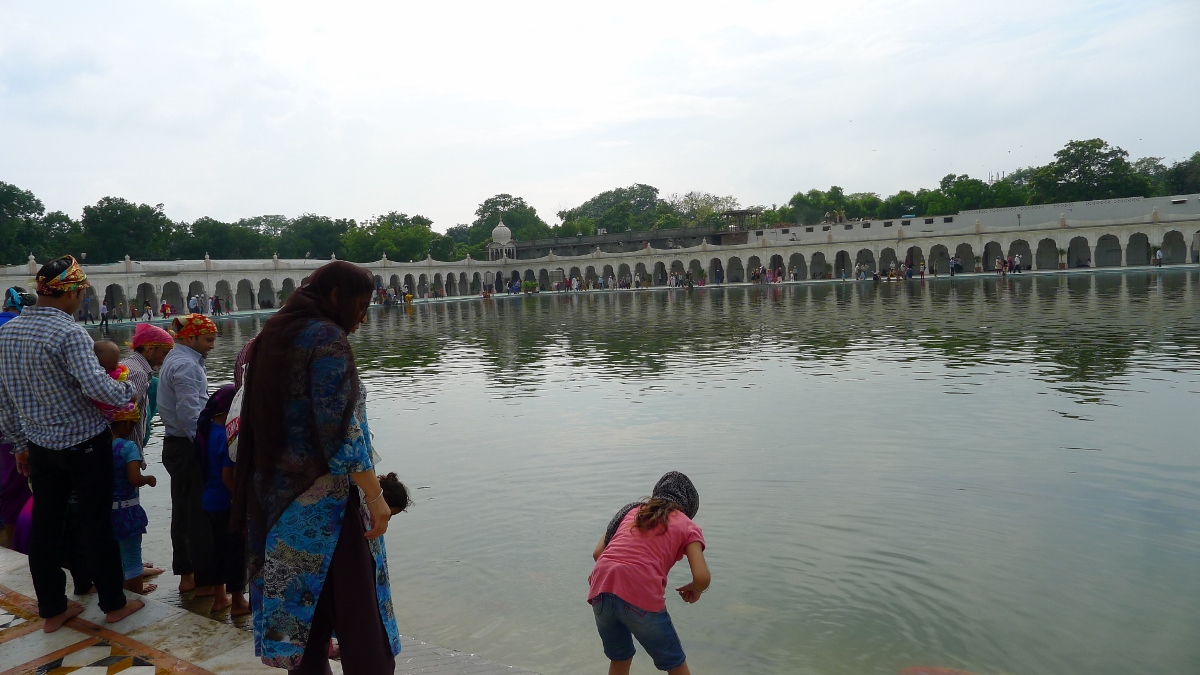
The Sikh temple had a huge shallow pool behind it, with waters that were supposedly holy. Hundreds of Indians were clustered around its edges (it was about half the size of a football field) wading in it, dipping their children in it, or even full on bathing in it. One thing the Sikh guards didn’t like though, were people sitting on its edges…a couple of white robed old fellows with stout staves were making the rounds along the edges of the pool, sharply rapping the marble steps next to anyone like myself who sat down for a second. “Stand up now,” one of them grunted at me, and the other gestured with his staff. Alright then! So we went inside the temple itself (after procuring proper head covering for both Christine and myself; Sikhs might have their turbans but I had my dear, beat up old hat from Jordan – only Christine needed to find a shawl to wrap around her hair). Inside, people were bowing and prostrating themselves before an alter with a man reading a book on it, and then tossing money into a huge long slotted box in front of him. We found out that it was a copy of the Sikh holy book, which is given an entire room to itself when not being displayed (“like a woman,” the young Sikh man who we asked about the curtained room at the corner of the temple told us).
In the center, a turbaned sea monster lurks
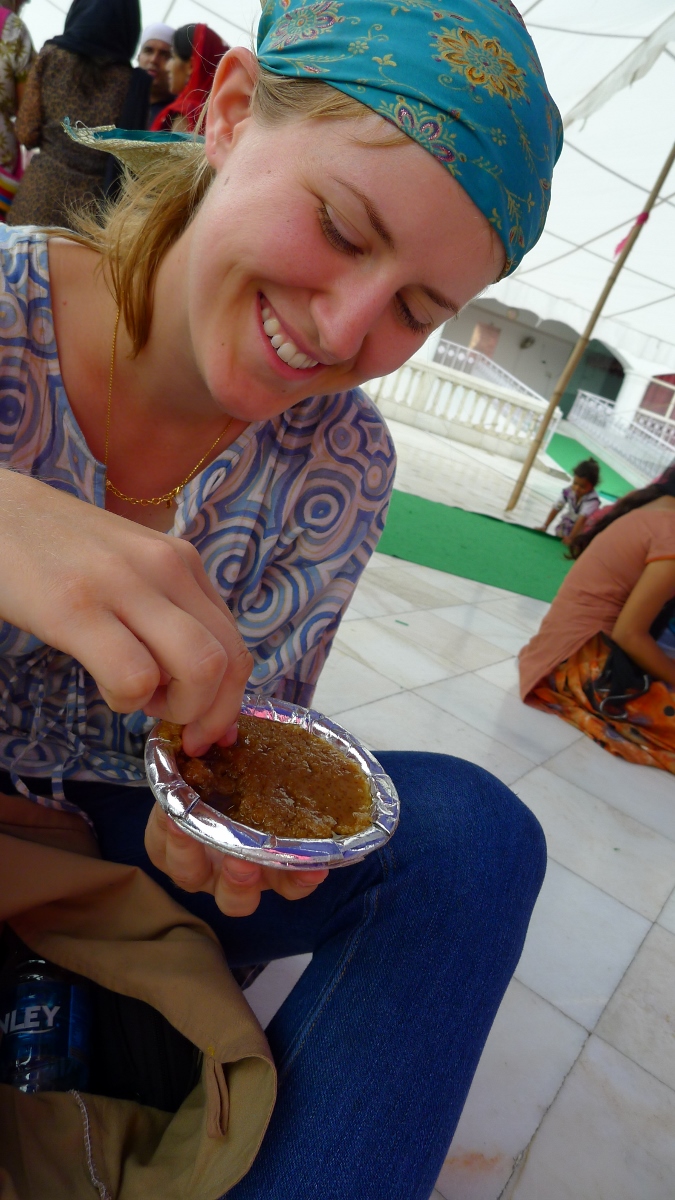
Back outside, we had some Prasad, which according to our guidebook and tripadvisor, is well-known throughout Delhi for being particularly tasty at this temple. We each donated 10 rupees to a man behind a counter, received a computer printout with our donation printed on it (it made us briefly nervous that it wasn’t enough, but I craned my neck and saw that most people were donating similar amounts on their own slips), and then gave that slip to another man at another counter, who slopped a brownish paste into a tinfoil cup and handed it to me. Christine and I sat down under a silk awning, surrounded by other diners, and sampled our blessed snack – it was very oily, like a lot of the north Indian food I’ve had so far, I could see the butter/ghee dripping off of every bit I picked up with my fingers. It tasted a bit like popcorn, actually, if the shells and the kernels together had been crushed down to a paste and mixed with oil. It was pretty good, but 10 rupees worth was definitely enough for me!
All we need now is a large coke and “coming soon to theaters near you”
The requisite “Taj at sunrise” photo. But we succeeded in beating 99% of the other tourists!
Just as we expected, the Oberoi staff (beardless young men in robes and turbans and attractive women in fake saris) were a bit confused when we trundled up the long driveway towards the imposing tan structure of the Oberoi Amarvilas hotel. “Are you staying here?” we were politely asked three or four times at various intervals as we made the long walk, dragging our luggage. When we got off the train, we figured that it would help our bargaining power with the rickshaw drivers if we didn’t tell them that we wanted to be dropped off at the most expensive hotel in the city, so we had our driver drop us off at the Taj Mahal’s eastern gate, about a kilometer from the Oberoi, and walked the rest of the way.
The touts and sellers are thick in this city, as you would imagine, and nowhere thicker than in that kilometer. To cut back on the pollution that is slowly staining the Taj from its magnificent white to a sludgy grey, only bicycle rickshaws and electric golf carts are allowed in that zone. Every few feet there was another bikeshaw driver grinning at us, or an ice cream cart, or a restaurant, or a jewelry salesman, or a kid selling postcards with the Taj on it. And we finally did tell one driver where we were going when he followed us for a hundred meters – “where you go? where your hotel?” – we replied, “the Oberoi, it’s very nearby” his eyebrows danced like black caterpillars and he said “ahhhh very nice!”
The Oberoi could be summed up as a perfect example of form over function. Everything about it was perfectly set – perfect volumes of music, perfect softness of bed, perfect temperature of the pool (Christine, reading this over my shoulder as I type, points out that it was astounding how the pool was attuned to the right level for the day’s heat) – and of course, the reason why it commands the highest price in the city – a perfect view of the southeastern corner of the mausoleum itself, visible over the tops of the trees on the private land that the hotel owns behind the building (that land itself, with no hiking access on it, must have cost the hotel an insane amount of money, but they have to keep it clear in order to guarantee that every room in the building can see the Taj, which is part of their brochure).
The window is a bit foggy from the fact that the A/C runs full blast all the time in here, but that cleared up by early afternoon
Of course, it seems to the fashion that any hotel that costs more than $150 in third world country charges outrageous amounts for internet access. I speculate that this is because they were probably some of the first businesses to have the internet, and their infrastructure is still set up to require it (versus just having a series of routers strung out throughout the floors like any American mid-range hotels might have). My parents and I found the same thing while staying on the banks of the Dead Sea in Jordan, too. For 400 rupees for an hour of access, it was flabbergasting – but they did have a free option: one half hour free, every 24 hours of your stay (when we checked out, I was 10 minutes into our 2nd 24 hour period, and it promptly logged me out and cancelled the rest of my 20 minutes because we were no longer in their system).
Ooh, the pillow menu! However, we were fine with the “default” goose down set of six our bed came with
But besides the the price on Internet and the extraordinarily high price of the minibar items (like the bottled water, which was selling for 75 rupees the same size bottle of water that would have cost 5 rupees in the city) the place was perfect. The pool area in particular was a multi-level series of terraces, trickling fountains that fed into waterfalls, and perfectly manicured turf. As we arrived at 7am, I watched numerous Indian employees in nondescript brown trousers and shirts painstakingly cutting the grass and bushes, practically blade by blade. They never spoke to us though – only the turbaned men and saried women did, smiling brilliantly and making perfect eye contact whenever we passed by. At the pool, if I would even so much as take a step in the direction of one of them, they would immediately stop whatever they were doing (except if they were serving someone else a drink or interacting with another customer) and wait to see if I was walking towards them or pass them, before they would resume their activities.
I wonder how many people would choose a temple filled with beady-eyed grey rats drinking milk out of rusty pans over the jewelry-making city of Jaipur? I guess it says a lot about Christine and I that we picked the former for our limited time in India – the main purpose of our out-of-the-way trip to Bikaner was to take a local bus 20km south again to the village of Deshnoak, to see the famous Rat Temple – more properly known as Karni Mata.
I’m getting ahead of myself – first there was the bus ride from Osian to Bikaner – what a ride. Rain started coming down in torrents before we reached Faloodi, a tiny backwater town that we didn’t see a whit of; just huddled under the awning at the bus stop. I gathered quite a crowd of gawking men around me, asking where I was from, where I was going, and why on earth I was here in Faloodi. People certainly stared at Christine, but societal norms meant that no one mustered the courage to try to talk with her – they saved that for me. I probably had 30 men ranging in age from middle school to a few elderly turbaned fellows by the time our bus to Bikaner arrived.
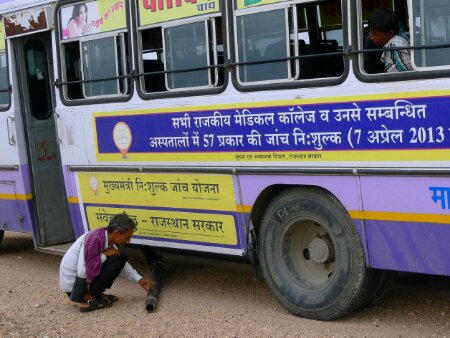
Everything was going fine – I had finished up that previous blog entry, and then started up a Shah Rukh Khan movie, “Om Shanti Om” with Christine on the tablet, when suddenly there was a loud WHAM, the bus swerved violently, and a hideous grinding, gasping sound filled the damp air. The bus wheezed to a halt on the side of the highway, which was mercifully between rain showers (but still sopping wet everywhere). Turns out the drive shaft powering the rear wheels had just plum fell off and was dangling like a black umbilical cord off of the bottom of the bus between the front wheels. There was nothing to do but drag out baggage off the bus, us and the 15 other Indians or so, and wait for the next hourly bus to Bikaner…and watch Om Shanti Om, to the delight of the Indians who clustered around behind us, pointing at the screen and jabbering away in Marwati or Hindi or something. It was better than constantly being asked questions about the trip that I’d answered dozens of times already!
The second bus was much less comfortable, although thankfully we boarded an hour later just as it started to rain and no one was carrying chickens under their arms. It was a tight squeeze – we fit Christine and I, plus our luggage, onto a seat that already had an old man and his luggage, and most of our fellow passengers fared about the same way. It was another hour to Bikaner, and the bus driver didn’t seem to have windshield wipers so he just poked his head out the side of the bus occasionally to make sure he wasn’t about to ram us into a placent cow, or an oil tank truck (in India, I’m not sure which would be worse for him). (more…)
We’re three days into our stay in the north-western state of Rajasthan, and are heading by bus to Bikaner for our last night before going to Agra tomorrow night. Instead of hotels or hostels here, we’ve been in homestays, living and dining with three very different families who call this desert state their home. So far, Christine and I agree that this might be our favorite part of India yet.
This leg of the trip didn’t start off too well, though. We left the Palm Grove “homestay” (they call it a homestay, but it was really just a hotel, although Christine commented that it seemed like the owner was sleeping in his own office so perhaps it was a homestay in that case) at 5 in the morning to make it to the airport for our flight at 8am. However, it was delayed for 45 minutes, which caused us to miss our connecting flight to Rajasthan in Mumbai and be waylaid at the airport. MakeMyTrip.com, the Indian website that Christine had booked through, had only given us 1.5 hours between flights – a risky bet in any country, and much worse in the 3rd world.
We had to quickly decide what to do as the flight attendants at the ticket counter politely but firmly refused us to go any further (even though our plane wasn’t leaving for another 15 minutes) – “sir, you cannot check in after 45 minutes before your flight” – even when we argued that it wasn’t our fault because our previous leg had been late. But MakeMyTrip had booked us on two different airlines so we couldn’t go to either of them for assistance. Long story short, fellow foreign travellers – scrutinize that website’s offerings very carefully before booking anything with them. In the end, we picked a first-class ticket on Air India to get to Jodhpur city, our Rajasthan state destination, on the same day – every other economy class ticket was on the next day, and we had a homestay waiting for us.
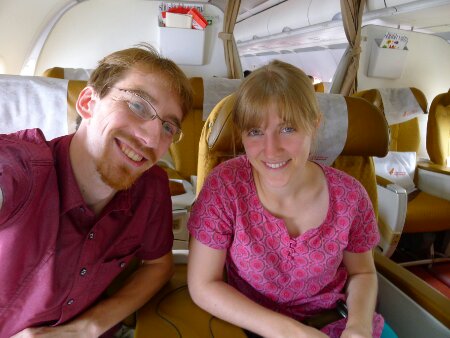
That was kind of fun (although for $400 a person compared with $50 a person for our original tickets, it had better be fun) – they kept bringing us newspapers, magazines, juice, and tea, and hot washclothes. And we were the only people in first class…Christine and I both joked that this is how these 2 hour flights get anyone into first class, just poor saps like us who had no other choice but to fly first class or have to ruin their travel itinerary. At least we had plenty of leg room, and we were the first ones off the plane too of course. I’ve actually never flown anything but economy before; Christine said she’d never paid for anything higher, but had been bumped up once.
It was fun, but I hope that the flight insurance Christine got will cover at least part of the $800 in tickets we had to buy…
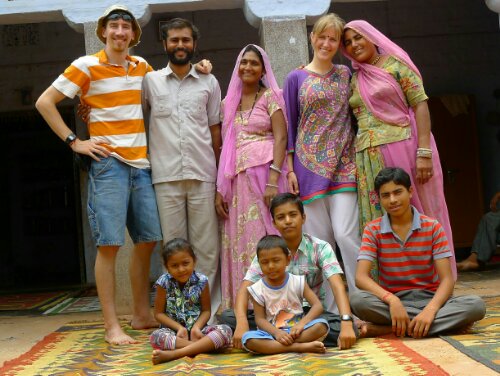
Our first homestay host, Chhotaram Prajapat, was waiting for us outside the dusty Jodhpur airport. Walking outside into the dry, bright sunlight was like coming back to Jordan, except cows were everywhere. Strolling along the road, along the sidewalk, crossing the street, and just standing completely fearlessly in the center of the street…they were a constant sight. Our bearded new friend Chhotaram was a quiet, friendly fellow who hardly ever honked at the cows and bulls all around him as we headed to his village in Salawas, just south of Jodhpur – I liked him already! We couldn’t believe it, but we found out that he was only 25 years old and already had three kids. The desert sun definitely can age a face, I thought he was early to mid thirties. His mother and father Darhiya and Pukrohgi actually own the lands of the house (it’s been in their family for over three hundred years, as their ancestor came here from Jodhpur to be an artist and the town kind of sprung up around him).
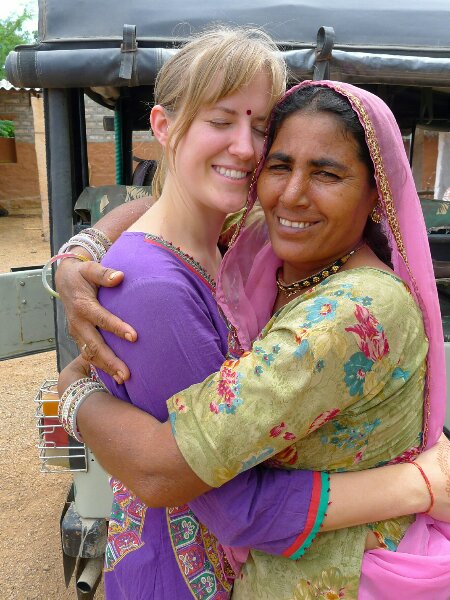
Darhyia and Christine (before we left for Jodhpur the next day)
Darhiya took an instant liking to Christine and I as she tied bright red and gold bracelets around our right wrists and ritualistically intoned something in the local Rajasthani language, Marwati, to welcome us to their household (I’m still wearing mine now!). Especially Christine, who she called her big sister even though she had to be 50 years old or so – but she just meant taller, of course! Pukrohgi wore a fine white turban and sported an equally fine salt and pepper mustache which he wore so long that he often wrapped the ends of it around his ears like spectacles. Chhotaram, his wife, and their three children were the formal inheritors of the household as the eldest, but Chhotaram’s younger three brothers still lived with the household too – only his two sisters had been married off already and lived elsewhere. But it was a big family, and they were eager to chat with us and find out more about America, as much as we were eager to chat with them.
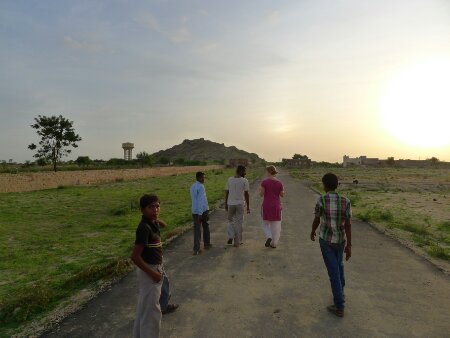
Out to sunset mountain with the guys
Chhotaram took us out to a large bluff near his home, about a 10 minute walk. In the extremely flat lands of Salawas, the huge rocky steps were an odd site as they seemed to rise out of nowhere as we turned a corner. A gaggle of local children now followed us up the cliff, singing Hindi pop songs, tossing stones around to see who could go the farthest, and of course trying their best to find out more about us using their limited English. On the bluffs, one was quite happy to climb up a rock wall behind us and show off how high he could go, as the others looked at us, nodded sagely and said “He crazy monkey.” Chhotaram sat on the edge of a rock and watched the sunset over the green fields of the desert with a small smile, saying little but answering the kids’ questions when they asked him. We joined him and watched the sun set over the scrubby trees.
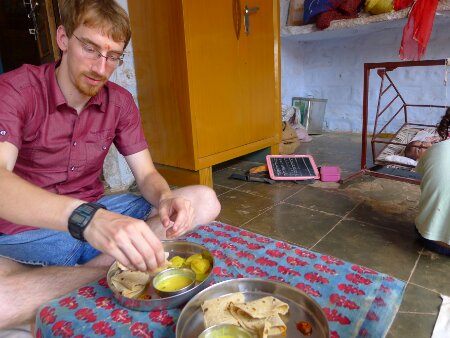
Trying out some yogurt curry – you can see baby Vasudev here, and daughter Kusboo's English alphabet school work on the chalkboard
Back at his homestead later that evening, we had a fine yogurt curry dinner, with potatoes fried in ghee fat, and lots of tasty chapatti bread. Christine says that one thing Indians are masters of cooking is many types of bread, but I think chapatti is my favorite. Christine cooed over Chhotaram’s youngest child, a two week old boy named Vasudev who had little black eyeshadow marks at the corners of his eyes – we learned that in Hindu culture, black lines or smudges are put on things you care about, in order to ward off the evil eye or bad luck. A few days later, our other homestay host Gemar would explain it as making sure the mind didn’t have 100% of its energy or chakra (or something?) focused on the beauty or cuteness of what you were looking at – as long as a little bit was distracted by ugly black tassles hanging off a car’s side mirrors, or smudges of black ash under a child’s eyes, you wouldn’t be able to focus evil energy on whatever you were looking at. I suppose it’s similar to the Muslim practice of writing “Ma sha’ Allah” (This is by God’s will) on the on their cars and trucks and saying it immediately after complimenting a parent on their children. Even in America we have old vestiges of that, like when we say “Knock on wood!” after saying something hopeful. But here of and in the Arab world of course, it’s taken far more seriously. You’re supposed to spit over your shoulder twice if you compliment someone, even.
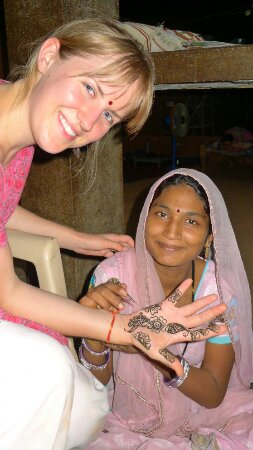
Rajasthani Stylin'Mumta's henna work – Christine said that she liked it a lot more than the stuff she'd tried to do before I arrived in Kerala
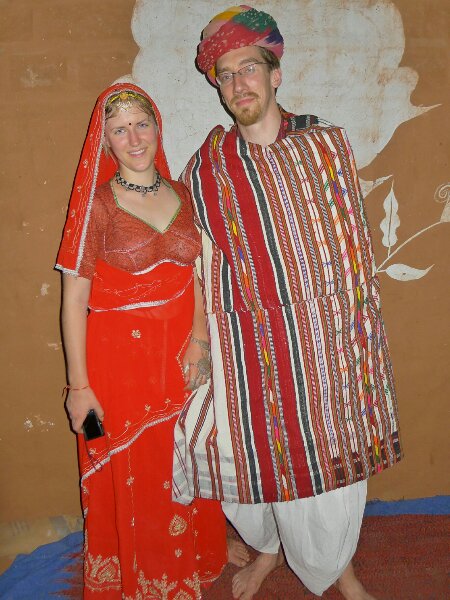
After dinner, Darhyia dressed up Christine in a red silk wedding dress with bangles hanging off of her, and Pukrohgi put a camel hair robe on me, and made a turban for me out of a thin, 9-meter long length of rainbow colored cloth, while Chhotaram’s 22 year old wife Mumta covered Christine’s hands in henna art – the acrid-but-pleasant lemony smelling black goo was smeared out of a paper tube. Finally, Christine and I had a couple of beers up on the roof of the homestead, looking up at the clear night sky – the Prajapat family as Hindu didn’t drink, but they sold us a couple of beers that they had brought from Jodhpur for their guests. At our request, they dragged out some bedframes into the yard for us to sleep on – while we loved the branch-thatched roofs of the huts that Chhotaram had made when starting his homestay business 3 years ago, we enjoyed sleeping out in the cool night air even more, at least until the flies started landing on us as the sun rose the following morning, when we escaped back into the hut, around 5:00. Around that time, I glimpsed Darhyia getting up to milk the cows to make the milk to add to our chai in a couple hours!
Chhotaram had to head back into Jodhpur to get some more tourists, but Pukrohgi and the 2nd eldest son Samburam had a second jeep and took us on a “village tour” around the fields and huts of their rug-making cooperative, and beyond. We were a little hesitant when our first stop was too a villager’s household named Vishnoy, who Pukrohgi told us in very halting English was part of a famous clan because they believed a certain kind of tree, the kazjri, were holy – and when developers in the city tried to knock them down a hundred years ago, many chained themselves to the trees and were subsequently killed. Mister Vishnoy intoned some words over a shrine to Shiva, then powdered something in a stone tray, mixed it with water, and filtered it through what looked like a sock. He then poured a bit of it into our right hands and gestured for us to drink it. “Opium party!” Pukrohgi said happily, as the Vishnoy’s son handed us some chunks of black crystal. “Opium with sugar!” he said again behind us. “Eat, eat!” Exchanging glances, we shrugged and popped the little pellets into our mouths….when in Rome, after all. I asked Samburam, who despite being much more silent than his gregarious father, spoke a bit better English, whether opium was legal in India. No, we were told, unless you have a medical need for it, and that’s why the old man has the legal right to use it. I didn’t ask whether that included sharing it with tourists on a village tour.
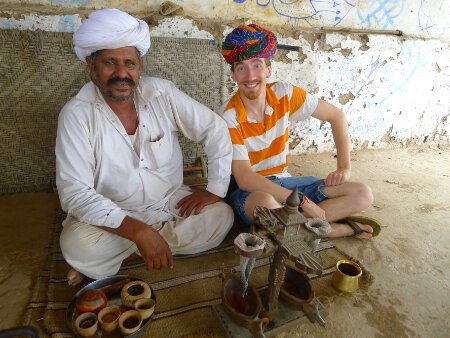
The vishnoy and his filter device. They sure like putting turbans on their guests! Note the goiter (or something) on the side of his face – perhaps the reason for his medicinal usage?
As we drove on narrow roads past clearly hand-planted fields of millet, lentils, and gum (we didn’t know what they meant when they told us the last one), we could hear a cackling haa-haa-haaaaa! call coming from in some trees, and out deeper into the fields. Finally, Pukrohgi pointed out what it was – there were peacocks and peahens running wild all over the place, and a few of the males were showing off their plumage. “India national bird!” Pukrohgi announced. “Village tour good!” As we drove, we often passed men and women walking on the road, or working out on the field. Later in the day, Christine asked Chhotaram why some people looked at us, and Pukrohgi so sternly. He seemed a bit embarrassed, but Christine hit on the obvious pretty quickly – “What do people who aren’t part of your cooperative, or your village tour think about your 60 USD a night new business of inviting foreigners into your home?” He shyly admitted that there was some jealousy, people wanting to be part of it and gain some of the money from it. I applauded his business sense though, and told him that it was his good business sense that allowed him to get the idea of homestays from a British friend that he sold rugs to, that had stayed at his home with his family some years ago. Chhotaram then asked his cooperative for financial assistance to build the 7 mud, dung, and stick huts (but with running water, electricity and fans) behind his home, and then share the profits from visitors with his community.
On the tour, though, people whose homes we stopped at (who were presumably getting a cut of the village tour money) were extremely cheerful and pleasant to us, and happy to show us around. We met an 83 year old woman, tiny and stooped, in a tiny mud hut where she was making chapattis over a cow dung fire. Christine and I had tried making chapatti last night for dinner with Mumta, and although she had succeeded on her third attempt (a woman’s touch, perhaps) mine were so bad that they had to be rolled back into a ball and redone as Darhiya, Mumta, and Christine laughed. Watching the women make them was mesmerizing though – they could do it in a seconds, making little balls of dough in their palms, then rapidly spinning them in their fingertips, pressing out the edges millimeter by millimeter. When I tried doing that, my fingers went right through. This old woman seemed to be even faster if that were possible – she probably had 77 years of experience at it.
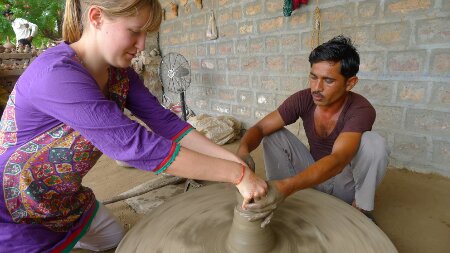
"Geez, she's making another plate for me, isn't she"How on earth did they get it to balance without having it fly off while it's spinning?
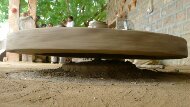
We saw antelopes with fluted horns galloping through the fields, and wild dogs everywhere. We stopped at a local potter, a Muslim family who were relaxing in the shade (Eid al fitur was the next day, so they were still fasting during the sunlight hours) but the potter, a 30 year old man with very strong arms, spun up his wheel with a long white stick. I couldn’t believe that with neither electric motor nor even a foot-pedal with a belt, he was able to make perfect pots, plates, and cups so easily. Christine and I each succeeded in making a plate, probably because of too much pressure. I could imagine his thoughts – “Pukrohgi’s bringing more tourists. Geez, I have so many plates already.” After the potter, we went to a women’s cooperative textile recycling shop named Dil, where we were given a smooth sales pitch and beautiful presentation of at least 50-60 different textile pieces. Our host Vikram told us that over fifteen thousand women from around the villages south of Jodhpur were employed making these textiles – he drove around every month providing fabric and designs to them, then coming by the next month and picking them up, giving out new material, and providing payment. There was a room with women cutting up old dresses and saris to be made into recycled wall hangings – they were so pretty that I bought one made of red and black dresses to hang on the wall behind wherever I decide to put my Rajasthani dresser. (more…)
At last, a day in which our umbrellas went unused! Christine said that Kochi was described to her as having “Door County charm” and she was right – we saw plenty of tourists in the Fort Cochin area probably for that very reason. Our hotelier recommended an A/C bus to us for getting from our lodgings at the edge of Ernakulum in the mainland city, but of course we were unable to find it and we had to take a regular city bus for the 15km trip – which ended up taking over an hour and a half!
We had brunch at this wonderful little restaurant that Christine’s sister had recommended to us, the Kashi Art Gallery. It was off on a little side street, surrounded by other restaurants and their attendants who hailed us repeatedly to come and eat with them. However, the Kashi had posted arrowed signs up in several spots so despite it being off the beaten track it was fairly easy to find. As it’s one of the highest rated restaurants on several travel websites, it probably is not well liked by its local competitors. Inside it reminded us a lot of the hotel we had stayed in San Jose, Costa Rica two years ago – a main building with a series of disconnected roofs out back that diners could eat underneath. And we arrived just in time, the (only) rain of the day fell as we were eating omelettes and pumpkin soup.
We strolled down bazaar lane, looking for the two main tourist attraction buildings, something called the Mattencherry Palace and the other, the oldest Jewish synagogue in India, created only a few decades after the fall of Jerusalem when a boatload of Jews arrived on the coast, offering gifts to the local raja and requesting asylum. We found it nestled into the old brick and stone hovels of “the jewtown” as it’s referred to in guidebooks. A scant few of the buildings are the century old originals, with faded Hebrew lettering above their lintels and with stars of David etched into their roofs. The synagogue was only 5 rupees to enter, but no photography was allowed. A single room with mirrored walls, hanging glass lanterns and the large wall hanging at the alter greeted us – not beautiful, but reverential and functional, which is what I’m sure the original congregation would have called it too. There are now only 70 Jews left in all of India, and only 6-7 in Kerala, according to a sign on the wall. They didn’t say whether anyone worshipped at this ancient temple anymore.
After another hour of walking down the lane (I fed a goat who was straining so hard for a plant growing just out of reach on a bridge that he was about to fall in) and we gave up on finding Mattencherry ourselves and hired a rickshaw driver – the first female driver we had seen, a young woman who was wearing a beige official looking uniform. I wondered if she was like the mythological female taxi drivers in Amman who only gave rides to women (there were supposedly a half dozen when I lived there) but she was amiable to taking both of us to the palace. As with the national history museum in Mumbai, I was impressed with the level of detailed description on all of the artifacts, especially on the dozen plaques talking about the Cochi royal family as it had existed before British rule, during, and even afterward (several are lawyers, and then others are teachers and accountants). The palace’s crowning beauty are the 2 meter tall wall murals made in 1300, telling the story of the Ramayana – Rama being an incarnation of Vishnu who had an adventure to reclaim his paramour Sita from a demon who had captured her. They were beautiful, but quite hard to read and comprehend – besides being faded and worn in many spots, the Hindu style of artistry used involved cramming as many people, demons and other objects into as small of panels as possible. Thankfully there was a guide on each panel telling us where to look for each particular event.
On Bazaar Road, there were also some amazing antique shops – including one owned by some Kashmiris that were able to get me hook, line, and sinker. We were walking through it, ignoring their touts as we saw the usual stone carving, wood carving, sari, and jewelry. Christine and I both admired a handsome meter-high chest of drawers painted garishly in beautiful red and black motifs. In the end, before the Kashmiris won me over I was able to talk them down to $450, including the cost of packaging, insuring, and shipping to Milwaukee. They had originally wanted almost $700 for it, so I view it as a well-haggled investment. Now I just have to find somewhere to put it when it arrives at the port of Milwaukee…
The guy in the blue said his name was "Happiness" in English but Christine thinks he was just relieved to move a piece of furniture in the tourist off-season
The final event of the evening was a Kathakali “face dance” – the traditional Keralan theatre. The place was jam packed with tourists, more than I’d seen in one place before. The show technically began at 5, as the doors opened to let us in – each actor applied their own makeup by hand. As you can see from the video linked here (I didn’t take any of mine because judging from the sound of dozens of cameras digitally clicking around me, this show doesn’t suffer from obscurity on the internet) the actors are painted in various elaborate patterns – green for Bhima the warrior prince, and red for the demon who needs to be slain. The yellow-faced priest who helps Bhima is also the person who does the demonstration of the special movements for the audience (the video is the same performer and musician we had). The two mock and taunt each other with words, true, but the “face” part of face dance comes from distinct eye, mouth, nose, and face muscular twitches that the actors train for years to be able to accomplish. Christine told me that apparently no Kathakali actors have ever needed to wear glasses, even when their in their senior years – the eye muscles are so taut and strong that they’re simply not needed. Meanwhile, as the two battle on stage in slow motion, a frantic pair of drummers and a warbling singer keep the beat on the side of the stage, all bare-chested and wearing dhotis and beads.
Well, not ALL makeup – the actors can do 75% of it but then a specialist fine-tunes the tiny intricate bits
It was pretty late when we got out, and we didn’t want to risk another hour and a half long bus ride back to Ernakulum from Fort Kochi. So we walked a short distance to a ferry jetty that ended up taking 7 minutes to transport us across the harbor (and 4 rupees apiece instead of 15) the same distance would have taken 45 minutes on the bus. We past some massive warships and freighters in the harbor, too – apparently the Indian Navy does a lot of work out of Kochi.
Now we’re on our way to the Cochi Airport, a 23km car ride. It’s an early flight at 8am, and Christine is asleep again already in the seat next to me. But we both knew that leaving at 5:30 in the morning was the safest option; you can never count on India to get you anywhere at the estimated time, so better safe than sorry.