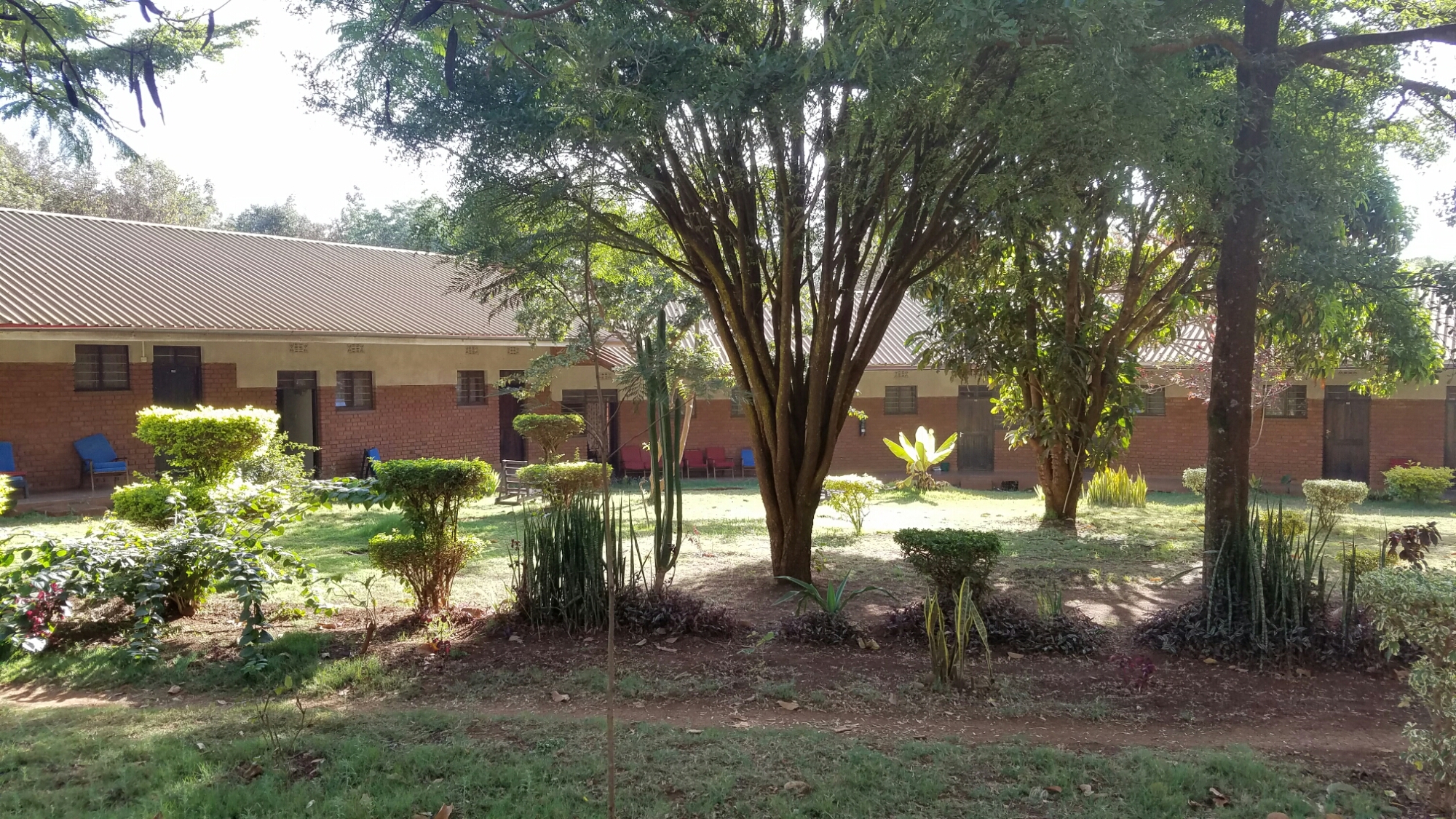
After the unpleasant circumstances of my prior blog post, it was nice to meet a friendly face back in DAR. Our hotel, Triniti, was staffed by a pleasant Zambian employee named Xavier. In case you didn’t know, Zambia is one of those African countries that’s adopted English as their native language, so our apologies about our lateness (due to cancelled and rebooked flights) were met with complete understanding and sympathy, without a language barrier in the way. Xavier gave us free water, on the house, and also waived the $5 airport transfer fee to get us back to the DAR airport the next day for our flight to Abu Dhabi. Bottom line – Triniti Airport Hotel, a 5 minute drive from the airport: highly recommended by us.
Being back in the Arab world, if only for 12 hours, was something I’d been looking forward to. In my two years of living in Jordan, I’ve never once been to the Gulf Countries, and I’d always been curious about them. My sole interaction with “Khaleejees” as Jordanians called them, was usually with speeding, honking, black SUVs with stone-faced men driving groups of fully covered women in them. As a Wisconsinite, they reminded us about our friendly jokes about Illinois folks – rich southern neighbors who come north to buy all the good land and can’t drive properly. Haha! Just some good natured ribbing, my dear Illinois friends.
Anyway, Abu Dhabi was….weird. No one spoke Arabic. Almost no one we interacted with, was an Arab. All of our taxi drivers were Pakistani, the grocery store staff were Filipino, and the hotel staff were a Malaysian and a Moroccan, who admitted that he knew a bit of Arabic but of course mostly spoke Berber.
One taxi driver, a handsome young Pakistani with a wry tone named Omer, explained that Abu Dhabi was like Las Vegas for the Arabs. They don’t live here, he said. They’re all in Sydney or in other countries. They come back occasionally to drive their Mercedes, Corvettes, and motorcycles in a country they can treat as their playground. All of us foreigners, he pointed out, just keep the place running for them as they jetset around. He said he’d just arrived in the country three months ago, looking for well paying work – hopefully not as a taxi driver for long; he had several accounting degrees and was just paying the bills while looking for a real job. He said it was too expensive to live anywhere close to Abu Dhabi itself; he had to drive 100 kilometers from a village of 4,000 people every morning – it was all he could afford the rent for.
We donned our Arabic robes, carefully packed away in our suitcases for the past two weeks in anticipation of this moment, and went out on the town, or tried at least. The city seemed basically dead – despite the incredible cool and calm winter weather – almost no one was on the streets but a few joggers and the occasional Arab in a robe walking about, usually on their phones. I tried to speak some Arabic, but was usually met with blank, apologetic stares. There were no restaurants on the street – due to restrictive liquor laws, only hotels had them, and they were mostly closed by 11 or so, even though it was a weekend night.
Our restaurant plans stymied, we ended up at a Carrefour grocery store at 12:50am, with it closing at 1am, frantically searching the aisles for a package of tortellini and some tomato sauce to make in our hotel room, which had a stovetop in it. It wasn’t how we had planned our return to the Arab world – in Abu Dhabi’s defense, we were rushed and had no internet apart from what we looked up in our hotel room ahead of time. Moral of the story – carefully plan your night plans while in Abu Dhabi, otherwise you’ll be glumly eating tortellini out of a pot at 2am.
“Hmm, which of these assorted cheeses should I eat first?”
Things went much better in Paris. Our AirBnB rental was right next to a direct train line to the airport and getting between the two places only took 40 minutes. Our host, Franck, had a lovely, tastefully decorated apartment on the edge of Le Marais, a district so packed with fine dining that we could have stayed there for months and eaten at a new place every night. We drank 5 euro glasses of wine at a lovely little cafe called Le Mesturat for hours, escargot-stuffed mushrooms, and wild boar in a wine reduction. It was heaven and I was very sad that we only had 22 hours in the city. Next time I’m in Paris I will almost certainly be looking for a place in Le Marais again – Franck, if his spare room is available.
Now, we’re on the plane back home – for real, this time. No timestamp changing funny business. In the next couple days/weeks I’ll be sorting my camera photos and updating almost every post I’ve made with fresh, high resolution photos from my actual camera. The smartphone does great for close-ups, but for a safari trip, nothing beats having an optical zoom. For everyone that’s been reading about our two week adventures – Guahari, Deylo, Ma’salaama, and Au Revoir! And thank you for taking an interest!
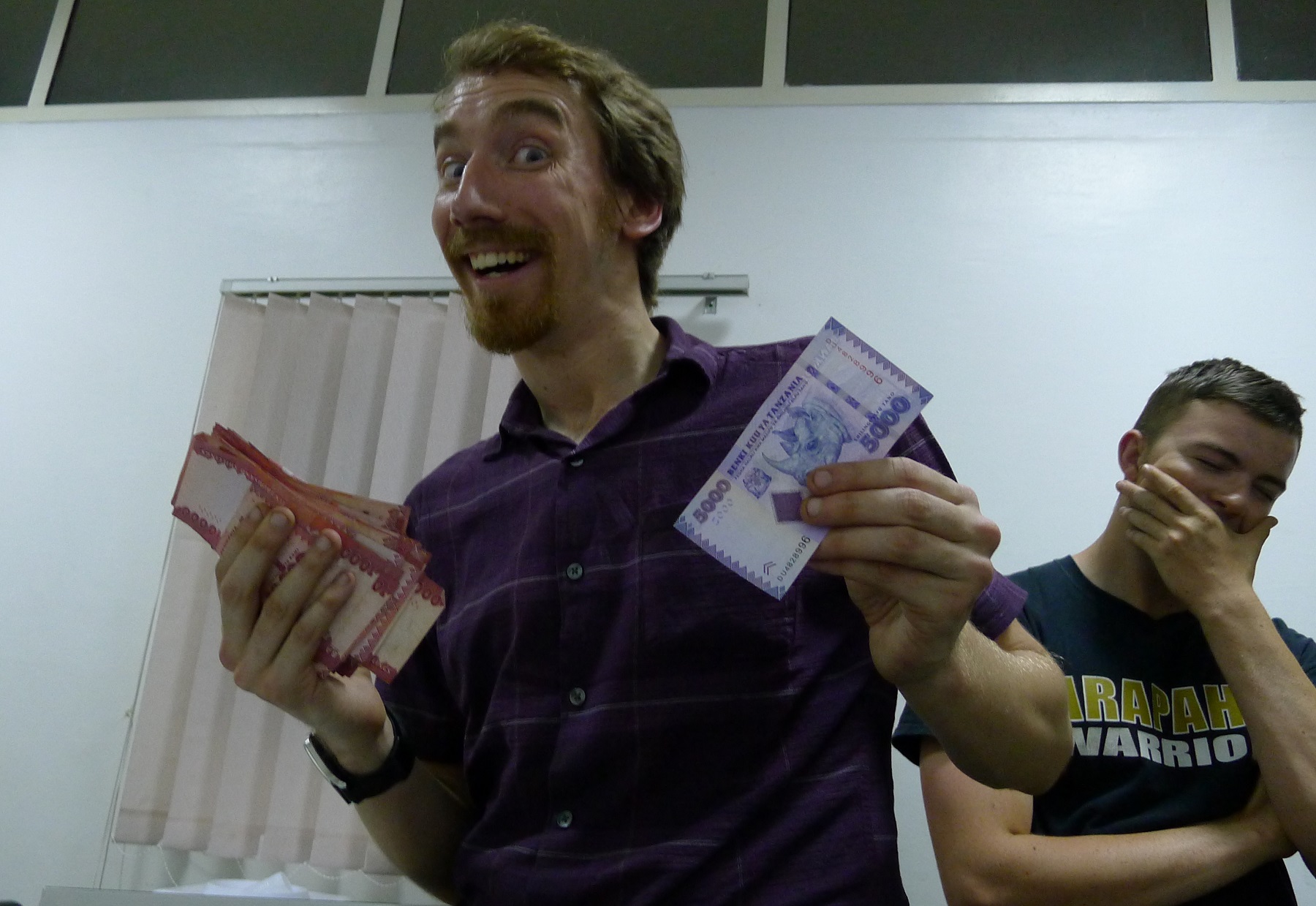
On the other hand, I might never again hold 1.1 million of a currency in my hand again
What a horrible end to our time in the north of Tanzania. We’ve just spent the past two hours running around the Kilamanjaro airport between ATMs, booking offices, and service counters. We’re $500 poorer, and not in a good mood.
We spent a relaxing afternoon at a restaurant near the Fastjet shuttle center in the middle of Arusha, paid our $5 each for the shuttle to the airport, and arrived with plenty of time. Our flight was delayed an hour.
Then two hours.
Then three.
Then suddenly…it was canceled outright. No explanation as to why. No rebooking forthcoming.
There was a mad dash by 75 people to the check-in counter. It was 7:30. Our flight to Abu Dhabi, the first of our two hops on the way to O’Hare, was at 1:50 the next day. If we couldn’t get on that flight, it would become very messy and complicated to make it home in a timely fashion.
But there was no other flights that night. The next one that they could offer us, they practically had to shout to me to be heard over the noise of people yelling and waving boarding passes around us as we crowded the counter, wouldn’t arrive at the DAR airport until 1:30 tomorrow…no way did we want to to cut things that close. There were no buses back to DAR either – none that run at night at least. It was an airplane or nothing.
We had paid $134 each for our round-trip fastjet tickets between DAR and Kilamanjaro airport, so I told them to just cancel our seats entirely; we’d go to their competitor, Precison Air, and get their 8:55 flight back. According to their website, they had one way tickets to DAR for only $50. No problem. We’d be getting about $70 or so back for cancelling our fastjet tickets.
Hah.
Christine went to go arrange Precision tickets at their ticket office, and I went next door to the fastjet office, literally separated from each other by a single piece of drywall and some studs. I was told that…interestingly enough…the $125 ticket was not split equally. Oh no. The flight up to Kilamanjaro from DAR was $111. The return flight was…$23. The agent told me, straight-faced, that I’d be receiving an automatic credit card refund of $46 for our two tickets. Strike one.
Meanwhile, Christine was finding out that, interestingly enough, supply and demand were in effect next door. The online price for one way tickets back to DAR was no longer $50. They were now $250. Each. Would you like to buy two? That’d be One Million, One Hundred and Five Thousand Tanzanian shillings. 1,105,000. Cash only. We don’t take credit cards.
Cue me, sprinting across the darkening parking lot to the only ATM in the airport, which was sitting in a flickering booth under florescent lights. Luckily, it wasn’t packed with other desperate travelers. I checked my watch – 8:10pm. I began the withdrawal process. “This ATM has a 300,000 shilling withdrawal limit. A 7,000 shilling fee will be charged per transaction.” Is it illegal to verbally and physically abuse an ATM? Probably, so I didn’t.
Four panicked transactions and one extremely stuffed wallet later, I was running back to the sales office. In case I haven’t mentioned this in previous entries, the largest denomination of Tanzanian currency is the 10,000 shilling bill. I had 100 of those jammed into my pocket, trying very hard to not have them come bursting out and spreading out into the wind like confetti.
The travel agent, face expressionless, carefully counted them as we stood, heart pounding and hoping that our prices would hold and we wouldn’t be forced to extract even more cash from a machine. They did, and we made our flight, in a very bad mood.
Tin Foil hats on. How much money did Precision Air make that night, from desperate homeward-bound, safari-weary tourists that couldn’t afford to wait a day for their flight? We were never told what had afflicted our original, $23 flight. My teeth ground together when I thought of the fact that I’d just paid ten times the price for the same flight, a slave to the next flight on the horizon. How often does this happen? How convenient is it that a flight that is originally $50 suddenly balloons five times that amount when their only competitor conveniently and unexplainedly cancels. How often does it happen? Wouldn’t it be a great money making idea to randomly and carefully take turns canceling flights, Precision one week and Fastjet the next, in cooperation with each other, then jacking up the prices of the only flight back to DAR? They wouldn’t do that, would they? Would they?
I don’t know. But the moral of this bitter, angry blog post is – avoid Precision and Fastjet whenever you can. Avoid that mousetrap of needing to make that one hour flight if you can. International tourists taking safaris in the northern parks should skip DAR entirely if you can, fly into Arusha/Kilamanjaro directly and back out. You certainly can; it’s an international airport. It’s a dangerously low-option pain point to need to get back to DAR, at night, when there are usually just a couple options, just two locally-owned small airline companies that may or may not be price-fixing and colluding with each other.
Soon after we left John and Endallah behind us, we were on our way back to Karatu for another bicycle ride – the one that we were supposed to have on the first day. Renatus, who we’d already met that first night, would be our guide. A relaxing three hour bicycle ride – on much nicer bicycles than we’d had in Dar es Salaam – was just what we needed. I asked Renatus how much the mountain bicycles, which were a Chinese brand I didn’t recognize, cost. He estimated $200 for them, which I thought was pretty good for their quality. Bicycle riding seemed to be common all over both the Dar and Northern regions, but ever single other person I saw was riding single-gear British style bicycles (I don’t know what they’re called, but they have a single large shaped piece of metal that flips down over the back wheel to act as a kickstand). Those, according to our guide, were $100. I wondered why people were so opposed to the better bicycle when they were only twice as expensive – it would be a good investment in my opinion. Renatus reminded me of the service required to keep a multi-gear bicycle with cantilever brakes running, in a dusty bumpy environment like Tanzania. Suddenly it made a lot more sense.
The highlight of the trip was stopping by a small local outdoor bar, where we got to sample some banana beer, brewed by the owner. For the equivalent of a nickel, Renatus was handed a warm liter of frothy malt-and-banana beverage in a plastic cup. We both tried it and it was…well, it was different. Apparently bananas ferment very easily, as this stuff was only 2% alcohol but had been made merely a few days earlier. It was filled with….solid material. The malt, I guess. It wasn’t terrible at all, in fact I could see myself developing a taste for it if we were in the region for awhile, but after a bumpy bicycle ride, I don’t think my stomach could have handled more than the 200ml or so it had. At lunch later with Renatus, for $2, I purchased professionally made bottle of “banana wine” which was 10% alcohol. That stuff packed a real kick – and I could still see the malt, finally ground, stuck to the bottom of the bottle. That stuff was great, and if only I could find it cold, I’d love to have more of it.
Me and my new “knife” style painting, and Tasha, its artist
Renatus also took us to a couple of shops, which I guess is to be expected for a tourist guide. We didn’t know that, though, thinking it was just going to be a bike ride + included beer sampling, so I hadn’t brought my wallet. All the shopkeepers seemed to know Renatus, though, and they all told us we could just pay him later. Christine and I ended up buying a couple paintings from a cooperative of young men artists. The two main styles are “tingatinga” or brush painting, and knife. No Swahili word for that, that they told us at least. I told Paul later that for future tours, he or Renatus should let the tourists know there’d be store stops so we’d know to bring our wallets. He said he didn’t know we’d be marketed to and seemed disconcerted and a bit embarrassed. I told him it was no big deal.
Paul picked us up after lunch and we headed to our fourth and final game drive region, Tarangire. This region was known for two things which immediately appeared for us – massive Baobob trees, and equally massive elephants.
They were everywhere. We saw more elephants over the next 24 hours in our two game drives than we’d seen in the entire trip, times ten. I’d estimate it at over 100, at least, usually in herds of at least 10-15. No more of the solitary elephants we saw leisurely wandering Ndutu – these were family units, almost always with a baby or two literally skipping and frolicking around a mother’s feet, a few oldsters with two foot long tusks, and most comically, the youngsters that were in the 3-4 year age group. These kids had tusks just starting to peep out from under their lips, only an inch or two long, which gave them the look of the bucktooth nerd stereotype as they trundled merrily along.
“lookit me, mom, I’m a nerdy baby elephant vampire!”
The baobobs were the other stars of the show, and Paul pointed out that the abundant water we saw in this area – more than any other – led to the trees, and the trees led to the proliferation of elephants. Everywhere we looked we saw massive, 5-meter wide trees – almost always with the telltale scrapes of tusks on them showing where the elephants tore off the succulent, water-filled bark and chowed down. Some of the trees had half their trunks missing, worn down by an excited herd like a gnawed carrot, and others had circular holes in their bases large enough for the Lion King’s Rafiki to build a shamanistic home in them.
Lions were the only predator we came across, including a single “tree lion” which Paul spotted from 300 meter distance. Apparently, it’s very uncommon to see them in trees anywhere but Lake Manyara, so we were lucky to glimpse one through binoculars. Overall, we saw 15 lions, usually in groups of 2-3. As usual, they were all napping – the show-off male from the edge of the Serengeti remains the only lion we saw doing anything but relaxing!
We also saw one more leopard, from a great distance – also napping. This was by the Silaleh swamp, an impressive multi-kilometer wide green swamp filled with Open-Bill storks and happy zebras, rolling about in the strong smelling mud at the edge.
And termite mounds. They were everywhere – I forgot to ask Paul, but I wonder now if they were also part of the Baobob ecosystem. More trees must certainly mean more animals that consume wood. Their mounds were massive, sometimes as much as 4 meters tall. Most were freestanding, but some of them were growing up right around trees, slowly and obviously killing them off as the termites bored away at them from inside their mounds. Seems like a logical to thing to do – if you’re a wood-eating creature, why make a freestanding mound when you could build right around a tree and gain shade, wind protection, and food right at your doorstep?
It wouldn’t be a Christine vacation without finding a cat to cuddle
I really enjoyed the camp we stayed at – it was a nice cross between the quiet solitude of Hugo Camp the first night, and the loud boisterousness of Nyani camp the second night. It was small, but had urinals and toilets, and even showers (filled with wasps nests, unfortunately). We had about a half dozen other campers, including one machine gun-toting Ranger who walked silently about the camp during dinner and breakfast, nodding politely at everyone.
What did we need protection from? Perhaps it would be nearsighted elephants. As I sat writing blog entries in the darkness of our tent with Christine sleeping in the other cot I began to hear crunching…and snuffling. Like a trombone hooked up to an air pump being slowly and gently crumpled. Dark shadows moved in the dim light from the almost-full moon above us. I nudged Christine – “hey, I think there are elephants eating in our camp.” She blearily rose and pressed her face to the screen of the tent door. “Where? What? I don’t see them…I’m gonna go outside and take a look.” I reminded her that Paul definitely didn’t want us to do anything that might spook or alarm the wild animals, and she grudgingly resumed pressing her face to the screen, peering around.
There was a crunch, a twang, and the tent vibrated. Christine leapt back, falling over my cot and jammed her fists to her mouth, whisper-screaming “ohmygodohmygodohmygoditsrightthere”
Seconds later, I saw it too – it’d be hard not to. An elephant’s foot had lightly brushed over the taut nylon ropes holding the tent covering down, which were pinned to the earth a meter from the tent itself. The dimness of the moon vanished and a huge shape passed in front of the door, no more than six inches from us. Christine told me that she had seen the eye itself, heavy lidded with long eyelashes, go right past her face. The ground shook again as the elephant took a few ponderous steps right past us, and in another second or two, was over by the bathrooms, grazing on a tree. Christine lay back down, shaking her head and muttering. In the resumed silence as the elephants moved off, I could hear her heart pounding.
I asked Paul casually the next day – “so, um, you told us that elephants have bad eyesight. What stops them from, y’know, stepping on tents? Accidentally, of course. Or tripping over their ropes.” His answer wasn’t particularly reassuring – “They know an unnatural thing and don’t go near it.” Someone tell that to the big fellow who was inches away from tripping and landing on us!
Small families of elephants like these were everywhere
The last – and definitely least – were the tsetse flies. They were unfortunately everywhere as well, and I have a few red welts on my hands (the only unprotected part of my body) to show for it. They itch like the dickens. Before I realized what they were, I photographed a massive, two-inch long one that had landed on Christine’s kitenga and was nosing about, looking for a weak spot to drill into. Paul later pointed out the flapping blue and black pieces of cloth, hung around every camp and picnic spot. They were drenched in a combination of tsetse fly attracting scent – and poison. The way most Americans have heard of this species of fly is because they carry the movie-famous “sleeping sickness” – but Paul assured me that only 1 in 1000 flies have it. Their bites, however, are still quite annoying and the government pays to put up those cloth banners all over Tarangire to try to keep their population down.
After our allotted 24 hours in the park, it was time to say goodbye to the elephants and baobobs and head back to Arusha. After we departed our last park, Paul frequented the healthy business of air filter cleaners for 15 minutes and a beefy auto mechanic blew out a termite mound’s worth of dust out of the truck’s filter. I was impressed, and asked Paul how often he replaced the filter in the truck. “After every tourist group,” he told me. Tanzania is a dusty country at this time of year.
We dropped Nico off at a bus stop at a crossroads near his hometown, Mto’mboo (which means “Mosquito River”) and we were immediately beset by trinket sellers who of course harassed us, but I was surprised to see they also went after Nico and Paul. I pressed our tip – $10 per day – into his palm carefully and discreetly. Paul bluntly told me this wasn’t a good area and to keep our money hidden.
Another hour later, and we were back in Arusha, staying at a curious place called, according to our program, “Lenana.” We really didn’t know what to make of it – it was a fine, modern looking home seemingly pressed against the back of a beer distributing warehouse (I saw their prices and advertisements tacked to the wall outside). A young woman, the daughter of the owner, greeted us – or rather Paul, since she didn’t speak any English. We took showers in the clean and tidy bathroom and I accidentally electrocuted my rump when it touched the water faucet – it seems that the electric water heater affixed to the shower head wasn’t properly grounded and the entire metal faucet/shower/handle system was coursing with electricity. Needless to say, between not having any English speaking receptionist to help tell us how to get to the Arusha airport the next day and the dangerous shower, I think I’ll be asking Endallah Tours to reconsider the usage of Lenana as the end-of-tour lodgings, at least in its current (pun intended) state.
And I thought Swahili was hard! We’ve just spent the past two-ish days hiking the farmland and small village of Endallah, south of Karatu, and home of the Iraqw tribe. If you had told me I’d be sitting down and eat dinner with a group of Iraqis (it’s how they pronounce their tribe’s name) I’d never have guessed it’d be with one of the largest non-Bantu (the majority) tribes in Tanzania.
Our guide was the effervescent, enthusiastic John Karama, who met us at the top of Lambo Hill about 30 minutes away from Karatu. We didn’t quite realize that it would end up being a 3 hour walk – oh how I wished we’d brought more than one bottle of water apiece – but John himself was so warm, talkative, and charming that the time and miles flew by.
John is a tailor, born and raised in Endallah. He has one wife and 7 kids (“only the richest man in town has 3 wives!”) and his trained six other tailors to help the village out. He doesn’t work for Endallah Culture Tours, but when John Mahu asked around the village for people who spoke English and could give a guided tour, he volunteered because he was so proud of his hometown and wanted more foreigners to see it. We were the first Americans that had ever been on the tour, to his recollection, and he was very happy to meet us.
As we walked over the dusty hills, following a group of sheep and goats (who did not want to be petted in the slightest) and some shy kids, John explained more about the word M’zungu, the singular word for Foreigner (vs the plural Wazungu). He wrote it in the dust at our feet with a stick (he did this a lot), then scratched out the Z. “This word? It is Mungu, which means God. Americans and Europeans, you are like Gods to us. I am in the presence of Gods!” We stared at him in a bit of shock. It’s not often someone you met 15 minutes ago calls you a God. He continued, “Climate change? You did it. Nuclear Weapons? They are yours. You can enter any country in the world. But you have also given so much to the African people. We have resources but cannot get them from the ground with your machines. You have given us medicine, science, technology, and a worldview. We owe so much to you.” He beamed at us. “Thank you so much for wanting to come see Africa yourself!”
He eagerly told us some stories about how his people, the Iraqw, first met the Masaai. “We used to have many wars with them. For almost a thousand years. The last one was in the 1970’s. We Iraqw have always both had cows and crops, but the Masaai, they only have cows. They accuse us, tell us we are ‘eating with both hands’ and we do not deserve the cows. So they steal them in the night, kill us. We killed them too! We used to live in caves for hundreds of years, us and our cows. We would make a pit in front of the cave and hide it. The Masaai would creep through at night, looking for cows – and then one would fall into the pit and we would jump out and kill him! The others would flee. But then, in the 70’s, President Nyerere wanted us to be at peace. He told us and the Masaai to send a leader to council. They met face to face, talked about things. Then their leader ran into the middle of our villages and said we will fight you no more, and ours did the same to their villages. Now we are getting married to their women, and they are marrying ours. We get along well now! When husband and wife fight, one will tell the other oh no no no! This war is done with remember?!” He laughed and shook his head.
It was a long, but beautiful walk…if only we’d thought to bring more water!
John pointed out local trees and how the Iraqw used them. He knew the Latin names for some of them too – I can’t remember what he called most of them, sadly, as my brain was starting to fry in the noonday heat. But he pointed out the Ebony tree, showing how white it was when it was young, then becoming old and black “like me!” He showed another plant with tiny leaves and said it was used by the medicine makers to fight black mamba and cobra bites. He demonstrated how the bark could be ripped and wrapped around a wound, or chewed and then the saliva pressed into a bite.
We crossed a tiny creek – dried up – that marked the boundary between Lambo village and Endallah village. “Now you are truly in my village. Welcome!” he said proudly. He tore a branch off a tree, then another, and explained that while most people used strike matches now, these two sticks could be rubbed together to make fire. I asked him if that was still used anymore, then, and he told another story.
“The shaman of the village, he uses the old fire making way for ceremonies – like when there is no rain for a long time, or a disease. Everything has to be done with purity. He asks for someone in the village to donate a sheep to the ceremony. Then he does not sleep in the same place with his wife for 3 days – and then another 3 days after the ceremony. He must be pure. He does not eat any food with salt in it. Then on the fourth day we gather together and he kills the sheep, collects its blood in a bowl, and takes a branch of the tree – like this – and dips it in the blood, then swish! Flicks it at the people. We cry out, why God are you hurting us, please forgive us, please! Then the rains come back.” I asked him if he’d ever seen this during his 48 year lifetime. “Only once. For rain at least. We have small ceremonies to resolve feuds in the villages, too. If a man fights with his neighbor, or beats his wife, then he must ask for forgiveness. The shaman tells him what the cost might be, to pay back his neighbor for wronging him, or medical bills for his wife. But he must make the sacrifice to truly show he is sorry. It is the Iraqw way.”
John continued, explaining the importance of sheep in their culture. “When a man marries a woman and builds a home for her, she crosses the doorway first, into the house. Then her dowry, the sheep, follow her inside the home. If they will not cross the doorway, it is a bad sign! Then the man is the third one into the home.” He went on about sheep versus goats. “You see, the sheep and goat are very difference. The sheep eats quietly and does not run around. The goat, it is loud and always yelling, complaining! According to our customs, a woman should be like a sheep – if she has a problem, she calmly takes care of it properly, she does not run around shouting and complaining to all.” Christine and I exchanged a few glances at this, but we didn’t say anything.
We learned a few simple greetings in the Iraqw language, like “Khayn Guamasyita” for me to greet men with, and “Low-why” for general hello. “Dey-lo” for goodbye, and “Sigh-you” for “fine.” The language seemed to have more throat sounds in it than Swahili, and sounded closer to Arabic than Swahili did when I heard John speak it quickly with people we walked by on our journey.
After ten km of walking, we reached John Mahu’s home on a hill above the village center. We ate a quick lunch with Paul, who was waiting for us, prepared by Mahu’s cousin, then collapsed in a mosquito-netted bed for a couple hour nap. There was no connection to the outside world for electricity, but Mahu had installed solar panels so we had LED lighting. For the first time in our trip, we weren’t spending the hottest part of the day in a safari truck with a nice breeze blowing on us. It was HOT. I found myself missing the Wisconsin winter we’d left behind for the first time.
In the evening after the heat had died down, John took us on another, shorter tour, showing the water pumps that Steven, the Belgian volunteer that helped run Endallah Cultural Tours, had started the project for. Projects like this is what our tour money were helping to pay for, since the village’s only river had run dry from global climate change in 2003, pumps were the only way they had year-round access to water.
The dried-up riverbed still has water a few feet below it (for now) so I stopped to help some locals dig it out
John walked us past a row of scrubby trees with finger-like succulent leaves and explained that they were used to make fences; they grew so fast that people would grow them in a line to demarcate a road or property line, then chop them down for a strong, erosion-proof natural fence. “These are Minyara trees, the national park Lake Manyara is named after them. They are used for natural glue, see? They have it in the leaves.” He demonstrated, tacking his fingers together. “But you must not get it in your eyes! It can make you go blind. The only cure is mama’s milk.” We looked at him. “Not cow’s milk or sheep or goat? Only a human?” I said. “Just mama.” he replied firmly. “If you get it in your eyes you must go around crying out mama, mama please help! Then she will come out of a house, just rub a bit on your eye, and you will be good as new!” Christine looked over at me and said, “please try not to get any of that stuff in your eyes or this is going to get weird.”
We walked through town, saw the “pool hall” which had some Iraqw sharpshooters skillfully playing while a football game blared on a tiny, energy efficient TV. A barber cut hair in the room next to it. John pointed out the vegetable market where farmers’ wives sold produce, and the local CCM government office where, from the faint sound of cheering we could hear from inside, the same football game was being watched on a larger screen. Apparently CCM didn’t have much to do around here besides make sure the people liked CCM.
The last thing was the hospital, which had one doctor and two nurses to support the village and the surrounding area. The doctor, a harried looking man named Immanuel, was on his day off, but he and his nurses lived in a building onsite and were apparently sent over from the Karatu Catholic Hospital system in a rotation. He led us quickly through the rooms – the registration, where medical entry forms were piled on shelves and when the official papers ran out, the backs of old school primer notebooks were used. The maternity set of rooms, some of which did not even have covers on the cushions, exposing the bare yellow sponge material. The vaccine injection room, with a partially collapsed table. Immanuel had a long suffering look on his face and simply said “it’s all we have.” The last room, the “men’s recovery room” had a motorcycle sitting in it. I leaned down, patted it, and murmured “don’t worry motorcycle, you’ll get better soon.” Immanuel stared at me, then laughed uproariously for a minute. I had been hoping he hadn’t heard that one before.
As Paul and John chatted in Swahili in the safari truck on the way to watch the sunset from the highest point in the village, overlooking Lake Manyara, Christine and I discussed the village…and the hospital. We agreed that the Iraqw people seemed like some of the nicest folks we’d met on the trip, very genuinely friendly and interested in showing us their town. But that hospital…Christine shuddered to think of delivering a baby there. It was better than nothing, of course. And Karatu town was only 30-60 minutes away, depending on how good your shock absorbers in your truck were, for more major problems. But it definitely made us appreciate well-run, well-stocked medical facilities in the USA.
Endallah’s high point
We clinked beer cans together from the high point and watched a dust storm roll in towards us. Someone had carved “Endallah Culture” in the rock we sat on, and John had brought a container of popcorn for us to eat. The weather, despite the impending dust, was cool and pleasant. But there’d be a lot more walking tomorrow, and Doctor Immanuel had pointed out that dust-caused upper respiratory infections was the 3rd most common disease he had to deal with, so we departed soon after.
Choosing which fabric to get…
John gushed over Christine’s new kitenga, which she wore around herself as a skirt. “When I see this on you, I think you are a real African! I want to make something for you both, free of charge – a dress for Christine, and a shirt for Zach, in the African style. If you wish, we can stop by Mahu’s store and you can buy fabric, then I will measure you and make the clothes tonight, ready for our hike tomorrow.” We agreed that this was even better than a Tanzanian soccer jersey and bought the fabric from Mahu’s daughter Lillian, a cute, shy 13 year old running her father’s shop under the light of a single bare LED. It was tough to see the colorful patterns in the evening darkness and a single LED, but we managed, and selected a fabric roll with enough material to make a matching dress and shirt. John pulled his trusty measuring tape from his pocket, swiftly took our dimensions, and we parted ways until the morning.
…and that next morning, there was John, wearing his beaming smile and with a newspaper roll under his arm, waving to us from Mahu’s courtyard after our breakfast. “I found this on my worktable this morning,” he said shyly. “I don’t know what it is, maybe you two should have a look.” We took the roll into our room and tore off the paper…there they were, as promised, two comfortable, loose-fitting (in the African style) pairs of matching clothing. We changed into them right away and thanked him profusely as he blushed.
We really lucked out with getting John as our guide!
The three of us had one more event scheduled together, a tour of a local banana plantation whose owner had declared it free for walking in for all tourists. John pointed out the common banana types – red Uganda bananas, green bananas, and grey-white “ash” bananas, used to brew local beer with. We saw avocado trees, which surprised us since we always thought they grew on bushes. And John took us on a long walk through wadi-like tree covered valley, strewn with volcanic rock, basalt, and caves. It was quite the hike, but John couldn’t talk nearly as much as he was busy trying to find the right route to take through the boulders and pools of standing water. After we climbed out, Paul and the truck were waiting for us, and we bid John a fond farewell, exchanging email addresses and physical addresses so we could mail him some pictures for the children and young men in the village, and email him the rest of the pictures and videos from our time together.
We hugged him, and the truck pulled away. The last we saw of him and his pale green matching shirt and trousers (which he’d made himself, of course) was him whistling, hands in his pockets, as he walked the dusty two mile road back to his beloved Endallah village.
Today’s highlight occurred right after we broke camp this morning. We were retracing our drive all the way back to Karatu, our starting point where we met John Mahu, right before Ngorogoro. On our road back to the main gate – still in the Serengeti – we suddenly found a lone male lion crouched in the brush, a mere 15 meters or so from the road.
However, this lion wasn’t just napping like every single other one we’ve seen so far. He had his huge, majestic face buried in the ribcage of a zebra, which from what we could tell from our angle, was already completely disemboweled. Now that we’ve seen two felines eating prey, it seems that meat falls under the following categorizations – “guts: easiest to rip out and probably(?) the most calorically dense” then “rump/shoulders/hocks: plenty of meat on them, but have to tear it more – which takes valuable time that I could be spending fleeing to shelter or resting” and then finally and last consumed, everything else. Especially the spindly legs which compared to the guts, must be worth almost less time and calories then what a predator gains from them.
The lion would occasionally raise his bloodied muzzle from his meal and look calmly over at us, then nose the carcass some more, delicately tearing small bits from the pelvis. I was reminded of how housecats will bring a mouse, or a toy, to their humans with pride. Was it possible that a young lion, who had lived his entire life in a national park under the awestruck eye of fascinated tourists, would have similar feline urges to show off a kill to humans? Out of all the vast empty plains on both sides of the road, this lion had chosen to eat his meal so close to human contact as to have us almost on top of him. Or perhaps we would be an ‘early warning system’ of some kind; if hyenas or other lions tried to advance on him to steal the carcass, had he “learned” over the years that we would make some noises or movements that he could react to? Very curious, and I wonder how much reasearch has been done into this.
After about 15 minutes of eating, the lion got to his feet for the first time, sniffed the air, and grasped the zebra carcass by the neck. He began pulling it south, still staying within 20 meters of the road. For the first time, we could see the zebra’s face – or what was left of it. The eyes and flesh had already been removed, leaving only a slightly meat-colored skull. Paul theorized that perhaps this lion had not been the killer – perhaps another pride had killed it earlier, eat their fill, letting vultures pick on the face, and this lion had just come across it and scared off the scavengers with his “I’m a big lion and I’m the boss” veto vote.
The lion’s belly was huge and swaying as he walked. He’d go for 20 paces or so, carefully dragging his zebra like a chew toy, then drop it, look at us, and rest for a few moments. Then pick it up again and repeat. Paul pointed out some tall bushes about another 200 meters down the road and theorized that’s where the lion was heading to rest in the shade, and continue eating. Satisfied with our great pictures – thanks for posing, Mr. Lion! – we continued on our way.
A new record holder for tiniest, cutest baby cheetah cub! (note: the original cameraphone photo replaced in February with better one from my real camera)
The only new animals we saw that day was a very shy herd of Eland antelopes, back near Ndutu park a couple hours later. It had just rained – the first time this trip – but we had just missed seeing it ourselves. The ever present dust was finally tamped down and a darker red than usual, the flora seemed even more eye-catching and vividly green, and the smell of the air was almost electrically charged with water, more strongly than I’ve ever noticed in America. I could almost hear Toto faintly blessing the rains in Africa, then realized it was Christine’s iPod.
We passed through the Ngorogoro registration area that we’d entered only 3 days before, and Paul stopped the car to report our departure. Christine and I got out to stretch, and suddenly a large male baboon ran towards the car, leapt up through Paul’s open window, climbed onto the dashboard, and began pawing through our paperwork. It found a container of shortbread biscuits, jammed them into his mouth, and leapt back out the way it’d come. The whole thing took less than 5 seconds – I’m not even mad, I’m impressed. It sat down about 20 meters away, daintily unwrapped the biscuits, and then jammed the lot into its mouth. It then had the gall to litter! In its own home! Lower primates, I tell ya.
An hour later, we were in Karatu, and Paul dropped us off at the Lutheran Guesthouse in the middle of town. We had seen a large open-air market on the way in, and asked what he thought of our idea to go check it out. In his usual polite, blunt way he said “It is not safe after nightfall here. Please return by 7:30. I will now take the car to be washed. See you tomorrow.”
The gardens of the Lutheran Guesthouse were pretty, the water was hot, and the staff were friendly. I’d recommend it.
Taking his advice, I divested my person of all but a few tens of thousands of shillings and we set off through the dusty evening with an hour to kill. As we walked through the gate, a young man peeled away from his mates milling around the entrance and greeted us warmly. He said his name was Richardo, a local artisan from the area. He was twiddling away with a little black finger drum as he talked, but his English was passable and he didn’t seem pushy, so I allowed him to follow us around and we chatted.
When he learned that Christine was in the market for one of the beautiful non-logo’d Kitenga cloth dresses we’d seen in Dar, he acted as our translator with one of the local tradeswomen. He fended off interlopers who seemed to want to sell us statues of cheetahs (“my wuzungu! Mine!”) When I told him I was potentially interested in a Tanzanian soccer jersey, he hunted all over the lot for one, tripping over several tied up roosters in his hurry.
In the end, since there was no night-lighting at all in the lot, the vendors started to pack up only a half hour after we arrived, and Richardo followed us back to the entrance. He told me that – what luck! – his brother owned a shirt store and perhaps I’d allow him to bring one of the jerseys I so keenly desired back to our lodgings. I had guessed this was coming but what the heck, I said sure, fine – I’ll pay 15,000 for a jersey. He immediately asked for 20,000. I told him okay, bring me a medium and a large sized jersey, the kind with the 3 horizontal color bands on it and the word Tanzania across the chest, so I can try them on for size, to the hotel at 7:40pm, and I’ll try them on and see if they fit and if they’re not too scuffed up and damaged. He agreed, and we parted ways – him leaping onto a passing tuktuk, and us walking the 7 minutes back home.
Fast forward to 7:50, when Richardo and a friend returned to the entrance of the Guesthouse, where I was waiting. What does he have in his hands? A mono-colored blue jersey, two tricolored Tanzanian winter hats, and a scarf. The game begins. I thanked him but pointed out that despite his assurances that his brother would have what I precisely requested, he did not bring it. They only make them in children’s sizes, he protested! Couldn’t I interest you in these two hats for 18,000? I’m from the frozen north american continent, I pointed out. I have plenty of winter hats. But no Tanzanian soccer jerseys. I also have plenty of simple blue shirts, I don’t need another one. But I came so far, he moaned. Surely you can help a brother out (yes, he actually said that). Okay, I said – well, I know those hats are made in China and you picked them up from a distributor for almost nothing. I’ll give you 5 thousand for one, or 10 thousand for both. I won’t even ask for a discount for buying both. 18,000, he cried. 9 USD for hats I could buy in America for even less, I retorted? Please Richardo – I want you to make a profit, but you and I both know that is ridiculous. 17,000? 10,000, I replied. He proceeded to wheedle another 4000 away, in 1000 increments, for the next 30 seconds. Each time I merely replied, 10,000. After the fourth time I attempted to hand them back to him (he ducked and dodged away from my hand, as if me touching the hats was a consent to purchase on his terms) and at 13,000 I reminded him that I could simply drop them in the dust and walk away if I wanted to, but he was a helpful guide at the market and I didn’t want to do that to his property. 12,000? Richardo, I said. You know how this works. You have a product you are trying to sell me that I don’t really want, that I’m only offering to buy from you as a favor. Either take the 10,000 or don’t. That’s it. He deflated, muttered something in Swahili that contained the word “America” under his breath, and accepted the 10,000.
“But what about a tip,” he wailed suddenly. “I took a tuktuk here, so fast to get to you! Surely you will tip me?” I pointed out that I only had two 10,000 shilling notes, and the little man produced 8,000 in change for me at lightning speed. I had to admire his perseverance so I gave him the 2,000 shilling tip. As the amused hotel guard, who had been watching closely, shut the gate with a clang behind me and Christine rolled her eyes at me indulging street vendors, I heard Richardo’s voice waft over the wall, “Support your local business…….!”
Well, now Christine and I have matching Tanzania hats. Maybe we’ll wear them in Paris together.
Note: this was originally going to be a longer post, made much earlier in the trip, but while I was writing it on my smartphone the WordPress Android app decided to inexplicably delete the entire content of the blog post I’d been working on for an hour. Unlike Microsoft Word, there is no autosave and unlike the actual WordPress website or Wikipedia there is no previous version database that I could revert back to, so all of my work was lost without explanation. I’ve now switched to using a Notes app on Android to write my posts, and only pasting the finished post into the wordpress app for uploading to the website when I’m done. I just can’t trust the WordPress app anymore, and I will never again make the mistake of thinking that a smartphone + bluetooth keyboard can possibly be as good and productive as a true clamshell computing system. I’ll try a Chromebook next time, see if that’s good enough. At $300-300 that’s the sort of price range I feel “okay” taking to the developing world. If not, it’s back to a standard desktop operating system.
The now typical combined herds of gnu, far less zebra though with them
A few dozen scattered herds of Thomson Gazelle
Two or three dozen elephants, including four babies born in the past month or two
A family of a couple dozen banded mongoose
14 Topi antelopes in a family unit
12 lionesses and their eight month old cubs. No adult males in sight
10 hyenas who were half asleep in a big mud puddle right next to the road
Around 8 Cape Buffalo. First we’ve seen them since the Crater
2 leopards in trees. One got out to unsuccessfully hunt a Bohor Reed buck. Hard to perform when 14 tourist trucks are starting and stopping next to you
2 cheetah females. One immediately after leaving Hugo camp, drinking at a watering hole then walking, sniffing, looking for Thomson gazelle but not seeing any. Another about an hour later in open savanna tracked a gazelle but was stymied by an alert zebra who bellowed and informed the Thomson to keep its head up
2 silver jackals baring their teeth and snapping at
7 vultures who were all hooding and guarding a bit of dead meat
2 ugly Marabou storks following the vultures around. They were picking up bits of bone and offal and cracking it like walnuts in their long beaks
2 crowned cranes at the same watering hole as the cheetah
We awoke with the sunrise. More specifically Christine did – I had already been up, tossing and turning on my cot and trying to find a comfortable way to lie. I had heard several hyenas laughing through the night but none had been close enough to make me worry. The tent was barren of everything but us and our electronics anyway; I was sure there wasn’t enough in there to make us smell interesting, just like scary humans. At several points I had thought I had heard long spans of something breathing, very close by and rhythmically… But then eventually I turned over and my ear positioning changed and I realized it was just the metal tent zipper scraping slowly across something, over and over again. I seemed to sleep a little easier after discovering that.
Outside the tent, alone, before Christine awoke, I stopped over to see how Rebecca the Dung Beetle was doing (fine) and heard a quiet rustling in the bushes. I stared hard, wondering if the hyenas had waited until now to pounce. Instead, sprinting away from me with an amusing lumbering run, was a honey badger. Thanks to the Internet’s interest in the HB and its inability to “give a fuck” I recognized it immediately. It was only in my line of sight for about 3 seconds before it ran behind another bush, farther away, and was out of sight.
Our morning game drive turned up a couple cheetah as described above as we moseyed north from Ndutu to the Serengeti. They both seemed interested in hunting, with the first one sniffing and slowly turning her head in every direction and walking a pretty clear one-way line. At one point she even briefly climbed a tree (albeit to a very low branch), stared around hard, and then came down to the ground and curled up in a very housecat kind of way. The hunt seemed to be over for her, at least for now. The same was true in the wide savanna north where we saw the second, but at least in that case there was a definite stalking of a Thomson gazelle. If only the zebras and gnu hadn’t saw/smelled the cheetah and sounded the alert for the otherwise oblivious Thomson, we could have seen a good hunt. However, Paul pointed out the hyena lurking nearby, about 400 meters away. Even if the cheetah had made a successful kill, there’s no guarantee she’d have been able to keep it.
We stopped under this sausage tree (see them hanging in the background?) to eat lunch on the way to the Serengeti.
On our way north, we stopped by a tiny little airfield at the edge of the Serengeti for Paul to register us, and we watched a tiny little 12-seat bush plane filled with tourists take off laboriously, possibly heading towards a private game reserve vs the public national parks that can get semi-crowded during high season.
Soon afterward we had a bit of minor car trouble- a flat rear driver side tire. We could hear it suddenly start leaking air even with the engine still on! Christine and I sat and read our Kindles under an acacia tree while Nicholas and Paul replaced the tire with one of their two spare tires that are attached to the back of the truck.
Nothing like a mud bath to keep your fur cool on a hot day
The roads got rougher – Paul said that unlike Ndutu, where we could basically drive wherever we wanted, in Ngorogoro and Serengeti all the vehicles had to stay strictly on the roads, which resulted in some deep ruts and teeth rattling bounces. Besides a couple of young elephants leaning against trees, gloating mud onto themselves in the heat, we didn’t see any other animals (besides, of course, zebra and gnu).
Until right before we reached the public campsite, Nyani, we’d be staying at to drop Nicholas and the gear off. We saw at a distance about 5 tourist trucks pulled up around something, and of course we’ve learned that means something special must be nearby. And it was! Our first spotted leopard was lounging in a tree, relaxing with its back to us, tail dangling down like a pendulum. More and more trucks started appearing and then, as if on cue, the leopard stretched, leapt down from the tree and stalked between the vehicles to the east, where a Reedbuck was standing alone, staring off into space.
A few trucks (there were 15 now, the most I had seen in one place to look at an animal) kept starting, stopping, or pulling around to try to give their tourists a better view. The leopard’s ears twitched in annoyance at the squealing brake sounds. After about 20 seconds of crouching and looking at the antelope, it suddenly darted back across the road, quick as a flash. The Reedbuck started, and suddenly screamed a rather horrific piercing call several times – obviously a warning call. We watched the leopard angle for position for about 15 more minutes, even after out of the other vehicles had given up and left, but finally the leopard climbed into another tree to rest and even we admitted it was time to move on.
Just hanging out behind a public bathroom. Y’know, like the cool kids in high school did.
As we waited for Paul and Nicholas to unload the truck at the campsite, I noticed a small, lean, tube shape running around the wall of the bathroom. It suddenly stood up on its hind legs and jerked its head around. I followed at a distance. Was it a meerkat, completing my Lion King collection? I rounded the corner and suddenly two dozen pairs of beady black eyes were looking at me. I remembered from Paul’s book that these must be banded mongooses.They ranged in size from about 1.5 feet to little 6 inch long sausage babies, a few of which were tussling and making cute little squeaking sounds.
They stared at me in watchful interest. A few started bowing their heads up and down while still making eye contact. I did the same. They chattered excitedly, standing up on their hind legs. I crouched and rose at the same time. More of them gathered in front of me, bowing and bowing again. I tried to copy them exactly. I had about 15 in front of me, squeaking and coming closer. We all bowed rapidly at each other like we were about to close a business deal in Tokyo.
Then Christine came around the corner, “what are you doing over here?” and the mongooses immediately scattered, squealing, into the underbrush. A few heads popped up from the weeds and looked back, but the spell was broken. At least, until Christine started tossing little chunks of banana to the group. Suddenly I was forgotten and the little tribe had a new best friend.
A big family group – males, females, and babies. I wish other species allowed for this!
Back in the truck, we bounced down the well-suited paths and found a herd of elephants, the largest group we’d seen together yet. There were some adorable little babies, about a month old in Paul’s estimation, running about gleefully with their trunks up in the air, crashing into things like toddlers often do. I noticed something on the mothers that I’d never seen on any other mammals – instead of the nipples being located on the belly in a line, the elephants had two nipples, each located just behind the forelegs. From that point forward it became easy to recognize male vs female elephants.
NSFEW – Not Safe For Elephant Work. Something I never thought I’d write on this website.
We saw a second leopard, but it didn’t do too much – just sat in its tree and gazed down at us for about 2 minutes after we arrived, then fell asleep, both tail and one rear leg dangling from the tree. After that, we stayed for about 15 minutes at a pride of no less than 12 lionesses/cubs, the latter were extremely adorable 8-month-olds who made tiny roars, played with each other, flopped onto their backs and waved their paws in the air, and nursed their mothers while growling in contentment. Paul pointed out there was no male adult in sight or sound – contrary to the image portrayed by the Lion King, elder males tend to eat baby males, who they (rightfully) recognize as a threat to their leadership of the pride.
“Don’t make me come down there and like, eat you or something.”“Don’t mind me though, I’m an adorable restless lion cub with my mom, aunts, and cousins”
Back at the campsite, the party was in full swing. There were two main pavilions – one filled with shouting, hardworking Tanzanian cooks, and the other filled with smoking, shouting European tourists, about 30-40 by my count. Seriously, the smell was pretty bad. I wish I could say that someday they’ll ban smoking “indoors” at the public campsites but considering the pavilions are mesh screens halfway up the wall, it’s unlikely. And the Spaniard table talked and smoked all night as I was trying to post the last two blog entries (in case you couldn’t tell, diligent readers of Jan 9, 2017, I’m a little bit behind). I had a cough for the entire next day.