Carrying on from my previous blog entry, I awoke the next morning with the sudden realization that I didn’t know what I would have for breakfast or lunch. Whenever I did wadi hikes previously, it was with a house of my own and a well-stocked fridge. I decided to test my luck and hope that Abu Jbara would be open already at 7:40 in the morning – and they were! Six falafel sandwiches over the course of 12 hours? No problem!
Original bins
Grace and I rendezvoused with her friends at 7th circle on the way out of town, heading towards the Dead Sea. I had the opportunity to see how the recycling drop-off point, constructed by Entity Green, had changed over the years. When I left, it was a couple of bins with a big sign over it right next to the Cozmo grocery store. Now it had been moved further away into a parking lot, but it didn’t seem to be a slight – the bins had changed into a mobile home-sized green-painted building with separate room, diagrams of how recycling helps the environment, and separated slots for 5-6 different items. I noted they were still collected stale old bread, something that EG used to collect when I was around and resell to farmers to use as feed.
Entity Green's Cozmo recycling center – it's so big!
All told, we were eight intrepid hikers heading south through the surprisingly green countryside toward the less-green slopes near the sea. Only a month ago, Jordan had issued a minor “emergency” of several inches of snow, causing school to be closed for two days and throwing the city into chaos. Jordanians barely are able to keep from crashing into each other in good weather days; the addition of any extra element into roads is understandably a recipe for disaster. However, the added moisture had done wonders for the appearance of the rocky terrain, and the weather was warm and sunny.
When our two cars reached the point that Nelle had told us about, precisely at the “55km to Amman” road marker across the highway from the Dead Sea’s “O Beach”, we found a nice little semi-cleared flat lot. We could expect to see Bedouin on the trip, as Nelle had pointed out a watermelon patch that her groups had walked through on their way back out of the wadi on the northern cliff overlooking the wadi. The Bedouin’s influence on this area would turn out to be quite beneficial to us later in the day.
At first, I have to admit that we were disappointed. Although there was the usual concrete bridge holding up the highway and allowing the wadi to drain into the Dead Sea…it was absolutely dry. I’d never seen that before in any of the Dead Sea wadis we’d visited before, and I worried that this was going to be more of a rock climb that anything else. Grace even called Nelle (thankfully for us, the nearby hotels mean that there are plenty of cell towers nearby to prevent any loss of coverage, in case of any accidents) to make sure that we were in the right place.
We shouldn’t have worried – the ground grew damp bit by bit, and finally a small trickle of water was found vanishing into the dust. From there, the trickle turned into a small but steadily gurgling stream, filled with the typical thick green strings of algae so common in Jordan’s wadis. As pretty as it is, it’s probably caused by the overuse of fertilizers by Bedouins – it’s commonly known fact in Jordan that crop farmers receive water and fertilizer subsidies from the government even though the GDP from crops in the country is quite small. Many activists in the country wish the government would stop the subsidies in order to try to encourage Jordanians to grow crops more suited to the desert, but of course that’s not likely to happen anytime soon.
As we walked through the canyon, we passed in and out of shade quite frequently, a sign of fluctuation in the width and height of the canyon walls. The high exposure to sun, the small amount of water, and the numerous waterfalls, big and small, reminded me a lot of the Wadi Himara hike I’d taken a few weeks before my departure in 2010. Truth be told, although we saw a lot more frogs and crabs than any other wadi hike I’d been on, there was nothing particularly special about the wadi. It boasted several very large waterfalls (probably in the top five in the country, after the country’s largest which is in Himara) that made for a good place to relax and snack in the pleasant shadows of the 40 meter tall canyon walls.
If you squint, I'm the tiny black dot on the wall of the canyon. It was a slippery climb!
It wasn’t without dangers, either. One of our eight members, a tall and quiet Asian fellow named Charles, nearly slid to his death (or at least probable injury) as we were climbing up an almost sheer rock face that Nelle had aptly named “the sketchy part” of the wadi hike. Basically, in order to reach the sought-after deeper water pools further up the stream, getting to the top of that 40 meter waterfall was necessary and the sketchy route was the only one we knew. A slight misstep and a strangled “whoa” and I saw Charles begin to bounce down the slope. He was saved by a large fern plant which stoically grabbed at the edge of the canyon wall, and its large fronds waved in his face as he shakily pulled himself back to his feet. I was the last one in the line of our party of eight – Grace and I probably had the most wadi-hiking experience, and some of the members, including Charles, had none at all. None of us had ever been to the wadi before. The only other close calls that we had – and me personally, too, was people bouncing baseball sized rocks past my head as we struggled up the side of the cliff. I encouraged us to fan out as much as possible on the cliffside to prevent a misstep from dislodging killer rocks on each others’ heads.
Ahmad should get an award for tolerating my constant photo-taking. The photo on the left is from August 2008, a week after my arrival. The right is from yesterday.
The past three days of my vacation in Jordan have been hot and tiring, but very satisfying. I’m throwing myself back into my “old ways” of being in the country with great gusto, but perhaps with slightly detrimental results. I should have remembered that it took time for my body to adapt to Jordan’s food, water, heat, and my active lifestyle here. Sure, I’ve been biking regularly in America, but that can’t compare with the wadi hiking and constant walking that I was doing while I lived here. By the time I started hiking in the wadis in 2010, for example, I’d already lived here for a year and a half and my body was already able to cope with extreme heat and walking. By contrast, I think I’ve really strained my muscles with walking and playing frisbee this time around.
On Thursday morning, I stopped by Amman’s massive “City Mall,” where I knew my old friend Ahmad was working. The cavernous space hadn’t changed much, but I took the opportunity to buy a sack of Nescafe 3-in-1, a “coffee” drink that my parents and I both like, and isn’t available in America. Ahmad found me soon after, and the two of us headed to the new Entity Green office – new to me, I mean. Ahmad is another example of someone that’s had a lot change for him in the past two years. He’s gotten married, bought a car (he couldn’t even legally drive when I was here) and been promoted to overseer of six Entity Green recycling-sorting employees at City Mall’s collection point. I asked him if he missed working in the EGT office, his old job when I had been around. He sighed and reminded me that all the foreign employees, including myself, had left Jordan in 2010. “What job was there for me to translate for when you all left?” I was embarrassed that I had forgotten that the Arab “dream job,” according to Haitham, involved putting your feet up in an office and drinking coffee all day. It might have been a promotion to become a manager in my eyes, but to Ahmad this was debatable. I teasingly asked him if he and his wife Amani had any kids yet. “Not yet,” he chuckled. “Soon, insha’allah.” To be married and not have any kids at 24 is a bit “odd”; he’s probably asked this question by Arabs all the time, and probably with more seriousness.
Khalil greeted me warmly at the office, but couldn’t chat at the moment – he more or less manages the day-to-day operations of Entity Green now and always has many meetings to attend with the new director, Thomas. I had a chance to sit down with the two of them a little later, coffee in hand (the new office is directly above a Starbucks in West Amman, leading to a noticeable increase in the consumption of American coffee versus the Turkish coffee we all used to drink by the tank full). I joked with Khalil that I had half-expected Wusam, the starry-eyed young Palestinian who used to serve us coffee in Ein al Basha, (and tell me how famous I was, repeatedly) to bring it to me. He told me in complete seriousness that Wusam was still with the company, but working at the border to Iraq, hours away, in a new contract with BP that had been signed after I’d left.
The tall and serious-looking Thomas had time to chat with me about the overarching goals for Entity Green, increasing profitability and site locations throughout the country, and furthering the public’s knowledge of the company and recycling. Between Khalil’s long-time knowledge of the ins and outs of the company as Wajih’s right-hand man, and now as the same for Thomas, and the latter’s eye for the future, it warms my heart with pride that I was part of the foundation of the company. I hope Philip feels the same when he hears about it – Entity Green was his baby, after all!
It was only a short walk down the street from the Entity Green office to the Royal Automobile Club of Jordan, hidden behind high walls that I’d biked past many times but of course never set foot inside. I had always assumed that it was literally a car club, but I found out that it was created by wealthy Jordanians to sponsor the numerous car rallies that the former King Hussein had always enjoyed during his lifetime. There was nary a fancy classic car in sight, but I didn’t spend much time outside in the cool evening – the dinner was in a clean, simple dining hall. I didn’t know a single person there, but found out a little about my excited and nervous tablemates, who were from all over the world. The dinner was only available to people who had paid a JD80 “foreigner’s” entry fee; Jordanians and foreigners with residence permits only paid JD15 for the race itself, but didn’t get the dinner. My tablemates were from Portugal, Singapore, Brazil, and – after I was complimented enthusiastically for being a foreigner with “such an incredible grasp of the Jordanian accent!” – an Iraqi-Englishman.
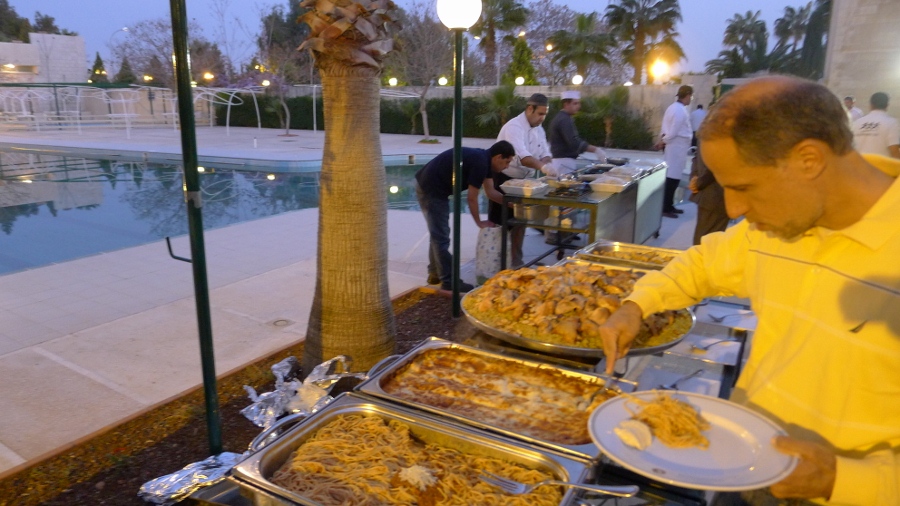
I wince whenever I see exposed outdoor swimming pools in desert countries like Jordan – or Israel. They had a passable buffet, though.
I will admit to a bit of a white lie here. When my tablemates asked me what race I was running the next morning, the event organizers were right nearby, and I wasn’t sure what the policies were for a non-runner, non-racer who had just happened to be handed a ticket to the dinner from a friend. So I lied and said that I was running the full 50 kilometers from the middle of Amman to the Dead Sea. The Englishman and I chatted for half an hour after everyone else had left, and I was very embarrassed to continue the lie, but by that point it would have been weird to lean over and confess that although everything else I had said about my work with Iraqi refugees and Entity Green was true (even if it was from two years ago instead of now, another lie I spun so as to not mention that I was only here on vacation) – I wasn’t going to be running the race. He looked flabbergasted when I mentioned I was going out for drinks with some friends after this dinner. “But your 50 kilometers starts at 5 in the morning – don’t you want to get some sleep?” He gave me his email so I could send him a picture we took together – I’ll write to him when I get back to America and confess my deception and ask him how his race went. He had been looking forward to setting an unofficial speed record, because he was doing the half marathon (21km) on skates, instead of running. I hope the race administrators didn’t give him any trouble – Jordanian administrators love nothing more than creating hassles, after all!
It was lucky that I wasn’t running the next day, because a few pints of familiar Amstel beer at Rover’s Return in West Amman went a long way to causing me to sleep in the next day. My friends Mai and Hala, who also went to Austria with me in 2010, were some of my friends who came to the bar, and we had fun going over the old pictures from our trip on my laptop. I got to meet Mai’s fiancee Khalid for the first time, and my friend Rula gave me a free ticket to an Arabic instrumental concert at the Ras al-Ein cultural center that she and Mai play in. My old biking friend Rami is a mutual friend of Mai’s (they used to be coworkers at Intracom, the sponsor of my 3rd-placing Dead2Red cycling team in 2010) and so I’ll be able to sit with Khalid and Rami at the concert! I’m looking forward to that quite a bit.
Hala holds picture of Hala, holding a picture of Hala. The point was to replicate the extremely serious expression she was wearing for the Austrian photographer.
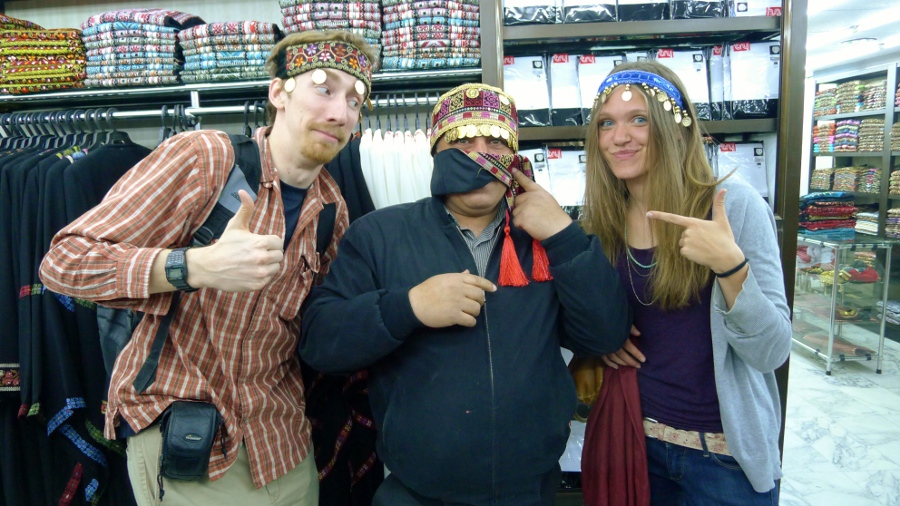
Identities of certain clothing store owners have been hidden under protest that "headdresses are for women only!"
At first it seemed like Jordan had become a quieter city in my absence. Less traffic, fewer weather-beaten looking pedestrians. However, that may have been because my arrival in the country was at 2:30 in the morning. I had been afraid that the visa price at the airport would have tripled (some of my friends had warned me of this possibility) but it had only doubled, to JD20. One thing that American visitors to Jordan never have to worry about is the exchange rate changing – the currency is still locked to the USD at 1.41USD = 1JD. Makes planning much easier.
My former director at the PTEE, Dick, picked me up from the airport. The tall man in the pressed wool jacket was easy to pick out from the crowd of shorter Jordanians around him. My seat from Frankfurt to Amman had been near the rear of the plane, making me one of the very last passengers to make it out of the security checks.
In all seriousness, it didn’t seem like much had changed at all as we sped through the quiet city. Airport road had been completely torn up, not for touristic remodeling as I had originally thought, but for the placement of water transport pipes below the road. It’s going to be interesting seeing that road in the daylight and all of the bypasses and switches on it. If I thought Jordanians were crazy drivers before… But the huge twin towers of the Jordan Gate buildings still sat derelict and unfinished, a sad reminder of poor financing protection in Jordan. It looked like some of the huge panes of glass had fallen off.
My old colleagues at PTEE and Whitman were happy to see me the next morning. Dick hadn’t told any of his colleagues, but his wife Robin had mentioned it to some of her teachers at Whitman, so various levels of surprise played across people’s faces. The last time I saw the new PTEE building, it had just been purchased and was basically little more than rubble – the inside was a total disaster area. Now, the second floor had been completely finished and everyone had moved in. The place looked extremely modern and western, with hidden upward-facing lighting on the ceiling, and in-wall cabling for power and networking – no trunks on the walls here, unlike everywhere else I’ve seen in Jordan!
I jokingly asked Muna, Whitman’s secretary, whether anything looked different about me since I’d last been there. The only difference (I hope) was the mustache I brought back as a souvenir from Costa Rica, and she pointed to it and said, “you have a schwarib now, I see!” I pretended to mishear her and said, “you mean, this schwarma on my upper lip? Yes, I’m saving that for later.” I’ll admit I’ve used that joke several times with my Arab friends in the past few days; no more than once per person though. I suppose it’s the vocabulary equivalent of saying that I have a mustard on my lip.
Speaking of schwarma, one of the moments I had been waiting for was biting into one of the amazing grilled schwarma from the little shop a couple blocks from Whitman, a place Silas had introduced me to years ago. Their prices hadn’t changed from 60 gersh per sandwich, and neither had the taste. I need to franchise some of these schwarma restaurants into the USA. I can’t go for twenty months without having one anymore!
I did a once-over Whitman to make sure that they hadn’t made any major changes I’d missed, like adding yet another floor onto the building like they did in the summer of 2009, but once satisfied, hung out in the teachers lounge and chatted with my former coworkers when their schedules allowed it. Several of them started to ask me computer-related questions, then stopped with slightly embarrassed looks on their faces. “It’s like you never left!” one commented.
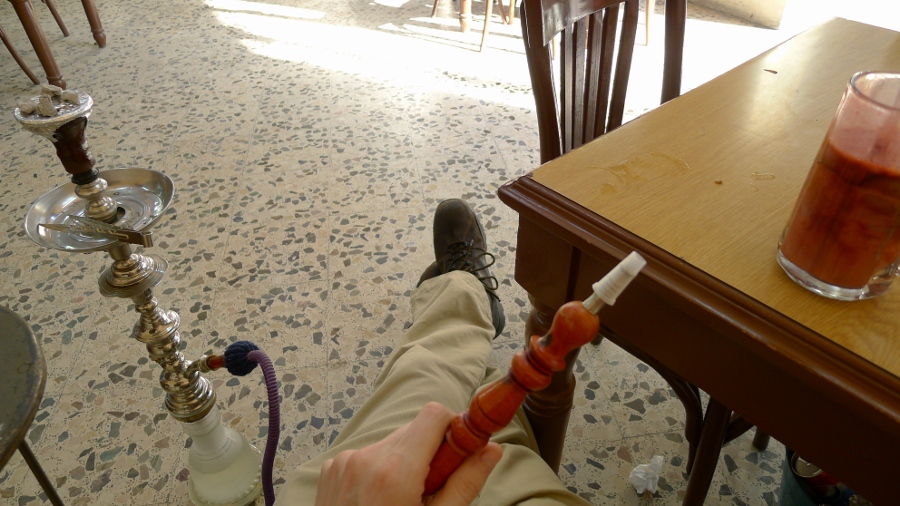
After Whitman, I took a leisurely hour at al-Borij to enjoy a smoothie and a hookah. Here was one place where I could count on prices to stay the same – JD2.50 for the two items!
As it turned out, one of my former high school classmates from Brodhead was also in Jordan, and I was able make excuses to myself to get more schwarma and then go to Hashem’s in the bellad with her. I hadn’t seen Rachel since graduation, almost 8 years ago, but we were both here for a vacation – me from America, and she from the Arab Gulf, where she currently works. She hadn’t yet tried the famous food at Schwarma Reem or at Hashem’s yet, so I met her near the battered old Reem stand (already being heavily trafficked even though it was only 6) and made our order. The manager of the shop recognized me right away through the crowd and immediately called out to the 3-4 men carving the meat and slicing the vegetables – “Zakky’s here – he’s come back to Jordan!” He reached over two or three shoulders and grabbed my hand in a hearty handshake. His employees, of course, were extremely busy, but I stopped by their window and they looked up, grinned, and waved. “Try not to wait two years before coming back again!” one of them called out to me. I didn’t have time to make my schwarma/schwarib joke to them before I was shoved aside by droll-faced Jordanians but it was probably for the best.
Rachel and I had fun comparing the differences and similarities between the Gulf and Jordan – things like heat, cleanliness of the street, and so on. I recalled that when I was still living here, we had exchanged a couple of messages about her interest in working in the Middle East, so it was great to see that she had brought her goal to fruition. As she only had a couple days left in Jordan, and I needed to do some souvenir shopping anyway, after a second snack of fuul at Hashem’s we combined forces to hunt for some deals, or at least shops that were willing to haggle with Americans.
I first stopped by the open-air keffiyeh shop run by two guys around my age. One of them recognized me, and smiled broadly. I told them I was back for more keffiyehs – they’ve always given me good prices for high-quality keffiyehs, made by the “Basaam al-Owsli” factory (Basaam the Original) that Arabs have told me is a good buy. I picked two up, and extended a ten-dinar bill in my hand for them. They wouldn’t take it, telling me – “we know you will come back again, please take these ones for free and tell your friends about us!” I thought I’d seen everything in Jordan, but I never could have imagine street vendors in the tourist-heavy bellad area giving away their product not just at a discount, but belaash – for free. So, ahem, everyone who happens to find themselves in the bellad and in the market for keffiyehs, check out the little shop inside the “Souq al Bisharat” – and you can contact Ziad, the man I spoke to, at 079-688-7899. Tell ’em that Zach the ajnubee taweel sent you and he’ll give you a great deal (although probably not quite as good as the one he gave me; you’ll have to go there at least a half dozen times to get that!)
We wandered the streets for about an hour. Of course, every vendor attempted to woo Rachel, and most of them assumed that she and I were married and playfully demanded to know where the babies were. Sometimes I swear there’s a script that these guys all read for their lascivious yet friendly behavior. Of course, these generic vendors haven’t been the only ones – some of my own friends and colleagues have coyly requested details and information about relationships. I suppose this is the Christian Conservative way, though – get married, have kids, then travel around the world spreading Christianity and aid. Or at least two out of three.
Frankfurt's skyscrapers, as seen from the train into the city from the airport.
I’ve begun a return trip to Jordan. It was rather spur of the moment, as ticket prices suddenly dropped $300 for the first week in April, and I bought them on a whim last month, a craving for schwarma and wadis re-awakening deep within me. I’ve just finished off the first part of trip, a 11 hour excursion through Frankfurt, Germany, the location of my single layover before reaching Amman in another few hours.
My morning started off inauspiciously. I apparently neglected to drink enough “brain juice” (i.e. coffee) to function properly, and as I sat at the kitchen table emptying out my wallet of every nonessential, I for some reason thought I wouldn’t need my debit card, only my credit card. Of course, when the taxi dropped me off at the Memorial Union 20 minutes later and I went inside to withdraw some money, I facepalmed my head pretty hard. What choice did I have? I called up the same taxi company (Green Cab) and requested a rapid round-trip service to my house and back to the Union again to collect a single piece of plastic, tripling my taxi fees. I suppose I’ve paid the stupidity tax for the day.
Transportation here in Frankfurt, however, has been a breeze. The eight hour journey, plus a seven hour time zone change, passed smoothly (I was amazed that Lufthansa has apparently embedded tablet computers, like Kindle Fires or something, into each plane seat, allowing completely autonomous movie/music enjoyment without needing to follow a plane-wide schedule). I didn’t get more than an hour of sleep, as the seats seemed to be gradually moving closer together in a vise-like fashion, but I figured I would find some more brain juice in Germany and play it by ear.
I had heard from friends before I arrived in Germany that there just isn’t much to do in Frankfurt. But with almost 14 hours between my flights, there was no way I was going to waste it sitting in an air conditioned advertisement center like Frankfurt Flugelhafen (which, by the way, should go on record for the funniest word ever).
I bought a Frankfurt Day Pass (I love these things; you may recall me using them in Salzburg, Innsbruck, and Vienna two years ago) which gave me unlimited public transport usage and 50% off all museums. It wasn’t quite as nice as the free-access passes that the Austrian passes gave me, but this pass was only 9 euro, instead of in the 20’s like the others. It was a fair trade, especially since I had such little time.
As the train burst out into the 7 AM sunrise, I blinked and found myself staring at a wall of graffiti. Was I actually in New York? The graffiti even seemed to be in English. However, the copious huge and lovely conifer trees surrounding me definitely weren’t in New York, and when we rounded a corner and saw an immense football (soccer) field, my juice-less brain finally hooked into the “yes, you are in Germany” mode.
At least a dozen skyscrapers rose across the Main River to greet me. I disembarked at the stereotypical European-esque central train station, the Hauptbahnhof (they all basically look alike, I’ve realized) and headed east into the city. My map, which the friendly lady at the Frankfurt Day Pass booth had also given me, pointed me towards the old city which was just ahead.
But first I wandered through a decidedly new-city neighborhood filled with nothing but ads and shops selling sex toys and sex shows. At this hour in the morning nothing was open of course, and it was basically just me, some street cleaners, and a few tired-looking businessmen who owned the sexy streets of Frankfurt. I was quite hungry; my chicken teriyaki on the plane had been either 6 or 13 hours ago and I wasn’t about to frequent the numerous McDonalds that were strewn about between the sex shops.
I finally found a place that was open, a suspiciously chain-looking restaurant named Der Bäcker Eifler and had a cappuccino and some sort of pastry with strawberries on it. Revitalized, and smarting against the cold of the open-air shop (there were no seats either, just tables to stand at) I decided to visit the Seckenberg Natural History Museum and wait until the sun rose higher in the sky before doing any more walking exploration.
The museum was positively gorgeous. They had exhibits ranging from plant evolutionary biology to dinosaurs to meteorites, and also continental divide, mammalian, reptilian, and avian exhibits numbering in the thousands, and a special exhibit on spiders that I did not pay an extra 2 euro to see. Unfortunately, 90% of it was in German. I suppose I shouldn’t have been too shocked, being that I had firmly decided that I was in Germany, but at the same time, I was. I’m used to major metropolitan museums in every country I’ve been to having their descriptions in the native language, and also English. Maybe Arab countries have spoiled me. Most of the reptiles had been translated into English, as well as most of the dinosaur skeletons, but that was about it. It was even more painful because the exhibits were amazing, with diagrams and flip charts and all kinds of details that I would have loved to have known more about. I had even asked the woman at the desk when I bought my 50% reduced ticket if the exhibits were in English, to which she replied “ya!” A slight miscommunication.
The museum was so good that even with me being able to understand very little of it (and skipping the plant evolution section altogether) I stayed there for two hours. By the time I left, the museum was packed with little German children, who appeared to be having the time of their lives. I will admit to jealousy. I wanted to take an educated-looking German person hostage and force them to translate the museum into English for me.
They also had an exhibit on human biology. Children's museums in Germany are a little less conservative than ours.
I next headed up to the Main Tower, which might seem like a boring name, but then you have to remember their river is named Main, too. The elevator had a small counter in it which showed us the rate of speed we ascended at (around 18 km/h) and we shot up to 190 meters in about 20 seconds. The sun was out by now and the observation deck was comfortably busy. I was expecting Empire State Building levels of “don’t kill yourselves, morons” security, but the the railing only came up to my hips. A lone security guard wandered the concrete deck, frowning at air molecules and crossing his arms. I could distantly see the Flugelhafen (hee hee) in the distance, and unsucessfully tried to find the museum. I was, however, able to use my map and my high vantage point to plot out my walking path around the old city.
By this point it was a little after noon, and I needed something besides sugar and caffeine to keep me going. I didn’t want to follow the instructions of my guidebook, and instead lucked out – as it was lunchtime, I merely watched the flow of importantly-dressed businesspeople flowing out of the skyscrapers, and went to the shop where I saw the most well-dressed people congregated. Ebenster’s Suppenstrube was my choice, and for a little under 3 euros I got a rostbratwurst on a kaiser roll with brown mustard. Wisconsinites rejoice; we truly are the descendents of these people. I would have photographed my immense wurst (it was over 8 inches long) but the people in business suits were already casting sidelong glances at me as I ate at their picnic tables in the sidewalk, so I decided to forgo the photo, this one time.
I wandered into the old city, and up into the “Dom” or cathedral. My Frankfurt pass got me a 1.5 euro ticket to climb the bell tower – 298 steps, a mere 66 meters. Remember how it took 20 seconds to get up the Main Tower in the elevator? It took me a good 10 minutes to climb a mere third of that, but I appreciated the view all the more. Sandwiched in a little crevice-like catwalk space, right below the spire of the main tower, surrounded by carved red gothic stonework and tacked-on lightning rods, I felt far more adventurous here than on the wide concrete slab of the Main Tower. Besides, from here I was only a stone’s throw away from the interesting architecture of the old city, instead of a hundred and fifty meters above it. Pigeons fluttered around me, but they didn’t land to cast aside their loads (so to speak): the church had wisely installed thin metal wires on every upward-facing surface above the catwalk, preventing birds from landing in opportune places.
66 meters doesn't seem like much compared to 200, but when you're climbing up steep stairs in a low-ceiling tower…
After the harrowing descent (cracking my forehead into the low stones several times), I headed across the Main into the Suchenhachen, a district known for its alcohol brewing. My crossing took me over the Eiserner Steg, a wrought-iron pedestrian bridge with hundreds of padlocks curiously locked into every iron crevice, sometimes in clusters of a dozen or more. I peered over at one group, and found that they had couple’s names and dates engraved on them. I can only assume it’s a Frankfurt tradition that when couples get married, they add a lock onto the bridge to symbolize their unbreaking love.
I liked the message written in English at the bottom.
I was looking for the best apple wine-serving pubs that a young tourist could afford. My guidebook recommended three different ones, but curiously enough two of them were completely closed on Mondays. I couldn’t imagine why, but it made my choice of Kanonesteppel all the easier. And what a great choice it ended up being!
I walked hesitantly into the courtyard, afraid of another defeat after being turned aside at my previous choices. A solitary man was walking ahead of me, and disappeared into the building at the opposite end. I followed him into the building, and rounded a corner to find him being handed a huge jug of dark yellow liquid wine by a smiling bartender. I found that the tender spoke English quite well, and we struck up a conversation about the food, the wine, motorcycles (he had just purchased a new Harley Davidson, and his eyes lit up with recognition when I said I was from Wisconsin). The barkeep, Marcus, gave me free samples of the wine and his favorite item on the menu, frankfurterschnitzel. Of course I sat down to be served a full meal with a couple glasses of the tasty wine, and nearly exploded trying to eat it all. Marcus patted his stomach and commented, “this is why most Germans look like this! You must eat more, you are built like a stick!” As I paid my check using my last euros (I had withdrawn 30 for the day, not counting the Frankfurt pass) he produced a wineglass filled with an even dark yellow beverage with a fruit floating in it. “My gift to you,” he beamed. It was an apple brandy with some sort of fruit called a mispel floating in it, and although the room swam a bit as I drank it, I managed to find Marcus’ extended hand and give it a firm and grateful shake.
I had seen these blue stoneware jugs all over the place; now I knew they were for storing apple wine. I got to pour my own glass!
I had given myself 2 hours of leeway to make it back to the airport before my flight to Amman at 8:20 PM, but it turned out that this much caution was unnecessary. Like most modern European cities, there is a rail station built underneathe the Flugelhafen (last time I use it, I promise) and I was able to make it from Kanonesteppel to the terminal in under 30 minutes. As I climbed the escalator into the main concourse, I was suddenly surrounded by tweeting, honking, and drumming people covered in protest signs. I thought I had stumbled into a march from Occupy Frankfurt (I had seen their tents assembled as I walked past the sex shops this morning) but it turned out that they were protesting the expansion of Frankfurt Airport due to the massive noise pollution it had created in their small peaceful villages to the southwest of the city. A young woman about my age (with impeccable English, of course) explained the situation to me, and when I mentioned that I wished there was something I could do to help, she smiled and said “anyone from anywhere in the world should make their solidarity known to our government!” When I scratched my name and address down on the piece of paper she extended to me, she noticed my name and said “Your surname is Heise, so you are a German anyway! How wonderful to have a German American stand with us!”
Now, as I sit at gate B20, waiting for the loading to start in 20 minutes, I’m surrounded by the familiar, yet sadly unfamiliar sound of Levantine Arabic. How much have I remembered, versus forgotten? Will my old Zain phone number still work? Will taxi drivers smell blood in the water again like they used to when I first arrived? Most importantly, is the Bu’ab al-Urdan completed yet? I’ll find out very soon.