HeiseHeise.com

The Personal Blog of Zach Heise

A random image

A random image. Reload page for more. Want more info?

Month: January 2013

  • Cooking, Elephants, in Chiang Mai

    With our elephant an Mahout at the Ban Chaang sanctuary

    Oh the importance of the comma. These past couple days have continued the relaxation binge we’d began in Phuket – we’re more than content now to be carried luxuriously from destination to destination by various groups now, instead of driving! After arriving late in the evening at the Aoi Garden Home in central Chiang Mai, we enjoyed their cozy room, but not so comfortable apparently rock-filled mattresses only briefly before beginning a cross-town hike to our luxurious lodgings at the Tanita Guest House.

    Sorry Ray, but this toad has ceased to be.

    On the way, we stopped for directions (and for the free wifi) advertised at the Vegetarian Restaurant of Chiang Mai, a restaurant owned and managed by an affable chap from England named Ray. I enjoyed my vegetarian pad thai (easy to make, just leave out the chicken or prawns I guess) but Christine was more iffy on her plate of what appeared to be straw, or at least hay. Ray called out “ehya guys, lookit thisear toad I found next to the loo!” (seriously, his accent was quite thick and difficult for us Yanks to understand). “Thinkee’s alive?” he asked with some concern as he brought the toad to our table on a napkin. “Still soft…but poor bloke isn’t budgin’” he then reported sorrowfully when he set him into a small pond near us. “Sorry chap, inta the bin with you.” Good choice for breakfast conversation.

    The Tanita House was a beautiful example of old Thai-style architecture, and Christine and I had an entire small house all to ourselves for $80, complete with three bathrooms, a dining room, a sitting room, and two bedrooms with queen-sized beds and balconies. Very luxurious. They also gave us a whole six pack of bottled water in the fridge downstairs, which we didn’t need and we instead distributed it out to beggars out on the street; it was a hot day. We spent the morning just walking the streets and eating, while hunting for Aeon Bank ATMs all the while, of course (still trying to avoid that $5 surcharge!). No luck finding that, but plenty of good food was had.

    Christine poses in our room of our private Tanita House, house.

    We had arranged an afternoon trip to the Baan Chang Elephant Sanctuary, so we were picked up around 3PM from Tanita by a private bus and driven out deep into the countryside to meet our guide and mahouts. Tan, the guide, was very businesslike and professional – he immediately had us change out of our street clothes and into blue jumpers, telling us that “by the time you’re done riding and cleaning the elephants, you would not want to smell yourselves anymore!” I believed them; the elephants out in the field a hundred meters from us were already creating a distinct perfume that permeated the air. We crossed the road and went over to them, resplendent in our blue duds, with Tan enlisting myself and a few other men to carry a couple heavy baskets filled with sugarcane and small bananas.

    The elephants knew what that meant, and looked over at us expectantly, pulling gently on the chains they had tethering their feet to the ground. Each elephant had a young, dark-skinned man standing next to it, or in some cases, playfully lounging out the elephant’s back. Christine and a few other women were a bit keen to ask questions about the leg chains, as well as the metal spiked sticks that the Cambodian mahout trainers each carried. Tan drew himself up a little bit and responded a bit defensively, telling us that we needed to remember that these were not ‘pet’ elephants, nor tame elephants – this was an elephant rescue sanctuary, so all the elephants we were seeing were from bad backgrounds or cruel owners, and Ban Chaang purchases them for thousands of USD in order to give them a bit of a better life. Many of them are violent to other elephants, so they have to be restrained to prevent them from beating each other up.

    Tan informed us that there were some companies that will tell tourists they don’t use the hookstick on elephants. “That might be true, but then they are hiding a spike in their palm or wrist to control the elephant, to make you think that they are different from other organizations. An elephant is not like a dog or cat or a pet; they learn that the stick stings so they will behave themselves. We only use them if we absolutely have to, but normally, showing hookstick to elephant is enough to make elephant behave.”

    The elephants were oblivious to this and continued to happily stuff their faces with the food we were providing them, suggestively hooking their trunks and pointed into their open mouths. “Always put the sugar cane in sideways, not longways,” Tan instructed. “Otherwise it could get caught in their throat.” As for the bananas though, we really could just actually place it right into the elephants’ mouths – they seemed quite content, and one elephant with a set of clappers around his neck was even more content.

    I’d never really imagined what elephant teeth looked like…as it turns out, they’re pretty different from ours!

    His mahout grinned at Christine and I, and crooked his finger at us to come up right next to the necklaced elephant. The mahout called something then, and immediately a long trunk snaked around my shoulders, coiled around my neck, and kissed me on the neck with a loud sucking noise. “He’s a special case,” said Tan with a smile, watching us. “He is the only really tame elephant here; we purchased him when very young so we taught him a lot of things, and we even let him run free in the woods at night because he doesn’t damage the fences or farmers’ crops the way the others might. He wears the necklace so that we can hear him coming and going.”

    The tame elephant gives Christine a squeeze – this would probably not be covered by travel insurance!

    After our baskets were empty. Tan gave us each some riding lessons on the elephants – unlike at the cheap tourist attraction in Phuket a few days ago, we would be riding bareback, so we learned some calls to get our elephants to kneel to allow a rider on and off, to go, to stop, and to turn left or ride. Bai, meaning go, would be the one I would be using a lot. However, I also wanted to ask Tan the most important command that he didn’t mention – how to congratulate our elephant for something. Tan reached up to the elephant that Christine and I were sharing and patted the knobby forehead, hard, and rubbed the spiky hairs vigorously. “You touch here, very hard, otherwise he cannot feel it. Then you say Deeeeee…deeeeee! It means, Good, good!”

    (more…)

  • Relaxing in Karon Beach, Phuket

    The ‘big Buddha,’ built on a hill just south of our beach, was built for the king’s 80th birthday. You can see a worker under his right hand for scale!

    I might have gained 10 pounds in my past two days in Phuket, thanks to the delicious cheap food that I’ve been eating at every possible opportunity. Christine and I have just gotten to our hostel in Chiang Mai, Thailand, but I don’t know how anything can top Phuket (pronounced Poo-ket, causing me to lose the bet I had with Christine, darn it) and the two and a half days we spent there.

    After I finished my last blog entry early in the morning of the 4th, I almost locked myself into the internet-capable lobby of the POD Backpackers hostel – those magnets they use to hold the doors shut are really powerful, and I thought for a second that they turned off the unlock switches at midnight or something. But after a quick shower, I was ready to make the trek to the pickup station for the “low cost commuters terminal” or LCCT. The prostitute was no where to be found at this time of morning, and despite hustlers trying to get me to pay twice as much for my bus ticket, I found one selling for 8 ringgit, and immediately fell asleep on the bus.

    I’ve never seen an airport as ugly as the LCCT; it’s obvious that they call it low-cost for a reason; it’s built like a warehouse and may have in fact been one. Fortunately, the Asia Air plane they provided for us didn’t shake apart in the 2 hour flight from Kuala Lumpur to Phuket, and I found myself emerging, blinking, into the bright and sunny Thai tropics, where I was immediately shaken down by taxi drivers, who were somewhat turned away by my insistence that I didn’t yet have any Thai baht. A woman behind a counter was happy to offer me a bad exchange rate, so I took my chances with a nearby ATM machine.

    It was then that I discovered the nasty little trick that 99% of Thai ATMs have in store for users, both foreign and local – a 150 baht, or 5 USD, surcharge applied to every single transaction. Oh, you’ll find lots of ATMs in Thailand, but only a tiny fraction of them don’t levy a 5 dollar fee, and those are normally found in big malls and supercenters, and often from a single bank called Aeon. I sucked it up, and paid the toll – and had a few thousand baht, 200 of which I needed to take the hour long shuttle bus ride from the airport at the north of Phuket island, down to Karon Beach.

    I was quickly impressed by people working in the Thai service industry. My shuttle bus contained 8 other fellow foreign tourists, and the bus pulled over about 10 minutes from the airport at a strip mall, where we were all politely requested to exit the bus and enter a building, which had five women at desks, asking us for the name and phone numbers of our hotels. In five minutes more, we were all back on the mini bus and on our way. I was the only person going to Karon Beach (every one else was going to the much more party-centric Patong Beach, just a bit north of me) but although the driver told me he’d never heard of “Karon Beach Clinic,” the guesthouse I was staying at, he had already gotten semi-precise directions from our hosts on the phone, thanks to his colleagues at the office. Very nice!

    The hostel was absolutely wonderful for the price we had paid for it. Christine’s stuff was piled in one corner, since she had arrived last night, and I wrote her an email joking that since this place was just costing us $23 a night, less than what I pay to live in Madison, we might as well just retire to live in a hostel, right now. Unfortunately, although the price was good, I hadn’t withdrawn enough baht from the first ATM to pay for both nights at the hostel, so I gritted my teeth and suffered another 5 dollar surcharge at an ATM in front of a supermarket just down the street. They also sold beer by the bottle for 90 cents apiece, though, so that took the edge off a bit.

    I had no plans for this first day, nor any part of time in Phuket. I had originally planned to go on a “discover scuba” adventure with the same company that Christine had left with, but strange chest pains back in Malaysia had worried me, and I had cancelled my tentative plans (readers might recall my bout of collapsed lung problems in late 2011). But I found a random tour group website and booked a “combined package” day event that included whitewater rafting, ATV riding, and an elephant ride. Christine and I were already hoping to do the latter in Chiang Mai in a few days – and probably with a more reputable organization than a company which sells a full day of activity for $60.

    But I needed to find something to do for the rest of my first day. I asked our friendly hostesses at the Karon Beach Clinic where I might find a good place to eat like the locals would, and she told me to go up the road to the nearby beach of Kata. Well, I tried, but I’d been awake for the past 36 hours without much food in me and I wearied quickly, trotting down the sunny asphalt towards a town of unknown distance. Although I was tempted to stop at establishments with names like “Non Stop Bar,” featuring fat old Western men slumped over with beers in front of them, I was still hoping to find a local place. I spied a little open-air cafe on my right, and I gave in and went for it – and boy, was I glad I did.

    The restaurant, called Between Restaurant, was manned solely by a young Thai named Ton (pronounced Tone) and his slightly younger brother. I was the only westerner there – success! The small menu had a couple pages in English, and the prices didn’t seem to be more than a couple bucks per plate. I ordered 2 dishes – the Pad Thai and the garlic fried pork. Ton whipped everything up in about 10 minutes and had the plates in front of me, expertly presented with a lime and springs of beansprouts. It was fantastically delicious and I promised him I’d bring my girlfriend with me as soon as possible – and where did he learn to cook like that? Ton told me proudly that he’d been working in hotel restaurants for 4 years, but only 6 months ago had decided to open up his own.

    Don’t be fooled by Ton’s simple workstation – the man works food miracles!

    Happily full, I napped in the hostel for a few hours, before resolving to get some sightseeing done before the sun set. I wandered the shops and streets, looking for sunglasses (I had forgotten my own on the counter at home) thatweren’t obvious fakes, but every single thing on the streets were branded “Dolce and Gabana” and “Puma” and “Oakleys” – and selling for $2 apiece, I’m pretty sure they weren’t. I asked the vendors if they had anything without a namebrand on it and they looked absolutely dumbfounded. Going into an optical shop, I was confronted with the opposite side of the spectrum – they were asking $90 for a pair of sunglasses in there. Where is the Walmart middle ground of a generic, UV-blocking set of shades for $20? I gave up and headed on to the beach.

    I relaxed and read a book for awhile, and donated 200 baht to a wandering woman who had official looking paperwork saying that she worked with orphans (I even got a receipt, stamped by the Ministry of Public Works). Eh, even if she was a scam artist, at least I feel like I did my good deed for the day. I watched the tourists riding jet skis out in the ocean and wondered how prevalent jet ski scammers were on Karon Beach – apparently they’re quite common elsewhere in Phuket. When I bothered to ask how much they were charging, they told me it was too close to sunset to rent to me anyway, and the agents leapt onto their skis and disappeared to the north, towards Patong.

    I got a haircut on the way back, from an elderly man named Pon who was watching TV with his wife when I entered. I was leery of scams now, and when he told me it was 200 baht for a haircut, I raised an eyebrow. His wife shouted something at him and he immediately said “okay, okay, one hundred!” I don’t know what she said, but as Pon slipped the plastic apron over me, his wife toddled up to me, smiled happily, and pinched my cheek. Guess I was adorable enough to merit a discount or something? Pon offered to give me a shave as well, which I accepted – it was my first time ever receiving a professional shave with a straight blade razor, and I wondered if it was a good idea to demand discounts from someone who was gently caressing my throat with a razor blade. With my head craned up, I saw the prices written on the mirror – Haircut, 200 baht, Shave, 100 baht. I felt guilty – Pon was just asking the regular price; he wasn’t trying to scam the tourist. When he was finished, I gave him 300 anyway, and though he told me in extremely halting English that we had already agreed on 100 baht for everything, I told him he did good work and I didn’t want to shortchange him. Zach Heise: terrible at bargain hunting with locals.

    Pon’s about to get started on my coif. I wonder if he always wears that, or if there is something particularly terrifying about my hair?

    Even though it was only 9pm, I was ready for bed again, as I knew I had to be up early to meet the tour bus. The driver was a dry young man with a penchant for shades, hair gel, and cigarettes named Annan, and since Karon was the first stop on his pickup list, he and I were the only ones in his 12-seater van. He didn’t seem inclined to talk much at first, but he noticed I was taking pictures of things, and as the vehicle picked up various Australians from various hotels, he started pointing out interesting sights to photograph, usually just upcoming temples and whatnot (of which I’d already seen dozens in Malaysia) but even so, I appreciated his effort. It turned out that this adventure tour was quite far away – on the Thailand mainland, actually. Crossing the bridge only took 30 seconds, though, and we were soon deep in the jungles around Phang Nga.

    My fellow adventurers were almost exclusively Australians, with the exception of 3 Kuwaiti guys who had been staying at a rather opulent hotel at the top of a hill in Patong. Our whitewater-touring boats could only seat 4 people each, besides the two Thai pilots, so I was paired with three Australians that I’d struck up conversations with in the van – Jarrod, Luke, and Darryl. As we stepped out of the lodge by the road, fitting our helmets and life jackets on, I saw the river for the first time and realized that it definitely wasn’t going to be like the private river that Christine and I enjoyed in Costa Rica last year – this river was absolutely packed with people. There must have been 50 boats in the river, representing at least 5 different rafting companies, and the shores were swarming with people too. What proceeded over the next hour was fun, in a bumper-boats sort of way, but not what I was expecting. Luke in particular, a big, burly miner, was greatly enjoying the “splash water into other boats as rapidly as possible” part of the trip, and I was foolishly wearing contacts, so I spent most of the time trying to cover my eyes up as Luke’s targets retaliated. Our grinning guides only gave us 2 paddles to share, so Jarrod and I switched off between Luke and Darryl, who were cousins, to have a go at the rapids. I wonder though, if they only gave us two paddles for the four of us in order to purposely keep us from going to fast, or being able to bypass the constant thumping into other boats we were doing! We passed under at least five rope bridges, all covered with Thais with cameras, snapping away at us. I already knew that we were going to be offered to buy our adventure photos as soon as we got back to the lodge!

    Definitely not like the private river we had in Costa Rica, on which we were one of 3 boats, if I recall rightly.

    (more…)

  • A lunch for leeches

    The six of us with Kevin, and the Hammer waterfall

    My time in Malaysia is almost at an end, but what an amazing adventure we’ve had over the past couple days! This afternoon, we returned from a two-day hiking and camping trip (with the awesome hiking group Open Sky Unlimited) out in the rainforest to the northeast of Kuala Lumpur, and I just got back from a few last hours of hiking around the city with Farahnush. I figure I might as well not even bother to sleep tonight, as I have to be up in just a couple of hours for my bus to the airport, where I’m heading to Phuket, Thailand next.

    We only had one worry before our camping departure on the morning of the 2nd: would we all make it to the pickup point in time? It was another early-rising morning, as I mentioned in my last blog entry – our native Chinese-Malaysian guides, Kevin and Amos, were expecting to meet us at 7AM outside the K.L. Sentral train line in the center of town. There was a faint glimmer of the sun on the horizon when the taxi picked Farah, Christine and myself up from Cyberhomes, and when we told our driver, Solomon, that we needed to be in K.L. at 7am, he chuckled and said he would do his best. In my opinion, we were lucky to get a well-spoken and chatty taxi driver – he was a Hindu Indian himself, so he told us what it was like to live in a Muslim-majority country with a Muslim king, explained some of the laws of Malaysia, and gave us his opinion on the stunt-riding motorcycle boys we’d seen yesterday on our way down from Penang (“they’re all crazy. It’s illegal but they don’t even care – no police officer can catch them all.”)

    The other three members of our party were Abu Bakr, Mohammad, and Abdush, who were a little late in finding us (hence the scare) but great company when we arrived. All three of them spoke perfect English – one had gone to school in California for awhile – and so did Kevin and Amos. Interestingly enough, I noticed right away when they took us out for breakfast that they spoke English to each other even for their personal communications, not Chinese or Bahasa Malay. Amos chuckled and grinned over the table at his friend, telling me that Kevin didn’t speak Chinese very well so they stuck to English. The place that they took us too was only a few blocks from Batu Caves, and served us delicious Rohti bread packed with all manner of great stuff, like eggs, cheese, chocolate, and bananas. I was also introduced to soft-boiled eggs (for the first time, surprisingly!) and to some hot and cold types of Malaysian sweet tea mixed with coffee.

    Well fed, the eight of us were split into Amos and Kevin’s two cars and we headed out into the wilderness, driving for about an hour until we turned off of the toll highway to a much smaller (and curvier) one. “This road actually used to be the main highway before the toll roads were built. You can imagine what it was like getting stuck behind a semi truck on these!” Amos quipped to Farah and Christine and I. Once we turned onto a dirt farm road, we passed a Buddhist karma farm – a place where monks would release animals that they’d purchased from vendors in the city so that a win-win situation could play out – the Buddhists gained karma points and the animals could live out their days in safety on a farm. There was sign with Malaysian writing on it showing a shadow image of a soldier outline shooting a second, convulsing outline. “These monks are really serious about keeping their animals safe!” Christine said. Amos told us that was just the default “no trespassing” sign that stores sold… the Buddhist monks probably wouldn’t shoot you to death if you came onto their farm.

    The only time we stopped on the way was so that Kevin and Amos could show the six of us a rubber tree farm up close – to my surprise, they told us that natural rubber was making a major comeback against synthetic rubber, due to the high cost of petroleum, and SE Asia was some of the best climates in the world for natural rubber trees. It was a scene not unlike the northwoods of Wisconsin – hundreds of tall, thin deciduous trees surrounding us, each with a small black tapper stuck in its side, with a bucket hooked underneath it. Kevin pointed out the lines on the trees, curving diagonally down towards the tap. “The farmer cuts a tiny section of the bark off in a diagonal way, and the rubber sap goes down the edge and drips into the pot.” There were some bits of pinkish-grey rubber all over the forest floor – it was really neat to just lean over and pick up some all natural bits of rubber, complete with chunks of dirt and bark mixed in with it.

    One of Christine’s pictures – Farah and I demo the stretchiness of natural rubber! You can see the black collection pots behind us

    Our little caravan bounced a bit further along the muddy track until we finally came to a halt in a clearing with a few farmhouses nearby. We were told that the farmers had given our guides free reign to use a section of their land to reach the larger jungle on the other side of the river that we were about to ford over. We were quickly buckled into large hiking backpacks, and I put on some classy bug-proof pants (think of it as a wearable screen door). We hiked a little ways along a service road, surrounded by mangostein fruit trees, before descending down into the river, fording it with our packs held high above our heads to keep our sleeping bags and hammocks from getting wet.

    Above the jungle river…where we could hear something getting louder ahead of us!
    On the left – tasty berries. On the right…well, they were described as “shit berries.”

    Kevin and Amos were great guides – they were quick to tell us about what we were seeing, like the various edible and non-edible jungle berries. Dark colors are good, we were told – avoid the lighter colors. I had been snacking on dark purplish-blue berries, and as I forged ahead like a truffle-hunting hog, I called back, “what about these little blue ones?” They looked similar to what I’d been snacking on, but Amos told me that I’d get a very bad case of diarrhea if I munched on those.

    Speaking of lunching, we were almost certain to get lunched on, Amos and Kevin told us. There were two main kinds of leeches in Malaysia, we were told – regular brown leeches, and tiger leeches with a long black stripe on them. They were in the water and on the forest floor, and would constantly be trying to get into our clothes. Farah and Christine, the only two ladies in our group, looked downright nervous about this, and Farah anxiously tucked her socks even more tightly into her trousers. Apparently, in a previous hike, one guy even found a leech merrily latched onto his testicles. These suckers (heh) weren’t messing around.

    At least there weren’t many mosquitoes or itching, biting insects around. We were told that the mosquitoes generally stayed where the large animals were, humans included, and therefore the forest floor was pretty safe to be. My bug pants would hopefully serve just as well as leech pants.

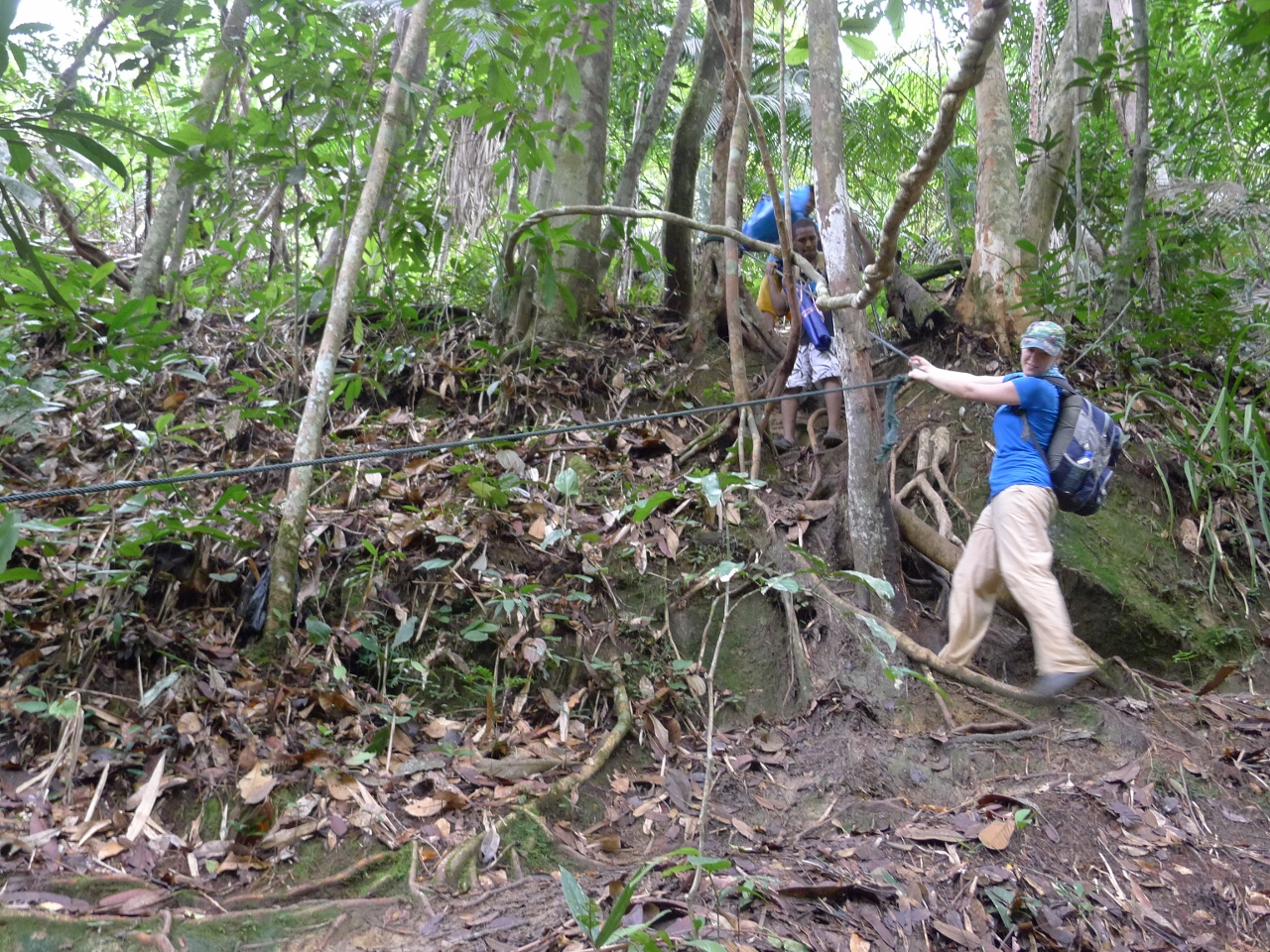
    Someone had strung up some nylon cords to help hikers navigate the very steep descent down to the river
    A tranquil area, if you don’t mind the pounding noise

    Right before we descended back down the level of the river, we passed by some huge stands of bamboo, knocked over in places by the frequent rainstorms in the jungle and splintered, exposing their razor-sharp edges to us. “Be careful as you step through here…very careful” our guides reminded us. The roar of the river had gotten steadily louder, and now we saw why – the Hammer waterfall was going to be our companion at camp. We got well-accustomed to its white-noise roar over the next day, and after dumping our bags on the beach, the other guys and I took turns leaping off of its rocky abutments  into the chilly water below. Even the temperature of the air around us was perfectly comfortable, the trees around us insured that not much sunlight hit the water itself.

    Christine goes for the leap, as I watch from the water below

    (more…)

  • What to do in Malaysia?

    The impressive Batu Caves, with the golden idol of Lord Murugan standing guard.

    Well, we’ve been off to a bit of a bumpy start the past few days, but I have confidence that things will improve. We’ve been here for 3 days now, and although there’s definitely been a few amazing/gorgeous highlights to file away, it seems like a lot of our time has been spent driving in circles, trying to find things to do!

    Fully divested of street clothes, I’m enjoying my snacks before my full-body massage.

    My dear adopted sister Farahnush, whom I last saw on my trip to Tajikistan in 2009, met us at the airport with her Sudanese friend Beebo. We were whisked off by airport-city commuter train to Bin Bentang, a nightlife-neighborhood where Christine and I were first introduced to the glorious SE Asian massage. Farah and Beebo had never had one in their 3-4 years living as students in Malaysia, but their friends had recommended a place where the employees wore orange shirts. Armed with this knowledge, we scoured the street twice – our senses constantly both assaulted and allured by the constant throbbing music of the nightclubs surrounding us – before Christine’s sharp eyes picked out a single man standing in the crowds of walkers, handing out flyers and wearing an orange shirt. We looked at the flyer he handed us – it was for a place called Liang Xin Reflexology Centre. Good enough for us! We followed the little man into an elevator which took us up a single story, and into a beautiful room filled with wood décor, long curtains, dim lanterns, and the faint sound of waterfalls. The two of us were left to our massages while our hosts ran errands, and our masseuses, Ida and Anita, did an amazing one-hour Thai massage on Christine and I, in adjoining curtained cells. Afterward, we were served fresh fruit, juice, and dragonfruit ice cream. The bathrooms, Christine reported, “looked amazing. I kind of wanted to live in there.”

    Farah and Beebo took us to a delicious Iraqi restaurant, where I had a chance to bone up on my Arabic with the servers (I already had been with Beebo, of course, but Sudanese is quite a bit different the dialects I know). The prices were refreshingly low compared with Hong Kong, but it didn’t matter; Farah had steadfastly refused to let us pay for anything so far. After a dinner of schwarma, Turkish coffee, and kebabs, Farah hailed a taxi for us to carry us back to her apartment in the nearby university city of Cyberjaya. The trip took about an hour and cost 50 ringgits, which at 3 ringgits to a USD, seemed quite reasonable. The apartment complex was named Cyberia Smart Homes, and with seven adjacent 15-story buildings, it seemed like it could easily host the entire population of my hometown of Brodhead. Each one looked identical and without our native guides, I would have easily gotten lost and slept on the concrete floor. I was tired enough to do so!

    We slept well in the college apartment dorm that Farah had procured from us from another student, and the next morning, Farah and Beebo had a car rented for us from another contact. So far, so good! The car, rented to us by the somewhat oily and shady-looking Ajnan, was a cute and compact little white Proton Saga, a Malaysian car company that of course, both you and I have never heard of before. Beebo volunteered to be our driver, and as neither Christine nor I had experience driving in the right-sided British style, and Farah didn’t have a license, we immediately agreed. And we were off! The Malaysian highways were numerous and confusingly labeled, but Beebo confidently navigated us through the heart of Kuala Lumpur to our first destination of Batu Caves.

    The first snag in our journey was all my fault. Batu Caves is a beautiful Hindu cave system hosting several shrines to the Lord Murugan, and has a massive golden statue to the man outside the front of the caves. However, besides being a monument and tourist attraction, it’s also the name of an entire city district in K.L. and when I searched for directions on Google Maps, I didn’t realize I was just getting directions to the district, not to the tourist attraction. Beebo, thankfully, was a master of direction inquiries, which he called out in friendly English to anyone who looked even slightly local when my directions proved false. Eventually, after politely refusing the offers of several taxi drivers to escort our car to the location for a small fee, we spotted the massive golden statue of Murugan from the highway.

    The statue stands in front of a large staircase, covered in tourists and macaque monkeys, that leads up to the cave shrine itself. A large and ornately decorated Hindu temple stands slightly to the left of the stair system, and in front of that, numerous Malaysian cart vendors helpfully sell small offerings of food and flowers that tourists can offer to the shrines and the monks within. The four of us selected some coconuts to offer the monks, reasoning that although they weren’t as pretty to look at as the ubiquitous yellow flower wreathes, the monks might be able to get more practical use from coconut meat and milk than flower petals. We offered our coconuts to a priest/monk in front of a particularly large shrine – there must have been at least a couple dozen in the temple – and then a few minutes later at a different shrine, received blessings of reddish paste, smeared onto our foreheads by a solemn looking fellow who helpfully rattled his collection plate in front of him afterward. I guess 4 coconuts weren’t enough for the Full Blessing Package.

    Feeling lightened in wallet and spirit, we ascended into the cave, pausing to photograph the extremely playful and mischievous little monkeys who cavorted around the tourists, snatching food from their hands and leaping on each other the low hanging trees surrounding us. A few of them had babies, which prompted adoring coos of delight from the multitudes. In the temple caves themselves, we even saw one tearing apart an aluminum Diet Coke can with its bare paws. “Diet Coke: So good, a monkey will rip apart metal for it.”

    Baby monkeys at Batu Caves have to get used to paparazzi from an early age
    The four of us right outside the cave system. It stretches inward for about 200 meters, and the ceiling is 50-60 meters tall!

    Besides the cute monkeys, some pigeons and roosters, and the a few more shrines and gift shops in the huge natural cave, there wasn’t much more to see, so we headed back into the city for what turned out to be a fruitless search for a perhaps-mythical Tourist Information Center somewhere in Kuala Lumpur. Without the internet, Google Maps on my phone was restricted to street maps and a GPS, so I couldn’t search for anything new, so we drove in circles around the famous Petronas Towers and begged anyone standing still for directions. Christine even jumped out of the car while we were stuck in heavy traffic, ran into a classy 4 star hotel and posed as a guest and scored a paper map for us. Not even that could help us, though, so we headed north to try to find an internet cafe that could give us some more ideas for plans for the evening.

    Looking out over Kuala Lumpur from the top of the Batu Cave steps

    We were in luck, as a shady and secluded public rainforest educational center called Kuala Selangor was only an hour and a half northwest of the city, near the ocean. We roared away in our little Proton through the palm tree plantations and misty mountains surrounding the city and were able to hike for an hour before the sunset, finding the park with only a little difficulty. The place was completely deserted, as it seemed to have closed for the day a half hour earlier, but we found the gates unlocked and unbarred so we helped ourselves to a free hike. The macaque monkeys knew that the tourist time was over, so they were in the process of retreating back into the jungle as we entered, but they turned and stared at us in curiosity as we followed them. Don’t tell on us, fellas!

    “Wait, we thought the tourists had left for the day…!”

    (more…)